


































Description
Leonardo da Vinci – Self-Portrait
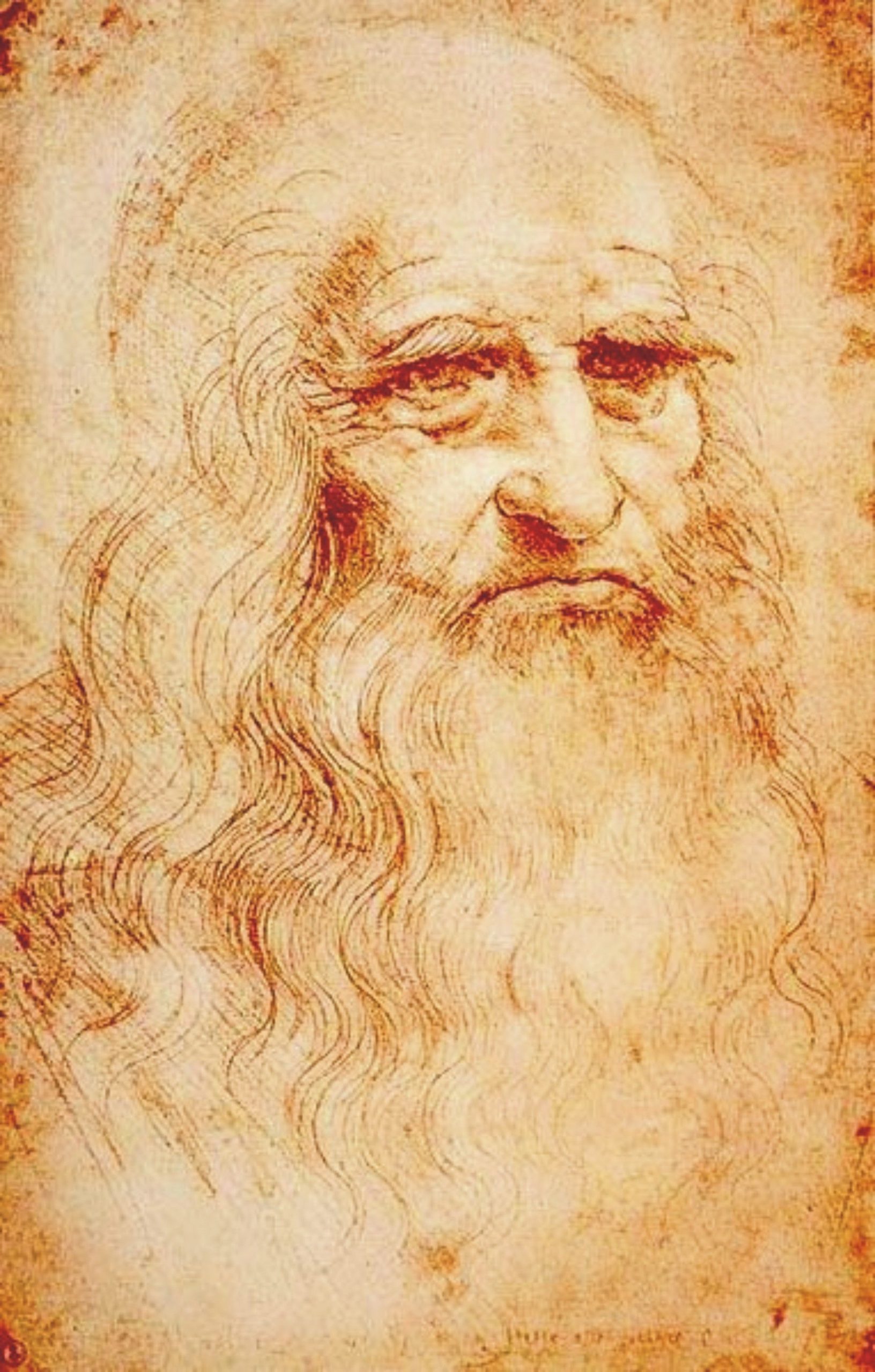
The best-known likeness of Leonardo da Vinci is not a painting at all, but a red chalk drawing on paper measuring 33.3 × 21.6 cm. It is held by the Biblioteca Reale in Turin, which dates the sheet to 1517–1518 – Leonardo’s final years at the court of Francis I at Amboise. Precisely because it is a drawing and not a painting, it is today among the most fragile works in any European collection.
Is it really Leonardo?
The name “self-portrait” dates from the 19th century. It rested on the resemblance between the drawn old man and Leonardo’s figure in Raphael’s School of Athens, and on the sheer quality of the sheet. Since the second half of the 20th century, however, scholars – among them Martin Kemp, Pietro Marani, Carlo Pedretti and Martin Clayton – have pointed out that the sitter looks older than Leonardo ever became: he died at 67. Other identifications have been proposed, most often his father Piero da Vinci or his uncle Francesco, both of whom lived to about eighty. That objection rests on an earlier dating of around 1510–1512; if the holding institution’s dating of 1517–1518 stands, Leonardo was sixty-five or sixty-six. We do not close the question: the inscription “Leonardo da Vinci, portrait of himself as an old man” was added to the sheet later, while the museum consistently calls the work Leonardo’s self-portrait.
Why almost no one has seen it
The sheet is badly marked by so-called foxing – brownish spots. They were long attributed to iron salts and moisture; a 2015 study found no active fungal or bacterial infection on the drawing, but did find airborne spores and fungal residue. Conservators deliberately declined to intervene until the cause was reliably established. During the Second World War the sheet was moved from Turin to Rome and was damaged in the process. Since 1998 it has rested in a vault held at constant temperature and humidity, and it has been shown to the public only a handful of times in the past century – most recently in 2012 at the Venaria Reale, for three months and in a climate-controlled case.
Our hand-painted reproduction
Because the original is effectively impossible to see, a reproduction carries particular meaning here. Our hand-painted painting on canvas carries the drawing into colour and into a format you can actually hang: every copy is painted to order in our workshop and never printed. As canvas wall art or a painting on canvas it sits well in a study, a library or a living room. If Leonardo the draughtsman interests you, see also Saint Jerome in the Wilderness and The Adoration of the Magi – both works were left unfinished, and the underdrawing is still visible on them; the most famous work of all remains the Mona Lisa.
- Original: red chalk (sanguine) on paper, 33.3 × 21.6 cm
- Dating: 1517–1518 according to the holding institution
- Held at: Biblioteca Reale, Turin – in a climate-controlled vault
- Our version: hand-painted on canvas, from 40 × 63 cm to 150 × 235 cm, from €600