







































Description
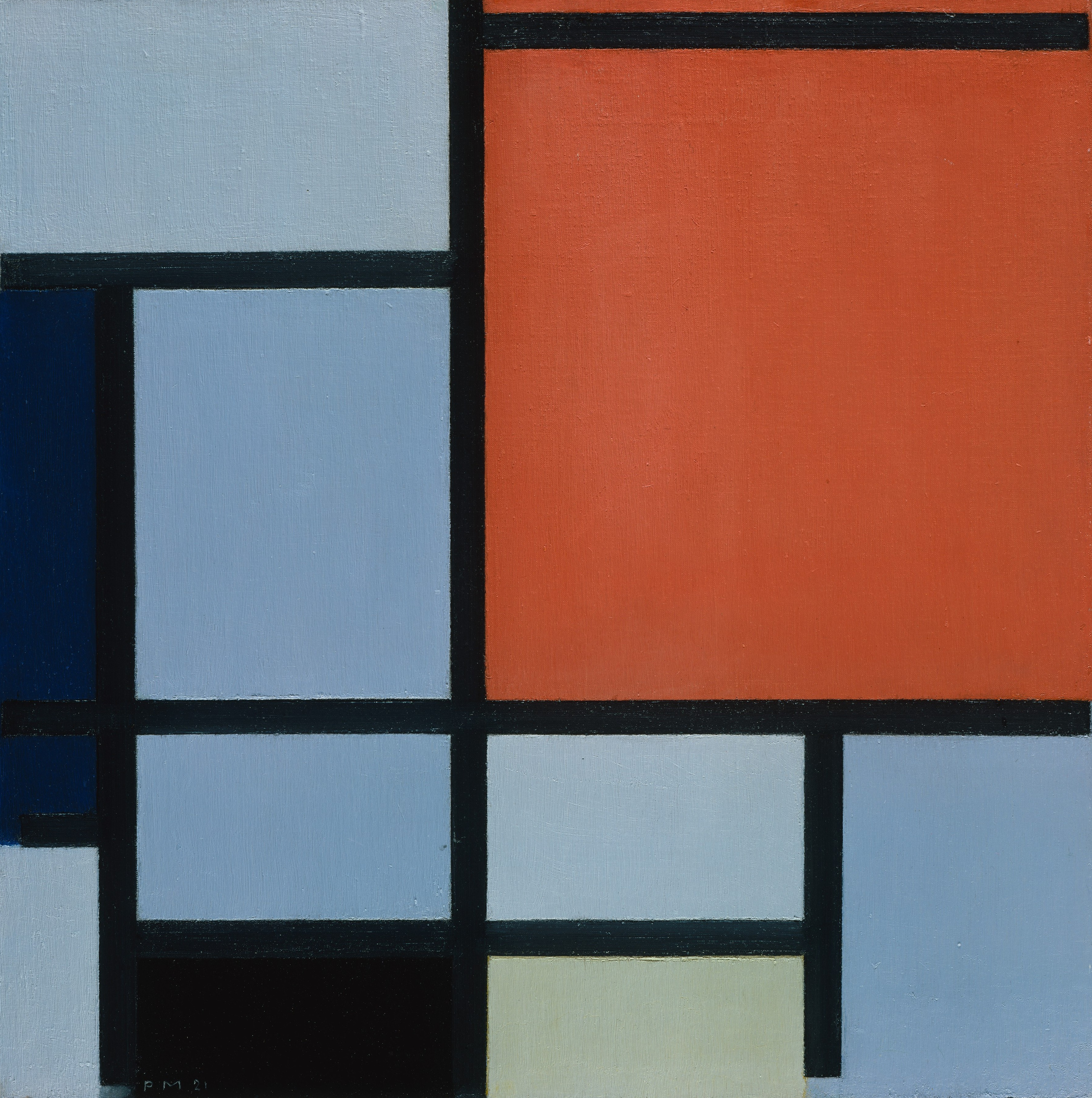
Composition (1921) is a square painting by Piet Mondrian from 1921 and one of his first Neoplastic compositions: thick black lines divide the canvas into fields, a large orange-red plane spreads across the upper right, a narrow dark blue strip runs along the left edge, a black rectangle sits at the bottom, a pale yellow field at the lower centre, and the remaining fields are pale grey-blue. The original, oil on canvas, measures 49.5 x 49.5 cm and belongs to The Metropolitan Museum of Art in New York. We paint it for you by hand in oil on canvas, in 8 sizes from 35 x 35 to 196 x 188 cm or made to measure, and send you a photograph of the finished painting before dispatch.
| Title: | Composition (1921) |
| Other titles: | Komposition (1921) · Composizione (1921) |
| Painter: | Piet Mondrian (1872–1944) |
| Year painted: | 1921 |
| Original size: | 49.5 cm x 49.5 cm (height x width) |
| Original technique: | Oil on canvas |
| Painting style: | Neoplasticism (De Stijl), abstract painting |
| Located at: | The Metropolitan Museum of Art, New York (acc. no. 1999.363.57) |
| Our reproduction: | Hand-painted oil on canvas, 8 sizes or made to measure |
Composition (1921) – Piet Mondrian
What does Composition (1921) show?
There is no landscape, figure or object here. All you see are thick black horizontal and vertical lines and the fields between them, each in a single colour. The lines cut the square into fields of very different sizes, from broad planes to thin bands.
The largest is the orange-red field at the upper right, which takes up a good part of the canvas. A narrow dark blue strip runs down the left edge, a black rectangle lies along the bottom, and above it, in the centre, sits a pale yellow field. Every other field is a pale grey-blue that gives the red and yellow a quiet ground.
The arrangement is not symmetrical: the weight sits at the upper right, the dark accents along the left and bottom edges. At the lower left are the monogram and date PM 21, with which Mondrian signed the canvas.
What does the painting mean, and how did it come about?
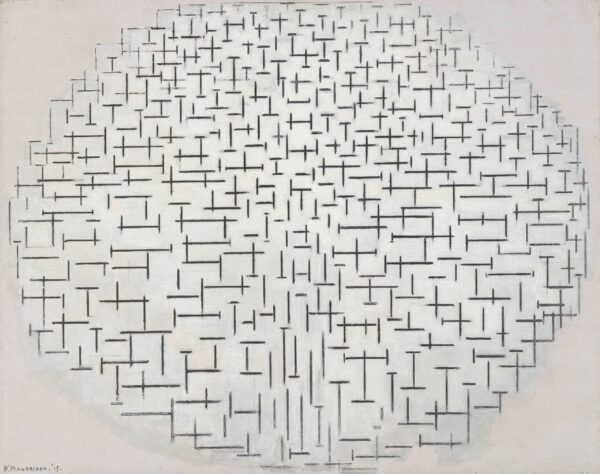
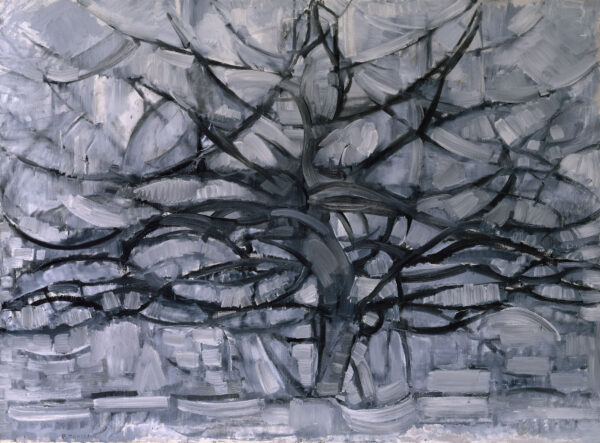
Mondrian started out painting Dutch landscapes, windmills and trees, and around 1908 he turned to bright, unnatural colour. Between 1911 and 1914, in Paris and under the influence of Cubism, he reduced his motifs to grids of short lines and planes.
In 1915 he painted in black and white alone, and a year later soft fields of colour came back between the lines, as Composition (1916) shows, painted in the Netherlands during the First World War.
Around 1920 this search grew into Neoplasticism, the style associated with the De Stijl group: only horizontal and vertical black lines, the three primary colours red, blue and yellow, plus white and grey. Composition (1921) is among the first canvases where these rules apply in full. Its meaning lies not in a story but in proportion: the large red field holds its balance against the narrow blue strip and the black rectangle at the edges.
Why does this painting matter?
Because it shows the birth of the visual language by which almost everyone recognises Mondrian today. The grid of black lines with fields of red, blue and yellow is already in place, only softer than it would become: the red leans towards orange, and the light fields are not white but pale grey-blue.
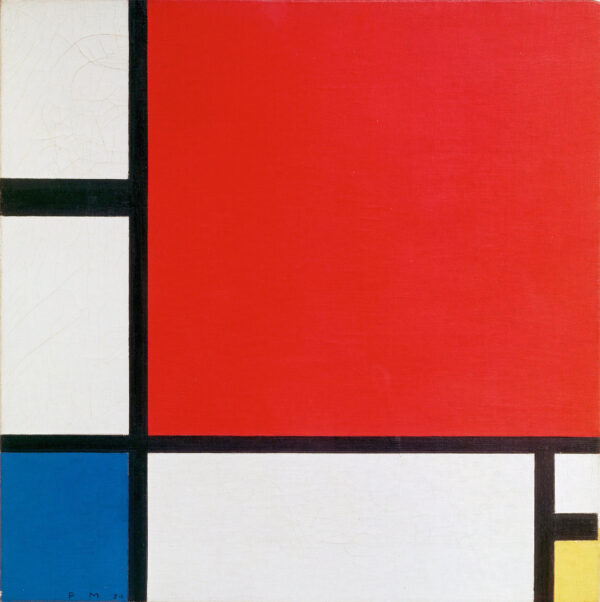
Nine years later Composition II in Red, Blue and Yellow also places a large red field at the upper right, and that type of composition is his best known. Anyone who loves the later canvas will find its beginning in 1921.
Where is the original?
The original belongs to The Metropolitan Museum of Art in New York, accession number 1999.363.57. The canvas is small: each side measures only 49.5 cm.
New York is also the city Mondrian moved to from London in 1940 and where he died in 1944. Since the original stays in the museum, a hand-painted copy brings the same composition into your home, in a size that fits your wall.
Composition (1921) or another Mondrian?
This canvas painting is happiest in a modern, minimalist or Scandinavian room, an office or a hallway, where one strong colour has to carry the wall. Being square, it hangs well in the middle of a wall above a chest of drawers, a table or a bed.
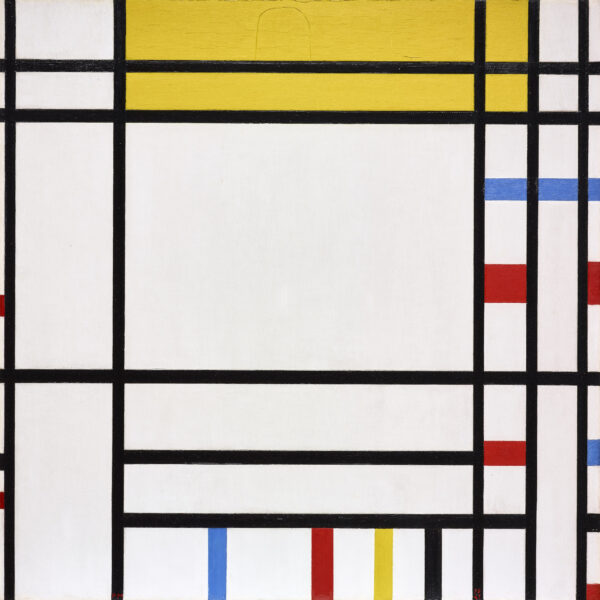
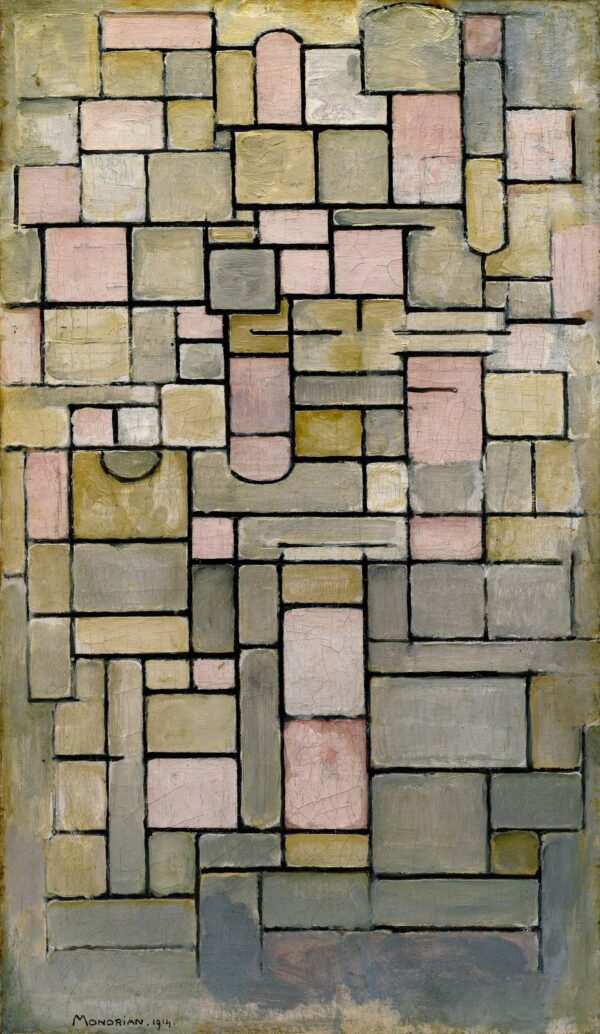
If you want to see how Mondrian arrived at the grid, look at Composition 8 from 1914, where a façade dissolves into a grid of pink and ochre rectangles. A late version of the same language is Place de la Concorde, begun in Paris and finished in New York.
Every Mondrian reproduction we paint to order, from the early trees to the famous Mondrian paintings of his New York years, is gathered on the Piet Mondrian page.
How does our painter paint your Composition (1921)?
With Mondrian every slip shows: a line one millimetre too wide or a field that is not even upsets the balance. So our painter first transfers the exact proportions, the width of the black lines and the position of each field from the original onto the canvas.
Then he masks the edges of the fields with tape so they stay sharp and straight, and lays on the colour in thin, even coats until the surface is smooth and equally full everywhere. He mixes the orange-red, dark blue, pale yellow and grey-blue one by one, so that they sit together as they do on the original.
The result is an oil painting reproduction with the soft sheen of oil paint and real depth of colour. On the wall it reads differently from a poster: the smooth planes of colour are real layers, not printed dots.
Which size for which wall?
In short: for a shelf or a narrow wall 35 x 35 or 45 x 45 cm, above a desk or a bedside table 60 x 57 or 70 x 70 cm, above a sofa or a bed 90 x 88 or 110 x 115 cm, and for a large empty wall 150 x 144 or 196 x 188 cm.
Composition (1921) comes in 8 sizes (width x height): 35 x 35, 45 x 45, 60 x 57, 70 x 70, 90 x 88, 110 x 115, 150 x 144 and 196 x 188 cm. The original measures 49.5 x 49.5 cm; 45 x 45 cm is 4.5 cm smaller each way, and 60 x 57 cm is 10.5 cm wider and 7.5 cm taller.
As a painting for the living room above the sofa, 90 x 88 and 110 x 115 cm work well, and the large red field comes into its own. Mondrian painted it small, but its clear division stands up well to a big enlargement.
Can I choose another size or a frame?
Yes. Because the original is exactly square, we can also paint it in a square size that is not on the list, such as 50 x 50 or 100 x 100 cm, recalculating the proportions of the fields precisely. Tell us the size you want and we will reply with a price and a delivery time.
We ship the painting rolled, stretched on a stretcher bar or framed; our workshop in Slovenia does the stretching and framing, as it does for every painting we send. You pick the frame in our 3D app, which serves only to choose the frame; viewing the painting on your own wall is a separate service.
A slim white, black or light wood frame suits Mondrian’s grid. You can also hang it without a frame, stretched on its bar alone.
When will my painting arrive?
Our painter starts as soon as your order comes in, and within 15 to 45 working days the painting is ready to ship. Before it leaves we send you a photograph of the finished painting, and whatever you would like different, we correct.
Inside Slovenia and across the EU your Composition (1921) travels with no customs formalities, and every order is covered by our returns policy.
Composition (1921) is a thoughtful gift for an architect, a designer or anyone who loves modern art. If you would rather the recipient chose the size, give them a wall art voucher.
Frequently asked questions
Which museum holds the original Composition (1921)?
The Metropolitan Museum of Art in New York, accession number 1999.363.57.
What do the colour fields stand for?
They depict nothing from nature. In Neoplasticism Mondrian used only horizontal and vertical black lines, red, blue, yellow, white and grey, and built the painting from their proportions.
Is this a print?
No. It is oil on canvas, applied with a brush by our painter, layer after layer.
How big is the original?
It measures 49.5 x 49.5 cm. Our nearest size is 45 x 45 cm, 4.5 cm smaller each way.
Which room suits it best?
A modern living room, a study or an office. In a bedroom it is livelier than the early trees, but with calm, light walls it fits in well.
When did Mondrian paint it?
In 1921. The monogram and date PM 21 are at the lower left.
How long does it take to make?
From order to dispatch takes 15 to 45 working days, and you receive a photograph of the finished painting before it ships.
Is it a good gift?
Yes, especially for lovers of architecture, design and modern art. A voucher lets the person you give it to choose the size themselves.
- Subject: thick black lines divide the square into orange-red, dark blue, black, pale yellow and grey-blue fields.
- Original: 1921, oil on canvas, 49.5 x 49.5 cm, The Metropolitan Museum of Art, New York.
- Ours: oil on canvas, painted by hand to order, in 8 sizes from 35 x 35 to 196 x 188 cm or in the size you ask for.
- Worth knowing: it is one of Mondrian’s first Neoplastic compositions.