







































Description
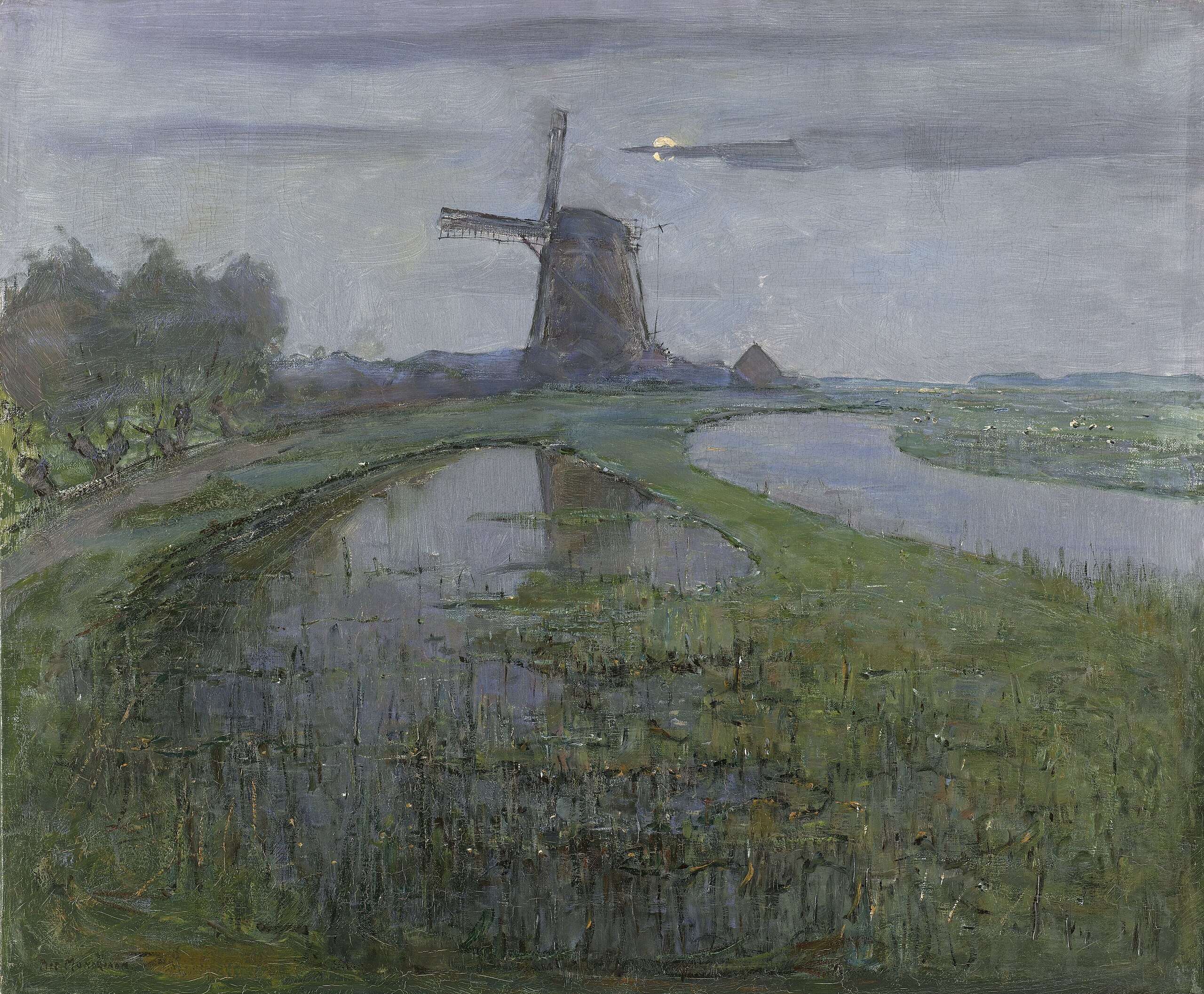
Oostzijdse Mill by Moonlight is a painting by Piet Mondrian from about 1903: a Dutch mill on the river Gein near Abcoude stands in the middle of the canvas under a quiet grey-blue sky, the moon above and to its right slips half behind a cloud, and the mill is mirrored in the silver water of the foreground. The original, oil on canvas, is 63 cm high and 75.4 cm wide and belongs to the Rijksmuseum in Amsterdam. Our painter paints it by hand in oil on canvas in 8 sizes from 40 x 32 to 190 x 151 cm or made to measure, and we send you a photograph of the finished painting before dispatch.
| Title: | Oostzijdse Mill by Moonlight |
| Other titles: | Oostzijdse Mill along the River Gein by Moonlight · Oostzijdse Mühle im Mondlicht |
| Painter: | Piet Mondrian (1872–1944) |
| Year painted: | c. 1903 |
| Original size: | 63 cm x 75.4 cm (height x width) |
| Original technique: | Oil on canvas |
| Painting style: | Hague School |
| Located at: | Rijksmuseum, Amsterdam (object no. SK-A-4987) |
| Our reproduction: | Hand-painted oil on canvas, 8 sizes or made to measure |
Oostzijdse Mill by Moonlight – Piet Mondrian
What do you see in Oostzijdse Mill by Moonlight?
The mill stands exactly in the middle of the canvas, dark and upright, its sails spread. The horizon runs just above half the height, so the water in the foreground takes up a large part of the surface. The mill is mirrored in it, and water plants push up through the reflection.
To the right of the mill, at a bend in the river, stands a small summer house; on the left a group of trees closes off the horizon. The moon sits up to the right of the mill, partly hidden by a cloud, so the light is soft and diffused.
The colours are restrained: a quiet grey-blue sky, silver water and a deep green bank. There are no hard contrasts and no loud tones, only a few shades that sit well together.
How did the young Mondrian paint a night landscape?
When this painting was made, Mondrian was about thirty and still painted Dutch landscapes, mills, farms and trees. The Rijksmuseum points out how much he owed to the Hague School at the time.
A few years earlier he had copied Paul Gabriël’s In the Month of July in that same museum. With the Oostzijdse mill he went beyond imitation: he changed the lines and the colours to make a non-realistic, decorative work.
You can see what that means in the water and the sky. The forms are simplified, the colours muted and tuned to one another, and the whole reads more like a carefully ordered surface than a record of a real night.
Why is this early work so highly regarded?
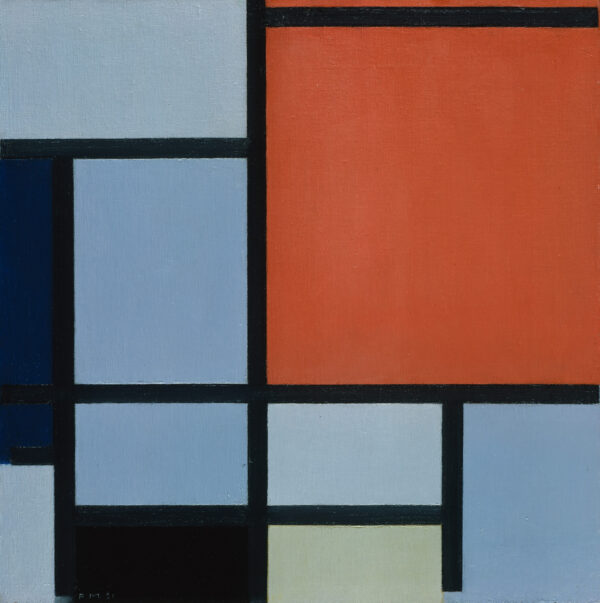
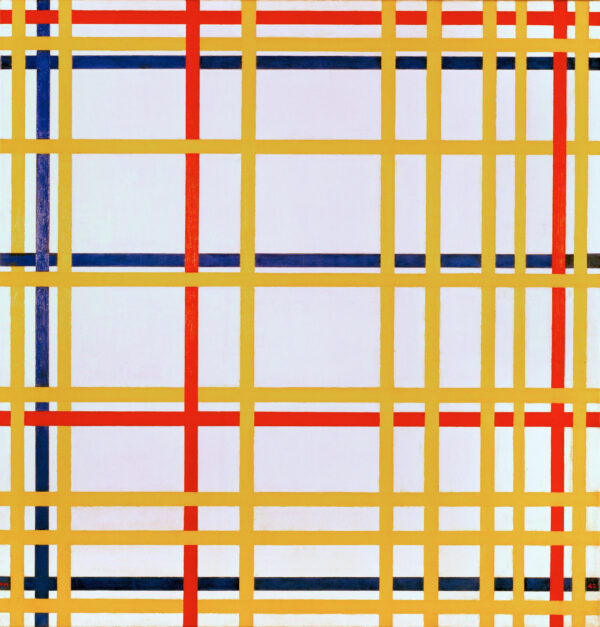
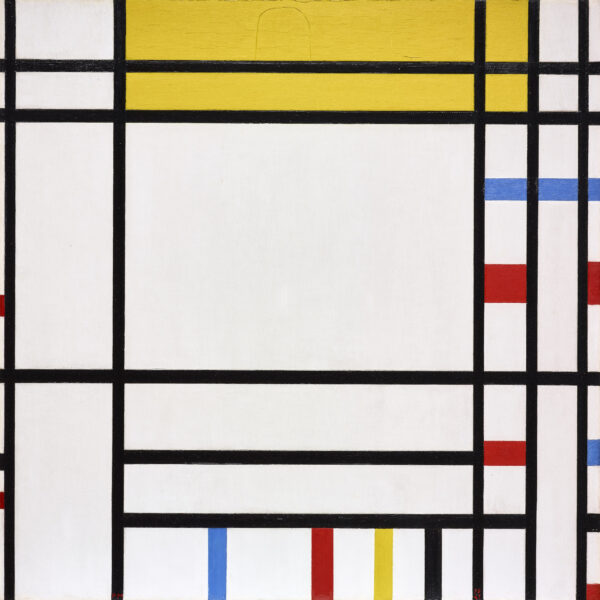
Mondrian is known worldwide for his grids of black lines and pure fields of red, blue and yellow, painted from around 1920. Among famous Mondrian paintings those grids take the spotlight, yet Oostzijdse Mill by Moonlight shows where he started: in the quiet Dutch landscape he knew well.
On this canvas respect for the older Dutch painters meets his own wish to reshape nature. The mill at the centre, the level line of the horizon and the vertical reflection in the water give the painting an order you would not expect from such a still subject.
How far he went later is shown by Gray Tree of 1911, where a tree appears only in grey, black and white, its branches curving out in wide arcs.
Where is the original, and how did it reach the museum?
The original is in the Rijksmuseum in Amsterdam, object number SK-A-4987. The museum bought it in 2005 with support from the BankGiro Lottery and the Rijksmuseum Fonds.
It is oil on canvas, 63 cm high and 75.4 cm wide, so a landscape format, clearly wider than it is tall. The museum’s full title is Oostzijdse Mill along the River Gein by Moonlight.
At the lower left the signature PIET MONDRIAAN stands in capital letters, the Dutch spelling of his surname.
Oostzijdse Mill by Moonlight or another Mondrian?
This canvas painting belongs in calm rooms: a bedroom, a living room with wooden furniture, or a country-style house. The landscape format hangs well above a bed, a sofa or a long sideboard.
If you would like a second mill beside it, choose Mill at Evening of 1917: there the dark silhouette of a tall mill fills an upright canvas under a lilac and grey sky. Lighter and more luminous is Windmill from the same year, a different painting altogether, which hangs in Dallas. A reflection in still water also appears in Farm near Duivendrecht, a daylight scene with a long white house behind a row of bare trees.
The whole range, with farms, trees and late compositions alongside the mills, is on the Piet Mondrian page, where you can choose any Mondrian reproduction our painter makes to order.
How does our painter paint the Oostzijdse mill?
In a night landscape everything depends on tone. Our painter first transfers the composition onto the canvas: the horizon just above the centre, the mill exactly on the axis, the small house at the river bend on the right and the trees on the left, so that the proportions match the original.
Then he paints in oil, one layer after another. First he lays in the grey-blue sky and the moon behind its cloud, then the deep green bank and the trees, and last the silver water with the mill’s reflection and the plants.
He leaves the loose brushwork visible, as in the original, and keeps the moonlight quiet, without harsh contrasts. The result is an oil painting reproduction with a real layer of paint, and it has a depth no print can offer, because light comes back slightly differently from every stroke.
Which size for which wall?
In short: 40 x 32 or 50 x 42 cm for a small wall or a shelf, 65 x 52 and 74 x 59 cm above a bedside table or a chest of drawers, 90 x 78 and 115 x 96 cm above a sofa or a bed, 150 x 120 and 190 x 151 cm for a large open wall.
There are 8 sizes (width x height): 40 x 32, 50 x 42, 65 x 52, 74 x 59, 90 x 78, 115 x 96, 150 x 120 and 190 x 151 cm. The original measures 75.4 x 63 cm; the nearest size, 74 x 59 cm, is 1.4 cm narrower and 4 cm lower, while 90 x 78 cm is 14.6 cm wider and 15 cm taller.
Every size is a landscape format like the original, so the broad stretch of water and the horizon keep their proportion. As a painting for the living room above a sofa, 115 x 96 cm works well; above a bed, 90 x 78 cm.
Can I choose another size or a frame?
Yes. If your wall needs a different width or height, we paint the mill in the size you choose and adjust the composition with care. Send us the size you have in mind, and we will reply with a price and a lead time.
The moonlit mill reaches you rolled, on a stretcher bar, or framed and ready for the wall. Stretching and framing are done by our workshop in Slovenia, which prepares every painting we make in the same way. You choose the frame in our 3D app, which is meant for frame choice only; seeing the painting on your own wall is a separate service.
A night landscape suits a dark wooden frame or a plain light moulding.
When will my painting be ready?
Work begins once your order reaches us, and 15 to 45 working days later the painting is ready to go. You get a photograph of the finished painting before it is sent, and any change you ask for is made.
Within Slovenia and to the rest of the EU it travels without customs, and our returns policy applies.
Moonlight over a Dutch mill makes a fine gift for anyone who loves Holland, night landscapes or early Mondrian. If you would rather the recipient chose the size, give a gift voucher.
Frequently asked questions
Where does the original hang?
In the Rijksmuseum in Amsterdam, object number SK-A-4987.
Which mill is it?
The Oostzijdse mill on the river Gein near Abcoude, in the Netherlands.
Is it a print?
No. It is a hand-painted copy in oil on canvas, with loose, visible brushwork.
How big is the original?
It is 63 cm high and 75.4 cm wide. Our nearest size is 74 x 59 cm.
Can I have a size that is not listed?
Yes, we also paint to measure. Tell us the width and height and we will send a price.
How long will I wait for it?
Making it takes 15 to 45 working days, and you see a photograph of the finished painting before it ships.
Is it a good choice for a bedroom?
Very much so. The quiet grey-blue tones and soft moonlight look lovely above a bed.
Why does it not look like his grids?
Because it was painted around 1903, while he was still painting landscapes; the grids came only from around 1920.
- Subject: a mill on the river Gein by moonlight, mirrored in silver water, with a summer house at the bend and trees on the horizon.
- Original: c. 1903, oil on canvas, 63 x 75.4 cm (height x width), Rijksmuseum, Amsterdam.
- Ours: painted by hand in oil on canvas, 8 sizes between 40 x 32 and 190 x 151 cm, or a size of your choice.
- Worth knowing: the museum bought it in 2005; the signature PIET MONDRIAAN is at the lower left.