



Description
Arlesiennes (Mistral) – Gauguin’s Arles autumn, painted on jute
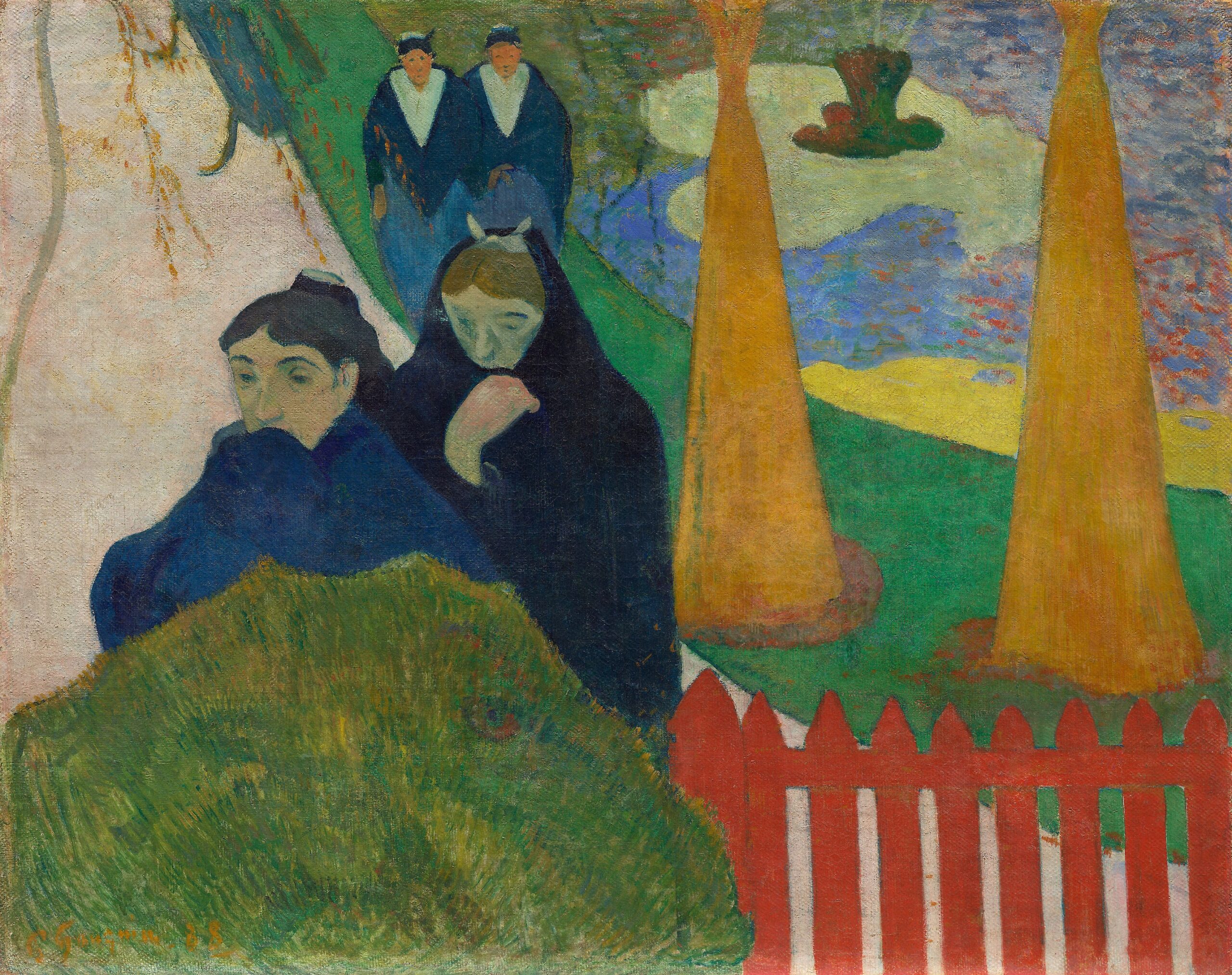
In the autumn of 1888, during the shared stay with Vincent van Gogh, Paul Gauguin painted the Arlesiennes in Arles. The work measures 73 x 92 cm – the museum states height first and width second – so it is a landscape format, wider than it is tall. It is held by the Art Institute of Chicago under accession number 1934.391. Two women in Arlesian dress walk in the foreground, cloaks pulled over their heads; behind them opens the garden of the hospital where van Gogh spent that winter recovering.
What the painting shows
The two figures are caught mid-stride, bent against the wind. The mistral, the cold north wind of Provence, is in the title and in their posture: the cloaks are drawn tight around the face, the bodies tipped forward. Behind them grow two conical bushes that Gauguin has simplified almost to a geometric shape, and an orange-brown path turns away into the depth. A bench and a few smaller figures appear in the background.
Technique: oil on jute
The support is not canvas in the usual sense but jute – the coarse sacking from which sacks were sewn at the time. Gauguin and van Gogh bought a roll of it in Arles because it was cheap, and that is why this work was made on jute rather than on painter’s canvas. Jute is strikingly coarse and irregular in weave; the fabric shows through the thin layers of paint and gives the surface a grainy character. Colour does not sit smoothly on it but catches in the fibres.
The lettering along the bottom edge
Along the lower edge, brushstrokes in the paint itself form lettering. It is the painter’s own brushstroke and part of the original work – not a watermark added afterwards, and not a publisher’s mark. On the reproduction it is painted just like the rest of the scene, because it belongs to the work.
How a hand-painted reproduction is made
The reproduction is painted by hand, in oils on canvas, brushstroke by brushstroke. On this subject the greatest care goes to the balance between the roughness of the support and the softness of the two figures: if the texture is lost, the work turns too smooth and gives up the character of the original. Before dispatch you receive a photograph of the finished piece for approval.
- Subject: two Arlesian women in traditional dress, bent against the mistral, before the garden of the hospital at Arles.
- Technique: oil on jute, flat colour with a pronounced outline.
- Sizes: landscape format, from 40 x 32 cm to 200 x 160 cm; the most frequently chosen are 100 x 80 cm and 120 x 96 cm.
- Of note: the jute was bought in Arles as a cheap substitute for canvas; its coarse weave is now one of the recognisable marks of this work.
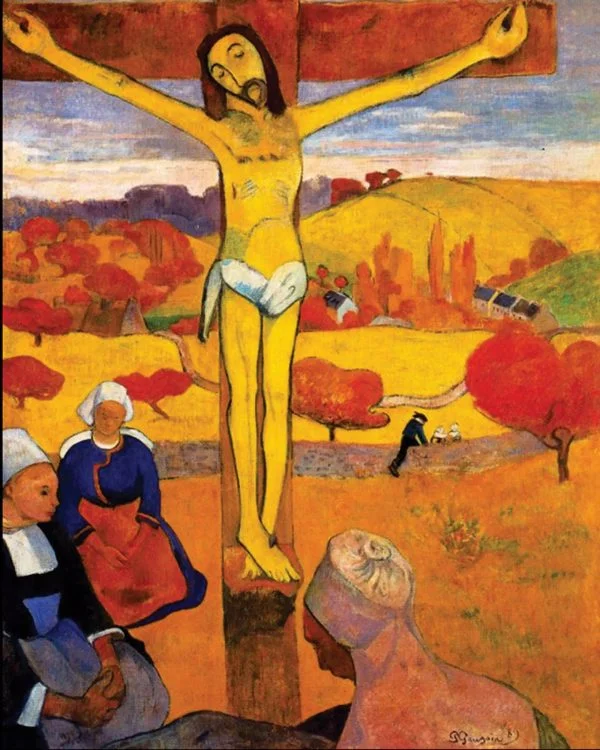
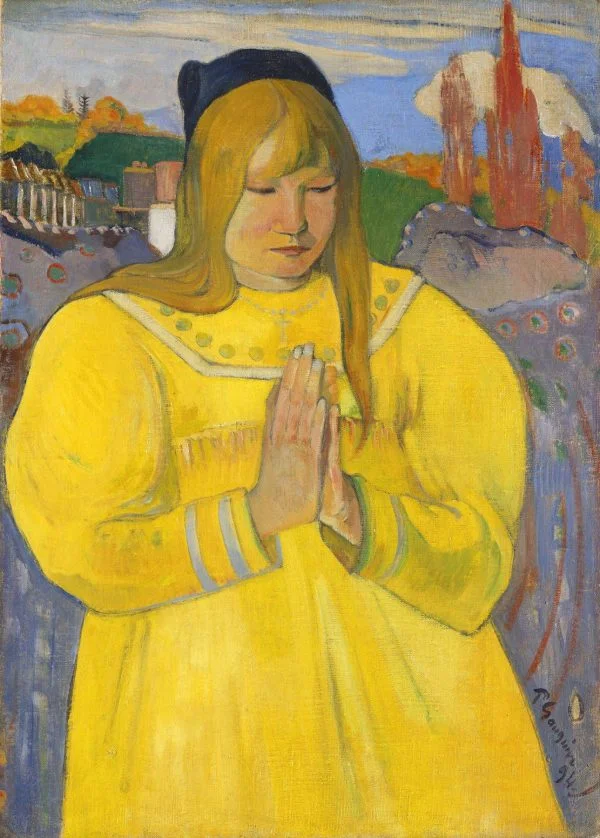
If the same period interests you, look also at Vision of the Sermon from that same year 1888, and Breton Peasant Women and Young Christian Girl, where Gauguin likewise paints women in traditional dress.