







































Description
The Siesta – Gauguin’s Tahitian veranda and an ordinary afternoon
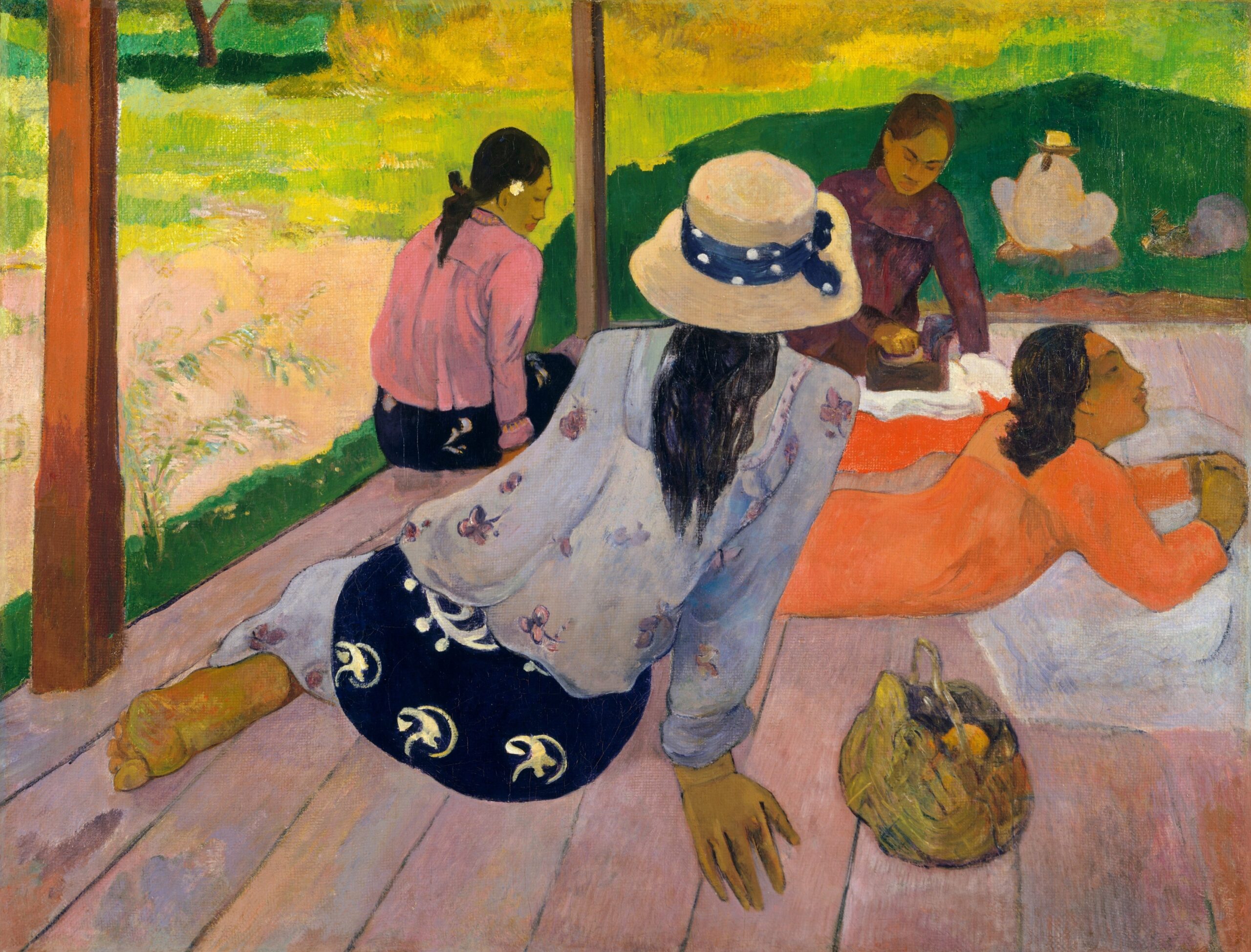
Between 1892 and 1894, in his first Tahitian period, Paul Gauguin painted a scene in which nothing much happens: four women pass the afternoon on a covered veranda. One is ironing linen, a second lies propped on her elbow in an orange dress, a third sits with her back to the viewer, and the fourth sits in the foreground on the boards with a large straw hat on her head. Outside, on the grass, a fifth figure sits. The work is held by the Metropolitan Museum of Art in New York under accession number 1993.400.3. The format is landscape – the museum states height first and width second, so 88.9 x 116.2 cm.
An ordinary afternoon, not a ceremony
Gauguin is usually associated with mythological scenes, yet here he watches an entirely ordinary afternoon. A flat-iron stands on the white cloth, a woven basket of yellow fruit waits beside it, and the women work or rest, each to herself. Nobody poses and nobody tells a story – the painter has held an hour that passes without an event. That is exactly what makes this work an exception in his Tahitian output.
The hat that closes the centre
The central figure is the woman in the foreground, seated on the floor with her back to us. Her broad pale straw hat, with its blue spotted band, is the lightest area on the canvas and the first thing the eye catches. With it Gauguin closed the middle of the composition: the look halts at the hat and only then slides on to the woman who is ironing and to the reclining figure in orange.
Pink boards and green grass
The veranda floor is painted a warm pink that no real shade would give you, and immediately behind it a strong green of grass begins, with a band of yellow foliage above. It is these three colours that carry the whole canvas. If the pink floor cools in a reproduction, the scene loses its afternoon light and becomes a plain interior.
Where the original is, and how it is dated
The original is at the Metropolitan, accession number 1993.400.3, oil on canvas. The museum dates the work approximately, between 1892 and 1894, while the encyclopaedic record gives the beginning of that span. That is a difference in the precision of the dating, not a contradiction between the sources: on the measurements the two records agree.
How an oil on canvas reproduction is made
The reproduction is painted by hand, in oils on canvas, brushstroke by brushstroke. On this subject the pink floor is the hardest part: it has to stay warm and quiet at once, or it breaks up into patches. Before dispatch you receive a photograph of the finished piece for approval.
- Subject: four women on a covered veranda, one ironing linen, one lying in orange, the straw hat and the fruit basket in the foreground.
- Technique: oil on canvas, broad quiet planes of colour and a warm pink floor.
- Sizes: landscape format, from 40 x 30 cm to 200 x 150 cm; the most frequently chosen are 80 x 60 cm and 100 x 75 cm.
- Of note: the flat-iron on the white cloth is one of the rare scenes of household work in Gauguin’s Tahitian output.
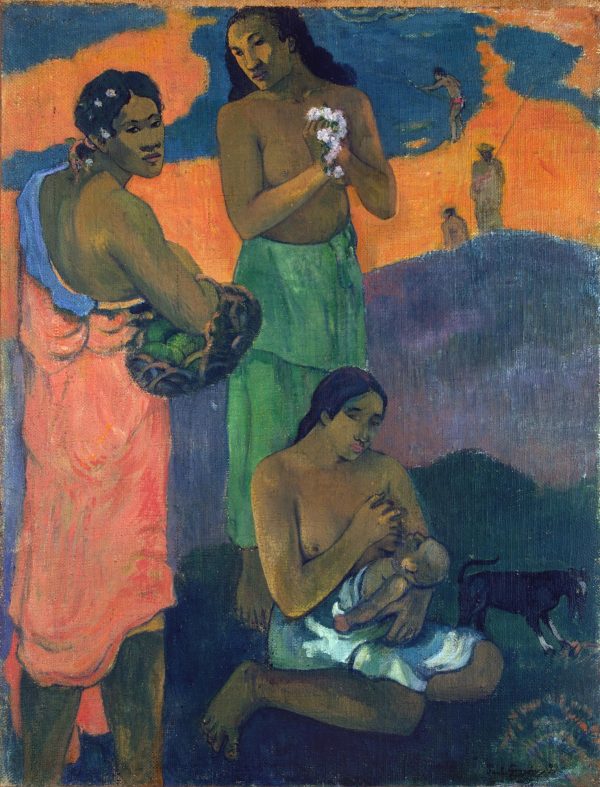
If other Tahitian scenes of everyday life interest you, look also at Arearea (Joyousness), Fatata te Miti (By the Sea) and Maternity (Women on the Seashore), where Gauguin likewise shows people at an everyday occupation or at rest.