







































Description
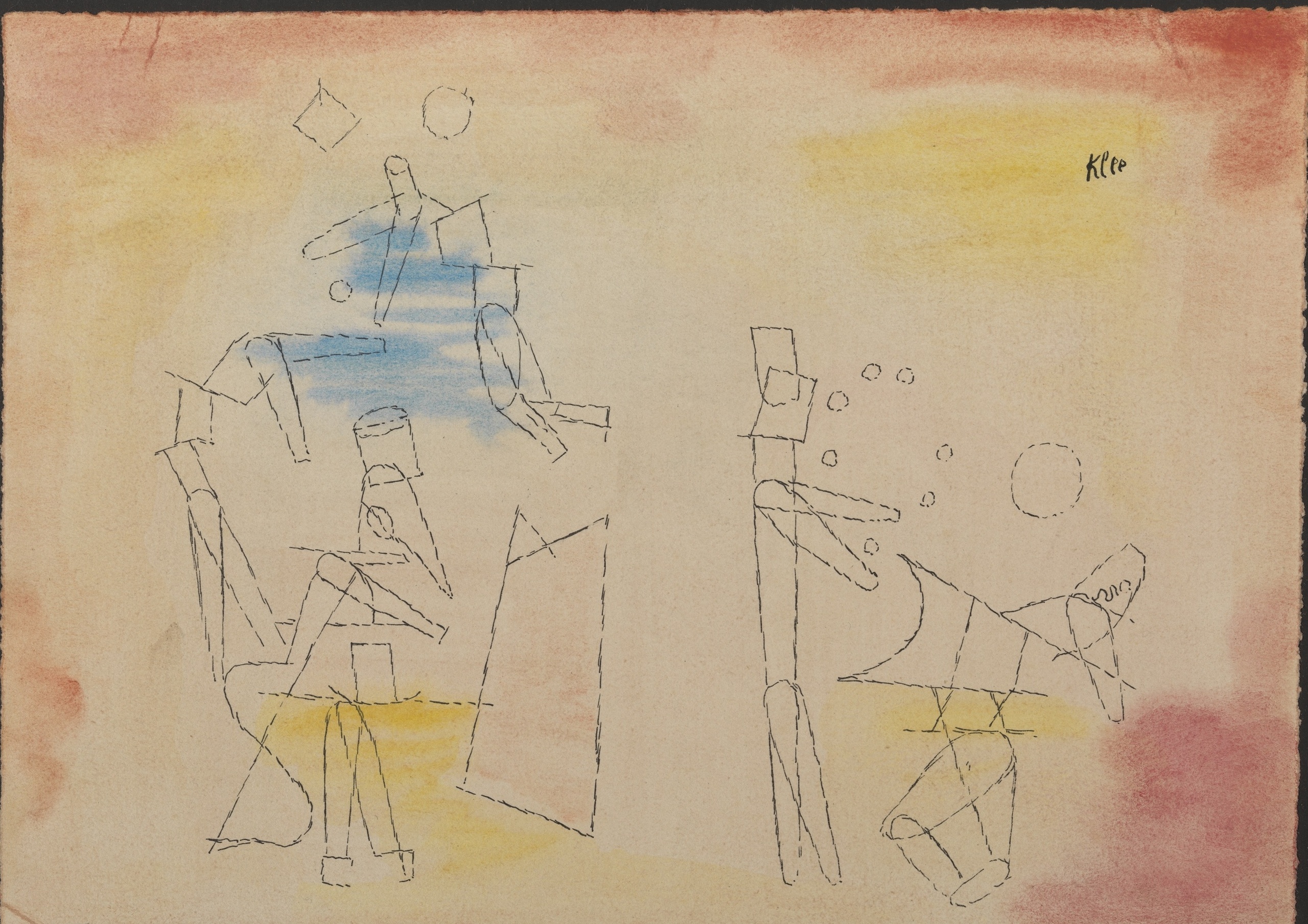
Acrobats is a painting by Paul Klee from 1915: on a pale cream sheet edged with soft washes of pink, coral and yellow, figures drawn in fine broken lines balance beneath floating balls, circles and a diamond, as if someone had just tossed them into the air. The original is a small watercolour with ink and pastel on paper, only about 22 x 27 cm, held by the Solomon R. Guggenheim Museum in New York. Our painter paints it for you by hand on canvas, in oil or acrylic, in 8 landscape sizes from 45 x 31 to 190 x 130 cm or made to measure. A photograph of your finished painting reaches you before it is packed.
| Title: | Acrobats |
| Other titles: | Artisten (German title) · Acrobati (Italian title) |
| Painter: | Paul Klee (1879–1940) |
| Year painted: | 1915 |
| Original size: | 22.5 cm x 27 cm (height x width) |
| Original technique: | Watercolour, ink and pastel on paper |
| Painting style: | Modernism |
| Located at: | Solomon R. Guggenheim Museum, New York, USA |
| Our reproduction: | Hand-painted in oil or acrylic on canvas, 8 sizes or made to measure |
Acrobats – Paul Klee
What does Acrobats show?
The sheet is wide and bright: an almost empty, creamy centre, with pink, coral red and yellow gathering at the edges like coloured lights over a circus ring, and a patch of sky blue on the left behind the upper figure.
On the left rises a group like a human pyramid. A figure sits cross-legged on a kind of plinth, and above it a second one is assembled from straight pieces, with a small round head and outstretched arms. A diamond and a circle hang over its head and a little ball floats lower down, so it reads easily as a juggler.
On the right stands a tall, narrow figure with a square head. A string of tiny rings rises in an arc before its face, a large empty circle floats beside it, and lower down a third shape of triangles and a crescent tilts to one side. At the upper right the name Klee is signed in black ink.
Every line is thin and broken, as if stitched with a needle.
What does the title Acrobats mean?
Klee wrote a German title on the sheet together with the year; the word names the performers of the circus and the variety stage. In our photograph that inscription is cropped off, so only the scene remains.
Our sources record no explanation of the scene from Klee himself. What we see is a moment of balance: one figure sits, a second rises above it, a third stands upright, and the balls hang in mid-air. Rehearsal, show or a game of geometric parts: the viewer decides.
Play and the stage were part of Klee’s home life too. Between 1916 and 1925 he made 50 hand puppets for his son Felix, and thirty of the surviving ones are kept today at the Zentrum Paul Klee in Bern.
Why does this sheet feel so light?
A year earlier, in April 1914, Klee had travelled to Tunisia with August Macke and Louis Moilliet. The light there struck him so hard that he wrote that colour had taken possession of him and that he and colour were one. The transparent washes running like light along the edges of this sheet echo that discovery.
The line, meanwhile, stays light and almost mischievous. Oskar Schlemmer, later Klee’s colleague at the Bauhaus, noted in his diary in September 1916 that Klee could reveal his wisdom in a minimum of one line. Here a few straight strokes and a few small rings are enough to set a whole circus act in motion.
For his life and work, read the Wikipedia article on Paul Klee; it is in English and covers the painter, as this work has no article of its own.
Where is the original, and how large is it?
The original belongs to the Solomon R. Guggenheim Museum in New York, accession number 48.1172.67. It is watercolour, ink and pastel on paper, and the museum gives 22.5 x 27 cm (height x width), roughly a sheet of letter paper.
Klee made it in 1915, in the middle of the First World War. In March 1916 he was conscripted as a reserve soldier, and the deaths of his friends August Macke and Franz Marc in battle weighed on him. He still went on painting and exhibiting, and by 1917 critics hailed him as the best of the new German artists.
Acrobats or another Klee?
Acrobats is a canvas painting for a bright, airy wall with a touch of humour; its open cream space never crowds a room.
If Klee’s stage figures appeal to you, look at Little Jester in a Trance. For dense colour there is Florentine Villa District, a warm patchwork of pink and ochre fields, or May Picture, a grid of soft spring squares. A narrow, tall wall suits Curtain, a dark wine-red field threaded with white lines.
Our Paul Klee page gathers the famous Paul Klee paintings we can paint for you.
How do we hand-paint Acrobats on canvas?
Klee’s original is not an oil painting but a small watercolour with ink and pastel on paper, about 22 x 27 cm. Ours is an oil painting reproduction made on canvas, in oil or acrylic and in the size you choose, so it hangs like any other painting, not like a sheet behind glass.
The painter first lays a light, warm ground, then builds the pink and coral edges, the yellow patches and the breath of blue in thin, transparent layers, keeping the centre as bright as the paper.
Once the colours are dry, he draws the broken lines of figures, balls and circles with a fine brush, exactly where Klee placed them, then adds the signature, keeping each enlarged line calm and even so it stays light.
Which size suits which wall?
In short: 45 x 31 or 56 x 40 cm for a shelf or a narrow stretch of wall, 63 x 45 and 80 x 59 cm above a bed, a desk or a chest of drawers, 101 x 74 cm above a sofa, and 130 x 90, 150 x 102 or 190 x 130 cm for a large, light wall.
We paint Acrobats in 8 landscape sizes (width x height): 45 x 31, 56 x 40, 63 x 45, 80 x 59, 101 x 74, 130 x 90, 150 x 102 and 190 x 130 cm. The original sheet is only about 27 x 22 cm (width x height), so even our smallest size is larger; at 190 x 130 cm the scene is roughly seven times as wide as in New York, and its few thin lines gain room to breathe.
As a painting for the living room it works best at 101 x 74 or 130 x 90 cm above the sofa; the smaller sizes, with their playful figures, also suit a child’s room.
Can I order another size or a frame?
Yes. For different proportions we keep both groups of figures whole and adjust only the pale space and the coloured edges. Tell us the measurements you have in mind and we reply with a price and delivery time.
Your painting can travel rolled, on a stretcher bar or in a frame; our workshop in Slovenia does the stretching and framing. The frame is chosen in our 3D app, which serves only to pick the moulding; seeing the painting on your own wall is a separate service.
When will Acrobats arrive, and how is it delivered?
When you confirm the order, our painter begins, and Acrobats is ready for dispatch in 15 to 45 working days. You see a photograph of the finished painting before it leaves us, and any change you ask for is made.
Orders within Slovenia and the rest of the EU pay no customs duties, and our returns policy applies to each one.
These cheerful acrobats make a lovely present for anyone who loves the circus and theatre. Unsure of the size? A wall art voucher lets the recipient choose.
Frequently asked questions
Where can I see the original Acrobats?
At the Solomon R. Guggenheim Museum in New York, accession number 48.1172.67.
What exactly is on the sheet?
Acrobat figures in thin broken lines, with balls, circles and a diamond above them, on pink, yellow and blue washes.
Will I get a print?
No, a hand-painted copy on canvas, brushed by our painter in oil or acrylic.
How big is the original sheet?
About 22 x 27 cm (height x width); our sizes go up to 190 x 130 cm.
Can you paint a size missing from the list?
Yes. Send us the width and height you need and we reply with a price and a date.
How long is the wait?
Between 15 and 45 working days, with a photograph of the finished painting before dispatch.
Would Acrobats suit a child’s room or make a good gift?
Yes. The juggling figures feel cheerful and light, for children and adults alike.
What does the German inscription on the original say?
It is the German word for circus and variety performers, written by Klee with the year 1915.
- Subject: acrobat figures in thin broken lines, with balls, circles and a diamond, on a light sheet washed with pink, yellow and blue.
- Original: watercolour, ink and pastel on paper, 1915, about 22 x 27 cm, Solomon R. Guggenheim Museum, New York.
- Ours: a Paul Klee reproduction painted by hand in oil or acrylic on canvas, 8 sizes from 45 x 31 to 190 x 130 cm, or made to measure.
- Worth knowing: Klee made it the year after his 1914 trip to Tunisia, where colour took hold of him.