







































Description
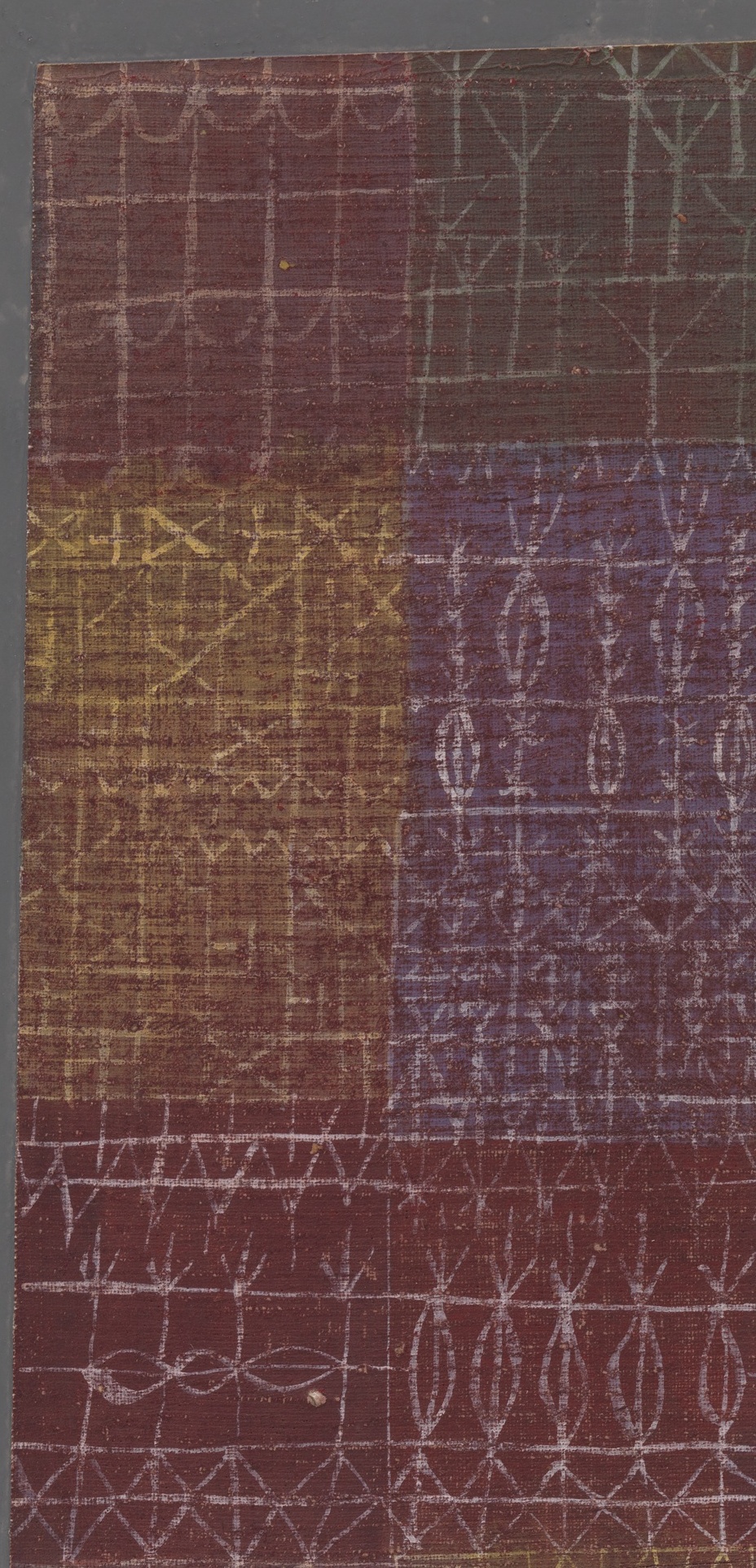
Curtain is a painting by Paul Klee from 1924: a tall, narrow panel of deep wine-red linen is divided into blocks of wine red, ochre gold and violet, crossed by fine, chalky white lines – a grid, little crosses, spindles, leaves and zigzags – as if you were looking at an embroidered or woven curtain. The original is a tiny watercolour on linen mounted on cardboard, only about 28 x 17 cm with its mount, and it belongs to the Solomon R. Guggenheim Museum in New York. Our painter paints it for you by hand on canvas, in oil or acrylic, in 7 tall upright sizes from 25 x 50 to 80 x 160 cm or made to measure, enlarging it a great deal. Before we ship it, you receive a photograph of the finished painting.
| Title: | Curtain |
| Other titles: | Vorhang (German title) · La tenda (Italian title) |
| Painter: | Paul Klee (1879–1940) |
| Year painted: | 1924 |
| Original size: | 28.2 cm x 17.2 cm (height x width) |
| Original technique: | Watercolour on linen on cardboard |
| Painting style: | Modernism |
| Located at: | Solomon R. Guggenheim Museum, New York, USA |
| Our reproduction: | Hand-painted in oil or acrylic on canvas, 7 sizes or made to measure |
Curtain – Paul Klee
What does Curtain show?
Klee divides an upright rectangle, almost twice as tall as it is wide, into a few large blocks. At the top left lies a wine-red field, beside it a dark greyish brown, below them an ochre-gold field meets a violet one, and at the bottom a broad wine-red band fills the surface again.
A net of thin white lines runs across every block, as if drawn in chalk. Each field has a pattern of its own: in the upper red, rows of arcs hang like garlands; in the dark field stand branching signs that look like little trees; in the gold, crosses and zigzags follow one another; and in the violet, spindles and leaves are threaded onto vertical strings.
The lower band gathers it all once more: triangles and zigzags alternate with spindles and a wavy little chain. Everywhere the weave of the linen shows through the paint, so the surface looks grainy and slightly rough, like real cloth.
Why is it called Curtain?
The title simply names what you see: an upright piece of fabric decorated with patterns, as though someone had woven or embroidered it. Painted on real linen, the cloth here is both subject and support.
Our sources record no interpretation of the signs. They are not letters you can read but simple shapes repeated in a rhythm, as in folk embroidery or woven braid. You may find trees, buds or strings of beads in them, but those are your readings, not the artist’s.
Why does such a small Klee win people over?
Our Curtain is a canvas painting that reads as pattern and as colour at once. From a distance you see three or four calm areas of colour; up close, a crowd of tiny white signs that Klee drew freehand, so no two are quite alike.
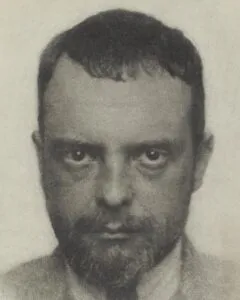
Born in 1879 at Münchenbuchsee near Bern to a German music teacher and a Swiss singer, Klee took up the violin as a boy and later played in an orchestra; to the poet Rilke his drawings were like music written down.
For more on the painter, see the Wikipedia article on Paul Klee, in English; there is no separate article on this work.
Where is the original kept, and how big is it?
The original belongs to the Solomon R. Guggenheim Museum in New York, where it is listed under accession number 71.1936.R115. Klee made it in 1924, during his Bauhaus years (January 1921 to April 1931), when Wassily Kandinsky taught there too.
The work is tiny: watercolour on linen mounted on cardboard, given by the museum as 28.2 x 17.2 cm (height x width), so about 28 x 17 cm with its mount, smaller than a sheet of A4. In that same year Klee had his first exhibitions in Paris, where the French Surrealists took to him with enthusiasm.
The Guggenheim also owns Klee’s Acrobats of 1915, two figures in fine line on a pale sheet, which we paint as well.
Curtain or another Klee?
Choose Curtain if you want calm colour on the wall and a fine play of pattern that only shows up close.
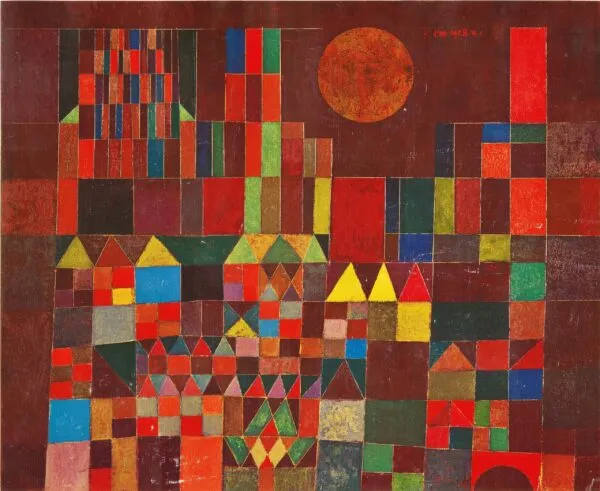
If warm tones and small patterns appeal to you, look at Florentine Villa District, where little houses and trees hide among the coloured fields. If you prefer a grid of coloured squares, you will enjoy May Picture, and for a different side of Klee there is Still Life.
Our Paul Klee shelf brings together famous Paul Klee paintings and quieter works alike, all painted to order.
How do we hand-paint Curtain on canvas?
Klee’s original is a watercolour, thin watery paint on linen, no bigger than a sheet of paper. Ours is an oil painting reproduction on artist’s canvas: the painter works in oil or acrylic, in the size you choose, building it up layer by layer so that it hangs on the wall like any other painting.
First he divides the canvas into the large blocks and lays them in with thin glazes so they stay translucent and soft, as in watercolour. Then, with a fine brush, he draws the grid and all the white signs: arcs, little trees, crosses, spindles and zigzags, field by field.
Slightly rough strokes and a dry brush hint at the grain of the linen, so even a large canvas still reads as fabric.
Which size suits which wall?
In short: 25 x 50 and 30 x 60 cm for a narrow strip of wall between doors or beside a window, 40 x 80 and 50 x 100 cm for a hallway, a staircase or the space next to a wardrobe, 60 x 120 cm beside a sofa or above a chest of drawers, and 70 x 140 and 80 x 160 cm for a high wall where the painting can rise like an upright band of colour.
We paint Curtain in 7 tall upright sizes (width x height): 25 x 50, 30 x 60, 40 x 80, 50 x 100, 60 x 120, 70 x 140 and 80 x 160 cm. The original measures about 17 x 28 cm (width x height) with its mount, so even our smallest size enlarges it, and at 80 x 160 cm the painting is almost six times as tall as it is in New York.
As a painting for the living room it works best at 60 x 120 or 70 x 140 cm beside a window or between two cabinets, where a painted curtain is also a small joke.
Can I order another size or a frame?
Yes. Our sizes keep a ratio of roughly 1 : 2; if your wall needs a different one, we lengthen or shorten the blocks in proportion so that every field and pattern stays whole. Even resized, this Paul Klee reproduction keeps every sign in its place. Tell us the measurements you need and we will quote a price and a delivery date.
It travels rolled, stretched on a stretcher bar or framed, as you prefer. Stretching and framing happen in our workshop in Slovenia. Our 3D app is where you choose the frame and nothing else; a view of the painting on your own wall is a separate service.
When will the painting arrive, and how is it shipped?
The painter starts as soon as you confirm the order, and Curtain is ready to ship within 15 to 45 working days. Before anything is packed, you see the finished painting in a photograph, and any change you ask for is made.
Within Slovenia and to other EU countries the parcel travels without customs duties, and every order is covered by our returns policy.
Curtain makes a fine present for a new home, for someone who loves textiles or for a collector of modern art. Not sure of their wall? A wall art voucher lets them pick the size themselves.
Frequently asked questions
Where can I see the original Curtain?
At the Solomon R. Guggenheim Museum in New York, under accession number 71.1936.R115.
What is in the painting?
A tall surface of wine-red, gold and violet blocks covered in fine white patterns, like an embroidered curtain.
Is it a print?
No. Every Curtain we sell is a hand-painted copy, brushed onto canvas in oil or acrylic by our painter.
How big is the original?
The museum gives 28.2 x 17.2 cm (height x width) including the mount; our largest size is 80 x 160 cm.
Can I order a size that is not listed?
Yes. Tell us the width and height, and we will send an offer with the making time.
How long will I wait for it?
From 15 to 45 working days until dispatch; before that you get a photograph of the finished painting.
Will it suit a bedroom or a hallway?
Yes, the slim upright format sits well beside a bed, in a hallway or between a door and a window.
What do the white signs mean?
No interpretation is recorded; they are repeating patterns, like embroidery or weaving, and everyone reads them their own way.
- Subject: a tall panel of wine-red, gold and violet linen with fine white patterns, like an embroidered curtain.
- Original: watercolour on linen mounted on cardboard, 1924, about 28 x 17 cm, Solomon R. Guggenheim Museum, New York.
- Ours: painted by hand in oil or acrylic on canvas, 7 sizes from 25 x 50 to 80 x 160 cm, or made to measure.
- Worth knowing: Klee made it in his Bauhaus years, the year of his first exhibitions in Paris.