







































Description
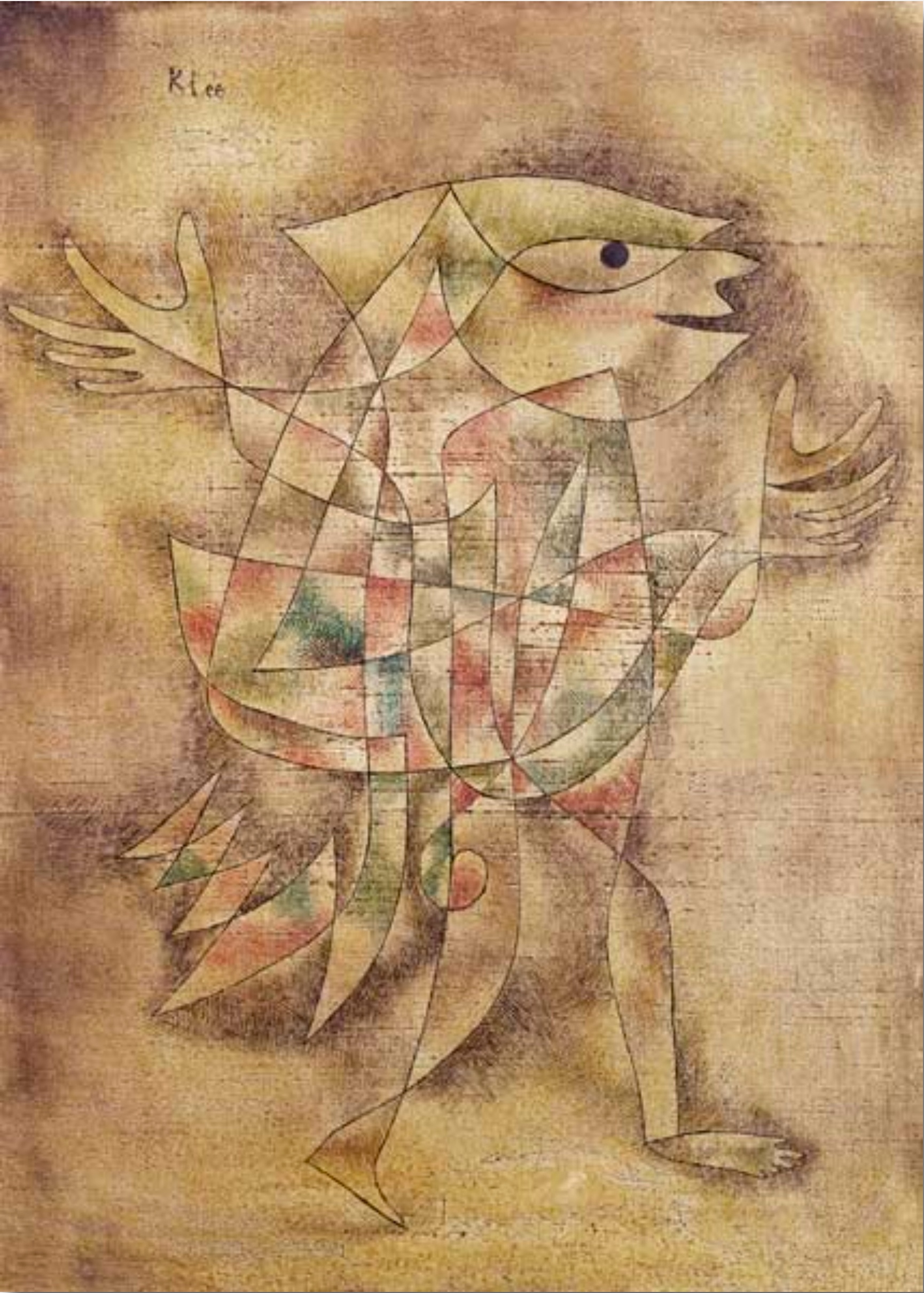
Little Jester in a Trance is a painting by Paul Klee from 1929: thin brown lines on a sandy ochre ground draw a dancing figure with a bird-like head, a round eye and an open mouth, arms flung wide and legs caught mid-step, its body built of small angular facets in faint pink, green, yellow and blue. The original is oil on canvas, only 50.5 x 35.5 cm, and belongs to the Museum Ludwig in Cologne. Our painter paints it for you by hand on canvas, in oil or acrylic, in 8 upright sizes from 31 x 42 to 136 x 193 cm or made to measure. Before the jester ships, we send you a photograph of the finished painting.
| Title: | Little Jester in a Trance |
| Other titles: | Kleiner Narr in Trance (German title) · Piccolo giullare in trance (Italian title) |
| Painter: | Paul Klee (1879–1940) |
| Year painted: | 1929 |
| Original size: | 50.5 cm x 35.5 cm (height x width) |
| Original technique: | Oil on canvas |
| Painting style: | Modernism |
| Located at: | Museum Ludwig, Cologne, Germany |
| Our reproduction: | Hand-painted in oil or acrylic on canvas, 8 sizes or made to measure |
Little Jester in a Trance – Paul Klee
What does Little Jester in a Trance show?
A single figure dances in the middle of the upright format. Klee drew it in thin, dark brown lines that run across the sandy ochre ground like the trail of a pen nib. Around the figure the background thickens into brownish violet clouds, so the paler body stands clearly out of the space.
The head turns to the right and looks like a bird’s or a fish’s: one round black eye and an open mouth that cuts sharply into the profile. The arms are flung wide, and the fingers are no more than a few long loops. The left arm rises towards the top corner, the right reaches out into empty space beside the body.
The body has no single outline. It is made of angular fields that overlap like the patches of a motley costume, washed with pale pink, green, yellow and bluish tones. At the lower left, pointed triangles stick out like a fluttering hem. The legs take a dance step, one to the left, the other to the right. The weave of the canvas shows through the thin paint, and at the top left Klee wrote his name.
What does the title tell us?
The title names a jester, a court fool or clown, and a trance, a state in which you forget yourself. Our sources give no explanation from Klee for this particular work, so we stay with what can be seen.
Flung-out arms, an open mouth and swinging legs really do show a body carried away by dancing. The bright angular fields recall a costume stitched together from scraps.
The Wikipedia article on Paul Klee, in English and about the painter rather than this painting, says his works reflect a dry humour and a sometimes childlike perspective, and that he often painted playful figures of animals and people. The little jester is both at once: a bird-headed man dancing for no one but himself.
Why does this jester catch the eye?
Because it is drawn out of almost nothing. A few fine lines and some see-through colour are enough for a whole figure that moves, looks and opens its mouth.
Klee was a Swiss-born German artist, the son of a music teacher and a singer, and he played the violin from childhood. Rilke wrote that his drawings seemed like transcriptions of music, and with a dancing figure the comparison comes naturally.
In 1929, the year this work was painted, the first major monograph on Klee’s work came out, written by Will Grohmann.
Where is the original kept, and how large is it?
The original belongs to the Museum Ludwig in Cologne, Germany, where it is recorded under inventory number ML 76/3041. It is painted in oil on canvas and measures 50.5 x 35.5 cm (height x width).
Klee made it during his Bauhaus years: he taught there from January 1921 to April 1931, alongside Wassily Kandinsky, and then at the Düsseldorf Academy until 1933.
Ten years older is With the Rotating Black Sun and the Arrow, from 1919, painted shortly before Klee joined the Bauhaus.
Little Jester in a Trance or another Klee?
Little Jester in a Trance is a canvas painting for anyone who loves a light line and warm, muted colour. Upright and centred, it suits a narrow wall or a staircase.
If you want another dance, look at Dance of the Moth, from the same Bauhaus years. Lovers of darker, more mysterious scenes will find Omega 5 (Traps), and if you like movement without figures, try Rhythmical.
More famous Paul Klee paintings, from small heads to large mosaics of colour, are waiting on our Paul Klee page.
How do we hand-paint Little Jester in a Trance on canvas?
Klee’s original is itself a small oil on canvas, only just over 50 cm tall. Ours is an oil painting reproduction on fresh canvas, worked in oil or acrylic in the size you choose, so it hangs as real painted work rather than a poster.
The painter first draws the figure in a thin brown line: the beaked head, the eye, the spread fingers and both dance steps. The line has to stay equally fine and steady from start to finish, because the whole painting rests on it.
Then, in thin, almost transparent layers, he lays in the sandy ochre ground and the darker clouds around the figure. He tints the fields of the body pale pink, green, yellow and blue, so that in places the colour only lightly veils the ground. Last come the round eye and Klee’s signature at the top left.
Which size suits which wall?
In short: 31 x 42 and 40 x 55 cm for a shelf, a hallway or a child’s room, 45 x 65 and 60 x 82 cm above a chest of drawers or a bed, 77 x 107 and 85 x 125 cm above a sofa, and 110 x 152 or 136 x 193 cm for a tall empty wall or a stairwell.
We paint Little Jester in a Trance in 8 upright sizes (width x height): 31 x 42, 40 x 55, 45 x 65, 60 x 82, 77 x 107, 85 x 125, 110 x 152 and 136 x 193 cm. The original measures 35.5 x 50.5 cm (width x height), so most of our sizes enlarge the small canvas a good deal; at 136 x 193 cm the dancer is almost four times as tall as in Cologne.
As a painting for the living room it looks best at 85 x 125 or 110 x 152 cm, where the fine lines still read clearly from the far side of the room.
Can I order another size or a frame?
Of course. If you need different proportions, we keep the figure whole, from fingertips to feet, and widen or narrow only the sandy ground. Send us your measurements and we will come back with a price and a date.
Your painting can travel rolled, stretched on a stretcher bar or ready framed. Our workshop in Slovenia does the stretching and framing and gets every piece ready for the journey.
The moulding is picked in our 3D app, which exists for that choice alone; seeing the painting on your own wall is a separate service.
When and how will the painting reach you?
Once you confirm the order, the painter starts work, and the painting is ready to ship within 15 to 45 working days. Before we pack it, we send you a photograph of the finished painting; if you would like a change, we make it.
Within Slovenia and across the rest of the EU, parcels travel without customs formalities, and every order is covered by our returns policy.
The dancing jester is a cheerful present for a birthday, a wedding or a housewarming, especially for someone who loves music or theatre. If you are unsure which size would fit, give a gift voucher and let them choose.
Frequently asked questions
Where is the original?
At the Museum Ludwig in Cologne, under inventory number ML 76/3041.
What is in the picture?
A dancing figure with a bird-like head, a round eye and outstretched arms, drawn in thin brown lines on a sandy ground.
Is it a print?
No, it is a hand-painted copy, brushed onto canvas by our painter in oil or acrylic.
How big is the original?
It is 50.5 cm high and 35.5 cm wide; our sizes go up to 136 x 193 cm.
Can I order a size that is not listed?
Yes. Tell us the width and height you need and we will send you an offer.
How long will I wait?
Between 15 and 45 working days, and you see a photograph of your finished jester before it ships.
Is the jester right for a bedroom, or as a present?
Yes. The calm sandy tones are easy to live with, and the dancing figure is a witty gift for anyone who loves music or dance.
What does the title mean?
Our sources do not interpret it; it speaks of a jester lost in a trance of dancing, which is exactly what the body shows.
- Subject: a dancing figure with a bird-like head, a round eye and outstretched arms, built of pale coloured facets.
- Original: oil on canvas, 1929, 50.5 x 35.5 cm, Museum Ludwig, Cologne.
- Ours: a Paul Klee reproduction hand-painted on canvas in oil or acrylic, in 8 sizes from 31 x 42 to 136 x 193 cm, or made to measure.
- Worth knowing: painted in Klee’s Bauhaus years, the year the first major monograph on his work appeared.