







































Description
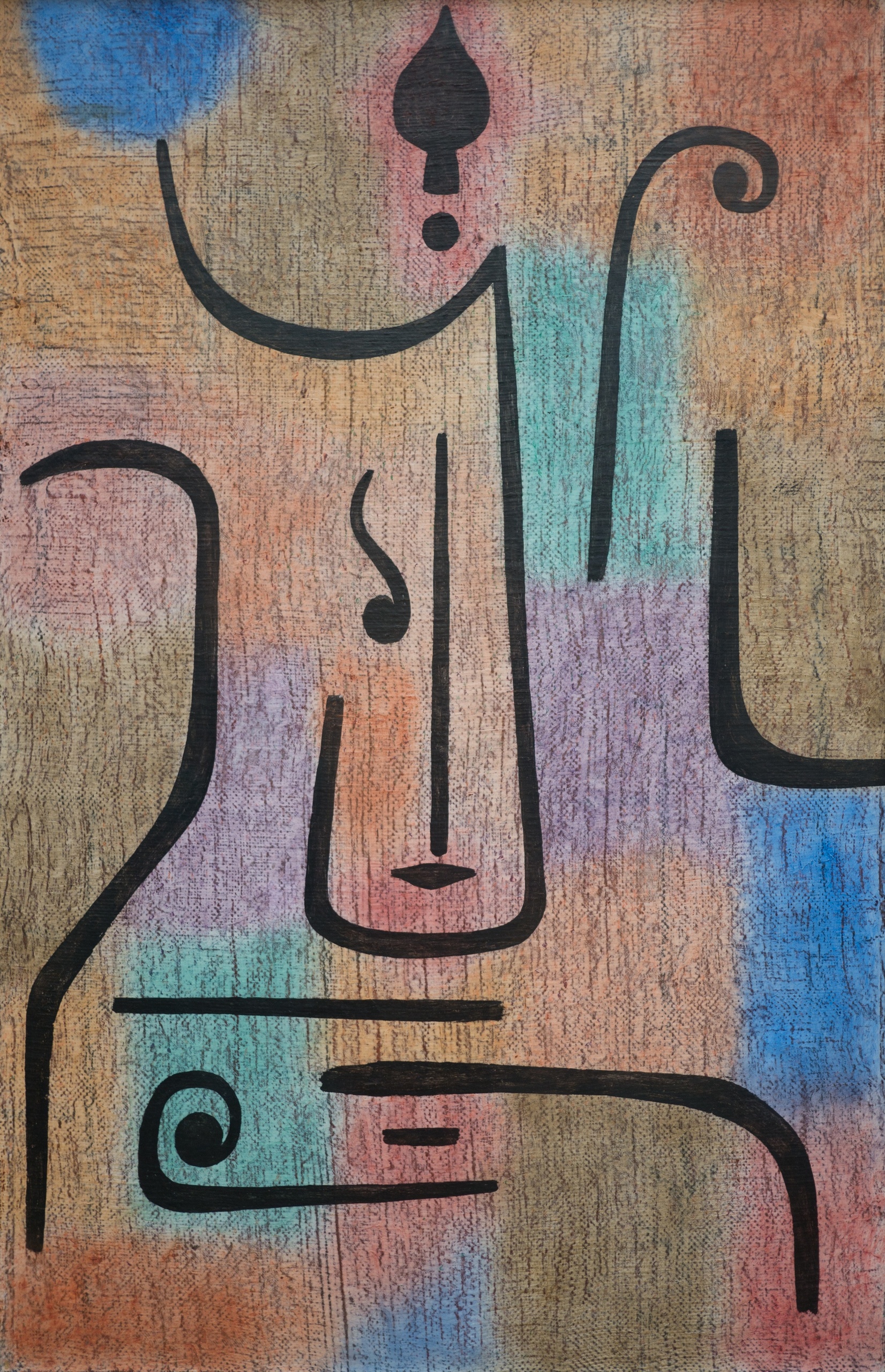
Archangel is a painting by Paul Klee from 1938: thick black arcs, hooks and bars, like large handwritten letters, build a tall, narrow face with a long nose, a small mouth and a flame-like crown, set on a soft ground of rose, ochre, lavender, turquoise and blue. The original, in oil and unusually large for Klee at 100 x 65 cm, belongs to the Städtische Galerie im Lenbachhaus in Munich. Our painter paints it for you by hand on canvas, in oil or acrylic, in 8 upright sizes from 29 x 46 to 128 x 191 cm or made to measure. Before Archangel leaves us, we send you a photograph of the finished painting.
| Title: | Archangel |
| Other titles: | Erzengel (German title) · Arcangelo (Italian title) |
| Painter: | Paul Klee (1879–1940) |
| Year painted: | 1938 |
| Original size: | 100 cm x 65 cm (height x width) |
| Original technique: | Oil |
| Painting style: | Modernism |
| Located at: | Städtische Galerie im Lenbachhaus, Munich, Germany |
| Our reproduction: | Hand-painted in oil or acrylic on canvas, 8 sizes or made to measure |
Archangel – Paul Klee
What does Archangel show?
A few thick black strokes, not an outline, carry the face in the middle. A long vertical line is the nose, a small dark diamond below it reads as a mouth, and a broad U holds the whole face from beneath. To the left of the nose hangs a small hook ending in a dot, like a musical note, which you can read as a closed eye.
Above the head rises a black teardrop shape with a stem and a dot, like a flame or a crown. To its left a wide arc swings out; to its right a thin rod curls into a spiral. A second spiral sits at the lower left, above two horizontal bars that lie under the face like shoulders or outstretched arms.
Behind the signs spreads a mosaic of soft colour fields: rose, ochre, lavender, turquoise and blue drift into one another without hard borders. A grainy, cloth-like texture shows through the paint. The effect is calm and monumental.
How should you read these black signs?
The title promises an archangel, yet there are no wings and no halo. The angel is a handful of signs that read like a script, so the meaning stays open: we recognise a face, a crown and arms, and the viewer supplies the rest.
English Wikipedia notes that from 1938 Klee worked more intensively with hieroglyph-like elements, and that his late works use heavier lines, geometric forms and fewer but larger blocks of colour. This painting is a clear example of that late hand.
Angels returned in Klee’s work until the very end. He painted and drew many angels in his last years, and in his final months alone he made fifty drawings of them.
Why does this angel hold the eye?
First, through its simplicity. With a few strokes that could be written with a broad nib, Klee builds a face that anyone recognises.
Second, through its colour. Under the stern black signs lies a delicate, almost pastel ground, so the work never feels heavy despite its thick lines.
Third, through Klee himself. The Swiss-born German artist played the violin from childhood, in an orchestra too, and Rilke wrote that his drawings were like transcriptions of music.
For more on the painter, his life and his late style, see the Wikipedia article on Paul Klee, written in English; there is no separate article on this work.
Where is the original, and how did it come about?
The original belongs to the Städtische Galerie im Lenbachhaus in Munich, where it is listed under inventory number AK 9. Klee painted it in 1938 in Bern, where he had moved with his family at the end of 1933, after losing his Düsseldorf post under the Nazis.
At 100 x 65 cm (height x width) it is a large format for Klee, most of whose works are small and made on paper, gauze or board.
1938 was prolific: English Wikipedia counts 489 works, and more than twelve hundred the year after. Simpler and larger compositions let him keep working despite his illness.
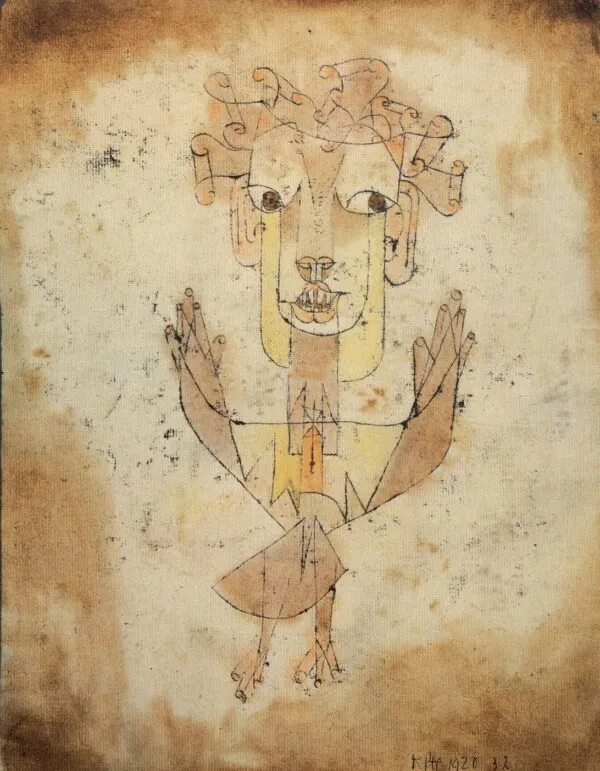
The angel had been with him before. In 1931, during his Düsseldorf years, he made In Angel’s Care, where a single thin coloured line draws a large angel with spread wings over a smaller figure. Seven years on, that fine, winding line has become a thick, solemn sign.
Archangel or another Klee?
Archangel is a canvas painting for anyone who wants a single calm, upright figure with a clear outline on the wall.
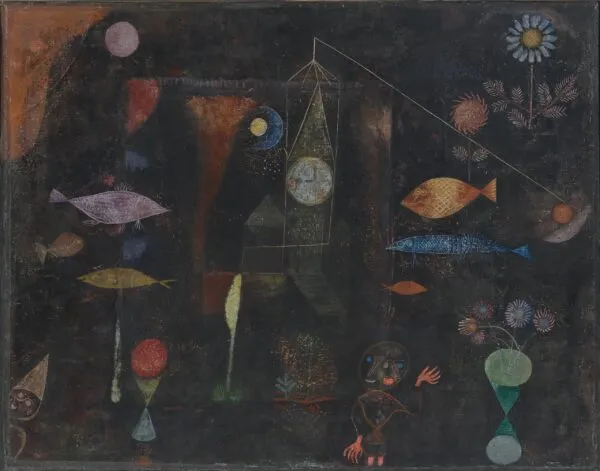
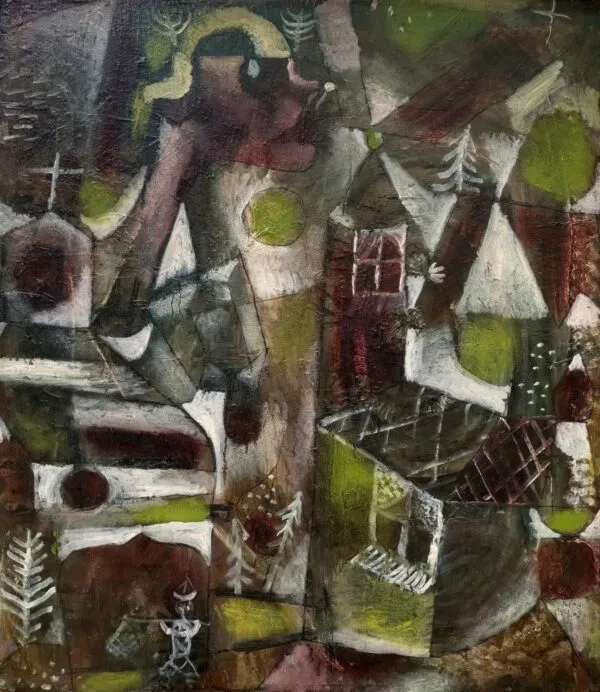
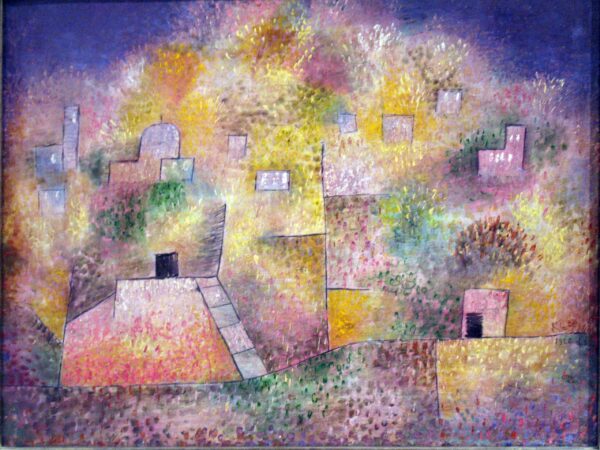
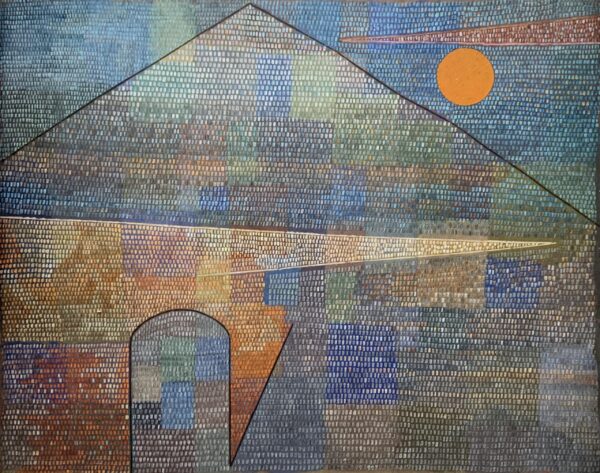
For a landscape with the same strong outlines, look at Rocks at Night from 1939, angular stones in deep blues fitted together like a mosaic. Masks and vessels hide among thousands of tiny dots in Barbarian Sacrifice. And for a witty face there is Nearly Hit, a head in a hat with an arrow flying just over it.
The famous Paul Klee paintings we offer, from small watercolours to large oils, are gathered on our Paul Klee page.
How do we hand-paint Archangel on canvas?
Klee’s original is an oil measuring 100 x 65 cm. Our Archangel is an oil painting reproduction on fresh canvas: the painter works in oil or acrylic, in the size you choose, and builds it up layer by layer.
He first lays in the coloured ground, field by field, letting the colours meet softly. Once it is dry, he drags an almost dry brush across it so the grainy texture of the original comes alive.
The black drawing comes last. Every arc, hook and spiral needs the right weight and a rounded end, so the painter pulls them with a broad brush and a steady hand, without stencils.
Which size fits which wall?
In short: 29 x 46 or 40 x 60 cm for a narrow wall, a hallway or beside a door, 48 x 75 and 55 x 85 cm above a chest of drawers, next to a bed or between two windows, 70 x 110 and 81 x 120 cm for the living room, and 100 x 155 or 128 x 191 cm for high walls and stairwells.
Archangel is tall and slim, so we paint it in 8 sizes (width x height): 29 x 46, 40 x 60, 48 x 75, 55 x 85, 70 x 110, 81 x 120, 100 x 155 and 128 x 191 cm. The original measures 65 x 100 cm (width x height), already big for Klee. From 70 x 110 cm upward our paintings are larger than the museum piece, and at 128 x 191 cm almost twice as tall.
As a painting for the living room it works best at 81 x 120 or 100 x 155 cm, hung on its own beside the sofa or above a low sideboard.
Can I order another size or a frame?
Yes. For other proportions, the face with its crown and spirals stays whole, and we widen or shorten only the coloured ground. Send us your custom size and we will reply with a price and a date for your Archangel.
We send Archangel rolled, stretched on a stretcher bar or framed. Our workshop in Slovenia stretches and frames it and readies it for the journey. You choose the moulding in our 3D app, which serves that choice only; seeing Archangel on your own wall is a separate service.
A slim black or dark grey frame picks up the colour of the signs.
When will Archangel arrive?
After you confirm your order, Archangel is ready to ship within 15 to 45 working days. Before packing we send you a photograph of the finished Archangel; if you want anything changed, we change it.
Within Slovenia and across the rest of the EU, parcels travel without customs duties, and every order is covered by our returns policy.
The calm, crowned angel makes a fine present for a new home or a birthday. Unsure of their wall? A wall art voucher lets them pick the angel’s size.
Frequently asked questions
Which museum holds the original?
The Städtische Galerie im Lenbachhaus in Munich, under inventory number AK 9.
What exactly is painted here?
A tall face of thick black arcs and hooks, crowned, on a soft multicoloured ground.
Is it a print or a real painting?
A real painting: you receive a hand-painted copy, worked by our painter with brushes on canvas in oil or acrylic.
How big is the original?
It measures 100 x 65 cm (height x width), unusually large for Klee; our sizes go up to 128 x 191 cm.
Can I have a wider or shorter version?
Yes. Give us the width and height you need for Archangel, and we will reply with a price and a date.
How long will I wait?
Archangel takes 15 to 45 working days to paint, and you see a photograph of it before dispatch.
Does Archangel suit a bedroom or make a good gift?
Yes. Its calm colours suit a bedroom, and as a present it is a good choice for anyone who likes modern art.
What do the black signs mean?
There is no single reading; the signs read like a script from which a face, a crown and arms emerge.
- Subject: a tall face of thick black arcs, hooks and spirals with a flame-like crown on a rose, ochre, turquoise and blue ground.
- Original: oil, 1938, 100 x 65 cm, Städtische Galerie im Lenbachhaus, Munich.
- Ours: a Paul Klee reproduction painted by hand in oil or acrylic on canvas, 8 upright sizes from 29 x 46 to 128 x 191 cm, or made to measure.
- Worth knowing: Klee painted it in his late Bern years, when he worked with thick black signs and often returned to angels.