







































Description
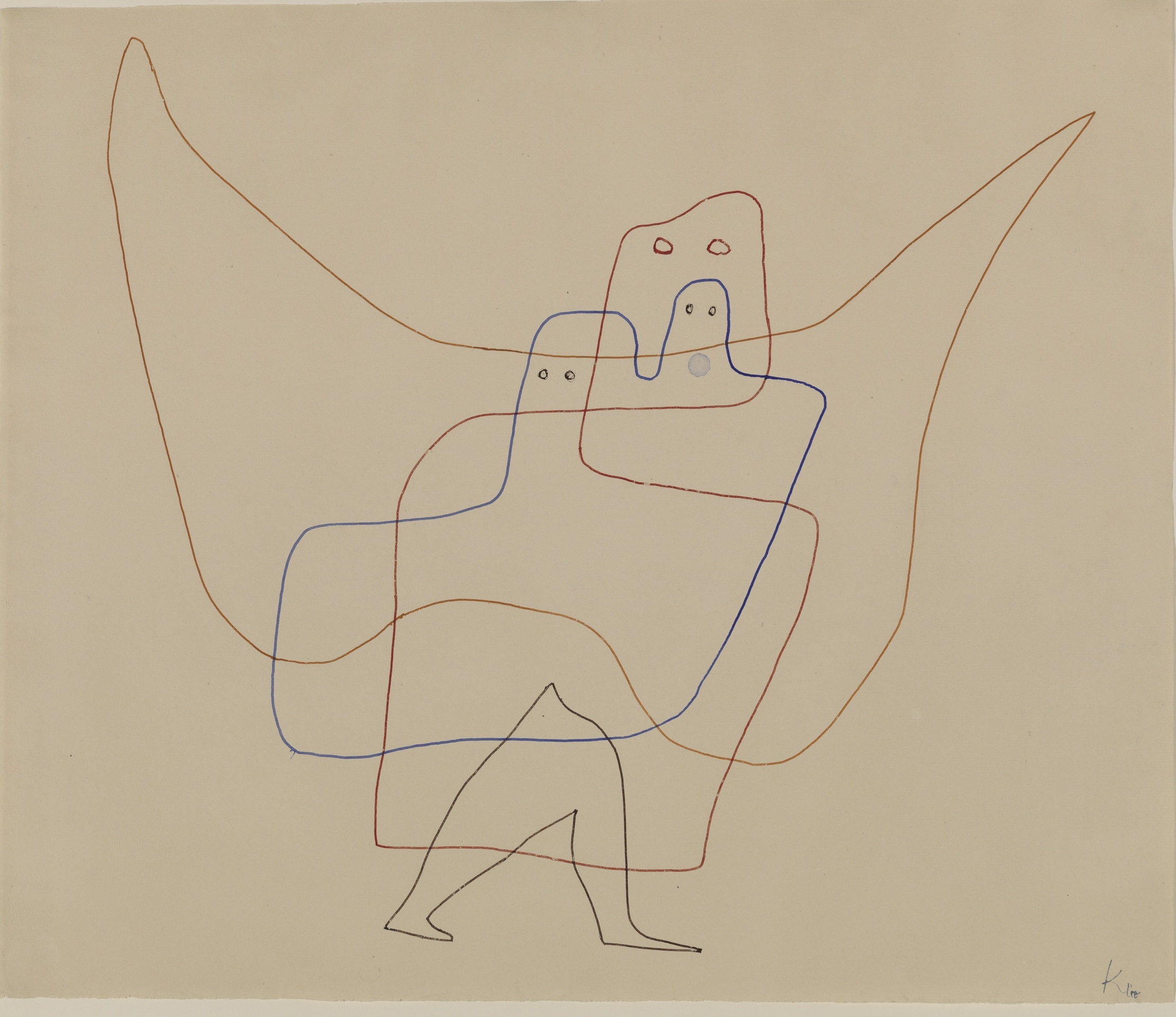
In Angel’s Care is a painting by Paul Klee from 1931: on a soft beige sheet, a thin brown, red and blue line draws a large angel whose wide, pointed wings spread over a smaller figure with a round face, which the angel seems to hold and shelter, while two small legs walk along at the bottom. The original is ink and watercolour on paper, 50 x 64.9 cm, and it belongs to the Solomon R. Guggenheim Museum in New York. Our painter paints it for you by hand on canvas, in oil or acrylic, in 8 landscape sizes from 40 x 33 to 170 x 140 cm or made to measure. Before dispatch we send you a photograph of the finished angel.
| Title: | In Angel’s Care |
| Other titles: | In Engelshut (German title) · Sotto la custodia dell’angelo (Italian title) |
| Painter: | Paul Klee (1879–1940) |
| Year painted: | 1931 |
| Original size: | 50 cm x 64.9 cm (height x width) |
| Original technique: | Watercolour and ink on paper |
| Painting style: | Modernism |
| Located at: | Solomon R. Guggenheim Museum, New York, USA |
| Our reproduction: | Hand-painted in oil or acrylic on canvas, 8 sizes or made to measure |
In Angel’s Care – Paul Klee
What does In Angel’s Care show?
The warm, sand-beige paper holds no filled colour, only a few thin lines. The longest, in brownish orange, rises to a sharp point on the left, dips in a wide curve through the middle and climbs to a second point on the right: two outspread wings across almost the whole sheet.
Beneath the wings a red outline and a blue one wind through each other. The red one closes a head with two red eyes that peeks out over everything; the blue one shapes a smaller figure with rounded shoulders and a face as round as a doll’s. Because the outlines overlap, the large figure seems to hold the small one in its arms.
At the bottom two thin black legs step out, one forward and one back, in mid-stride. A pale bluish dot sits between the faces, and Klee signed small in the lower right corner. The rest is bare paper.
What does the title tell us?
The title names the large winged figure an angel that guards the smaller one. The gesture is simple and tender: one figure wraps the other, covers it with its wings and looks out over it.
The English Wikipedia article on Klee says that after moving to Düsseldorf in 1931 he drew a series of guardian angels, and names this work among them. Its overlaying technique, the article adds, shows the polyphonic character of his drawing between 1920 and 1932: the lines cross like voices in a choir.
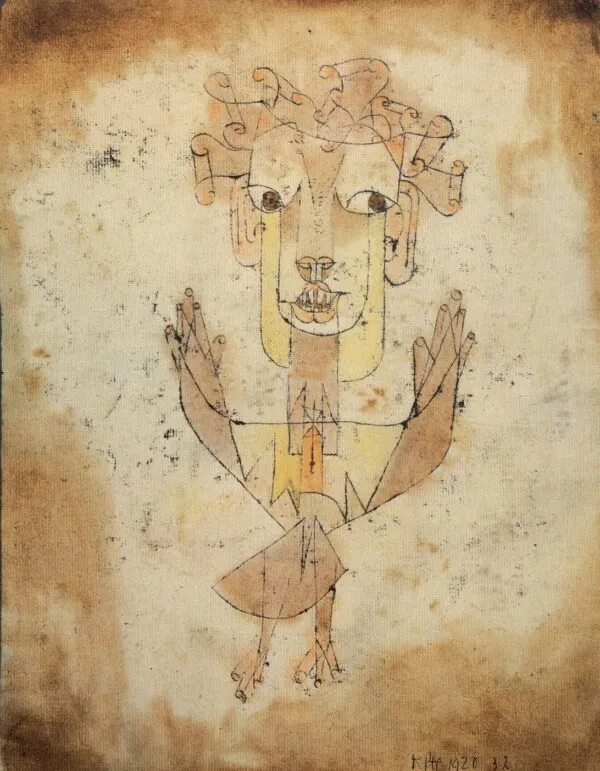
Angels grew frequent in his final years; in his last months alone he drew 50 of them. This earlier one needs only an unbroken line in three colours and a few dots for eyes.
Why does this angel speak to so many people?
The drawing is almost empty, yet it feels full: a few strokes give us wings, a face and a step, and the eye does the rest.
Klee, a Swiss-born German artist, grew up with the violin and played in an orchestra; Rilke likened his drawings to transcribed music, and here the brown, red and blue lines really do run side by side like three melodies.
To learn more about the painter, read the Wikipedia article on Paul Klee; it is in English, covers the artist and mentions this work in one sentence.
Where is the original kept?
The original belongs to the Solomon R. Guggenheim Museum in New York, inventory number 48.1172.486. It is ink and watercolour on paper; the museum gives 50 x 64.9 cm (height x width), so the sheet is wider than it is tall.
It dates from 1931, the year Klee left the Bauhaus, where he had taught since 1921 alongside Wassily Kandinsky, for the Düsseldorf Academy, where he stayed until 1933.
The Düsseldorf years also produced Two Ways of 1932, a watercolour of grey rectangles opening towards a bright square at the centre, with two arrows pointing in opposite directions.
This angel or another Klee?
In Angel’s Care is a canvas painting for people who like calm on their walls: light space, few lines and one warm gesture. Its pale ground suits white, grey and wood-toned rooms.
If the angel appeals, see Archangel of 1938, where thick black bars on soft patches of colour build a tall, quiet face. For signs without figures there is Inscription of 1926, its small marks running along brownish lines like an unknown script, and for a dense surface Barbarian Sacrifice of 1932, covered in thousands of tiny dots.
Our Paul Klee page gathers all the famous Paul Klee paintings our painters make to order, from the angels to the dotted compositions.
How do we hand-paint the angel on canvas?
The original is a drawing in ink and watercolour on paper, not an oil painting. Ours is an oil painting reproduction on canvas, worked in oil or acrylic in the size you choose and built up layer by layer, so it hangs like any other painted work.
First he lays a warm beige ground, gently alive like the original paper. Then a fine brush draws the brownish orange wings, the red and blue figures, and finally the black legs, tiny eyes and signature.
Everything depends on the line: thin, even and softly muted in places, the way ink settles on paper, with the empty areas left clean.
Which size suits which wall?
In short: 40 x 33 or 50 x 42 cm above a bedside table, in a hallway or a child’s room, 56 x 48 and 70 x 63 cm above a chest of drawers or a bed, 90 x 78 and 115 x 100 cm above a sofa, and 131 x 110 or 170 x 140 cm for a large wall where the wings can open to their full span.
We paint the angel in 8 landscape sizes (width x height): 40 x 33, 50 x 42, 56 x 48, 70 x 63, 90 x 78, 115 x 100, 131 x 110 and 170 x 140 cm. The original is 64.9 cm wide and 50 cm high, so the three smallest sizes are smaller than it, while the four largest enlarge it clearly; at 170 x 140 cm the angel is a good two and a half times as wide as it is in New York.
The thin lines gain from size: the wings become a broad gesture and the empty beige calms the room. As a painting for the living room it looks best at 115 x 100 or 131 x 110 cm above the sofa.
Can I order another size or a frame?
Of course. For other proportions we add or remove a little beige ground around the drawing; the wings, figures and legs stay whole. Send us the size you need and we will quote a price and a date for the angel.
The angel travels rolled, stretched on a stretcher bar or framed. Our workshop in Slovenia stretches and frames it for the road. The frame itself is chosen in our 3D app, which covers frame choice only; a view of the angel on your own wall is a separate service.
A slim frame in pale wood or a plain white moulding suits the light ground; a dark, wide frame would drown the fine lines.
When will your painting arrive?
Once you confirm, the painter begins, and the angel is ready to ship in 15 to 45 working days. You see a photograph of the finished angel before it is packed, and any change you ask for is made.
The angel travels without customs duties within Slovenia and across the EU, and your order is covered by our returns policy.
A painting about care makes a lovely present for a new baby or a new home. Unsure of their wall? A wall art voucher lets them choose the size.
Frequently asked questions
Where is the original?
At the Solomon R. Guggenheim Museum in New York, under inventory number 48.1172.486.
What can I see in it?
An angel with outspread, pointed wings embracing a smaller figure with a round face; two small legs walk along at the bottom.
Is it a print?
No. It is a hand-painted copy, made by our painter with brushes on canvas in oil or acrylic.
How big is the original?
The museum gives 50 x 64.9 cm (height x width); our sizes run from 40 x 33 to 170 x 140 cm.
May I order measurements that are not on the list?
Yes. Tell us the width and height, and we will send an offer with a price and a making time.
How long will I wait for my painting?
From 15 to 45 working days; before dispatch we also send you a photograph of the finished work.
Is it right for a bedroom, or as a gift?
Yes. The calm lines and the tender gesture of care belong above a bed, in a child’s room or among gifts for a new baby.
What does the angel embracing a figure mean?
The title says the large winged figure guards the smaller one; Wikipedia counts the work among Klee’s guardian angels of 1931.
- Subject: an angel with wide, pointed wings, drawn in a thin brown, red and blue line, sheltering a smaller figure.
- Original: ink and watercolour on paper, 1931, 50 x 64.9 cm, Solomon R. Guggenheim Museum, New York.
- Ours: a Paul Klee reproduction painted by hand in oil or acrylic on canvas, 8 sizes from 40 x 33 to 170 x 140 cm, or made to measure.
- Worth knowing: it was made in the year Klee moved from the Bauhaus to the Düsseldorf Academy, as one of his guardian angels.