







































Description
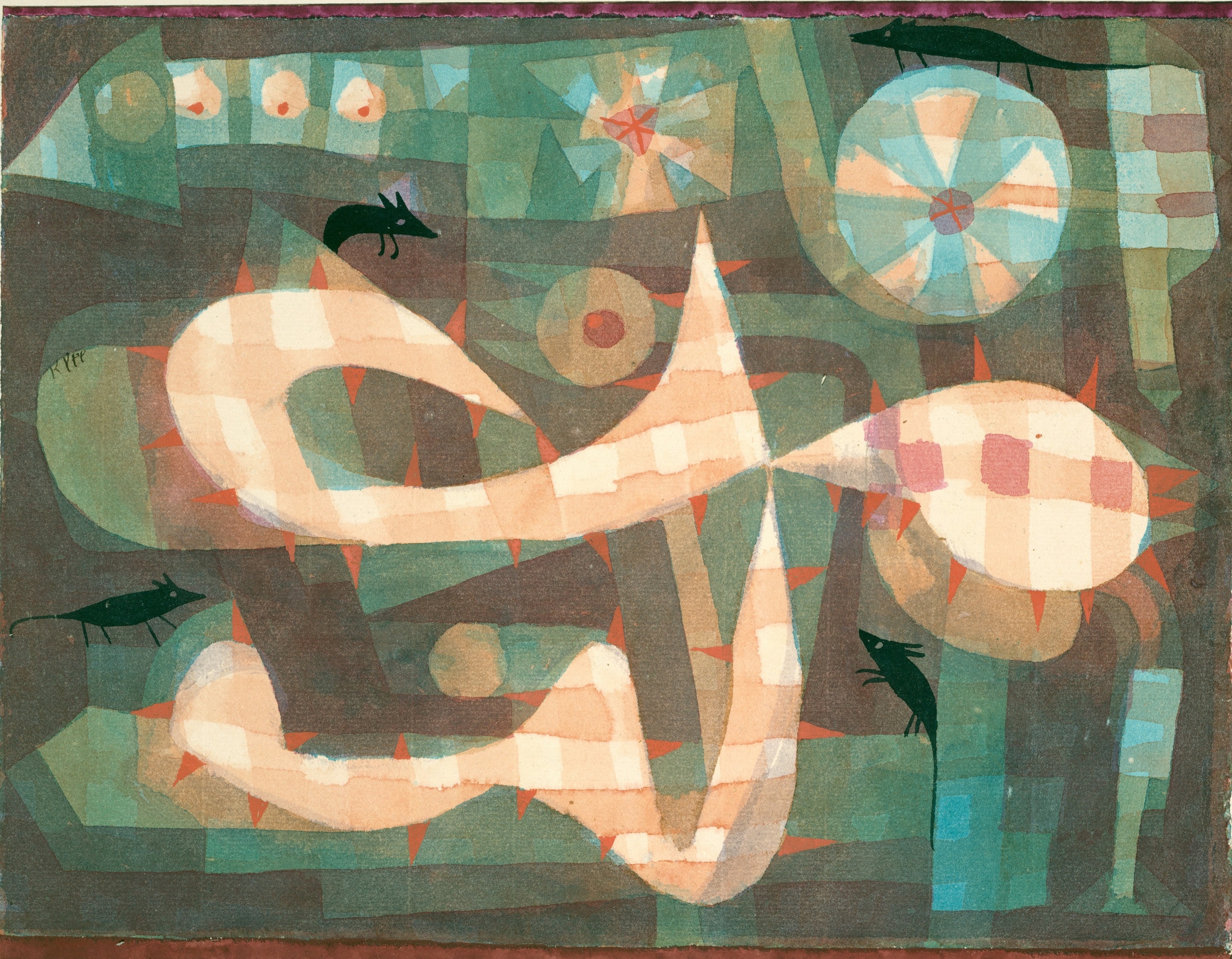
The Barbed Noose with the Mice is a painting by Paul Klee from 1923: a long cream and pink ribbon, set with small red thorns, twists across the sheet like a knotted rope, while four little black mice scurry around it. The original is a watercolour and gouache on paper, only 31.1 x 40 cm, and it belongs to The Metropolitan Museum of Art in New York. Our painter copies it for you by hand onto canvas, in oil or acrylic, in one of 8 landscape sizes between 40 x 30 and 200 x 162 cm, or made to measure. Before dispatch you see the finished work in a photograph.
| Title: | The Barbed Noose with the Mice |
| Other titles: | Die Dornenschlinge mit den Mäusen (German translation) · Il cappio spinato con i topi (Italian translation) |
| Painter: | Paul Klee (1879–1940) |
| Year painted: | 1923 |
| Original size: | 31.1 cm x 40 cm (height x width) |
| Original technique: | Watercolour and gouache on paper mounted on cardboard |
| Painting style: | Modernism |
| Located at: | The Metropolitan Museum of Art, New York, USA |
| Our reproduction: | Hand-painted in oil or acrylic on canvas, 8 sizes or made to measure |
The Barbed Noose with the Mice – Paul Klee
What does The Barbed Noose with the Mice show?
In the middle of the sheet lies a long, broad ribbon in cream and soft pink. Gentle checks run across it, as if it were cut from gingham, and small red thorns stick out along its edges. On the left it bends into a loop, in the centre it twists, on the right it swells into a round drop, and below it winds round once more, so the whole recalls a knotted rope or a sideways figure eight.
Four tiny black mice with long, thin tails run around the ribbon. One dashes along the top edge, a second stands above the left loop, the third hurries off at the lower left and the fourth climbs upwards on the right. None of them minds the thorns; they look as if they are playing tag.
The ground is built from see-through rectangles of sea green, turquoise and dark brown that overlap like pieces of coloured glass. At the upper right glows a big round disc like a wheel, in pale blue and peach; at the upper left a row of little lamp-like shapes lines up, with a small star not far off, and a blue jar sits at the right edge. Thin painted bands close the sheet at the top and bottom, and Klee signed it near the left edge.
What do the thorns and the mice mean?
The title says exactly what you see: a noose with thorns, and mice. No single reading of this sheet is accepted as the right one, and we do not make one up.
English Wikipedia notes that many of Klee’s works and their titles reflect his dry humour and his sometimes childlike perspective. You can feel that here: a noose that might be dangerous is soft and colourful like a toy, and the mice hop around it without fear.
That is why most people read the scene as a game rather than a trap. Some see a snake in the ribbon, others a bow or a skipping rope.
Why do people love this painting?
Klee often built his compositions from geometric forms and grids and combined them with playful figures of animals and people. Here the web of see-through rectangles holds everything together, and the mice bring it to life.
Klee was born in 1879 in Münchenbuchsee, near Bern in Switzerland. You can read more about his life in the Wikipedia article on Paul Klee; it is in English and covers the painter, not this particular work.
Where is the original kept, and how big is it?
The original belongs to The Metropolitan Museum of Art in New York, under accession number 1987.455.13. The museum lists it as part of The Berggruen Klee Collection, with the year 1987.
The sheet measures 31.1 x 40 cm (height x width). Klee painted it in watercolour and gouache, gave it a gouache border and mounted it on cardboard.
He made it in 1923, while teaching at the Bauhaus, where he worked from January 1921 to April 1931, among other things as a form master in the stained glass workshop; from 1922 Wassily Kandinsky taught there beside him.
The Barbed Noose with the Mice or another Klee?
This canvas painting suits anyone who likes humour and small stories on the wall, and its wide format fills the space above a sofa or a dining table nicely.
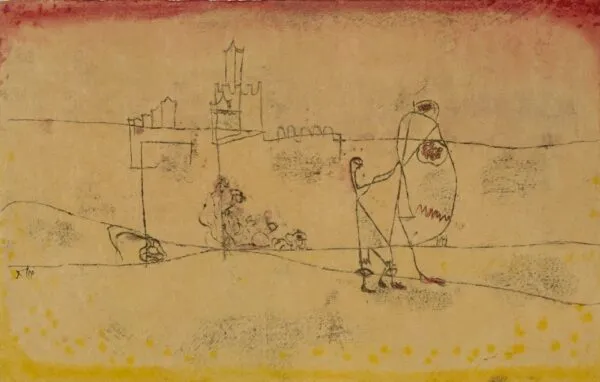
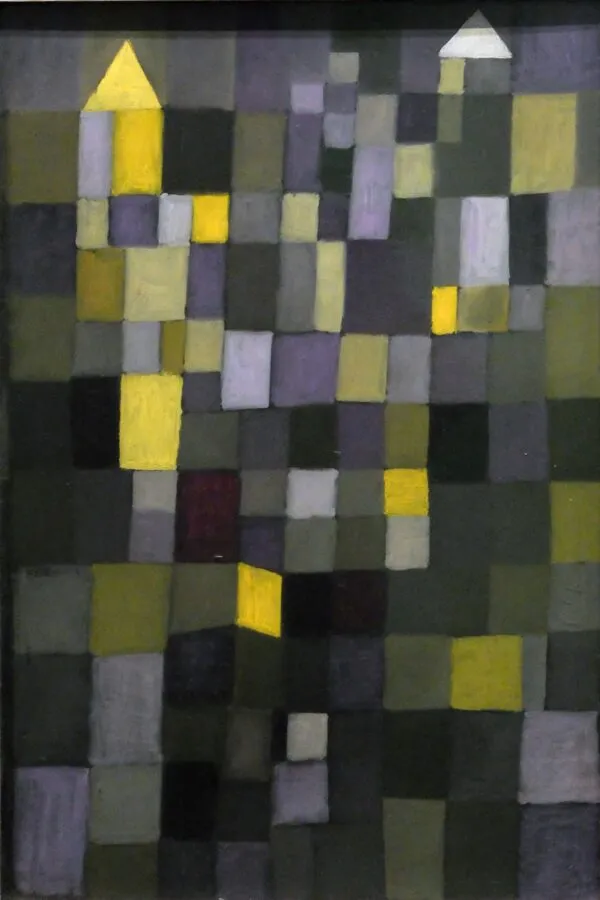
From the same Klee selection we also recommend Episode Before an Arab Town and, if the theatre appeals to you, Comedians’ Handbill. For comparison, take a look at Clarification and Deep Pathos too.
All the famous Paul Klee paintings we paint to order, with mice, angels, heads or coloured dots, are gathered on our Paul Klee page.
How do we hand-paint The Barbed Noose with the Mice?
The original is a small sheet of paper worked in watercolour and gouache, not an oil on canvas. Ours is a Paul Klee reproduction painted on canvas: the painter works in oil or acrylic, layer by layer, in the size you choose, so it hangs on your wall like any other painting.
He first draws the course of the ribbon and the grid of rectangles in the ground. He renders the watercolour’s transparency with thin, overlapping glazes, so the green, turquoise and brown stay airy. Then he paints the checks on the ribbon, and last of all he brushes in the red thorns, the four black mice with their tails and the bands along the top and bottom edges.
Which size suits which wall?
In short: 40 x 30 or 50 x 38 cm for a shelf or a narrow wall, 65 x 49 and 80 x 63 cm above a chest of drawers or a desk, 100 x 79 and 130 x 100 cm above a sofa or a bed, and 160 x 129 or 200 x 162 cm for a large wall.
We paint the work in 8 landscape sizes (width x height): 40 x 30, 50 x 38, 65 x 49, 80 x 63, 100 x 79, 130 x 100, 160 x 129 and 200 x 162 cm. The original sheet measures 40 x 31.1 cm (width x height), so most of our sizes enlarge it considerably; at 200 x 162 cm the noose is five times as wide as it is in New York.
As a painting for the living room it works best at 100 x 79 or 130 x 100 cm above the sofa, where the green calms the room and the mice raise a smile.
Can I order a different size or a frame?
Yes. If your wall needs other proportions, we adapt the painting so that the noose and all four mice stay whole, and we change only the width of the green ground at the sides. Send us your own measurements and we will reply with a price and a delivery date.
The noose and mice reach you rolled, stretched on a stretcher bar or ready framed. Our workshop in Slovenia takes care of the stretching and framing and prepares every painting for shipping. You pick the moulding in our 3D app, which is meant for choosing the frame and nothing else; viewing the painting on your own wall is a separate service.
When will my painting arrive?
After you confirm the order, the painter starts on the ribbon and the mice, and within 15 to 45 working days the painting is ready to ship. You see a photograph of the finished work before we pack it, and any change you ask for is made.
Within Slovenia and to the other EU countries the parcel travels without customs, and every order is covered by our returns policy.
With its mice, this work makes a cheerful present for a child, an animal lover or anyone who enjoys Klee’s humour. Not sure of their wall? Then a wall art voucher lets them pick the size of the noose themselves.
Frequently asked questions
Where can I see the original sheet?
At The Metropolitan Museum of Art in New York, accession number 1987.455.13.
What is in the picture?
A cream ribbon with red thorns twisted into a noose, four black mice and a green and brown ground with a wheel-like disc.
Is this an oil painting reproduction or a printed copy?
It is painted, not printed: a hand-painted copy made with brushes on canvas, in oil or acrylic.
How big is the original sheet?
31.1 x 40 cm (height x width); our sizes go up to 200 x 162 cm.
Can I get the noose and mice in an unlisted size?
Yes. Give us the width and height, and we reply with a price and a delivery date.
How long will I wait?
Between 15 and 45 working days, and before dispatch you see the finished noose and mice in a photograph.
Is the painting with the mice good for a child’s room?
Yes. The mice and the colourful ribbon appeal to children, and as a gift it is a witty choice for lovers of modern art.
Are the thorns dangerous for the mice?
Not in the painting: the mice run around the ribbon without fear, so the scene looks like a game rather than a trap.
- Subject: a cream checked ribbon with red thorns, twisted into a noose, and four black mice on a green and brown ground.
- Original: watercolour and gouache on paper mounted on cardboard, 1923, 31.1 x 40 cm, The Metropolitan Museum of Art.
- Ours: painted by hand in oil or acrylic on canvas, 8 sizes between 40 x 30 and 200 x 162 cm, or made to measure.
- Worth knowing: Klee made it during his Bauhaus years, and it shows his dry humour.