







































Description
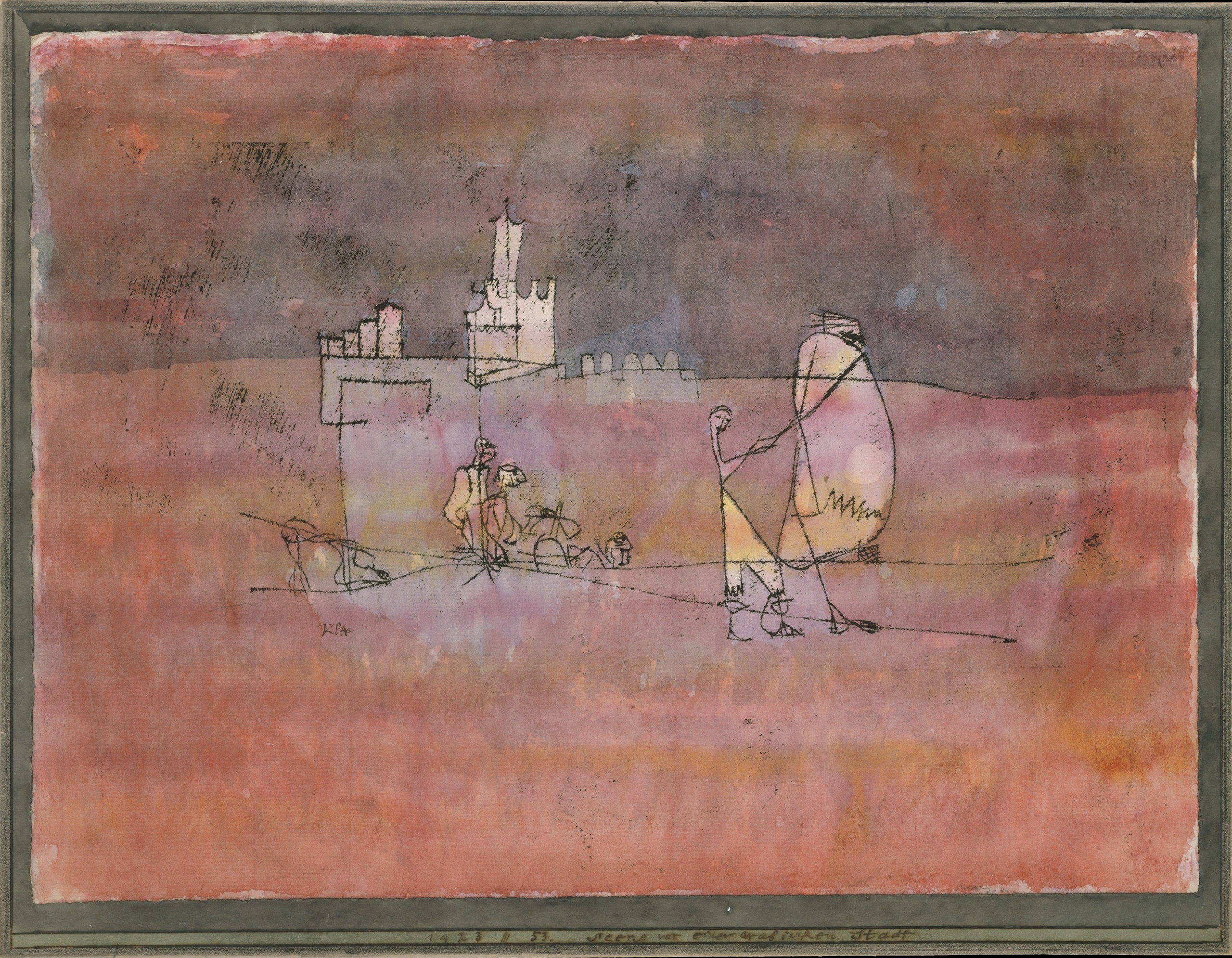
Episode Before an Arab Town is a painting by Paul Klee from 1923: on a soft rose-violet ground, fine black lines draw a walled town with a tall tower and, in front of it, tiny figures, an animal and a tall figure wrapped in a long cloak. The original is a small watercolour with transferred printing ink on paper, only 25.4 x 32.7 cm, and it belongs to The Metropolitan Museum of Art in New York. Our painter brushes this rose-coloured scene onto canvas for you by hand, in oil or acrylic, in one of 8 landscape sizes from 40 x 30 to 200 x 162 cm or made to measure. Before the little town is packed, you receive a photograph of the finished painting.
| Title: | Episode Before an Arab Town |
| Other titles: | Episode vor einer arabischen Stadt (German title) · Episodio davanti a una città araba (Italian title) |
| Painter: | Paul Klee (1879–1940) |
| Year painted: | 1923 |
| Original size: | 25.4 cm x 32.7 cm (height x width) |
| Original technique: | Watercolour and transferred printing ink on paper mounted on cardboard |
| Painting style: | Modernism |
| Located at: | The Metropolitan Museum of Art, New York, USA |
| Our reproduction: | Hand-painted in oil or acrylic on canvas, 8 sizes or made to measure |
Episode Before an Arab Town – Paul Klee
What does Episode Before an Arab Town show?
A transparent wash of rose, raspberry and violet covers the sheet. At the top it darkens into a grey-violet cloud; lower down it warms into a rosy orange, with paler patches and the grain of the paper showing through.
On the horizon, thin black lines draw the town: crenellated walls, a few boxy houses and a tall tower with a pointed top. The buildings are slightly paler than the ground, as if a gentle light fell on them. To the right the wall runs on in rounded battlements and melts into the wavy horizon.
In front of the town a small scene unfolds. In the middle a group of tiny figures sits together, at the left there is an animal, and at the right two figures stand: a thin one holding a staff and a tall one wrapped in a cloak that reaches almost to the ground. A long thin line crosses the scene like a path.
Below the scene, at the left, Klee signed his name small. A grey border he painted himself frames it all, with his inscription along its lower edge.
What story does the scene tell?
The title speaks of an episode: a brief event outside the town walls. Klee does not say who the figures are or where they are going; some sit, two stand apart, and the animal keeps to the edge.
Nine years earlier, in 1914, Klee had briefly visited Tunisia with August Macke and Louis Moilliet and was struck by the quality of the light there. That trip had shown him North African towns, but this painting was not made there and depicts no particular place.
Why does such a small sheet draw people in?
Klee was a Swiss-born German artist, influenced by expressionism, cubism and surrealism. His works often have a fragile, childlike quality and are usually small, and this scene shows both.
The line is thin and slightly grainy because Klee did not draw it straight onto the sheet. He pressed printing ink through from a drawing onto the paper, which is why the museum calls the technique transferred printing ink. The line breaks off here and there and leaves small shadows, which makes the scene feel almost dreamlike.
The poet Rilke compared Klee’s drawings to music written down; here you can feel it in the beat of the battlements and the long line that crosses the scene like a melody.
For the painter’s life, from the Bauhaus to his last years, read the Wikipedia article on Paul Klee, written in English; it is about the artist, as this sheet has no article of its own.
Where is the original kept?
The original belongs to The Metropolitan Museum of Art in New York, where it is listed under accession number 1987.455.14. It is part of The Berggruen Klee Collection, which the museum dates to 1987.
Klee made it in 1923, during the years he taught at the Bauhaus, from January 1921 to April 1931. The sheet measures only 25.4 x 32.7 cm (height x width): watercolour and transferred printing ink on paper, bordered with gouache and ink and mounted on cardboard.
Episode Before an Arab Town or another Klee?
This canvas painting suits anyone who loves stories: tiny figures, a town on the horizon and a soft colour that calms a room.
For comparison, take a look at Clarification, Comedians’ Handbill and Girl in Mourning; each shows a different side of the same painter.
The other famous Paul Klee paintings our painters make to order share one shelf, on our Paul Klee page.
How do we hand-paint this scene on canvas?
The original is not an oil painting but a small watercolour on paper whose black lines were transferred in printing ink. Ours is an oil painting reproduction on canvas: the painter carries the town and its figures into oil or acrylic, at the size you choose, and it hangs like any painted work.
First he lays in the rose-violet ground in thin, transparent layers so it stays soft, and darkens the sky at the top. Then, with a fine brush, he draws the town, the tower, the figures and the path; the stroke must stay fine and slightly grainy, never smooth.
Finally he paints the grey border, as Klee did, and the paler tones on the buildings, so the delicacy of the small sheet survives at a larger size.
Which size suits which wall?
In short: 40 x 30 or 50 x 38 cm for a shelf or hallway, 65 x 49 and 80 x 63 cm above a chest of drawers or desk, 100 x 79 cm above a bed, and 130 x 100, 160 x 129 or 200 x 162 cm for a large wall.
We paint the scene in 8 landscape sizes (width x height): 40 x 30, 50 x 38, 65 x 49, 80 x 63, 100 x 79, 130 x 100, 160 x 129 and 200 x 162 cm. The original measures only 32.7 x 25.4 cm (width x height), so every one of our sizes enlarges it, the largest about six times over.
As a painting for the living room it looks best at 130 x 100 or 160 x 129 cm above the sofa, where the rose tones warm the wall. Smaller sizes suit a bedroom or a reading corner.
Can I order a custom size and a frame?
Yes. If your wall needs other proportions, the town and figures stay whole and we lengthen or shorten only the rose ground, so the story does not change. For a different wall, send us the size you have in mind and we will quote a price and a date for this scene.
The scene can travel to you rolled, on a stretcher bar or already framed; our workshop in Slovenia does the stretching and framing and packs each painting with care. The moulding is picked in our 3D app, which exists for choosing frames only; seeing the painting on your own wall is a separate service.
A slim grey or silver frame echoes Klee’s border. If you like two Klees side by side, hang it next to Deep Pathos in the same frame.
When will my painting arrive?
The painter lays in the rose ground as soon as you confirm, and the painting is ready to ship within 15 to 45 working days. Before dispatch we send you a photograph of it and make changes if you ask.
As it travels within Slovenia or the EU, no customs duty is due on it, and your order is covered by our returns policy.
The quiet story before the town makes a lovely gift for people who like travel, books or modern art. If you do not know their wall, give a wall art voucher and leave the size to them.
Frequently asked questions
Where can I see the original?
At The Metropolitan Museum of Art in New York, accession number 1987.455.14.
What does the scene contain?
A walled town with a tall tower and, in front of it, tiny figures, an animal and a tall cloaked figure on a rose-violet ground.
Is it a print?
No. You receive a hand-painted copy: our painter puts every stroke on canvas with a brush, in oil or acrylic.
How large is the original?
25.4 x 32.7 cm (height x width), barely bigger than an A4 sheet; our sizes go up to 200 x 162 cm.
Can I order different proportions?
Yes. Tell us the width and height you want, and we will send an offer with a price and a delivery time.
How long will I wait?
Making it takes 15 to 45 working days, and you see a photograph of the finished scene before it ships.
Is this quiet town scene right for a bedroom or as a gift?
Yes. The soft colours and quiet scene are restful, and as a gift it pleases anyone who loves travel or reading.
What do the figures before the town mean?
Klee did not explain them; the title speaks only of an episode before an Arab town, and each viewer completes the story.
- Subject: a walled town with a tower and tiny figures before it on a rose-violet ground.
- Original: watercolour and transferred printing ink on paper, 1923, 25.4 x 32.7 cm, The Metropolitan Museum of Art.
- Ours: hand-painted on canvas in oil or acrylic as a Paul Klee reproduction in 8 sizes, 40 x 30 up to 200 x 162 cm, or to your measurements.
- Worth knowing: made during Klee’s Bauhaus years, nine years after his trip to Tunisia.