







































Description
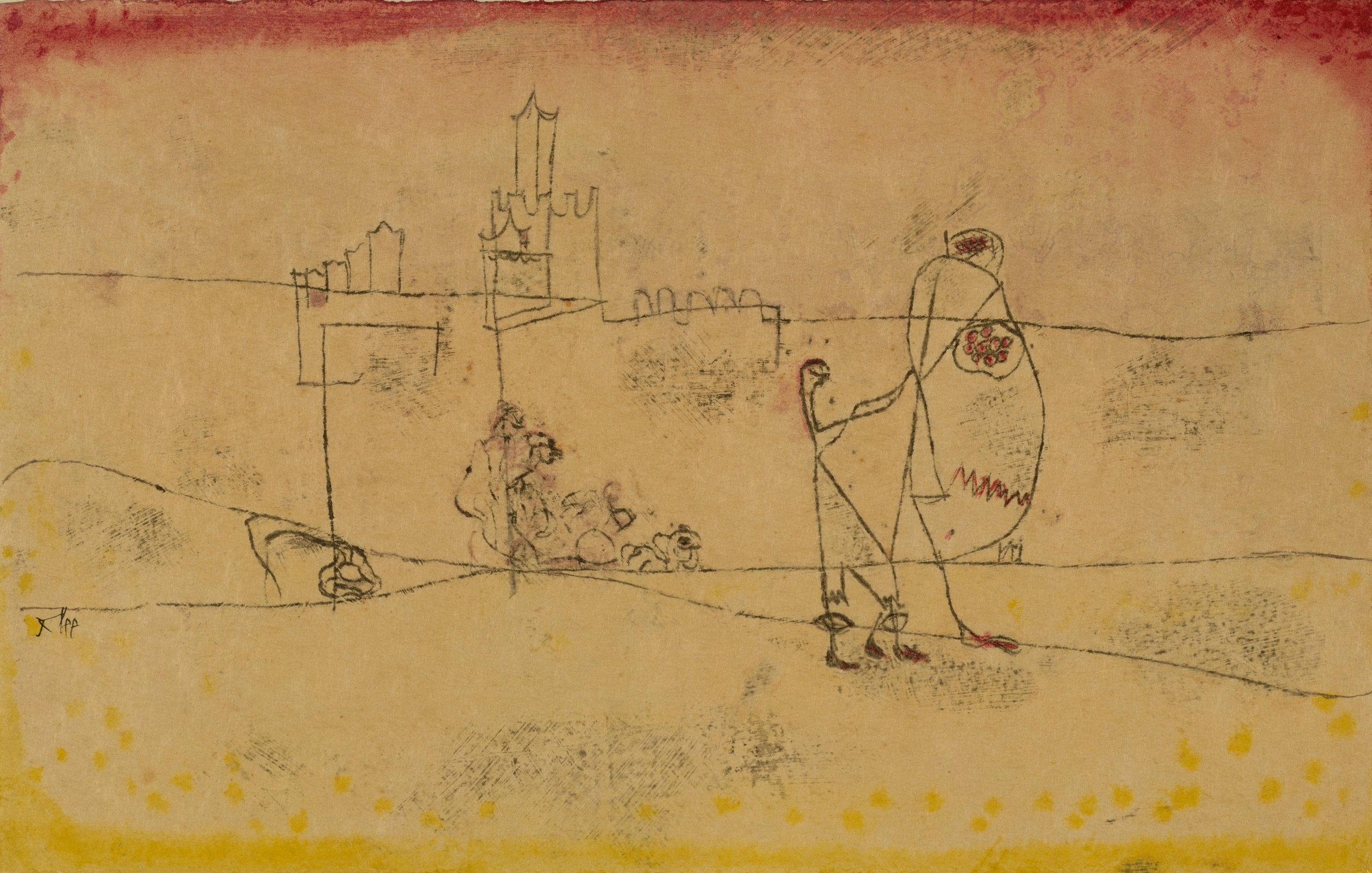
Episode at Kairouan is a work by Paul Klee from 1920: a fine dark line on warm, sand-coloured paper draws a walled town with towers, a tall veiled figure carrying a large round bundle and a smaller figure beside it, between a red wash at the top and a band of yellow dots at the bottom. The original is a small drawing with watercolour on paper, just 23.5 x 31.4 cm, held by The Metropolitan Museum of Art in New York. Our painter paints it for you by hand on canvas, in oil or acrylic, in 8 landscape sizes from 45 x 30 to 200 x 130 cm or made to measure. You see a photograph of the finished painting before it leaves us.
| Title: | Episode at Kairouan |
| Other titles: | Szene aus Kairouan · Scene aus Kairuan (Klee’s inscription) |
| Painter: | Paul Klee (1879–1940) |
| Year painted: | 1920 |
| Original size: | 23.5 cm x 31.4 cm (height x width) |
| Original technique: | Drawing and watercolour on paper |
| Painting style: | Modernism |
| Located at: | The Metropolitan Museum of Art, New York, USA |
| Our reproduction: | Hand-painted in oil or acrylic on canvas, 8 sizes or made to measure |
Episode at Kairouan – Paul Klee
What does Episode at Kairouan show?
Most of the sheet is bare, warm paper the colour of sand. A long, gently waving horizon crosses it, and above it, on the left, a town rises behind a wall: crenellated towers, one tall tower with pointed tips and a row of arches in the wall, like an arcade.
On the right stands the tallest figure, wrapped in a long robe with its head covered. It carries a large round bundle dotted with red, and a red zigzag runs across the robe. Beside it a smaller, thin figure raises an arm, as if holding on.
In the middle, along a lower ground line, a group of people sits with animals, sketched with rounded outlines. On the left, behind a rise, a horse or a donkey is half hidden. Grey hatching is scattered over the paper, a red wash tints the top edge and yellow dots run along the bottom.
What does the scene mean?
The title comes from Klee’s own handwritten inscription, Scene aus Kairuan, a scene from Kairouan, with the numbers 1920 and 35. Kairouan is a city in Tunisia that Klee visited in April 1914 on his journey with August Macke and Louis Moilliet. So the drawing was made six years later, as a memory of that trip.
Who the people are, Klee did not write down: travellers or townsfolk outside the wall, animals and loads, nothing more. The rest is left to the viewer, which with Klee is often the point.
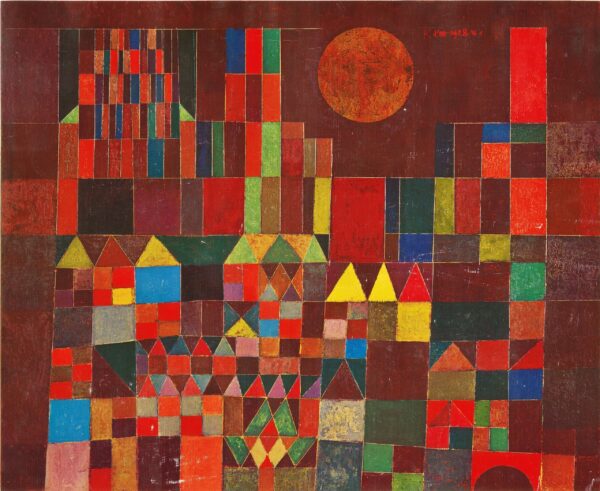
The Tunisian journey was his artistic breakthrough, because the light there led him to colour. Back home he painted a work in the style of Kairouan, built from coloured rectangles and a few circles, which English Wikipedia calls his first pure abstract. In 1920 he returned to the city with a fine line and only a little colour.
Why does this drawing hold the eye?
Klee was a superb draughtsman, and in Tunisia he added colour to his drawing. Here both share one sheet: the line carries the story, and the red and yellow bands wrap around it like morning or evening light.
Klee played the violin from childhood, and the poet Rilke wrote that his drawings seemed like transcriptions of music. Here the long ground lines flow like a melody, and the towers and figures stand on them like notes.
To learn more about the painter, born in 1879 in Münchenbuchsee near Bern, read the Paul Klee article on English Wikipedia. It is in English and covers the artist, since this drawing has no article of its own.
Where is the original kept, and how big is it?
The original is in The Metropolitan Museum of Art in New York, accession number 1984.315.17. It is a drawing with a watercolour wash on paper, which the museum gives as 23.5 x 31.4 cm (height x width).
Klee made it in 1920, a year before he began teaching at the Bauhaus in January 1921, where he stayed until April 1931 beside Wassily Kandinsky. When he died in 1940 he left more than 9,000 works, many of them on paper.
Episode at Kairouan or another Klee?
This canvas painting suits anyone who loves a quiet, airy wall: warm open space, a fine line and just two bands of colour.
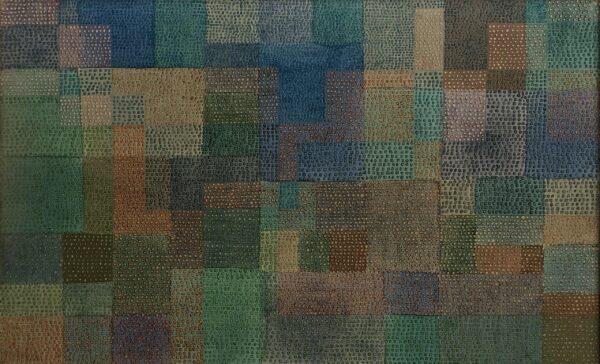
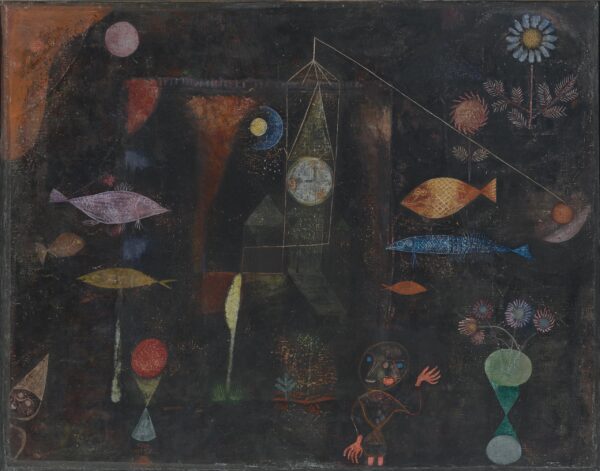
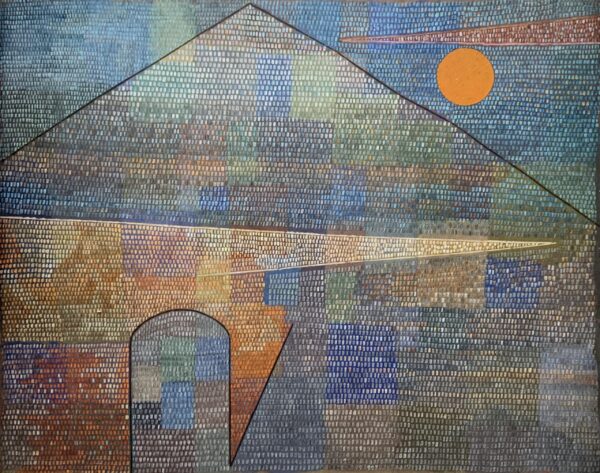
From the same Tunisian journey come two watercolours full of colour: Hammamet with Its Mosque, with its minaret and pink fields, and St. Germain near Tunis, with violet mountains and bright garden plots. For a darker, denser mood, look at Swamp Legend from 1919, and for a really big wall there is Polyphony from 1932, covered in thousands of dots.
Every one of the famous Paul Klee paintings in our range waits on the Paul Klee page.
How do we hand-paint the drawing on canvas?
To be plain: Klee’s original is not an oil but a small drawing with a little watercolour on paper. Ours is an oil painting reproduction on canvas, worked in oil or acrylic in the size you choose, so it hangs like any other painted work.
The painter first lays down the warm sand tone of the ground and darkens it here and there with grey hatching. Then, with a fine brush, he draws the horizon, the wall, the towers and the two figures, keeping the stroke light, the way Klee’s is.
Colour comes last: the red wash at the top, the yellow dots at the bottom and small red accents on the bundle and robe, all kept thin and translucent like watercolour.
Which size suits which wall?
In short: 45 x 30 or 60 x 38 cm for a shelf, a bedside table or a narrow hallway, 70 x 44 and 90 x 55 cm above a bed or a chest of drawers, 110 x 72 and 130 x 80 cm above a sofa, and 165 x 100 or 200 x 130 cm for a long empty wall.
We paint Episode at Kairouan in 8 landscape sizes (width x height): 45 x 30, 60 x 38, 70 x 44, 90 x 55, 110 x 72, 130 x 80, 165 x 100 and 200 x 130 cm. The original sheet measures 31.4 x 23.5 cm (width x height), so even our smallest size is larger, and at 200 x 130 cm the scene is more than six times as wide as in New York.
The drawing leaves a lot of open space, so enlarging it works well: the fine lines become readable from across the room. As a painting for the living room it looks its best at 130 x 80 or 165 x 100 cm above a sofa.
Can I order another size or a frame?
Of course. For other proportions we keep the town, the figures and both colour bands whole and only lengthen or shorten the warm ground at the edges; with so much bare paper, the change barely shows. Tell us the size you have in mind and you will get a price and a date.
It can travel to you rolled, on a stretcher bar or in a frame. Stretching and framing happen in our workshop in Slovenia, which also packs each painting for the road. The frame is chosen in our 3D app, a tool for picking the moulding and nothing else; a view of the painting on your own wall is a separate service.
A narrow black or dark brown frame suits the dark line, natural oak the sand tone.
When will the painting arrive?
The painter starts once you confirm the order, and within 15 to 45 working days the painting is ready to ship. First we send you a photograph of it, and make any change you ask for.
Deliveries within Slovenia and the rest of the EU carry no customs duties, and all orders are covered by our returns policy.
Episode at Kairouan makes a lovely present for anyone who has been to Tunisia or loves to travel. Unsure of the size? Give a gift voucher.
Frequently asked questions
Where is the original drawing?
At The Metropolitan Museum of Art in New York, under accession number 1984.315.17.
What is drawn on the sheet?
A walled town with towers, a tall veiled figure with a round bundle, a smaller figure, a group with animals and a horse or donkey.
Will I get a print?
No, it is a hand-painted copy on canvas, which the painter works with a brush in oil or acrylic.
How big is Klee’s original?
It measures 23.5 x 31.4 cm (height x width); our sizes go up to 200 x 130 cm.
Is a size off the list possible?
Yes, send us the width and height and we will answer with a price and a production time.
How many days will I wait?
Making it takes 15 to 45 working days, and before dispatch you receive a photograph of the finished painting.
Would it work in a bedroom or as a gift?
Yes, the calm warm tones belong in a bedroom, and travellers enjoy it as a gift.
Who are the people in the drawing?
Klee did not say; the inscription only calls it a scene from Kairouan, a memory of his 1914 trip.
- Subject: a walled town with towers, a tall veiled figure with a round bundle and a group with animals between a red and a yellow band of colour.
- Original: drawing with watercolour on paper, 1920, 23.5 x 31.4 cm, The Metropolitan Museum of Art, New York.
- Ours: a Paul Klee reproduction painted by hand in oil or acrylic on canvas, 8 landscape sizes from 45 x 30 to 200 x 130 cm, or made to measure.
- Worth knowing: drawn six years after his visit to Kairouan, a year before his Bauhaus years began.