Description
Comedians’ Handbill is a painting by Paul Klee from 1938: on a cream ground framed by a painted ochre border, thick black signs crowd together like the letters of an unknown alphabet, and among them appear a clown’s head in a pointed hat, a face turned upside down and acrobats with bent arms and legs. The original is gouache on newsprint mounted on cardboard, 54.6 cm high and 36.2 cm wide, and it belongs to The Metropolitan Museum of Art in New York. Our painter paints it for you by hand on canvas, in oil or acrylic, in 8 upright sizes from 30 x 45 to 128 x 191 cm or made to measure. Before the handbill leaves us, you get a photograph of your finished painting.
| Title: | Comedians’ Handbill |
| Other titles: | Komödianten-Handzettel (German translation of the title) · Volantino dei commedianti (Italian title) |
| Painter: | Paul Klee (1879–1940) |
| Year painted: | 1938 |
| Original size: | 54.6 cm x 36.2 cm (height x width) |
| Original technique: | Gouache on newsprint mounted on cardboard |
| Painting style: | Modernism |
| Located at: | The Metropolitan Museum of Art, New York, USA |
| Our reproduction: | Hand-painted in oil or acrylic on canvas, 8 sizes or made to measure |
Comedians’ Handbill – Paul Klee
What does Comedians’ Handbill show?
A warm cream covers the tall sheet inside a painted ochre band, like the edge of an old poster. Thick black brushstrokes spread over the whole surface; some recall letters such as T, K or R, others hooks, arches and broken lines, yet none adds up to a readable word.
Once your eye settles, figures surface among the signs. On the left stands a clown’s head with a white pointed hat and a pink face, above a goblet-shaped vessel. In the middle a large face with a white nose wears a wide curving stroke like a moustache; near the bottom another face peers out upside down, and acrobats twist all around.
A white circle at the top could be a sun or a wheel; touches of white and pale pink light up faces and hands, and Klee’s small grey signature sits at the upper right.
What lies behind the title?
A handbill is the sheet a travelling troupe hands out or pastes on walls before it reaches town. Klee’s sheet feels like one, except that instead of names and dates it offers signs among which the clown and the acrobats are already performing.
There is no single agreed reading, so it is fairest to describe what is there: signs that are half writing, half body. Find one face and you soon spot a second, then a third.
Theatre was no stranger to Klee: as a young man he wrote concert and theatre reviews besides playing the violin in an orchestra, and between 1916 and 1925 he made hand puppets for his son Felix.
Why do people love this work?
Comedians’ Handbill belongs to Klee’s late period. At the end of 1933 the family left Germany for Switzerland, and Klee spent his last years in Bern, where he had grown up. English Wikipedia notes that from 1938 he worked more with hieroglyph-like elements, heavier lines and fewer, larger blocks of colour.
That is what you see here: black strokes as broad as beams and hardly any colour. Yet the sheet feels cheerful, because Klee builds the clown, the faces and the tumblers out of the same signs; parody and wit stayed with him all his life.
In 1938 alone he produced 489 works, although illness was already troubling him.
For more about the painter himself, rather than this painting, read the Wikipedia article on Paul Klee, written in English.
Where is the original kept, and how big is it?
The original belongs to The Metropolitan Museum of Art in New York, where it carries accession number 1984.315.57. The Met acquired the handbill in 1984 with The Berggruen Klee Collection.
The sheet measures 54.6 x 36.2 cm (height x width). Klee did not paint it on canvas but in gouache, an opaque watercolour, on newsprint mounted on cardboard.
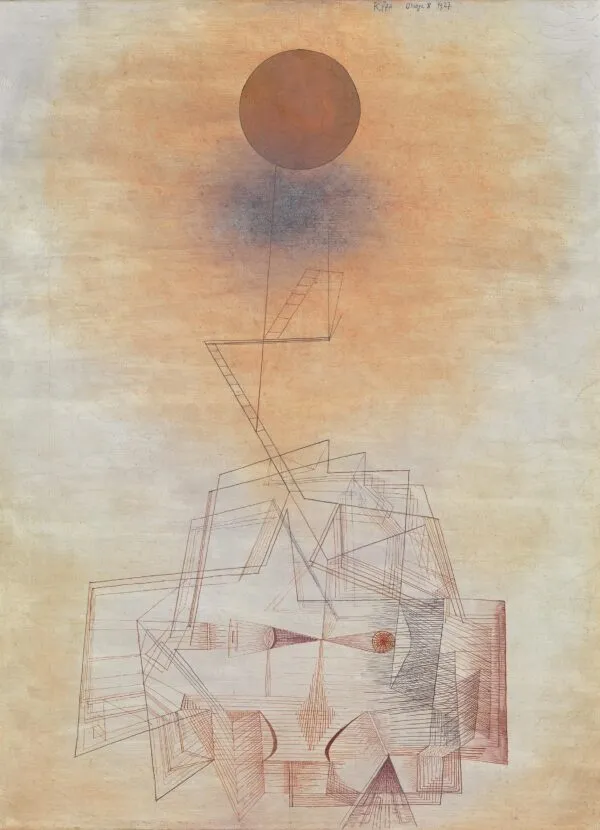
From his final years also comes The Hour Before One Night (1940), where thick black signs form a scaffold around fields of red, blue and grey.
Comedians’ Handbill or another Klee?
Comedians’ Handbill is a canvas painting for anyone who likes bold black strokes and a touch of humour on the wall. Its tall, narrow format suits the space between two windows or a hallway.
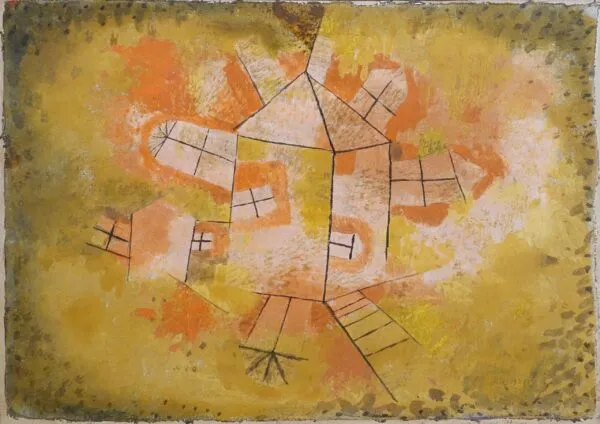
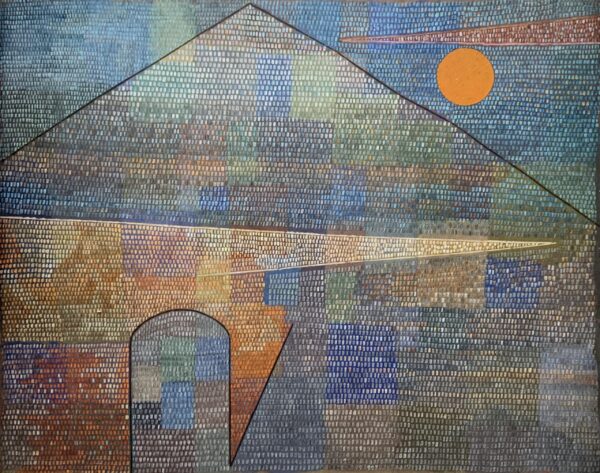
If Klee’s late black line appeals to you, look at Girl in Mourning from 1939, a gentle girl resting her face on her hand. More playful are two works from 1923: The Barbed Noose with the Mice, where four tiny mice run around a knotted ribbon, and Episode Before an Arab Town, with the fine lines of a walled town.
The famous Paul Klee paintings we offer are gathered on our Paul Klee page, where you can compare colours and formats.
How do we hand-paint Comedians’ Handbill on canvas?
The original is gouache on newsprint, a sheet of paper rather than a painting on canvas. Ours is an oil painting reproduction worked in oil or acrylic in the size you choose, so it hangs like any other painting.
The painter first draws in every sign so the faces, hat and goblet keep their places, then lays in the cream ground and ochre border, and only then pulls the black strokes with a broad brush.
Last come the white and pink touches on faces and hands, while the quick strokes of the cream ground stay visible. The result is a hand-painted copy of the handbill, sent rolled or stretched.
Which size suits which wall?
In short: 30 x 45 or 38 x 55 cm for a narrow wall, a shelf or a hallway, 42 x 65 and 57 x 82 cm for a bedroom or a work corner, 70 x 110 and 81 x 120 cm above a chest of drawers or a sofa, and 100 x 155 or 128 x 191 cm for a tall wall beside the stairs.
We paint it in 8 upright sizes (width x height): 30 x 45, 38 x 55, 42 x 65, 57 x 82, 70 x 110, 81 x 120, 100 x 155 and 128 x 191 cm. The original measures 36.2 x 54.6 cm (width x height): the smaller sizes stay close to its scale, the larger ones enlarge the sheet, and at 128 x 191 cm the handbill is about three and a half times as tall as it is in New York.
As a painting for the living room it is most convincing at 81 x 120 or 100 x 155 cm, where the cream ground stays warm and the black strokes hold the room together. The smaller sizes are a cheerful choice for a child’s room or a kitchen.
Can I order a different size or a frame?
Yes. For other proportions we keep every sign and figure whole and adjust only the ochre border and the cream ground. Send us the measurements you want and we will reply with a price and a delivery time.
The handbill reaches you rolled, stretched on a stretcher bar or framed, with the stretching and framing done in our workshop in Slovenia. Pick the moulding for the clown and his troupe in our 3D app, which serves only to choose a frame; viewing the painting on your own wall is a separate service.
A slim black frame that echoes the strokes suits the cream and ochre, as does warm natural wood.
When will my painting arrive?
The painter starts once you confirm the order, and the handbill is ready to ship within 15 to 45 working days. Before it leaves, a photograph of your finished painting reaches you, and any change you ask for is made.
Orders within Slovenia and to the rest of the EU travel without customs duties, and every order is covered by our returns policy.
This clown and his acrobats make a cheerful present for anyone who loves theatre, the circus or modern art; if you cannot guess the size, a wall art voucher lets them choose.
Frequently asked questions
Where is the original today?
At The Metropolitan Museum of Art in New York, under accession number 1984.315.57.
What is painted on the sheet?
Thick black signs like an unknown script, with a clown in a pointed hat, an upside-down face and acrobats among them.
Will I get a print?
No. Our painter works your painting with brushes on canvas, in oil or acrylic.
How large is the original sheet?
It measures 54.6 x 36.2 cm (height x width); our sizes go up to 128 x 191 cm.
Is a size outside the list possible?
Yes. Send us the width and height you have in mind and we reply with an offer.
How long will I wait for my painting?
Between 15 and 45 working days, with a photograph of the finished handbill before it ships.
Does it suit a child’s room or make a good gift?
Yes. The clown and acrobats are cheerful, and as a gift it delights anyone who loves theatre and modern art.
What do the black signs mean?
There is no single reading; some recall letters, others join up into the faces and bodies of performers.
- Subject: thick black signs on a cream ground with an ochre border, among them a clown, an upside-down face and acrobats.
- Original: gouache on newsprint mounted on cardboard, 1938, 54.6 x 36.2 cm, The Metropolitan Museum of Art, New York.
- Ours: a Paul Klee reproduction painted by hand in oil or acrylic on canvas, 8 upright sizes from 30 x 45 to 128 x 191 cm, or made to measure.
- Worth knowing: the work comes from Klee’s late period in Bern, when he often worked with hieroglyph-like signs.