Description
Cliffs by the Sea is a painting by Paul Klee from 1931, made of thousands of small square dabs of colour set in rows like a mosaic: a rose sky, a dark horizon, a blue and violet sea and a row of tall red, coral and orange shapes rising like cliffs or flames. The original, in oil and coloured paste, measures 44 x 62 cm and belongs to the Städtische Galerie im Lenbachhaus in Munich. Our painter paints it for you by hand on canvas, in oil or acrylic, in 4 landscape sizes from 101 x 74 to 190 x 130 cm or made to measure. You receive a photograph of the finished painting before we send it.
| Title: | Cliffs by the Sea |
| Other titles: | Klippen am Meer (German title) · Scogliere sul mare (Italian title) |
| Painter: | Paul Klee (1879–1940) |
| Year painted: | 1931 |
| Original size: | 44 cm x 62 cm (height x width) |
| Original technique: | Oil and coloured paste |
| Painting style: | Modernism |
| Located at: | Städtische Galerie im Lenbachhaus, Munich, Germany |
| Our reproduction: | Hand-painted in oil or acrylic on canvas, 4 sizes or made to measure |
Cliffs by the Sea – Paul Klee
What does Cliffs by the Sea show?
Look closely and the whole surface turns out to be made of tiny squares of paint. Klee set them in rows, one beside the next, and left a thin margin of pale ground around each, so the picture reads like a mosaic or a piece of woven cloth.
The top quarter is a warm band of rose, brick red and dusky brown. It may be the evening sky or a far shore; Klee does not say which. Beneath it runs a line of near-black dabs that marks the horizon.
Then comes the sea, a wide strip of blues and violets flecked with green and turquoise, growing lighter towards the bottom where the water meets the land. Out of it rises a row of tall, pointed forms in red, coral and orange. These are the cliffs of the title, though they flicker like flames as well. Along the bottom lies a shore of ochre, orange, grey and brown squares, and Klee’s signature is tucked in low down at the right edge.
What story lies behind the painting?
The title is all Klee gave us: cliffs and the sea. No particular coast is named, so read it as a landscape in strips rather than a portrait of one place.
He painted it in 1931, the year he left the Bauhaus, where he had taught since January 1921 beside Wassily Kandinsky, and moved to the Düsseldorf Academy. He stayed there until 1933.
In those Düsseldorf years he made a group of works built from small dabs of colour. The best known is Ad Parnassum of 1932, which the English Wikipedia article on Klee calls his masterpiece and the finest example of his pointillist style. Cliffs by the Sea was made the same way, a year earlier.
Why do people love this painting?
From across a room it shimmers. The thousands of squares never quite blend, so the colours vibrate against one another the way light does on water.
It is also an unusually cheerful Klee: festive coral, orange and rose against a deep, clear blue, with no figures or lettering to decode.
The painting has no Wikipedia article of its own; the article on Paul Klee, in English and about the painter, covers his life and his Bauhaus and Düsseldorf years.
Where is the original kept?
The original belongs to the Städtische Galerie im Lenbachhaus in Munich, where it is listed under inventory number AK 18.
Klee worked it in oil and coloured paste; it measures 44 x 62 cm (height x width), a modest format for the wall above a sofa.
The same gallery owns Botanical Theater of 1934, a dark stage of invented plants drawn in fine lines.
Six years after this painting, in 1937, the Nazis hung seventeen of Klee’s pictures in the “Degenerate art” exhibition and took 102 of his works out of public collections.
Cliffs by the Sea or another Klee?
Choose Cliffs by the Sea if you want colour and calm in one canvas painting: a horizon that steadies the room and a surface that changes with every shift of light.
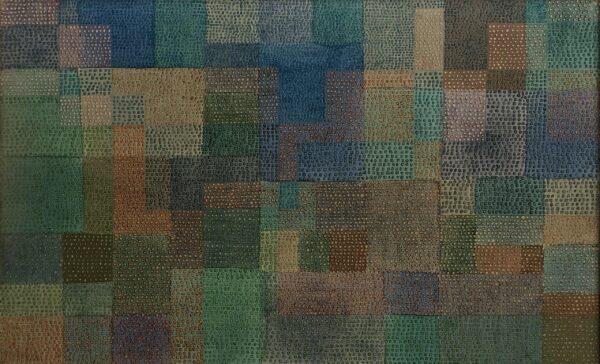
If the small squares draw you, see Town with the Three Domes of 1914, a town stacked from little squares and triangles that glow like stained glass. It dates from the year Klee travelled to Tunisia with August Macke and Louis Moilliet, the journey that opened colour to him. The same year produced the moodier On a Motif from Hammamet, whose title names a town on the Tunisian coast.
For wit rather than scenery, pick Seventeen, Insane of 1923, where a top hat, eyes, arrows and the number 17 float over a cloudy ground.
Ad Parnassum and the other famous Paul Klee paintings we paint to order are all on our Paul Klee page.
How do we hand-paint Cliffs by the Sea?
Klee’s original is a 44 x 62 cm work in oil and coloured paste. Ours is a hand-painted copy on canvas, worked in oil or acrylic in the size you choose, so it hangs like any painting on a stretcher.
The painter first lays in the broad bands: the rose sky, the dark horizon, the blue sea, the outlines of the cliffs and the ochre shore. Over these he sets the squares row by row, each in its own colour, leaving a narrow seam of pale ground between them as Klee did.
The work grows patiently, layer by layer. Within each band the colour shifts from square to square, a violet among the blues, a green fleck in the sea, and the painter keeps these small changes, because they make the surface sparkle.
The result is an oil painting reproduction, or an acrylic one if you prefer, with brushwork you can see and feel.
Which size suits which wall?
In short: 101 x 74 cm above a sideboard or a bed, 130 x 90 cm above a sofa, and 150 x 102 or 190 x 130 cm for a large wall that needs one strong piece.
We paint Cliffs by the Sea in 4 landscape sizes (width x height): 101 x 74, 130 x 90, 150 x 102 and 190 x 130 cm. The original measures 62 x 44 cm (width x height), so every size enlarges it: at 101 x 74 cm it is about one and a half times as wide, at 190 x 130 cm about three times.
We start at 101 x 74 cm on purpose. The picture is made of thousands of small dabs, and at a smaller width they would shrink to specks and the mosaic would blur.
As a painting for the living room it is at its best at 150 x 102 or 190 x 130 cm over a long sofa, where the warm reds and the blue band of sea can hold a big wall.
Can I have a custom size or a frame?
Yes. If your wall needs other proportions, we keep the horizon, the sea and the row of cliffs whole and stretch or trim only the bands of sky and shore. Send us your measurements and we will reply with a price and a delivery time.
It ships rolled, stretched on a stretcher bar or framed, and our workshop in Slovenia does the stretching and framing.
You pick the frame in our 3D app, which is only for choosing the moulding; a view of the painting on your own wall is a separate service.
When will my painting arrive?
The painter starts as soon as you confirm your order, and Cliffs by the Sea is ready to ship in 15 to 45 working days. You get a photograph of the finished work before it leaves, and any change you ask for is made.
Within Slovenia and the EU there are no customs charges, and our returns policy covers every order.
A warm seascape makes a fine wedding or housewarming present. If you are unsure about size, a gift voucher lets them choose.
Frequently asked questions
Which museum owns the original?
The Städtische Galerie im Lenbachhaus in Munich, inventory number AK 18.
What exactly is in the picture?
A coast seen in bands: a rosy sky, a dark horizon, a blue sea and a row of red and orange cliffs, all made of small square dabs.
Do I get a print?
No. Your Paul Klee reproduction is painted with a brush on canvas, in oil or acrylic, by our painter.
How large is the original compared with your sizes?
The original is 44 x 62 cm; our sizes run from 101 x 74 to 190 x 130 cm, because the small dabs need room.
Is a size outside your list possible?
Yes. Send us the width and height, and we will quote a price and a making time.
How soon will it be with me?
Making takes 15 to 45 working days, then it ships; you see a photograph before it leaves.
Would this seascape suit a bedroom, or make a good gift?
Yes. Its warm, calm colours suit a bedroom, and a painted coast is a present most people welcome.
Does the painting have a hidden meaning?
The title speaks of cliffs and the sea; the red shapes can also be read as flames.
- Subject: a coast in bands of tiny square dabs: rosy sky, dark horizon, blue sea, red and orange cliffs.
- Original: oil and coloured paste, 1931, 44 x 62 cm, Städtische Galerie im Lenbachhaus, Munich.
- Ours: painted by hand in oil or acrylic on canvas, 4 sizes from 101 x 74 to 190 x 130 cm, or made to measure.
- Worth knowing: painted in 1931, when Klee moved from the Bauhaus to the Düsseldorf Academy.