







































Description
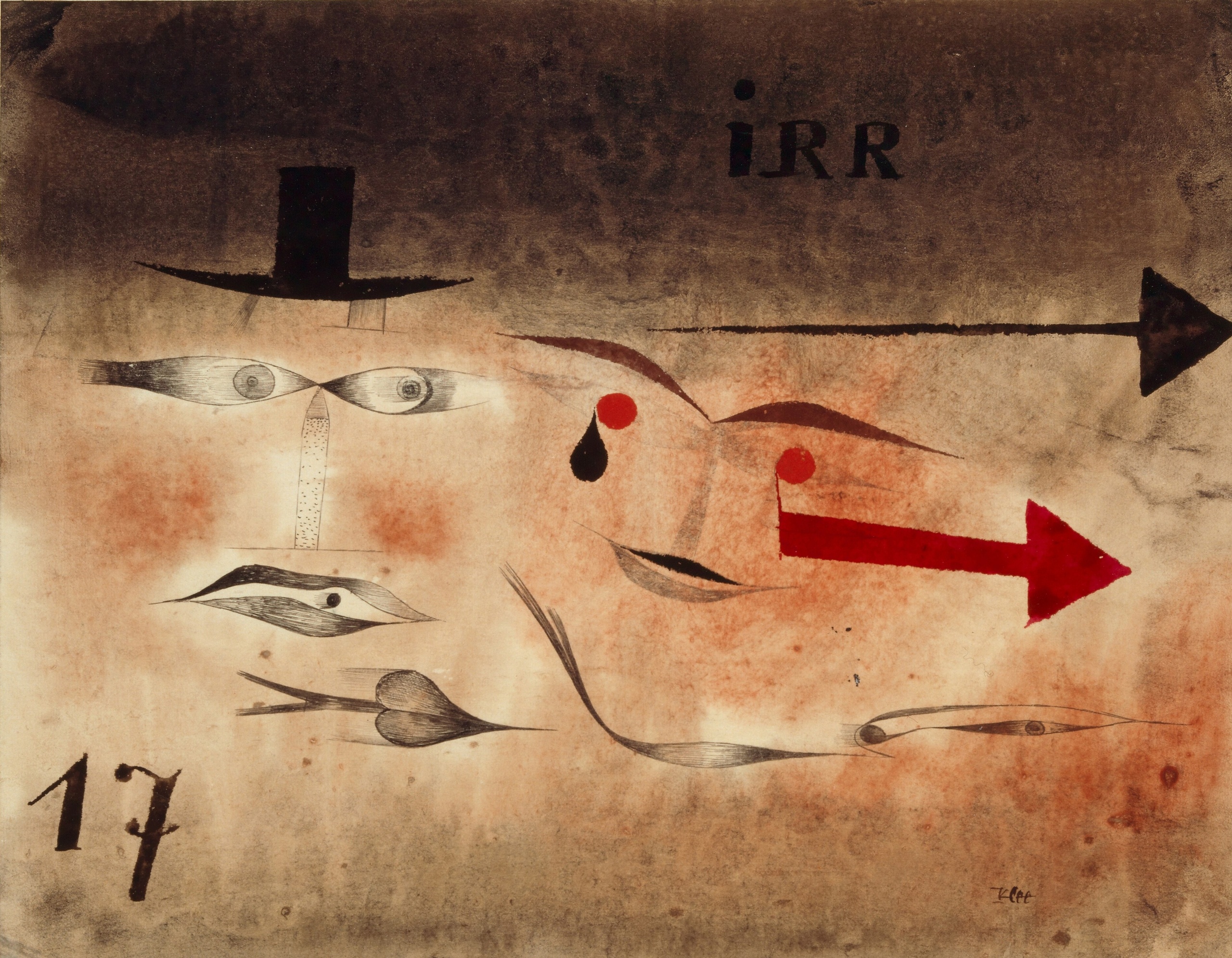
Seventeen, Insane is a pen and watercolour sheet by Paul Klee from 1923: on a warm, cloudy ground float a black top hat, fish-shaped eyes, a thin nose, lips, a little heart and feathery strokes, as if a face had come apart. A black arrow and a red one point right, the number 17 stands at the lower left and the letters irr at the top. The original, only 22.3 x 28.6 cm, belongs to the Kunstmuseum Basel. Our painter paints it by hand on canvas in oil or acrylic, in 8 landscape sizes from 40 x 30 to 200 x 159 cm or made to measure, and we send you a photograph of the finished painting before dispatch.
| Title: | Seventeen, Insane |
| Other titles: | Siebzehn, irr (German title) · Diciassette, folle (Italian title) |
| Painter: | Paul Klee (1879–1940) |
| Year painted: | 1923 |
| Original size: | 22.3 cm x 28.6 cm (height x width) |
| Original technique: | Pen and watercolour on paper on cardboard |
| Painting style: | Modernism |
| Located at: | Kunstmuseum Basel, Basel, Switzerland |
| Our reproduction: | Hand-painted in oil or acrylic on canvas, 8 sizes or made to measure |
Seventeen, Insane – Paul Klee
What does Seventeen, Insane show?
The ground is watercolour that spreads like clouds, dark as coffee at the top, peach in the middle, pale rose and sand below. Over it Klee drew the parts of a face with a fine pen, and each part drifts on its own.
At the upper left sits a black top hat with a wide, pointed brim. Below it two fish-shaped eyes touch at one point, and a thin dotted nose runs down from there. Lower down lies an eye shaped like a mouth, and near the bottom a small heart on a stalk. The right half holds two brown brows, two red dots with a black drop, a mouth with a dark slit and long feathery strokes.
Two arrows point right: a long black one under the top edge and a thick red one in the middle. The 17 is brushed in black at the lower left, the printed letters irr stand at the top, and Klee’s tiny signature sits at the lower right.
Why are a number and a word written on the sheet?
Klee wrote the title straight into the work: anyone standing in front of it reads the 17 and the word irr. Why seventeen in particular the sheet does not say, and our sources do not explain it either, so we do not invent a meaning.
English Wikipedia notes that Klee often put letters and numbers into his works, frequently together with playful figures of people and animals, and that many of his works and their titles reflect his dry humour. On this sheet lettering, numeral and drawing are equal partners.
What you see is a face taken apart: the top hat belongs to a gentleman, while eyes, nose and mouth lie scattered as if shaken out of a box. Klee left no note on how to reassemble them, so every viewer finds a face of their own.
Why does this sheet amuse so many people?
Because it is witty without raising its voice: a few fine lines, two arrows and two red dots tell a whole story.
A violinist since boyhood, Klee drew in a way Rilke compared to written-down music, and here the shapes do return like motifs in a tune: fish eye, feathery stroke, arrow, another eye.
For more on the artist, read the Paul Klee article on English Wikipedia; it is in English and is about the painter, not this particular work.
Where is the original kept, and what size is it?
The original belongs to the Kunstmuseum Basel in Switzerland (inventory number 1960.59). Klee made it in 1923, during his years at the Bauhaus, where he taught from January 1921 to April 1931, much of that time alongside Wassily Kandinsky.
The sheet is small: 22.3 x 28.6 cm (height x width), barely larger than a school exercise book, worked in pen and watercolour on paper mounted on cardboard. Klee liked such modest supports, which is why so many of his works are smaller than people expect.
Seventeen, Insane or another Klee?
Seventeen, Insane is a canvas painting for lovers of humour rather than landscapes or portraits. Its shapes spread across the full width, so it suits a landscape-format wall above a desk or along a hallway, where guests stop to hunt for the eyes.
Two colourful works of 1914 come from the same museum in Basel: Town with the Three Domes, squares and triangles glowing like stained glass, and On a Motif from Hammamet, violet and blue patches with a flash of red. For Klee’s mischievous side, see Oh! These Rumors! from 1939, odd creatures leaning together as if gossiping, and for a cheerful corner The Vase, with yellow blossoms on coarse jute.
All the famous Paul Klee paintings we paint to order, from early watercolours to late work from Bern, are on our Paul Klee page.
How do we hand-paint Seventeen, Insane on canvas?
Klee’s original is a small sheet in pen and watercolour, mounted on cardboard. Ours is painted by hand on canvas in oil or acrylic, in the size you choose; in oil it becomes a true oil painting reproduction that hangs like any other painting.
First the painter lays in the cloudy ground in thin, translucent layers, from sepia down to peach and rose, keeping the soft watercolour transitions. Once it is dry, he draws the eyes, nose, lips and feathery strokes with a fine brush, then adds the top hat, the arrows, the red dots, the 17 and the letters.
Which size suits your wall?
In short: 40 x 30 or 50 x 38 cm for a shelf or a narrow strip of wall, 65 x 49 and 80 x 63 cm above a desk or a chest of drawers, 100 x 79 cm above a sofa, and 125 x 99, 160 x 123 or 200 x 159 cm for a large empty wall.
We paint Seventeen, Insane in 8 landscape sizes (width x height): 40 x 30, 50 x 38, 65 x 49, 80 x 63, 100 x 79, 125 x 99, 160 x 123 and 200 x 159 cm. The original measures just 28.6 x 22.3 cm (width x height), so every one of our sizes enlarges the sheet, the largest almost seven times. The warm empty space lets the arrows and eyes breathe at any size.
As a painting for the living room it works best at 100 x 79 or 125 x 99 cm above the sofa, where conversation soon turns to the mysterious seventeen.
Can I order another size or a frame?
Of course. If you need different proportions, we widen or narrow the ground, while the top hat, the eyes, the arrows and the 17 stay whole and in place. Tell us the size you have in mind, and a price and a date come back to you.
The painting reaches you rolled, stretched on a stretcher bar or ready framed. Our workshop in Slovenia does the stretching and framing and packs each piece safely for the journey. The frame is chosen in our 3D app, which handles the moulding choice only; a view of the painting on your own wall is a separate service. A slim dark frame suits the sepia tones.
When will your painting arrive?
Your confirmation sets the painter to work, and the finished painting is ready to ship within 15 to 45 working days. Before packing we send you a photograph of the finished painting, and if you would like a change, we make it.
Within Slovenia and to the other EU countries we ship with no customs duties, and every order is covered by our returns policy.
It makes a clever present for a seventeenth birthday or a friend with a sense of humour; if you are unsure of the wall, give a gift voucher and let them choose.
Frequently asked questions
Where is the original?
At the Kunstmuseum Basel in Switzerland, under inventory number 1960.59.
What exactly is drawn on the sheet?
A black top hat, fish-shaped eyes, a nose, lips, a heart shape, a black and a red arrow, the number 17 and the letters irr on a warm ground.
Is it a print?
No. You receive a hand-painted copy, worked by our painter with brushes on canvas, in oil or acrylic.
What are the dimensions of the original?
22.3 x 28.6 cm (height x width); our sizes go up to 200 x 159 cm.
Are sizes outside the list possible?
Yes. Tell us how much room your wall offers and we will prepare an offer for exactly that size.
How long will I wait for the painting?
From 15 to 45 working days, and before dispatch you also get a photograph of the finished piece.
Does it suit a bedroom, or is it better as a gift?
It shows best in a living area, an office or a hallway, where people notice it; as a gift it delights anyone with a sense of humour.
Why do the 17 and the word irr appear on it?
Because they are the words of the title, which Klee wrote straight into the work; why seventeen in particular is explained nowhere.
- Subject: a face in pieces: top hat, fish-shaped eyes, lips, two arrows, the number 17 and the letters irr on a warm ground.
- Original: pen and watercolour on paper on cardboard, 1923, 22.3 x 28.6 cm, Kunstmuseum Basel.
- Ours: a Paul Klee reproduction painted by hand in oil or acrylic on canvas, 8 sizes from 40 x 30 to 200 x 159 cm, or made to measure.
- Worth knowing: Klee made it during his Bauhaus years, and the title is written on the sheet itself.