







































Description
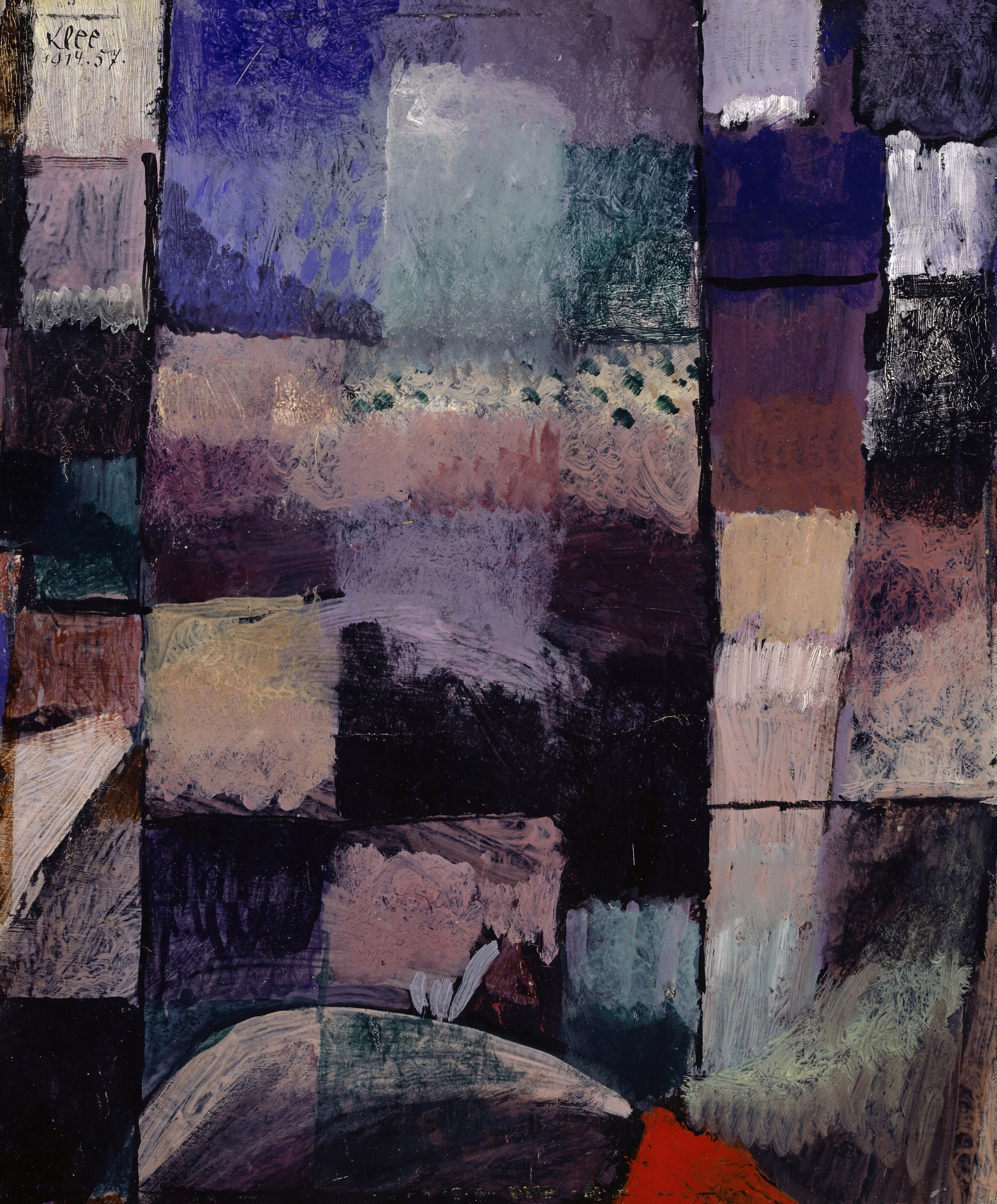
On a Motif from Hammamet is a painting by Paul Klee from 1914: broad, loosely brushed blocks of violet, deep blue, grey-blue, mauve, cream and near-black are stacked like a wall of patches or the stones of a town, dark upright bars stand at both sides, a grey-green form curves along the bottom, and a flash of red lights up the lower right corner. The original is a small oil on cardboard, only 26.9 cm tall, and it belongs to the Kunstmuseum Basel. Our painter transfers it by hand onto canvas for you, in oil or acrylic, in 8 upright sizes from 36 x 43 to 152 x 193 cm or made to measure. You get a photograph of the finished canvas before it is packed.
| Title: | On a Motif from Hammamet |
| Other titles: | Über ein Motiv aus Hammamet (German title) · Su un motivo di Hammamet (Italian title) |
| Painter: | Paul Klee (1879–1940) |
| Year painted: | 1914 |
| Original size: | 26.9 cm x 22.2 cm (height x width) |
| Original technique: | Oil on cardboard |
| Painting style: | Modernism |
| Located at: | Kunstmuseum Basel, Basel, Switzerland |
| Our reproduction: | Hand-painted in oil or acrylic on canvas, 8 sizes or made to measure |
On a Motif from Hammamet – Paul Klee
What does On a Motif from Hammamet show?
The surface is built from rectangular patches of colour, laid down with a quick brush whose marks stay visible. Violet alternates with deep blue, grey-blue, mauve and cream, with near-black fields lying in between. The patches are piled one above another like stones in a wall or like the houses of a town seen from far off.
On the left and right, two dark vertical bars run from top to bottom, much like door jambs or the frame of a window. Between them a central strip opens up where the colours weave together most densely. Towards the top the light thins into a pale, misty glow, as if morning were breaking through humid air.
Right at the bottom a rounded grey-green form arches across, which you can read as a dome or as a hill. Just beside it, in the lower right corner, a sharp patch of red burns, the only truly warm note in a cool palette. At the top left Klee wrote his name and the year 1914 on a pale field.
What does the title mean, and where does the motif come from?
The title names Hammamet, a town on the Tunisian coast. Nothing in the painting describes the place literally: no streets, no people, no lettering.
In April 1914 Klee spent twelve days in Tunisia with the painters August Macke and Louis Moilliet. English Wikipedia says the quality of the light there struck him, and that afterwards he wrote that colour had taken hold of him for good and that he was now a painter.
The method you see here grew out of that time: he divided the landscape into a grid so that it dissolves into a harmony of colour. The coloured rectangle became his basic building block, and some scholars compare it to a musical note.
Why does this painting hold the eye?
Most people picture Tunisia in blazing, sunny colours. Here, though, Klee chose muted violets and blues, as though he saw the town at dusk. That surprise keeps drawing the eye back, and the red patch feels all the stronger because everything around it is cool.
The strokes are loose and fast, and lower layers show through in places. The work feels less like a ruled plan than a note of the moment when the painter found out what colour alone can do.
For more on his life, see the Wikipedia article on Paul Klee. It is in English and covers the painter, since this work has no article of its own.
Where is the original kept, and how big is it?
The original belongs to the Kunstmuseum Basel in Switzerland, where it is recorded under inventory number 2258. It is painted in oil on cardboard and measures 26.9 x 22.2 cm (height x width), roughly the size of a sheet of paper.
Klee liked humble supports such as cardboard, paper or gauze, which is why so many of his works are small. Later, from 1921 to 1931, he taught at the Bauhaus alongside Wassily Kandinsky; he died in 1940.
On a Motif from Hammamet or another Klee?
This is a canvas painting for people who like quiet and deep colour, at home in a study or a bedroom.
If a simple object appeals to you more than a landscape, look at The Vase. Anyone longing for coast and water should open Cliffs by the Sea, plant lovers will enjoy Botanical Theater, and for a smile there is Oh! These Rumors!.
The whole range, from small heads to large grids of colour, is on our Paul Klee page, which gathers the famous Paul Klee paintings you can order from us.
How do we hand-paint this work on canvas?
Klee painted the original in oil on a small piece of cardboard. Ours is an oil painting reproduction on canvas: the painter works in oil or acrylic, in the size you choose, so the tiny board grows into a piece for a real wall that hangs like any other painting.
First he divides the canvas into a grid of fields and sets down the dark side bars and the arc of the grey-green form at the bottom. Then, layer by layer, he lays in the violet, blue and cream areas and lets the brushwork show, just as it shows on the board in Basel.
Thin glazes give the pale light at the top; the red patch in the corner goes on last, so it stays the freshest note.
Which size suits which wall?
In short: 36 x 43 or 46 x 55 cm for a shelf, a hallway or the wall by a door, 54 x 65 and 68 x 85 cm above a chest of drawers, a desk or a bed, 89 x 105 and 97 x 122 cm above the sofa, and 124 x 150 or 152 x 193 cm for a tall empty wall or a stairwell.
We paint the work in 8 upright sizes (width x height): 36 x 43, 46 x 55, 54 x 65, 68 x 85, 89 x 105, 97 x 122, 124 x 150 and 152 x 193 cm. The original measures 22.2 x 26.9 cm (width x height), so every one of our sizes enlarges it; at 152 x 193 cm it is about seven times as wide as in Basel. The broad, loose strokes take enlargement well.
As a painting for the living room it looks best at 89 x 105 or 97 x 122 cm, where the dark blues give the room depth.
Can I have a different size or a frame?
Yes. If you need other proportions, we adapt the work so that the dark side bars, the form at the bottom and the red patch keep their places while the grid of fields widens or narrows. Tell us the size you have in mind and you will get a price and a date from us.
It travels to you rolled, stretched on a stretcher bar or already in its frame. Our workshop in Slovenia stretches it and, if you wish, frames it before it sets off. You pick the moulding in a 3D app made for that alone; seeing the painting on your own wall is a separate service.
A slim dark walnut frame or a black moulding suits the cool violets.
When will the painting reach you?
Once you confirm, the painter sets to work, and the painting is ready to ship within 15 to 45 working days. A photograph of the finished painting reaches you before it ships, and any change you ask for is made.
Parcels inside Slovenia and across the EU pay no customs charges, and our returns policy covers every order.
This dark yet warm work makes a lovely present for a friend who has travelled the Mediterranean or anyone fond of modern art. Unsure of the size? A wall art voucher lets them choose.
Frequently asked questions
Which museum holds the original?
The Kunstmuseum Basel in Switzerland, under inventory number 2258.
What is in the picture?
A grid of violet, blue, cream and dark fields between two dark bars, with a grey-green arc at the bottom and a red patch in the corner.
Will I receive a print?
No. You receive a hand-painted copy that our painter works with brushes on canvas, in oil or acrylic.
How small is the original?
The board measures 26.9 x 22.2 cm (height x width); our sizes go up to 152 x 193 cm.
Can I order a size that is not listed?
Yes. Send us the width and height you need and we will prepare an offer.
How long will I wait for the painting?
Making it takes 15 to 45 working days, and before dispatch we send you a photograph.
Would it work in a bedroom, or as a gift for someone?
Yes. The calm dark tones settle a bedroom, and as a present it pleases people who love modern art and travel.
What is Hammamet?
A town on the Tunisian coast; Klee names it in the title of a work from the year of his trip to Tunisia.
- Subject: a grid of violet, blue, grey and cream fields between dark bars, with a grey-green arc and a red patch at the bottom.
- Original: oil on cardboard, 1914, 26.9 x 22.2 cm, Kunstmuseum Basel.
- Ours: a Paul Klee reproduction painted by hand in oil or acrylic on canvas, 8 sizes from 36 x 43 to 152 x 193 cm, or made to measure.
- Worth knowing: the work dates from the year Klee travelled to Tunisia and discovered the power of colour.