







































Description
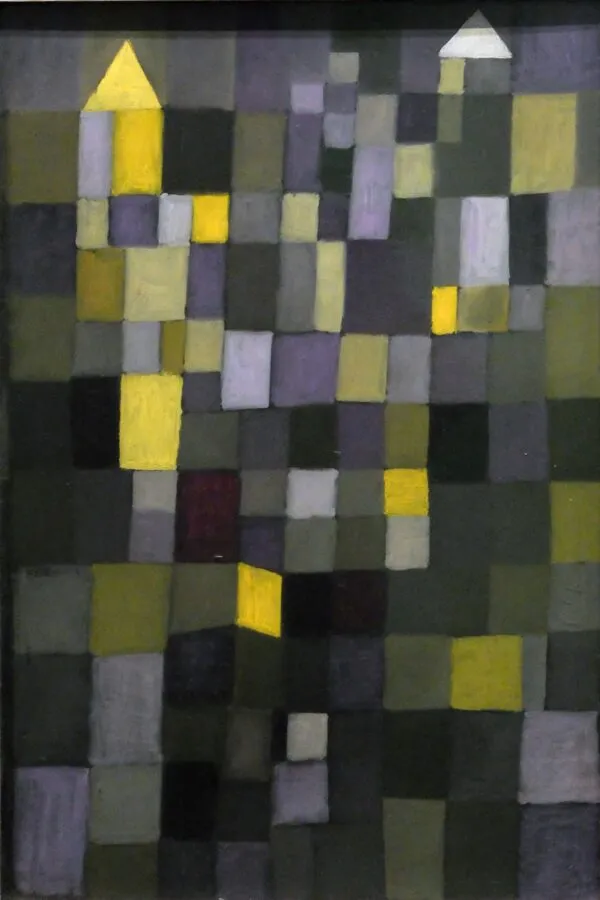
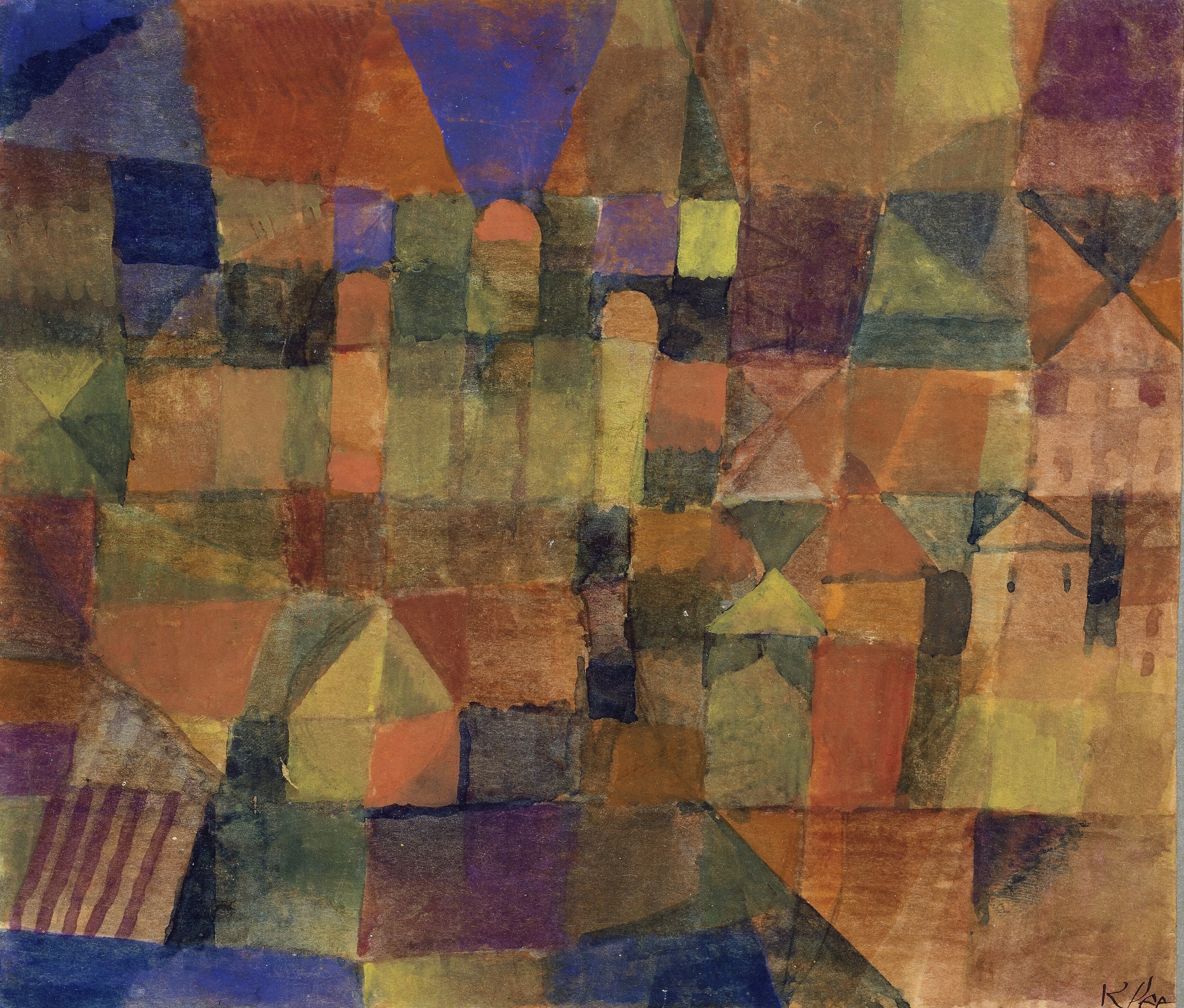
Town with the Three Domes is a painting by Paul Klee from 1914: a town built of small squares and triangles of transparent colour in ochre, orange, olive, violet and deep blue, with three rounded domes rising in its upper half and colours that glow like stained glass. The original is a tiny sheet in watercolour and gouache on paper, just 16.5 x 18.5 cm, and it belongs to the Kunstmuseum Basel in Switzerland. Our painter paints it for you by hand on canvas, in oil or acrylic, in 8 landscape sizes from 40 x 33 to 190 x 156 cm or made to measure. Before it leaves us, you see your finished town in a photograph.
| Title: | Town with the Three Domes |
| Other titles: | Stadt mit den drei Kuppeln (German title) · Città con le tre cupole (Italian title) |
| Painter: | Paul Klee (1879–1940) |
| Year painted: | 1914 |
| Original size: | 16.5 cm x 18.5 cm (height x width) |
| Original technique: | Watercolour and gouache on paper |
| Painting style: | Modernism |
| Located at: | Kunstmuseum Basel, Basel, Switzerland |
| Our reproduction: | Hand-painted in oil or acrylic on canvas, 8 sizes or made to measure |
Town with the Three Domes – Paul Klee
What does Town with the Three Domes show?
At first glance you see a dense mosaic of coloured planes. Squares, rectangles and triangles pile up like the houses, roofs and walls of a town climbing from the bottom edge towards the top. Because Klee worked in watercolour, the colours are transparent: ochre, orange, olive green, violet and deep blue overlap in places into new, darker tones.
In the upper half three rounded forms rise up, and we read them as domes. They have orange and light brown arched tops. Above them a deep blue wedge opens like a scrap of sky between the roofs.
At the lower left some planes are crossed by vertical violet stripes, like an awning or a fence, and a dark blue band runs along the bottom edge, closing the composition. On the right stand pink and orange houses with small dark windows and crossing lines.
What does the title tell us?
The title is Klee’s own and says exactly what we see: a town with three domes standing over it. It does not say which town, and no particular building can be recognised on the sheet.
The work dates from 1914, the year Klee travelled to Tunisia with August Macke and Louis Moilliet, a trip that brought his breakthrough in colour. Our sources do not say whether this town has anything to do with that journey, so we make no such claim.
So the meaning lies in the looking. The eye jumps from warm ochre to cool blue, from a pale triangle to a dark square, and out of that movement comes the sense of a living town.
Why does this small town hold the eye?
The transparent layers of watercolour give the planes a glow like church windows: the colour seems lit from behind, and the soft edges let the mosaic almost breathe.
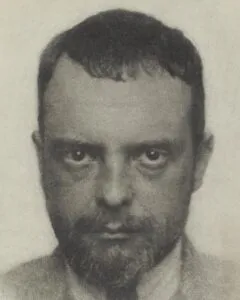
As early as 1911 and 1912 Klee belonged to the Blue Rider circle around Kandinsky and Franz Marc. He was born in 1879 in Münchenbuchsee near Bern, the son of a German music teacher and a Swiss singer.
He played the violin from childhood, in an orchestra too, and Rilke wrote that his drawings seemed like transcriptions of music; on this sheet the planes really do follow one another like bars, short and long, light and dark.
For more on his life, see the English Wikipedia article on Paul Klee, which is about the painter rather than this particular work.
Where is the original kept?
The original belongs to the Kunstmuseum Basel in Switzerland, where it is listed as Im 1301. It is watercolour and gouache on paper, and the museum gives its size as 16.5 x 18.5 cm (height x width).
After 1914 Klee taught at the Bauhaus from January 1921 to April 1931, then at the Düsseldorf Academy. When the Nazis staged the “Degenerate art” exhibition in 1937, seventeen of his works were in it, and 102 of his works were seized from public collections. He died in 1940, and this little sheet is one of more than 9,000 works he left.
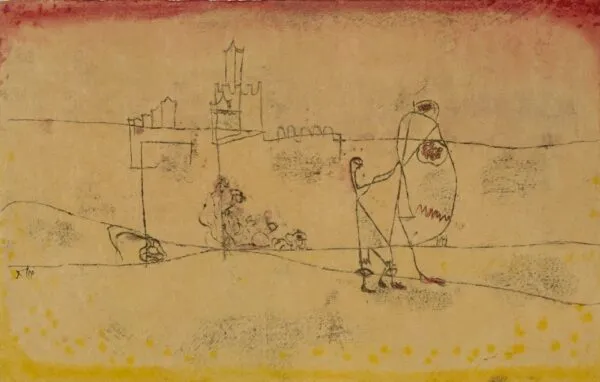
From the same year comes On a Motif from Hammamet, a small oil on cardboard whose title names Hammamet, a town on the Tunisian coast.
Town with the Three Domes or another Klee?
Town with the Three Domes is a canvas painting for anyone who loves colour more than story. The composition is wide and evenly filled, so it sits well above a long low sideboard, over a dining table or along a hallway wall.
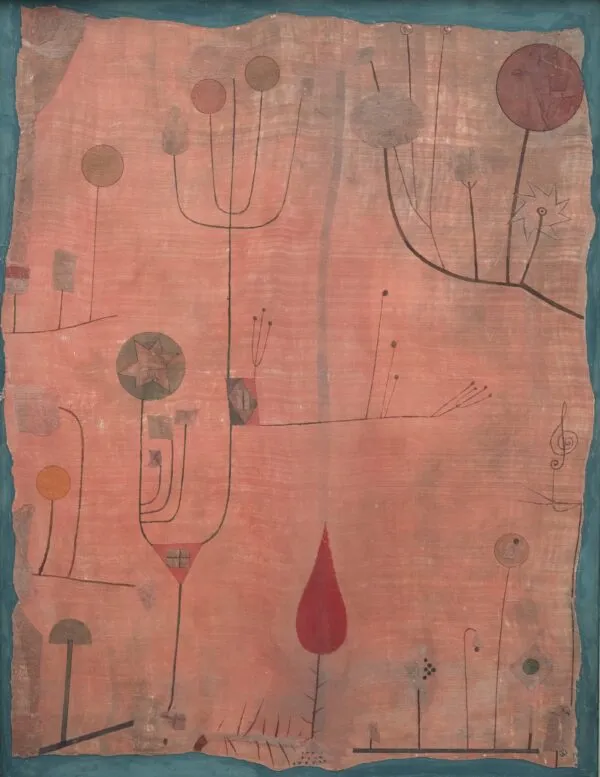
If you want more sea and light, look at Cliffs by the Sea from 1931, built from tiny dabs of colour like a mosaic. For humour there is the late Oh! These Rumors!, with odd creatures leaning towards each other as if trading gossip, while The Vase brings cheer with its yellow blossoms on coarse jute.
All the famous Paul Klee paintings we paint to order, from small watercolours to late works, are gathered on our Paul Klee page.
How do we hand-paint Town with the Three Domes on canvas?
The original is watercolour and gouache on a small sheet of paper about 17 x 19 cm. Ours is an oil painting reproduction on canvas: the painter works in oil or acrylic, in the size you choose, so it hangs on your wall as a true painting rather than a framed sheet.
First he divides the canvas with fine lines into a network of planes, because the domes, the triangles and the stripes at the lower left must sit in the right place. Then he lays on the paint in thin, transparent glazes, layer by layer, so the tones overlap at their edges as they do in watercolour.
Last come the dark accents, the blue band along the bottom and Klee’s signature.
Which size suits your wall?
In short: 40 x 33 or 50 x 42 cm for a narrow wall, a shelf or a work corner, 65 x 53 and 80 x 68 cm above a chest of drawers or a bed, 90 x 78 and 115 x 100 cm above a sofa, and 150 x 122 or 190 x 156 cm for a large empty wall.
We paint the work in 8 landscape sizes (width x height): 40 x 33, 50 x 42, 65 x 53, 80 x 68, 90 x 78, 115 x 100, 150 x 122 and 190 x 156 cm. The original is only 18.5 cm wide, so even our smallest size more than doubles it, and at 190 x 156 cm the town is about ten times as wide as it is in Basel.
As a painting for the living room it looks best at 115 x 100 or 150 x 122 cm, where the ochre and orange warm the room and the blue accents calm it.
Can I order another size or a frame?
Yes. If your wall calls for other proportions, we widen or narrow the network of planes a little, while the domes stay whole and in place. Send us the size you have in mind for this town, and a price and date come back to you.
The town travels to you rolled, stretched on a stretcher bar or ready framed; our workshop in Slovenia stretches, frames and packs it. The frame is chosen in our 3D app, which handles the moulding alone; a view of the painting on your own wall is a separate service.
When and how does the painting arrive?
From your confirmation, the painter needs 15 to 45 working days before the town is ready to ship. Before packing we send you a photograph of the finished work, and if you would like anything changed, we change it.
No customs duties apply within Slovenia or anywhere else in the EU, and our returns policy covers this order like any other.
This colourful town makes a lovely present for a house move or a friend who loves to travel. Unsure of their wall? A wall art voucher lets them pick the size of their own town.
Frequently asked questions
Which museum holds the original?
The Kunstmuseum Basel in Switzerland, under inventory number Im 1301.
What exactly can I see in the painting?
Coloured squares and triangles forming a town, with three rounded domes above.
Is it a print?
No. It is a hand-painted copy, worked stroke by stroke in oil or acrylic on canvas.
How big is the original sheet?
Only 16.5 x 18.5 cm (height x width); our sizes go up to 190 x 156 cm.
Could my town come in a size you do not list?
Yes. Give us the width and height, and an offer with price and finishing date follows.
How long will I wait?
From 15 to 45 working days; before dispatch you see the finished painting in a photograph.
Is this Klee right for a bedroom or as a present?
Yes. The warm, quiet colours suit a bedroom well, and as a gift it pleases anyone who likes modern art.
Is the town a real place?
The title names no place and no known building can be recognised on the sheet, so it cannot be pinned to a map.
- Subject: a town of transparent squares and triangles in ochre, orange, olive, violet and blue, with three domes.
- Original: watercolour and gouache on paper, 1914, 16.5 x 18.5 cm, Kunstmuseum Basel.
- Ours: a Paul Klee reproduction painted by hand in oil or acrylic on canvas, 8 sizes from 40 x 33 to 190 x 156 cm, or made to measure.
- Worth knowing: the work dates from 1914, the year Klee travelled to Tunisia and found his way to colour.