







































Description
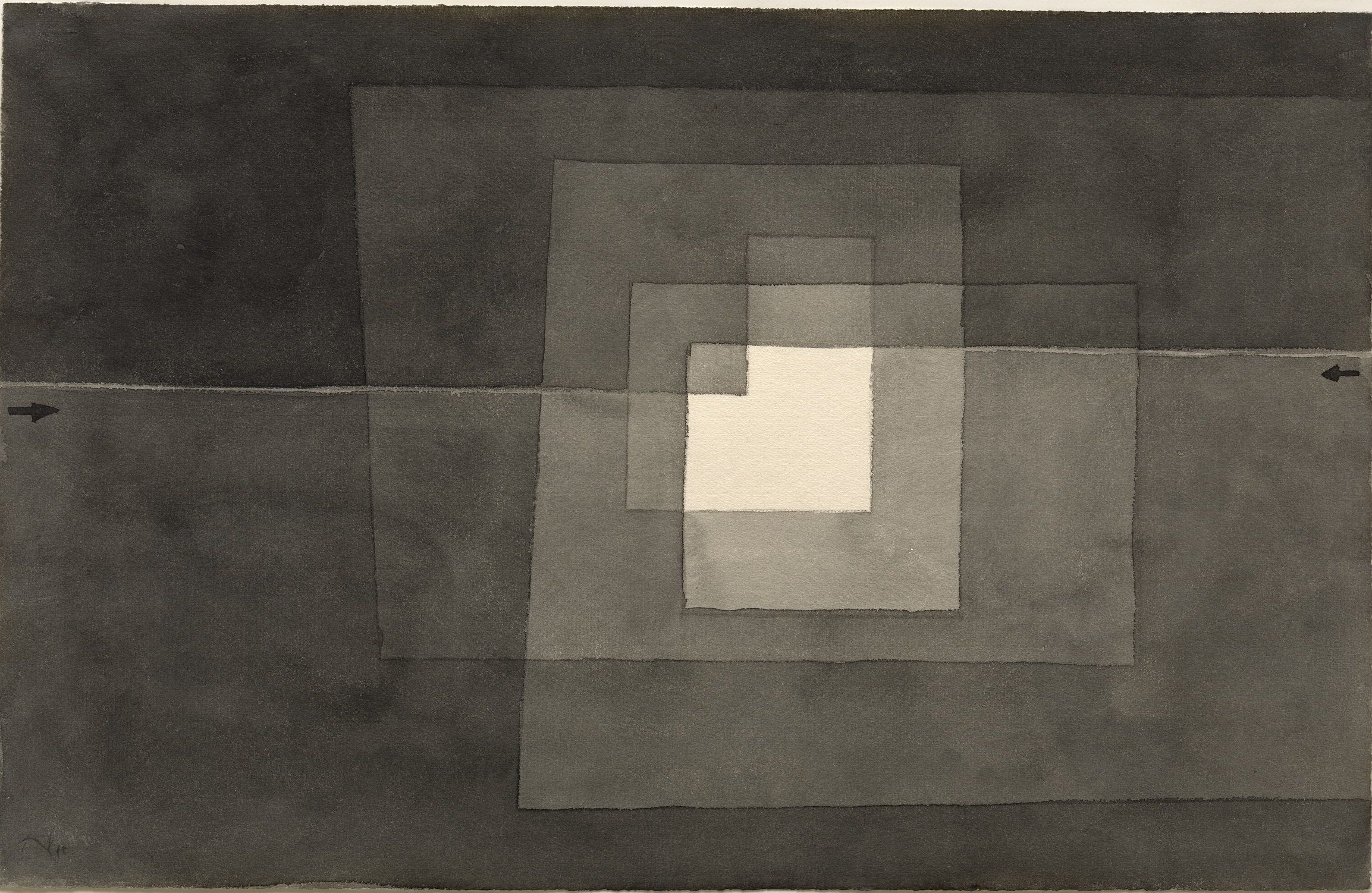
Two Ways is a painting by Paul Klee from 1932: grey rectangles stacked one over another grow lighter from almost black edges towards a small glowing square in the middle, while a thin horizontal line crosses the sheet with a tiny black arrow at each end, the two pointing towards each other. The original is a watercolour on paper of about 44 x 61 cm, held by the Solomon R. Guggenheim Museum in New York. Our painter paints it for you by hand on canvas, in oil or acrylic, in 8 landscape sizes from 45 x 30 to 180 x 120 cm or made to measure. Before the grey rectangles set off to you, we send a photograph of the finished work.
| Title: | Two Ways |
| Other titles: | Zwei Gänge · Due vie |
| Painter: | Paul Klee (1879–1940) |
| Year painted: | 1932 |
| Original size: | 44.3 cm x 61 cm (height x width) |
| Original technique: | Watercolour on paper |
| Painting style: | Modernism |
| Located at: | Solomon R. Guggenheim Museum, New York, USA |
| Our reproduction: | Hand-painted in oil or acrylic on canvas, 8 sizes or made to measure |
Two Ways – Paul Klee
What does Two Ways show?
The whole sheet is built from grey rectangles laid over one another. At the edges the grey is close to black; towards the centre each new layer lifts the tone a little, until the eye reaches a small cream-white square that glows like a lit window in a dark house. The rectangles lean or shift slightly, and where they overlap, new in-between greys appear.
A thin pale line runs across the middle. It is not quite straight, because the left half sits a little lower than the right, and the two halves meet at the white square. On the left edge a small black arrow points right; on the right edge another points left, so both lead inwards.
Klee’s small signature sits in the lower left corner. With no figures or objects, the sheet feels as still as the floor plan of rooms opening into one another.
What does the title Two Ways mean?
The title points most clearly to the two arrows: one way comes in from the left, the other from the right, and both end at the same bright square.
Our sources give no confirmed reading, and we will not invent one. You can see the rectangles as rooms or corridors opening towards the light, and the arrows as two people walking towards each other, or simply enjoy a play of greys and lines.
Why does this watercolour calm a room so well?
Because it barely needs colour. Everything happens between dark grey and light grey, and that restraint is its strength.
The work looks remarkably present-day, yet it was made in 1932. Klee painted it during the years he taught at the Düsseldorf Academy, where he had moved from the Bauhaus in 1931.
A Swiss-born German artist, Klee played the violin from childhood, in an orchestra as well, and Rilke likened his drawings to transcriptions of music; here the greys rise like quiet chords.
This watercolour has no Wikipedia article of its own; for more about the painter, read the Wikipedia article on Paul Klee, which is in English.
Where is the original kept?
The original belongs to the Solomon R. Guggenheim Museum in New York, under inventory number 48.1172.139. It is a watercolour on paper; the museum gives 44.3 x 61 cm (height x width), including the mount the sheet is fixed to.
Klee mostly worked in small formats and often on paper. His colours and papers are sensitive to light, so such works need rest periods and are shown only now and then.
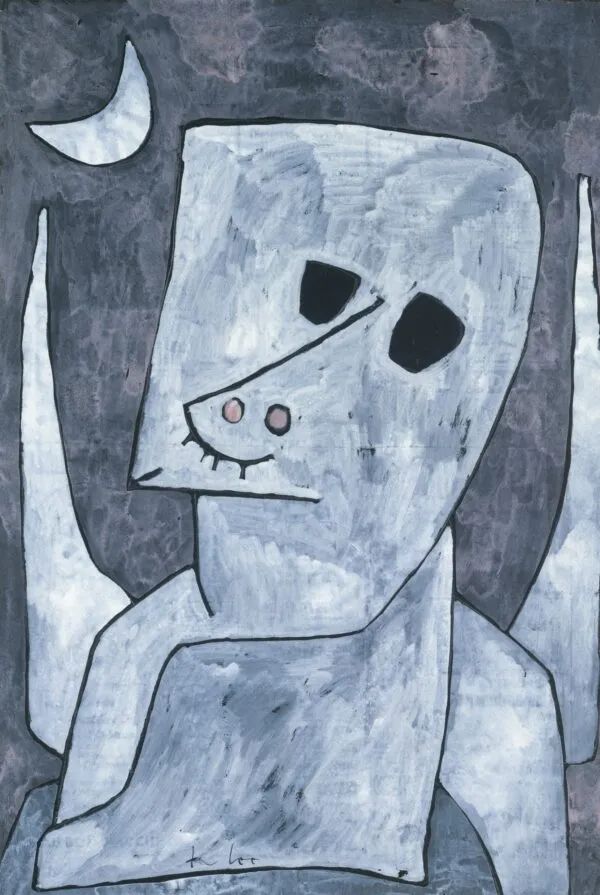
The same museum holds an angel from 1931, drawn with a single thin line; you can order it from us as In Angel’s Care.
In 1933 the Nazis dismissed Klee from the Düsseldorf Academy; late that year he moved with his family to Switzerland, where he died in 1940.
Two Ways or another Klee?
Two Ways is a canvas painting for people who like order, quiet and clear shapes; its greys get along with almost any interior.
If you like the arrows, look at Nearly Hit, where a grey arrow whizzes just over a comic head’s hat. For warm colour and signs of an unknown script, choose Inscription from 1926, and for a strong blue wall there is Rocks at Night from 1939.
All the famous Paul Klee paintings we offer, from quiet grey watercolours to the late angels, are waiting on our Paul Klee page.
How do we hand-paint Two Ways on canvas?
The original is not an oil but a watercolour on paper, about 44 x 61 cm. We turn it into an oil painting reproduction on canvas: the painter works in oil or acrylic, in the size you choose, so it hangs like any stretched canvas, without glass.
He first marks the rectangles, so that the pale square sits a little right of centre, then builds the greys from the outside in, layer by layer. In watercolour, washes laid over each other darken by themselves; on canvas the painter mixes every in-between tone separately, so the transitions stay soft and slightly translucent. Last of all he draws the fine line and adds the two tiny arrows.
Which size suits which wall?
In short: 45 x 30, 60 x 38 or 70 x 44 cm for a hallway, a desk or a narrow wall, 76 x 51 and 99 x 65 cm above a chest of drawers or a bed, 125 x 85 and 140 x 95 cm above a sofa, and 180 x 120 cm for a large, calm wall at home or in an office.
We paint Two Ways in 8 landscape sizes (width x height): 45 x 30, 60 x 38, 70 x 44, 76 x 51, 99 x 65, 125 x 85, 140 x 95 and 180 x 120 cm. The original is about 61 x 44 cm (width x height). Our two smallest sizes are therefore a little smaller than the sheet, while from 70 x 44 cm upwards our paintings enlarge it; at 180 x 120 cm it is nearly three times as wide as in New York.
The fields are large and calm, so enlargement suits the composition. As a painting for the living room it works best at 125 x 85 or 140 x 95 cm above the sofa, where the bright square becomes the centre of the room. Smaller sizes suit a bedroom or a work corner.
Can I order another size or a frame?
Yes. If you need different proportions, we keep the bright square and the rectangles around it whole and lengthen or shorten only the dark border. Send us the measurements of your wall space, and we will come back with a price and a delivery date.
Two Ways can travel rolled, already stretched on a stretcher bar, or framed. Stretching and framing are done by our workshop in Slovenia, which readies every one of our paintings for the road. The moulding that will hold the greys is chosen in our 3D app, used only to pick the frame; viewing the painting on your own wall is a separate service. A slim black or graphite frame suits it well.
How soon will the painting arrive?
Once you confirm the order, the painter starts laying the greys onto canvas, and the painting is ready to ship within 15 to 45 working days. Before dispatch we send you a photograph of the finished painting; if you want a tone lighter or darker, we adjust it.
Parcels to Slovenia and the other EU countries travel without customs duties, and Two Ways is covered by our returns policy like every order.
A calm grey painting is a thoughtful gift for a new home, an office or anyone who loves architecture and clean lines. If their wall is a mystery to you, give a wall art voucher so they can choose the size themselves.
Frequently asked questions
Where can I see the original of Two Ways?
At the Solomon R. Guggenheim Museum in New York, no. 48.1172.139; works on paper are not always on show, so check before you go.
What is painted on it?
Grey rectangles that lighten towards a white square in the centre, and a thin line with two arrows.
Will I receive a print?
No. This is a hand-painted copy, brushed onto canvas in oil or acrylic.
How big is the museum’s watercolour?
The museum gives 44.3 x 61 cm (height x width) including the mount; our sizes go up to 180 x 120 cm.
Can I have Two Ways in a size you do not list?
Of course: send us the width and height, and we will reply with a price and a making time.
How long until the painting is ready?
From 15 to 45 working days, and before shipping we show you a photograph of the finished work.
Does it suit a bedroom or an office?
Yes. The greys and the bright centre have a calming effect, in a bedroom, an office or a waiting room.
What do the two arrows mean?
Our sources record no meaning; you see two directions meeting at the bright centre, and the reading is left to you.
- Subject: layers of grey rectangles around a bright square, a thin horizontal line and two opposing arrows.
- Original: watercolour on paper, 1932, 44.3 x 61 cm with its mount, Solomon R. Guggenheim Museum, New York.
- Ours: a Paul Klee reproduction hand-painted in oil or acrylic on canvas, 8 landscape sizes from 45 x 30 to 180 x 120 cm, or made to measure.
- Worth knowing: Klee made it in the years he taught at the Düsseldorf Academy, 1931 to 1933.