







































Description
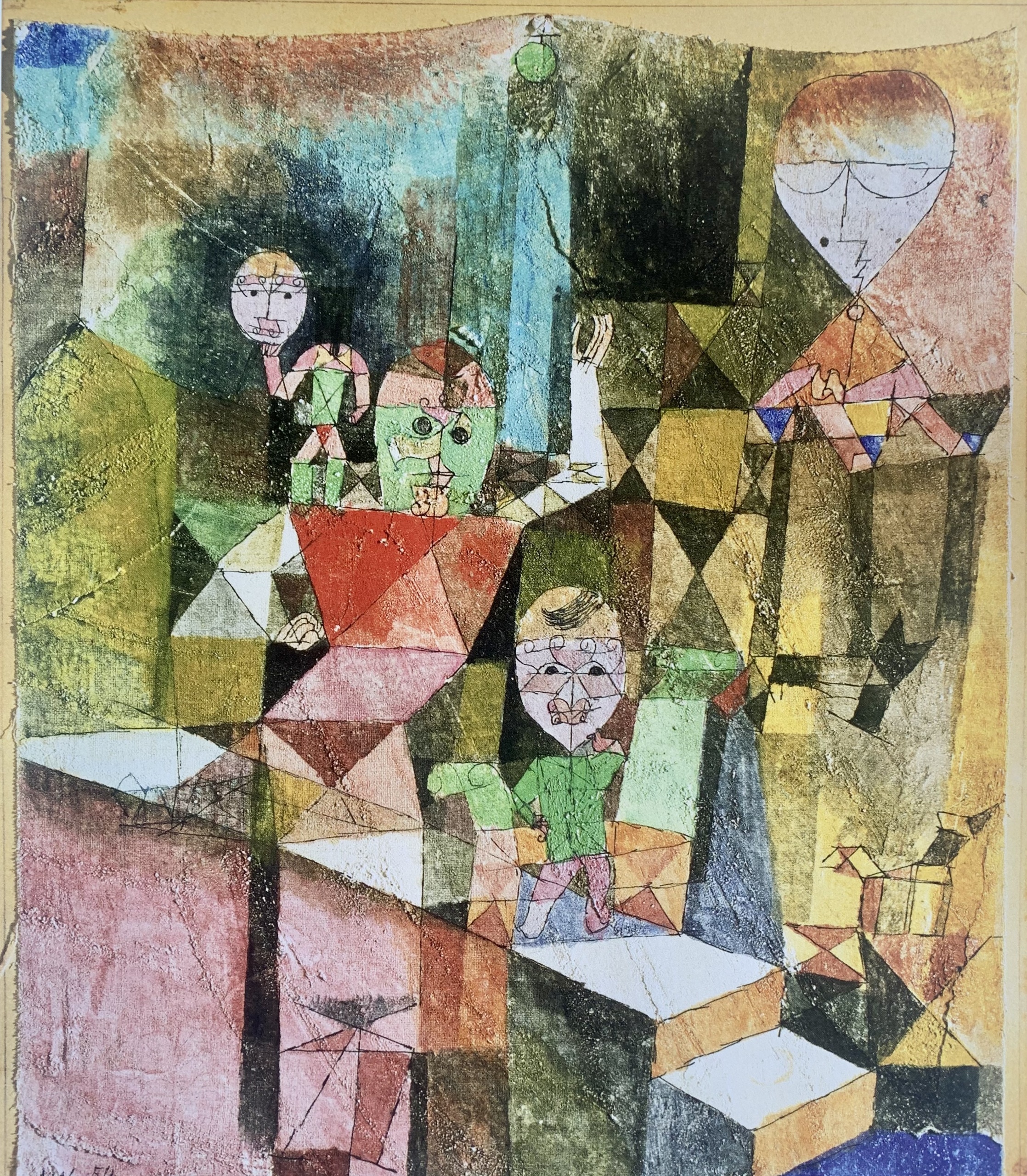
Introducing the Miracle is a painting by Paul Klee from 1916: on a kind of stage built of pink, ochre, olive, blue and red triangles, diamonds and blocks stand a few small figures with round, mask-like faces. One holds a mask high in the air, a green figure in front climbs a flight of steps, and at the upper right floats a head shaped like a hot-air balloon. The original is a small work on a prepared ground, only 29.2 x 23.6 cm, at the Museum of Modern Art (MoMA) in New York. Our painter recreates it for you by hand on canvas, in oil or acrylic, in one of 8 upright sizes between 36 x 43 and 172 x 200 cm, or made to measure. You see a photograph of the finished canvas before we pack it.
| Title: | Introducing the Miracle |
| Other titles: | Vorführung des Wunders · La presentazione del miracolo |
| Painter: | Paul Klee (1879–1940) |
| Year painted: | 1916 |
| Original size: | 29.2 cm x 23.6 cm (height x width) |
| Original technique: | Mixed media |
| Painting style: | Modernism |
| Located at: | Museum of Modern Art (MoMA), New York, USA |
| Our reproduction: | Hand-painted in oil or acrylic on canvas, 8 sizes or made to measure |
Introducing the Miracle – Paul Klee
What does Introducing the Miracle show?
The scene is built like a little theatre. A row of white and ochre steps climbs from left to right along the bottom, and behind it rises a wall of coloured planes: red and pink triangles, olive and yellow blocks, and dark diamonds repeating like the pattern on a carnival costume.
On this stage a few small figures with round, pale faces perform. At the upper left a tiny figure lifts a round mask high above itself, as if showing it to the audience. In the middle a larger green head with big dark eyes rises from a red triangular body, and above it a white hand reaches up with spread fingers.
In front, halfway up the steps, stands a small figure in a green jacket and pink trousers, curls above its pale face. At the upper right floats a large head shaped like a balloon or a heart, with a collar of pink, blue and yellow triangles beneath it. Every outline is drawn with a fine, slightly trembling line.
What story does this scene tell?
The title speaks of a miracle being presented, and the scene fits: the steps, the raised hand and the lifted mask recall the moment a conjuror or an actor shows the audience a trick. What the miracle is, the painting does not say, and our sources do not explain the title.
Klee rarely explained his works. Perhaps the miracle is the floating head that has just drifted off the stage; perhaps it is the mask the little figure holds aloft.
In March 1916, the year of this work, Klee was conscripted into the German army as a reserve soldier and, after training, served behind the front. The painting itself stays playful and fairy-tale-like.
Why does this little stage hold the eye?
Because it is childlike in its simplicity yet carefully composed. The faces are a few strokes, as a child might draw them, while the planes around them are ordered like a cubist composition.
The colours carry the warmth Klee found on his 1914 trip to Tunisia with August Macke and Louis Moilliet, when colour became his main means of expression.
Klee was a Swiss-born German artist who played the violin from childhood, and something musical runs through this work: shapes return like a theme in a piece of music.
This painting has no Wikipedia article of its own, so we link to the English Wikipedia article about the painter Paul Klee, which covers his life, his Bauhaus teaching years and the more than 9,000 works he left.
Where is the original, and how big is it?
The original belongs to the Museum of Modern Art (MoMA) in New York, under inventory number 395.1962. The museum gives its size as 29.2 x 23.6 cm (height x width), so it is an intimate piece, meant to be seen up close.
Klee made it as a small work on a prepared ground, its texture as rough as old plaster.
Only a year later, in 1917, came The Idea of Firs, where sharp, overlapping planes settle into a crystalline structure around a small dark tree.
Introducing the Miracle or another Klee?
This is a canvas painting for anyone who loves story-telling scenes full of small details that keep surprising you long after it goes up.
If the spirit of theatre appeals, look at Jumping Jack from 1919, a playful figure with red cheeks and a ball on a thread. Two strange opponents before a crowd of tiny spectators are the subject of Public Duel, and for a wide wall above the sofa there is Tropical Gardening, glowing in orange-red.
More scenes, and all the famous Paul Klee paintings we offer, wait on our Paul Klee page.
How do we hand-paint Introducing the Miracle on canvas?
The original is not a work on canvas but a small piece on a prepared ground, under 30 cm tall. Ours is an oil painting reproduction on canvas, worked in oil or acrylic in the size you choose, so it hangs like any painted work. Choose oil and your copy becomes a true oil painting, able to hold its own beside any classic.
First the painter divides the canvas into planes with fine lines: the steps, triangles, diamonds and the outlines of the figures. Then he lays on translucent layers of colour, from pale pink and ochre to deeper olive and blue, building them up layer by layer.
He suggests the grainy surface with a dry brush, and last of all draws the faces, eyes, curls and the fingers of the raised hand with a fine brush.
Which size suits which wall?
In short: 36 x 43 and 46 x 55 cm for a shelf, a hallway or a corner by the door, 56 x 64 and 72 x 85 cm above a chest of drawers, a bed or a desk, 90 x 107 and 102 x 122 cm above a sofa, and 135 x 160 or 172 x 200 cm for a large wall the scene should fill.
We paint it in 8 upright sizes (width x height): 36 x 43, 46 x 55, 56 x 64, 72 x 85, 90 x 107, 102 x 122, 135 x 160 and 172 x 200 cm. The original is just 23.6 x 29.2 cm (width x height), so every size enlarges the small work; at 172 x 200 cm the scene is about seven times as wide as in New York.
As a painting for the living room it looks best at 90 x 107 or 102 x 122 cm, where the coloured planes enliven the wall above the sofa. The smaller sizes suit a child’s room.
Can I order a different size or a frame?
Yes. If your wall calls for other proportions, we arrange the scene so the figures, the steps and the balloon head stay whole, and widen or narrow only the margin of coloured planes. For a price and a date, just send us the size that fits your wall.
The painting travels rolled, stretched on a stretcher bar or framed; our workshop in Slovenia does the stretching and framing. The moulding is picked in our 3D app, which does that one job; previewing the painting on your own wall is a separate service.
When and how does the painting arrive?
The painter begins as soon as you confirm, and the little stage is ready to ship within 15 to 45 working days. Before packing we send you a photograph of the finished work; if you would like a change, we make it.
Within Slovenia and to other EU countries we ship without customs duties, and every order is covered by our returns policy.
It makes a lovely present for theatre lovers or a new home. Unsure which size would fit? Give a gift voucher and let the recipient choose.
Frequently asked questions
Where is the original on display?
At the Museum of Modern Art (MoMA) in New York, inventory number 395.1962.
What can I see in the painting?
A scene like a stage: small masked figures, steps, coloured triangles and diamonds, and a balloon-shaped head.
Will I get a print?
No. You get a hand-painted copy on canvas, brushed by our painter in oil or acrylic.
How small is the original?
It measures 29.2 x 23.6 cm (height x width); our sizes go up to 172 x 200 cm.
Is a size outside the list possible?
Yes. Give us your width and height and we will quote a price and a delivery date.
How long will I wait for my painting?
From 15 to 45 working days; before dispatch you also receive a photograph of it.
Does it suit a child’s room, or work as a gift?
Yes. Children love the little fairy-tale figures, and it delights anyone who loves the theatre.
What does the title mean?
It points to a show in which performers present a miracle; Klee never explained it, so every viewer reads it their own way.
- Subject: a stage of coloured triangles, diamonds and steps with small masked figures and a balloon-shaped head.
- Original: a small work on a prepared ground, 1916, 29.2 x 23.6 cm, MoMA, New York.
- Ours: hand-painted in oil or acrylic on canvas as a Paul Klee reproduction, in 8 upright sizes between 36 x 43 and 172 x 200 cm, or made to measure.
- Worth knowing: Klee made the work in 1916, the year he was called up into the German army.