







































Description
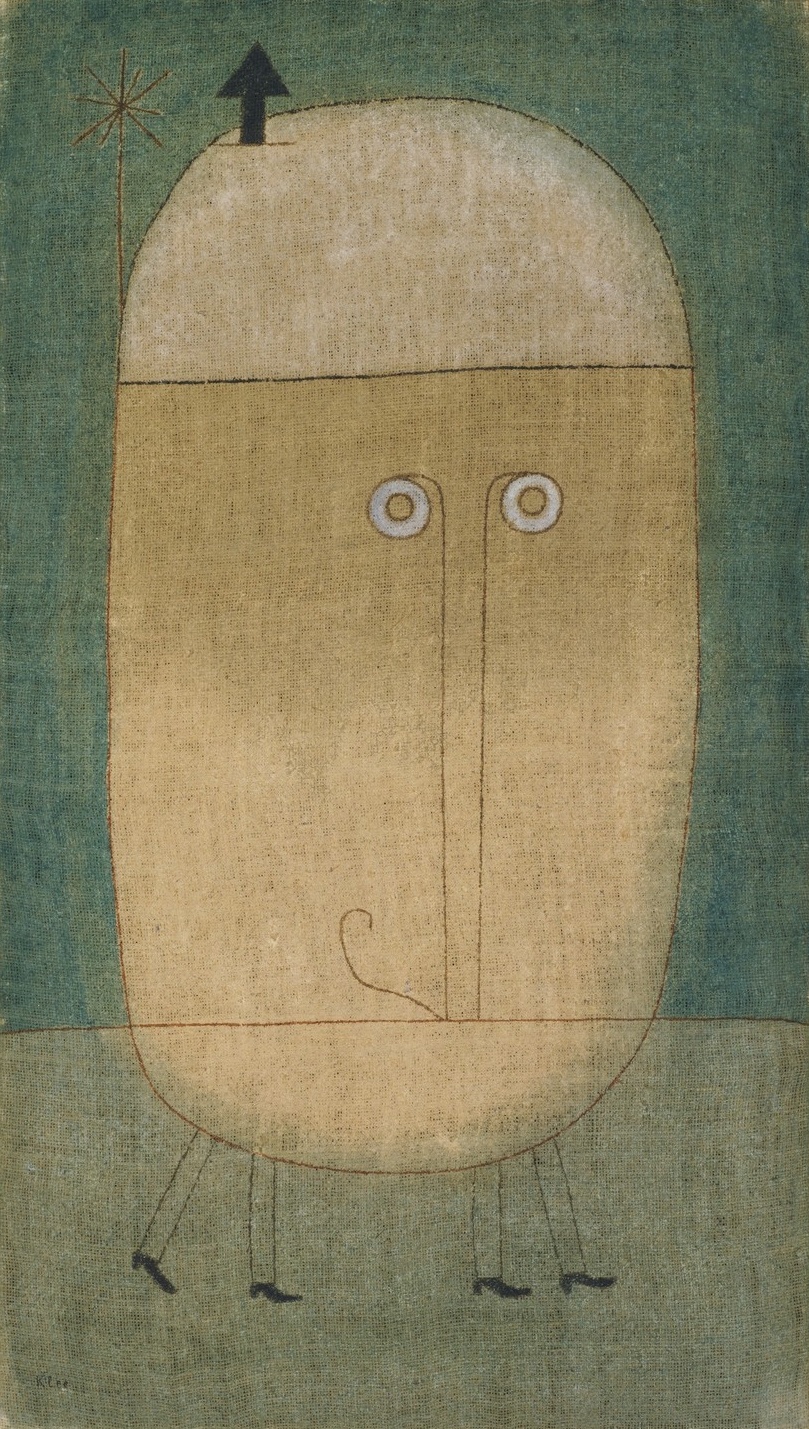
Mask of Fear is a painting by Paul Klee from 1932: a large, rounded mask in pale beige stands against a dark green ground and stares out with two round eyes, a black arrow points up from its top, and it walks on four thin legs in little black shoes. The original is oil on burlap, 100.4 cm high and 57.1 cm wide, and belongs to The Museum of Modern Art in New York. Our painter paints it for you by hand on canvas, in oil or acrylic, in five upright sizes from 30 x 55 to 60 x 105 cm, the largest being roughly the size of the original. Before we pack your Mask of Fear, we send you a photograph of the finished painting.
| Title: | Mask of Fear |
| Other titles: | Maske Furcht (German title) · Maschera della paura (Italian title) |
| Painter: | Paul Klee (1879–1940) |
| Year painted: | 1932 |
| Original size: | 100.4 cm x 57.1 cm (height x width) |
| Original technique: | Oil on burlap |
| Painting style: | Modernism |
| Located at: | The Museum of Modern Art (MoMA), New York, USA |
| Our reproduction: | Hand-painted in oil or acrylic on canvas, 5 sizes or made to measure |
Mask of Fear – Paul Klee
What does Mask of Fear show?
A single large shape, rounded like a bean or an egg, fills almost the full height of the canvas. It is pale beige and stands before a dark blue-green ground, while a lighter green band along the bottom reads as the floor.
The face is drawn in thin brown lines. Two round eyes with dark pupils look straight at you, and two long lines run down from them to make the nose. Near the bottom a fine line curls into a small spiral, and a short stroke beside it suggests the mouth. A horizontal line marks off the paler top, like a cap.
From the crown a small black arrow points upwards, and at the upper left a tiny star glints on a thin stem. Beneath the mask four spindly legs in black shoes step out, as if more than one person were hiding underneath. Klee signed at the lower left, and the coarse weave of the burlap shows through the paint everywhere.
What does the title mean?
The title says only two things: this is a mask, and it has to do with fear. What it hides, and whom it should frighten, Klee did not write down.
A mask is something to hide behind, and here the idea turns almost literal: the huge face has no body, only legs that seem to go their own way, as if a small group were sheltering behind one face.
Whether the fear belongs to the wearer or to those the mask is meant to scare, the painting does not say. Some see the wide-eyed face as frightened, others as comic or a little eerie; Klee added no explanation, so every reading stands.
Why do people love Mask of Fear?
The painting mixes humour with unease. A few fine lines, two eyes and four legs are as simple as a child’s drawing, yet the image stays in the mind, swinging between funny and strange.
The support matters too: rough burlap gives the beige warmth and grain, as if the mask were sewn from sacking.
Klee, born in 1879 in Münchenbuchsee near Bern to a German music teacher and a Swiss singer, played the violin as a boy. He left more than 9,000 works, many of them small, on paper, gauze or board.
For more on his life, read the Wikipedia article on Paul Klee; it is in English and is about the painter, since Mask of Fear has no article of its own.
Where is the original, and where does it come from?
The original belongs to The Museum of Modern Art (MoMA) in New York, under accession number 854.1978. It is oil on burlap, 100.4 cm high and 57.1 cm wide, which for Klee, who usually worked in small formats, makes it a fairly large work.
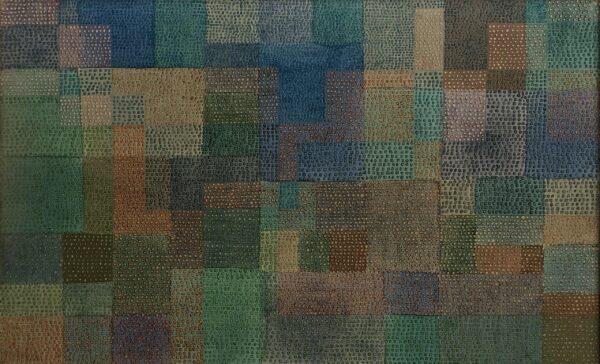
It was painted in 1932, during Klee’s Düsseldorf years. In 1931 he had left the Bauhaus, where he had taught beside Wassily Kandinsky since 1921, for the Düsseldorf Academy. His dotted Ad Parnassum dates from the same year.
While he taught in Düsseldorf, a Nazi newspaper singled him out, the Gestapo searched his home and Klee lost his post. At the end of 1933 he moved with his family to Switzerland.
Mask of Fear or another Klee?
Mask of Fear is a canvas painting for anyone who likes a wink and a touch of mystery, and its tall format fits narrow spots where a wider painting would not.
If the theme of the mask draws you in, look at Actor’s Mask from 1924, a calm green face laced with wavy red lines. Also from the Düsseldorf years comes Boy in Fancy Dress, a cheerful carnival figure against a ground of tiny dabs of colour, and for the night-time riddle of stars and moons choose Astrological Fantasy Portrait.
The rest of the famous Paul Klee paintings we paint to order, from small watercolours to large fields of colour, are on our Paul Klee page.
How do we hand-paint Mask of Fear on canvas?
Klee’s original is oil on burlap, a rough cloth with visible threads. What we send you is an oil painting reproduction on canvas, worked by our painter in oil or acrylic at the size you pick and built up layer by layer.
He first sets down the outline of the mask, the floor line and the eyes, so the big shape stands centred with the legs evenly beneath it. Next come the two-tone green ground and the beige mask, lighter at the top and warmer below. Last, a fine brush draws the face, the star, the arrow and the shod legs.
Soft, thin layers and slightly uneven colour hint at the rough burlap, so the surface never looks poster-flat.
Which size suits which wall?
In short: 30 x 55 or 40 x 70 cm for a hallway or a narrow wall by a door, 45 x 80 and 50 x 90 cm above a chest of drawers, bed or desk, and 60 x 105 cm where the mask should lead the room.
We paint Mask of Fear in five upright sizes (width x height): 30 x 55, 40 x 70, 45 x 80, 50 x 90 and 60 x 105 cm. The original measures 57.1 x 100.4 cm (width x height), so our largest size is about as big as the work in New York. We do not offer bigger sizes, because the photograph we paint from will not carry more.
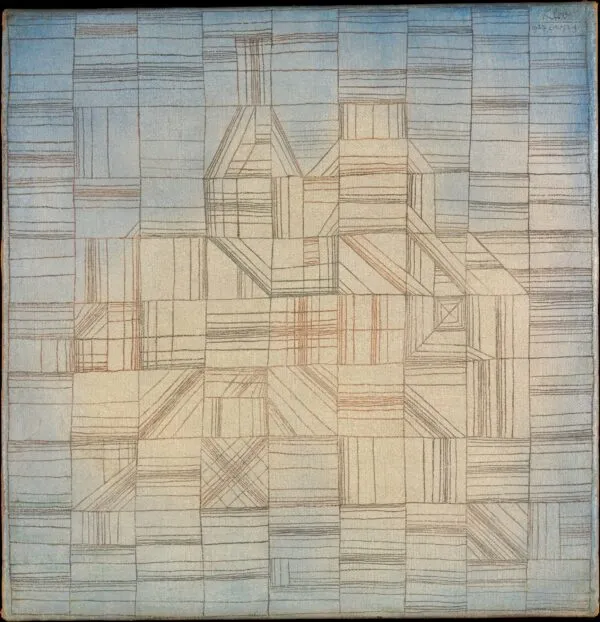
As a painting for the living room it looks best at 50 x 90 or 60 x 105 cm, beside the sofa or by the balcony door. If your wall is more square than tall, Redgreen and Violet-Yellow Rhythms, a mosaic of warm coloured rectangles, may suit it better.
Can I have a different size or a frame?
Yes, within this range. If you need slightly narrower or wider proportions, we keep the mask and legs whole and only widen or shorten the green ground. Send us the size you have in mind, and we will quote a price and a date for your mask.
Your Mask of Fear reaches you rolled, stretched on a stretcher bar or framed. The mask is stretched and framed in our workshop in Slovenia.
You find the frame in our 3D app, which is purely for choosing the moulding; seeing the painting on your own wall is a separate service. Slim natural wood or dark grey suits the green and beige.
When will Mask of Fear arrive?
Mask of Fear is ready to ship 15 to 45 working days after you confirm the order. When it is finished we send you a photograph, and we change anything you ask.
Within Slovenia and the EU your Mask of Fear travels without customs duty, and our returns policy covers the order.
The comic mask on thin legs suits a friend with a sense of humour or a new home. Unsure of the size? Give a wall art voucher.
Frequently asked questions
Where can I see the original Mask of Fear?
At The Museum of Modern Art (MoMA) in New York, accession number 854.1978.
What exactly can I see?
A large beige mask with round eyes, an arrow on top and four thin legs, set against a green ground.
Is it a print?
No, it is a hand-painted copy, brushed line by line in oil or acrylic on canvas.
How large is the original?
It is 100.4 cm high and 57.1 cm wide, roughly the size of our largest format, 60 x 105 cm.
Can I order it smaller or narrower?
Yes. Tell us the width and height, and we will send a price and a date for your mask.
How long will I wait?
From 15 to 45 working days; before dispatch we send you a photograph of your finished Mask of Fear.
Is it a good gift?
Yes. The witty mask on legs pleases lovers of modern art and anyone with a sense of humour.
What do the legs under the mask mean?
Klee never explained them; it looks as if several people were hiding under the mask at once.
- Subject: a large beige mask with round eyes, a black arrow and four thin legs against a dark green ground.
- Original: oil on burlap, 1932, 100.4 x 57.1 cm, The Museum of Modern Art, New York.
- Ours: a Paul Klee reproduction painted by hand in oil or acrylic on canvas, 5 sizes from 30 x 55 to 60 x 105 cm.
- Worth knowing: painted in Klee’s Düsseldorf years; four legs walk under the mask, as if several people were hiding inside.