







































Description
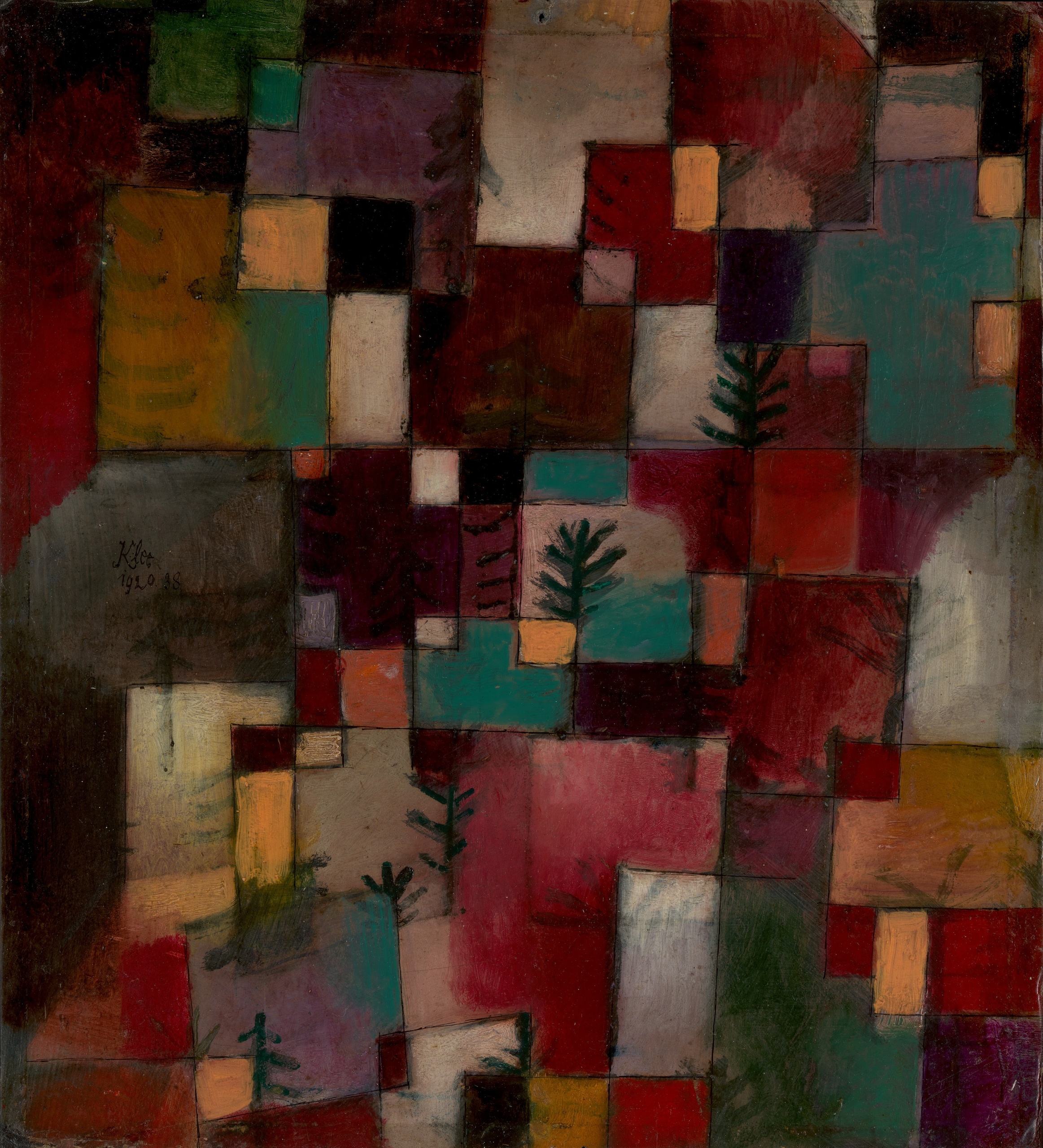
Redgreen and Violet-Yellow Rhythms is a painting by Paul Klee from 1920: a dense grid of soft-edged rectangles and squares in deep red, wine, rose, violet, ochre yellow, teal and cream, with a few small dark fir trees standing among them. The original is a small work in oil and ink on cardboard, only 37.5 x 33.7 cm, and it belongs to The Metropolitan Museum of Art in New York. Our painter paints it for you by hand on canvas, in oil or acrylic, in 8 upright, nearly square sizes from 40 x 43 to 172 x 200 cm or made to measure. You get a photograph of the finished painting before we ship it.
| Title: | Redgreen and Violet-Yellow Rhythms |
| Other titles: | Rotgrüne und violett-gelbe Rhythmen (German title) · Ritmi rossoverdi e viola-gialli (Italian title) |
| Painter: | Paul Klee (1879–1940) |
| Year painted: | 1920 |
| Original size: | 37.5 cm x 33.7 cm (height x width) |
| Original technique: | Oil and ink on cardboard |
| Painting style: | Modernism |
| Located at: | The Metropolitan Museum of Art, New York, USA |
| Our reproduction: | Hand-painted in oil or acrylic on canvas, 8 sizes or made to measure |
Redgreen and Violet-Yellow Rhythms – Paul Klee
What does Redgreen and Violet-Yellow Rhythms show?
The whole sheet of cardboard is covered by a dense patchwork of rectangles and squares, laid side by side and here and there over one another. No field matches its neighbour: one is dark red like wine, another rose, a third violet, a fourth ochre yellow or teal, and between them cream and greyish fields light up.
Thin dark lines of ink run along the edges of many fields. They outline the shapes without ever quite closing them, so the rectangles seem to shift, slide beneath one another and surface again.
Among the coloured fields stand a few small dark green fir trees, drawn with a handful of strokes: a trunk and slanting branches, the way a child would draw them. Beside them sits a tiny sign that recalls a bird. On the left, inside a darker grey-brown field, Klee wrote his name and the year 1920.
What does the title mean?
The title tells no story. It names two pairs of colours, red and green, violet and yellow, and adds the word rhythms: the eye travels from field to field the way the ear follows the beats of a bar.
Both pairs are complementary colours, which sit opposite each other on the colour wheel and strengthen each other when placed side by side. The English Wikipedia article on Klee notes that he sometimes used exactly such complementary pairs, and at other times deliberately dissonant colours, another sign of his bond with music.
The same source says the coloured rectangle became his basic building block, which some scholars associate with a musical note; Klee combined such blocks into a colour harmony comparable to a musical composition.
Why do people love looking at it?
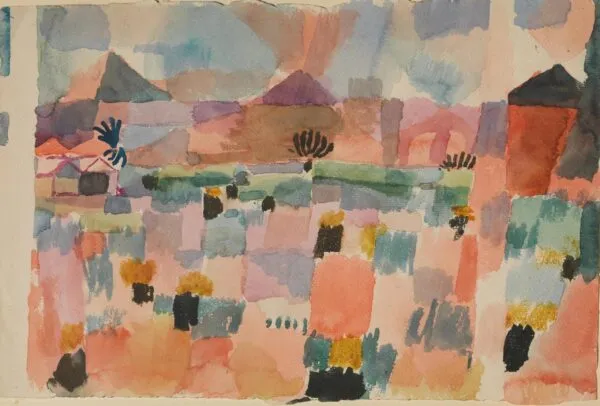
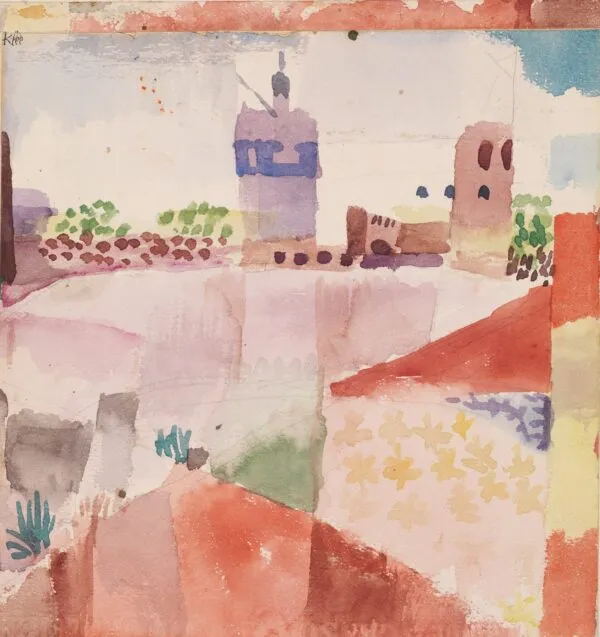
In 1914 Klee made a short trip to Tunisia with August Macke and Louis Moilliet, and there he found his breakthrough in colour. He wrote that colour and he were one, and that he was a painter.
Born in 1879 near Bern to a music teacher and a singer, he played the violin from childhood, in an orchestra as well, and the poet Rilke felt his drawings were like transcriptions of music.
The English-language Wikipedia article on Paul Klee covers the painter’s life and work, not this painting.
Where is the original, and what is its story?
The original belongs to The Metropolitan Museum of Art in New York, where its accession number is 1984.315.19. The Met received it in 1984 as part of The Berggruen Klee Collection.
It is a small work: 37.5 x 33.7 cm (height x width), oil and ink on cardboard.
1920 was an important year for him. A retrospective of more than 300 of his works was held, and in January 1921 he began teaching at the Bauhaus, where he stayed alongside Wassily Kandinsky until 1931.
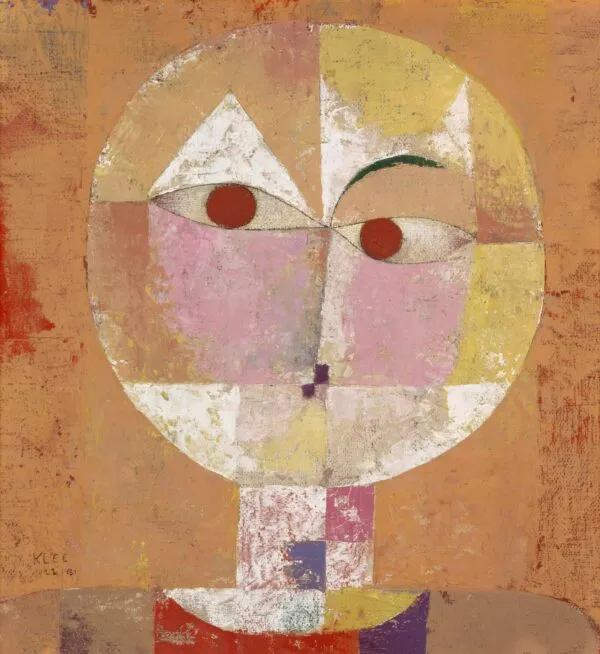
Among the Klee works we paint you will also find Astrological Fantasy Portrait, where an enigmatic face takes the place of the colour fields.
Redgreen and Violet-Yellow Rhythms or another Klee?
This is a canvas painting for people who care more about colour than about a story: with no single centre, it works as a warm surface that calms an empty wall.
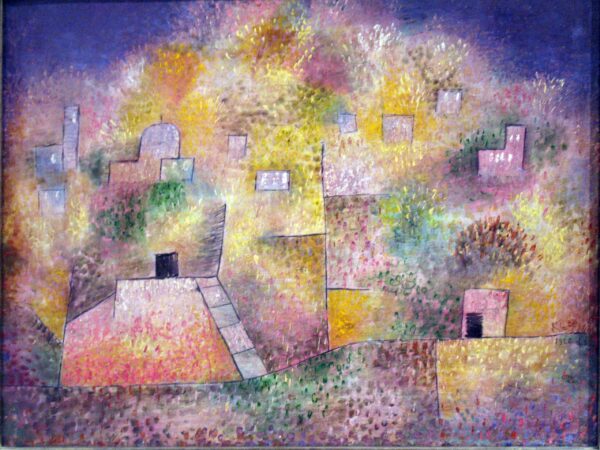
If you want something more playful, look at Boy in Fancy Dress; theatre lovers may prefer Actor’s Mask. And if you like watching Klee build a space out of patches of colour, there is Castle Garden.
All our Klee works, famous Paul Klee paintings and quieter ones alike, are gathered on the Paul Klee page.
How do we hand-paint this work on canvas?
Klee’s original is not painted on canvas at all: it is oil and ink on a small piece of cardboard. Ours is an oil painting reproduction made on canvas instead: the painter works in oil or acrylic, in the size you choose, so it hangs like any other painting.
He first divides the canvas into a grid of fields and draws in the fir trees and the signature, then builds up the fields layer by layer, from the dark wine reds to the pale cream, keeping the edges soft. Last of all he pulls the dark lines along the edges of the fields with a fine brush and adds the twigs of the fir trees, which give the painting its pulse.
Which size suits which wall?
In short: 40 x 43 or 45 x 50 cm for a hallway, a shelf or a pair, 56 x 64 and 75 x 85 cm above a chest of drawers, a bed or a desk, 98 x 104 cm above a sofa, 109 x 120 and 140 x 150 cm for a large living-room wall, and 172 x 200 cm for a really tall or open wall.
We paint the Rhythms in 8 upright, nearly square sizes (width x height): 40 x 43, 45 x 50, 56 x 64, 75 x 85, 98 x 104, 109 x 120, 140 x 150 and 172 x 200 cm. The original measures 33.7 x 37.5 cm (width x height), so every one of our sizes enlarges the small work; at 172 x 200 cm it is about five times as wide as it is in New York. The large, simple fields take enlarging well.
As a painting for the living room it looks best at 98 x 104 or 109 x 120 cm above a sofa or a dining table, where the warm red and violet bring warmth into the room.
Can I order a different size or a frame?
Yes. If you need other proportions, the painter widens or narrows the fields evenly, so every fir tree and the signature stay in place. Send us the size you have in mind and we will come back with a price and a date for your Rhythms.
Your Rhythms travel rolled, stretched on a stretcher bar or ready framed. Our workshop in Slovenia does the stretching and framing and prepares every canvas for its journey. The moulding is picked in our 3D app, whose only job is choosing the frame; a view of the painting on your own wall is a separate service.
Deep reds and violets go well with a dark wooden frame or a slim black moulding, while pale oak brings out the ochre and cream patches.
When and how does the painting arrive?
Once you order, the Rhythms are ready to ship within 15 to 45 working days. Before packing we send you a photograph of the finished painting; if you would like a field lighter or darker, we change it.
We ship from Slovenia, so buyers in Slovenia and the rest of the EU pay no customs duties, and every order is covered by our returns policy.
The colourful grid makes a lovely present for a wedding, a new home or a friend who loves music. If you are unsure which size would fit their wall, give them a wall art voucher and let them choose.
Frequently asked questions
Which museum holds the original?
The Metropolitan Museum of Art in New York, under accession number 1984.315.19.
What exactly will I see in the painting?
A grid of red, violet, rose, yellow and teal fields, with a few dark fir trees standing among them.
Is it a print?
No, it is a hand-painted copy, worked by our painter with brushes on canvas in oil or acrylic.
How large is the original?
Only 37.5 x 33.7 cm (height x width); our sizes go up to 172 x 200 cm.
Can the Rhythms be painted in a size not on the list?
Certainly; tell us the width and height, and we will send an offer with a price and a date.
How long will I wait for my painting?
Between 15 and 45 working days, and you see a photograph of your Rhythms before they are packed.
Would the Rhythms suit a bedroom, or make a good gift?
Yes. The calm grid of colour, with no faces in it, sits well in a bedroom, and as a present it pleases anyone who loves colour.
What does the word rhythms in the title mean?
The coloured fields alternate like beats in music; some scholars compare Klee’s rectangle to a musical note.
- Subject: a grid of red, wine, rose, violet, yellow and teal rectangles with a few dark fir trees.
- Original: oil and ink on cardboard, 1920, 37.5 x 33.7 cm, The Metropolitan Museum of Art, New York.
- Ours: hand-painted on canvas in oil or acrylic, a Paul Klee reproduction in 8 sizes from 40 x 43 to 172 x 200 cm or made to measure.
- Worth knowing: Klee made it a year before he joined the Bauhaus, after his breakthrough in colour in Tunisia.