







































Description
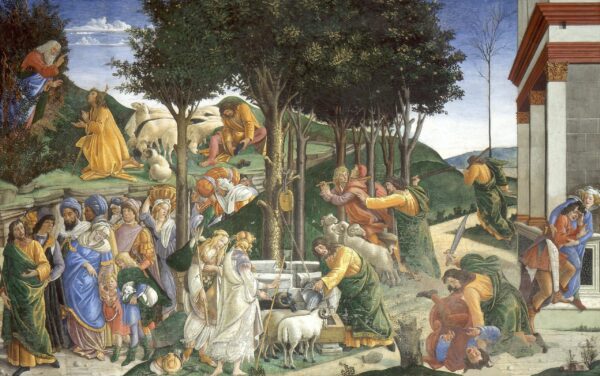
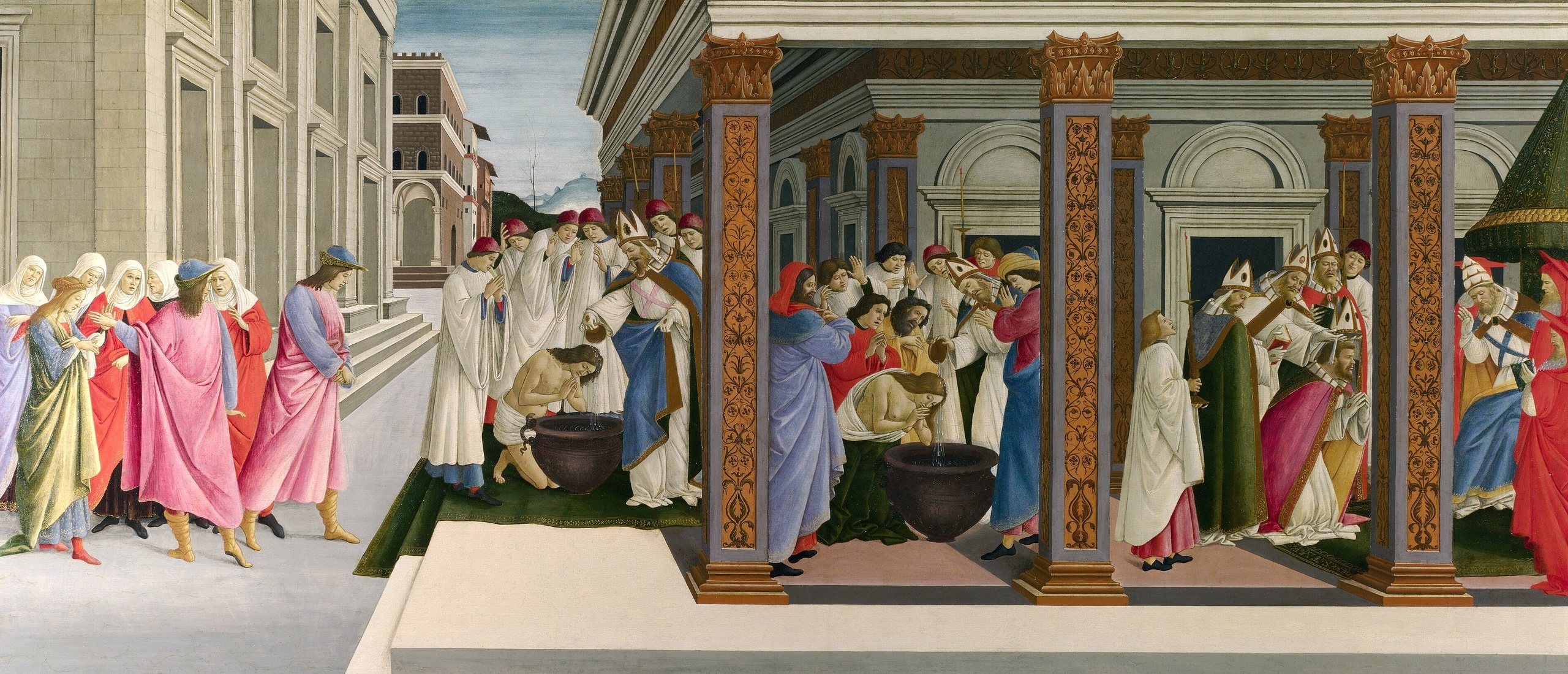
Four Scenes from the Early Life of Saint Zenobius is a painting by Sandro Botticelli from around 1500: along one long panel, four moments from the youth of Zenobius, later Bishop of Florence, follow each other from left to right – he turns down the bride his parents chose for him, is baptised, sees his mother baptised, and is finally consecrated bishop by Pope Damasus. The original, tempera on panel measuring 66.7 x 149.2 cm, belongs to the National Gallery in London. Our painter hand-paints it for you in oil on canvas in 5 landscape sizes from 120 x 55 to 200 x 90 cm, or to a custom size.
| Title: | Four Scenes from the Early Life of Saint Zenobius |
| Other titles: | Battesimo ed elezione a vescovo di san Zanobi (Italian title) · Štirje prizori iz mladosti svetega Zenobija (Slovene title) |
| Painter: | Sandro Botticelli (c. 1445–1510) |
| Year painted: | c. 1500 |
| Original size: | 66.7 cm x 149.2 cm (height x width) |
| Original technique: | Tempera on panel |
| Painting style: | Early Renaissance |
| Located at: | National Gallery, London, United Kingdom |
| Our reproduction: | Hand-painted in oil on canvas, 5 sizes or made to measure |
Four Scenes from the Early Life of Saint Zenobius – Sandro Botticelli
What does Four Scenes from the Early Life of Saint Zenobius show?
Botticelli sets all four events in a single city space. On the left rises a pale palace with severe windows. The right half is taken up by an open portico with tall pilasters, decorated with brown-and-gold scrolls and topped by Corinthian capitals.
At the left edge stands a group of women in white veils and red and violet cloaks. Among them a young woman in a yellow-green mantle modestly lowers her head as a man in a pink cloak and blue hat talks to her. To their right a young man in a long pink robe walks away, hands clasped in front of him, eyes on the ground.
On a green carpet in the centre a half-naked young man kneels over a great dark bowl, while a bishop in a blue cope and white mitre pours water over his head from a small vessel. Behind him stand clerics in white surplices and red caps, some with joined hands, others intent on the rite.
Under the portico the scene repeats: a woman with loose hair and bare shoulders bends over a second bowl, surrounded by men in red, blue and yellow. At the far right the young bishop kneels in pink and gold, bishops in white mitres hold a mitre above him, the pope sits beneath a green canopy, and figures in red stand at the edge.
Who was Saint Zenobius, and what happens in the painting?
Zenobius was one of the early bishops of Florence and perhaps died in 417. Botticelli spread his life across four panels, and this one tells the beginning: how a young Florentine became a Christian and a priest.
The story reads from left to right. First Zenobius rejects the bride his parents intended for him and walks away. Then he is baptised, and after him his mother receives baptism from the Bishop of Florence. Finally Pope Damasus, in Rome, consecrates him Bishop of Florence.
The painter closely followed the Life of Zenobius written by Fra Clemente Mazza in 1475: the panels take over its sequence, its details and even its chapter divisions.
Why is this late Botticelli special?
The panel belongs to the last phase of Botticelli’s career, perhaps around 1500–1505. Some authorities even count the series among his latest surviving works.
The style is starker than in the famous mythologies of the 1480s: the figures twist in anguish, and the architecture receives close attention.
Pigment analysis found the usual colours of the Italian Renaissance except ultramarine: the blues are azurite, the reds red lake and vermilion. All four panels are covered by an article on Wikipedia, written in English.
Where is the original, and where did it come from?
The original belongs to the National Gallery in London, which also owns a second panel of the series, with three miracles of the saint. A third hangs in the Metropolitan Museum of Art in New York and the fourth in Dresden: the Last Miracle and Death of Saint Zenobius closes the story with a young man whom Zenobius brings back to life, and with the saint’s own death.
In 1984 Ellen Callmann proposed an answer about the commission: the patron may have been Francesco di Zanobi Girolami, whose brother commissioned Mazza’s Life. The Girolami family claimed descent from Zenobius’ father, and the panels may have been spalliere for a wedding, probably that of Zanobi Girolami in 1500.
Around the 1880s the panels were in the Rondinelli collection in Florence; the London pair entered the gallery in 1924 with the Mond Bequest.
Four Scenes or another Botticelli?
This canvas painting suits anyone who enjoys reading a story scene by scene. The very long format sits well above a sofa, bed, sideboard or hall bench.
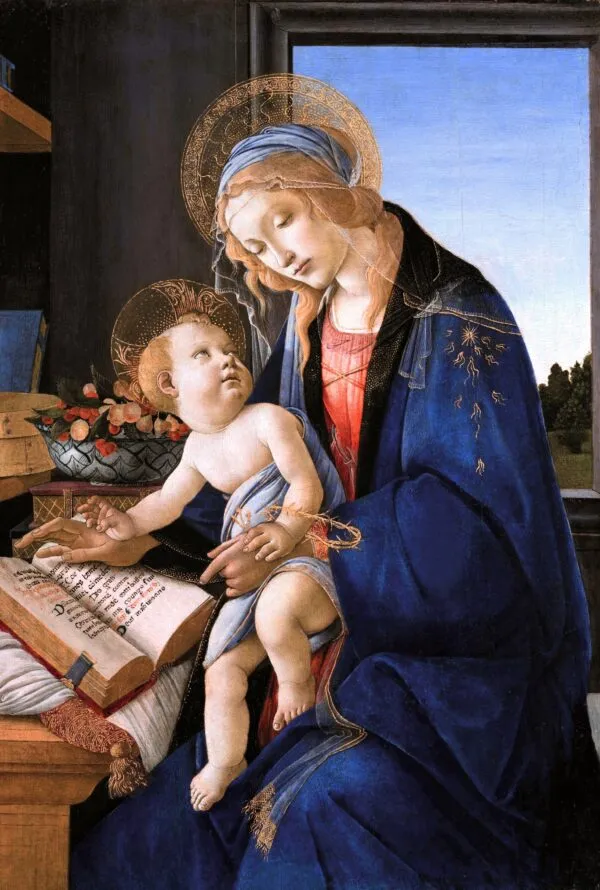
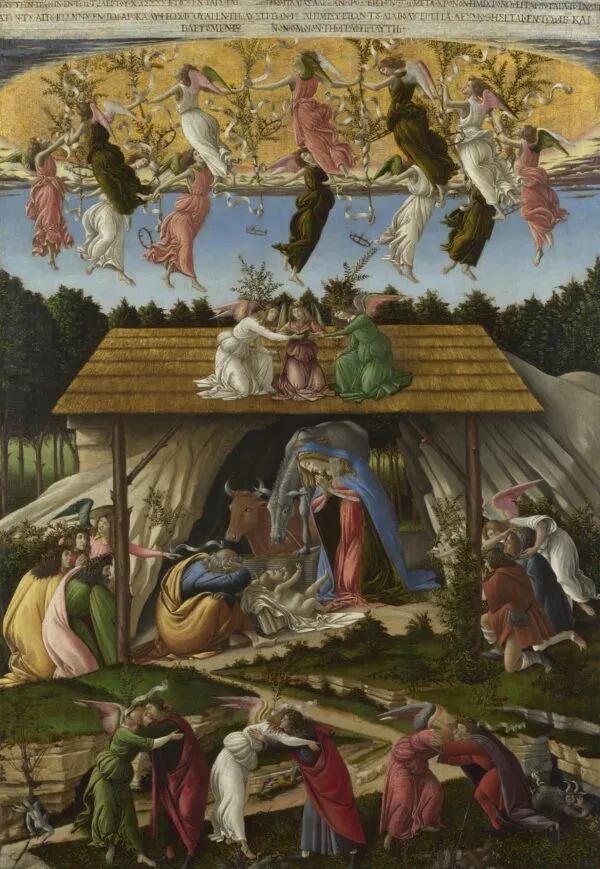
To see how differently the painter worked when young, compare the Sant’Ambrogio Altarpiece of around 1470, with the Virgin and Child enthroned among six saints. Many faces in one crowd fill the Adoration of the Magi, where the Medici are traditionally recognised, and for a large altarpiece choose the Coronation of the Virgin, in which God the Father crowns Mary among dancing angels.
More famous Botticelli paintings, from Madonnas to mythologies, wait on our Sandro Botticelli shelf.
How do we hand-paint Four Scenes from the Early Life of Saint Zenobius?
The London panel is tempera on wood, 66.7 x 149.2 cm, not oil on canvas. Our oil painting reproduction is built up in oil on canvas, layer on layer, so it can travel rolled, stretched on a stretcher bar or framed.
He paints the faces, one by one, from the pensive bride to the pope under his canopy. Last come the fine scrolls on the pilasters, the streams of water above the bowls, the gold borders of the vestments and the white mitres.
Which size suits your wall?
In short: 120 x 55 or 140 x 60 cm above a sideboard or bed, 150 x 70 cm and up above a sofa or a long dining table.
We paint Four Scenes from the Early Life of Saint Zenobius in 5 landscape sizes (width x height): 120 x 55, 140 x 60, 150 x 70, 180 x 78 and 200 x 90 cm. The original measures 149.2 x 66.7 cm (width x height). So 120 x 55 and 140 x 60 cm are smaller than it, 150 x 70 cm is about its size, and 180 x 78 and 200 x 90 cm are larger.
Because the panel is more than twice as wide as it is high, it needs a long, quiet wall. As a painting for the living room above a three-seater it works best at 180 x 78 or 200 x 90 cm, where from the sofa you can make out both baptismal bowls and single faces.
Can I order another size and a frame?
Yes. If your wall needs different proportions, we keep all four scenes whole and adjust only the sky above the street, the paving or the edge of the palace. Even a reshaped Sandro Botticelli reproduction still runs from the refused bride to the consecration. Send us your custom size and we will reply with price and timing.
Our workshop in Slovenia makes the stretcher bar and the frame and packs every canvas with care. You choose the moulding yourself in our 3D app; a view of the painting on your own wall is a separate service.
When will your painting arrive?
Four Scenes is ready to ship 15 to 45 working days after your order is confirmed. As soon as the painter puts down the brush, we send you a photograph of the finished painting, and any change you ask for is made before packing.
Four Scenes crosses no customs border within Slovenia and the rest of the EU, and our returns policy applies to every order.
The baptism scene makes a fine gift for a christening or a confirmation. If you do not know the recipient’s wall, give a gift voucher and let them choose painting and size themselves.
Frequently asked questions
In which museum is the original?
In the National Gallery, London, next to the panel with three miracles of Saint Zenobius.
Who is the young man walking away from the bride?
It is the young Zenobius, refusing the marriage his parents planned; in the next scene he is already being baptised.
Is it a print?
No. It is a hand-painted copy in oil on canvas: our painter brushes in every face, cloak and pilaster by hand.
How large is the original?
66.7 x 149.2 cm (height x width); our 150 x 70 cm size is about as large.
Do you also paint sizes outside this list?
Yes. Tell us the width and height, and we will send you the price and the making time.
How is the painting shipped, and when does it leave?
It ships after 15 to 45 working days, rolled in a tube, stretched on a stretcher bar or framed.
Does it suit a living room or work as a gift?
Yes. The long format belongs above a sofa, and the baptism scene is a lovely keepsake of a family christening.
What do the two bowls of water mean?
Both are baptisms: in the first Zenobius is baptised, in the second his mother, which gives the story its steady rhythm.
- Subject: four scenes from the youth of Zenobius on one panel: the refused bride, two baptisms and his consecration as bishop before the pope.
- Original: tempera on panel, c. 1500, 66.7 x 149.2 cm, National Gallery, London.
- Ours: hand-painted in oil on canvas, five landscape sizes from 120 x 55 to 200 x 90 cm, or a custom size.
- Worth knowing: it is one of four panels from one series, now divided between London, New York and Dresden.