







































Description
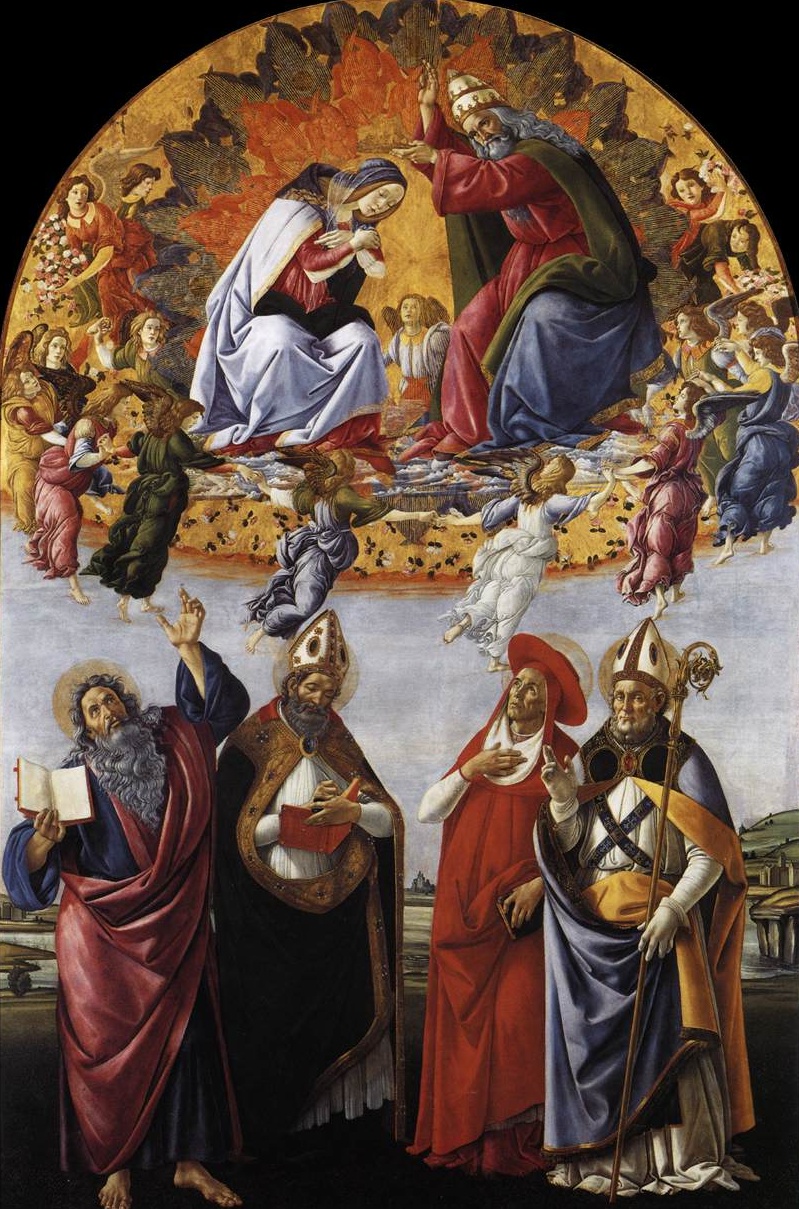
Coronation of the Virgin is the great altarpiece Sandro Botticelli painted in 1489–1490 for the goldsmiths’ chapel in the church of the Dominican convent of San Marco in Florence: above, in a golden sky, God the Father sets a crown on the head of the bowing Virgin within a ring of angels; below, four saints stand before a hilly landscape. The original, tempera on panel measuring 378 x 258 cm, hangs in the Uffizi Gallery in Florence. Our painter hand-paints it for you in oil on canvas in 3 portrait sizes from 50 x 75 to 65 x 95 cm, or to a custom size. Before your Coronation leaves us, we send you a photograph of it.
| Title: | Coronation of the Virgin |
| Other titles: | Incoronazione della Vergine (Italian title) · Pala di San Marco (Italian name) |
| Painter: | Sandro Botticelli (c. 1445–1510) |
| Year painted: | 1489–1490 |
| Original size: | 378 cm x 258 cm (height x width) |
| Original technique: | Tempera on panel |
| Painting style: | Early Renaissance |
| Located at: | Uffizi Gallery, Florence, Italy |
| Our reproduction: | Hand-painted in oil on canvas, 3 sizes or made to measure |
Coronation of the Virgin – Sandro Botticelli
What does Coronation of the Virgin show?
The tall panel ends at the top in an almost semicircular arch and is split into two clearly separate zones. The upper, heavenly zone is set on a gleaming gold ground; the lower, earthly one on a plain landscape of low hills under a pale grey-blue sky.
On a soft carpet of cloud sit God the Father, in a red mantle and a papal tiara, and the Virgin in blue and white. With his left hand he places the crown on her head and with his right he blesses her, while she bows humbly, arms crossed on her breast.
Dark blue and red cherubim and seraphim surround the pair in an upright glory, and a ring of hovering angels in coloured robes circles them horizontally. Between Mary and God one more angel peeps out behind the golden rays, and above the ring two angels on each side scatter flowers.
Below stand the four saints. On the left John the Evangelist holds an open book and points to heaven with his raised right arm. Beside him Saint Augustine, in a mitre, writes down what he sees; Jerome, in a cardinal’s red, lays a hand on his heart; and on the right the bishop Eligius, holding a crozier, is the only one who looks straight at us, raising his hand in blessing.
What does the scene mean?
In Catholic teaching Mary was taken up body and soul into heaven at the end of her earthly life, and her coronation follows that assumption. The crowning of Mary has been one of the major subjects of Christian art since the Middle Ages.
That explains the tall, two-part format: the crowning presupposes Mary’s arrival in heaven, so heaven is above and earth below. An arched top and so strict a division were rare in Florence then.
The first three saints carry books because they wrote about Mary’s assumption.
The German article explains the almost medieval gold ground by the patrons. The goldsmiths used so much gold to point to their own craft, and their rarely painted patron saint Eligius directs his blessing above all at the members of the guild.
Why is this altarpiece so admired?
Its size alone stands out: the painted surface measures 9.75 m², larger than almost every altarpiece in Florence at the end of the 15th century. Even Fra Angelico’s high altarpiece in the same church was smaller.
By the late 1480s Botticelli had won a high reputation as a painter of altarpieces, among them the Bardi altarpiece, which we offer as The Bardi Madonna, and the Cestello Annunciation.
Its poor condition long hid its quality. Shown at the Uffizi in 1990 after twenty years of restoration, it now counts among the first works of Botticelli’s new, late style.
The history of the altarpiece, its predella and its restorations is told in detail in the German Wikipedia article, which is written in German.
Where is the original today?
The original hangs in the Uffizi Gallery in Florence, where it came in 1919 when the state collections were reorganised.
It stayed in the side chapel of San Marco, much admired and mentioned by Giorgio Vasari, until 1596, when Paggi’s Transfiguration of Christ replaced it and the panel moved to the convent’s chapter house.
After Napoleon’s confiscation of church property it went to the Accademia in 1808; from 1969 the Opificio delle Pietre Dure spent twenty years securing paint that was flaking off the wood.
The long predella of five small scenes below the panel is not part of our painting.
Sandro Botticelli was born Alessandro di Mariano di Vanni Filipepi in Florence around 1445, into a tanner’s family. Vasari says he first learned the goldsmith’s trade, then painting under Filippo Lippi. He died in 1510 and is buried in his parish church of Ognissanti.
Coronation of the Virgin or another Botticelli?
Coronation of the Virgin is a canvas painting for anyone who wants a devotional scene full of light, gold and movement. Its upright format suits a narrow wall, a hallway or a prayer corner.
If you like an altarpiece with saints, look at another Botticelli panel in the Uffizi, the Sant’Ambrogio Altarpiece, where the Virgin and Child sit enthroned among six saints. A ring of dancing angels above the scene also appears in The Mystical Nativity, and Adoration of the Magi shows him some fifteen years earlier.
More famous Botticelli paintings, each painted to order, are on the Sandro Botticelli page.
How do we hand-paint Coronation of the Virgin?
The original is tempera on panel, almost four metres high, so our copy differs from it in both technique and size: it is a Sandro Botticelli reproduction painted by hand in oil on canvas, layer by layer. It ships rolled, on a stretcher bar or framed.
We paint the arched top as the photograph shows it, dark corners included.
The painter first draws the line between heaven and earth, the ring of angels and the outlines of the four saints. Then come the gold ground, the grey-blue sky and the hills, followed by the broad areas of drapery: the red of God the Father, Mary’s blue and white, the bishops’ copes.
Last come the faces, the flowers and the gold embroidery.
Which size works on which wall?
In short: 50 x 75 cm for a hallway or bedroom, 58 x 85 cm above a chest of drawers, 65 x 95 cm for a living-room wall or between two windows.
We paint Coronation of the Virgin in 3 portrait sizes (width x height): 50 x 75, 58 x 85 and 65 x 95 cm. The original measures 258 x 378 cm (width x height), so every one of our sizes is far smaller; the largest reaches about a quarter of its height.
As a painting for the living room it works best at 65 x 95 cm, where the saints’ faces and the ring of angels read from the sofa. The two smaller sizes sit well above a bed.
Can I order another size, and which frame suits it?
Yes, on request. Our photograph of the original is a small file, so we offer the three sizes it allows. You can still ask for a larger oil painting reproduction: send us your custom measurements, and we will check what is possible and quote a price and a date.
We ship the Coronation rolled in a tube, stretched on a stretcher bar or framed; our workshop in Slovenia stretches, frames and packs it. You pick the frame in our 3D frame app; seeing the painting on your own wall is a separate service. A gilded or warm wooden frame suits the golden sky.
When will your Coronation of the Virgin arrive?
Your Coronation of the Virgin is ready to ship 15 to 45 working days after you confirm the order. When the painter has finished, we send you a photograph of the painting and make any change you ask for before it leaves.
Within Slovenia and the EU it travels without customs duty, and our returns policy applies to every order.
It makes a fine gift for a confirmation or a wedding; if you are unsure of the size, give a gift voucher and let them choose.
Frequently asked questions
Where does the original hang?
In the Uffizi Gallery in Florence, where it has been since 1919.
Who are the four saints at the bottom?
John the Evangelist, Augustine, Jerome and the bishop Eligius, patron saint of goldsmiths.
Is it a print?
No. It is a hand-painted copy: our painter brushes every angel in oil on canvas.
How big is the original?
378 x 258 cm (height x width); all three of our sizes are far smaller.
Can I order it larger than 65 x 95 cm?
You can ask: send the width and height and we will reply with what is possible.
When will it be ready, and how is it sent?
Allow 15 to 45 working days before it ships, rolled, stretched or framed.
Is it right for a bedroom, or as a gift?
Yes. Its calm subject and gold tones suit a bedroom, and it is a fitting gift for church feasts.
Why is there so much gold?
The patrons were goldsmiths, who in all likelihood used the gold ground to point to their craft.
- Subject: God the Father crowns Mary in a golden sky within a ring of angels; below, four saints stand in a landscape.
- Original: tempera on panel, 1489–1490, 378 x 258 cm, Uffizi Gallery, Florence.
- Ours: the Coronation painted by hand in oil on canvas, in 3 portrait sizes (50 x 75 to 65 x 95 cm) or to your measurements.
- Worth knowing: the Florentine goldsmiths commissioned it for the chapel of Saint Eligius in San Marco.