







































Description
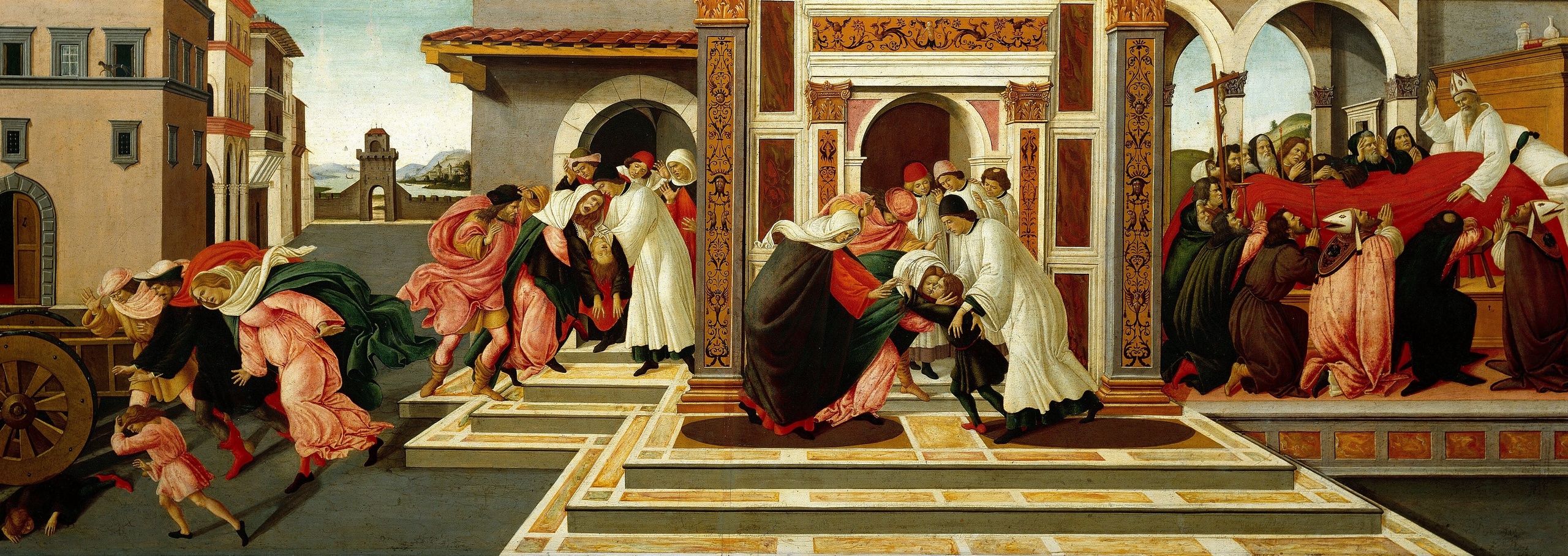
Last Miracle and Death of Saint Zenobius is a painting by Sandro Botticelli from around 1500, the final phase of his career. Along a long, low panel the story runs from left to right: a boy is run over by a cart, his distraught mother carries him off for help, the son comes back to her alive, and at the end the old bishop Zenobius blesses those kneeling around his deathbed. The original, tempera on panel measuring 66 x 182 cm, belongs to the Gemäldegalerie Alte Meister in Dresden. Our painter paints it for you by hand in oil on canvas, in 4 landscape sizes from 130 x 45 to 200 x 75 cm or made to measure. Before your painting is shipped, we send you a photograph of it.
| Title: | Last Miracle and Death of Saint Zenobius |
| Other titles: | Ultimo miracolo e morte di san Zanobi (Italian title) · Zadnji čudež in smrt svetega Zenobija (Slovene title) |
| Painter: | Sandro Botticelli (c. 1445–1510) |
| Year painted: | c. 1500 |
| Original size: | 66 cm x 182 cm (height x width) |
| Original technique: | Tempera on panel |
| Painting style: | Early Renaissance |
| Located at: | Gemäldegalerie Alte Meister, Dresden, Germany |
| Our reproduction: | Hand-painted in oil on canvas, 4 sizes or made to measure |
Last Miracle and Death of Saint Zenobius – Sandro Botticelli
What does Last Miracle and Death of Saint Zenobius show?
Everything happens on a single street in a Renaissance city. Pale palaces with stone-framed windows line the left, a gate with a tower stands in the distance, and beyond it a lake opens among bluish hills.
At the far left stands a cart with a big wooden wheel, and a child lies on the ground beside it. A boy in pink and adults in pink, green and red rush past in panic, cloaks flying and hands raised in horror. A little further on the mother, in a white veil, carries her dead son, while men and white-robed clerics gather round her before an arched doorway.
In the centre, under a richly decorated marble portal, the mother bends to embrace the boy, who is back on his feet.
On the right an airy arcaded loggia opens up. The grey-haired bishop in a white mitre sits up in bed under a red cover and raises his hand in blessing. Around the bed kneel priests in black, friars in brown and bishops in mitres; one lifts a processional cross high, and small jars stand on a shelf above the bed.
What story does this scene tell?
Zenobius was an early bishop of Florence who perhaps died in 417. Botticelli painted a series about him, of which four panels survive, each showing three or more incidents from the saint’s life. Today they are split between London, New York and Dresden.
The Dresden panel tells a single miracle in three scenes, from left to right. A widow’s son is run over by a cart and killed. His distraught mother carries him to the church, Zenobius restores him to life by his prayer, and the son is reunited with his mother.
For every panel Botticelli followed the written Life of Zenobius by Fra Clemente Mazza of 1475.
Why is this late Botticelli so unusual?
It is generally agreed that the series belongs to the last phase of Botticelli’s career, perhaps c. 1500–1505, and some authorities regard the panels as possibly his latest surviving works.
The style is stark, the figures twist in anguish, and the architecture plays a leading role. The buildings divide the story into separate acts: the street with its city gate, the side entrance of the house, a grand entrance with a triumphal arch and the saint’s room, set in an airy Renaissance loggia.
Grotesque ornament after ancient Roman models decorates the richer buildings. Botticelli caught the Roman style so well that he is suspected of visiting Rome after Nero’s Golden House was rediscovered around 1480, perhaps for the Holy Year of 1500.
The Wikipedia article on the whole series, in English, covers all four panels.
Where does the original hang, and how did it get there?
The original belongs to the Gemäldegalerie Alte Meister in Dresden. It reached the art market in the 1820s and entered the museum in 1868.
The other three panels came from the Rondinelli collection in Florence around the 1880s. The National Gallery in London owns two, among them Four Scenes from the Early Life of Saint Zenobius, with the young saint’s baptism and consecration, and the Metropolitan Museum of Art in New York has a panel with three further miracles.
A religious institution in Florence may have commissioned it to set the panels into the wood panelling of a room. Alternatively the panels were meant for a home: a possible patron is Francesco di Zanobi Girolami, whose family claimed descent from the father of Zenobius. They may have been spalliere given for a wedding, probably that of his son Zanobi in 1500.
Last Miracle and Death of Saint Zenobius or another Botticelli?
This is a canvas painting for anyone who enjoys a story read from left to right like a book, and for lovers of Renaissance architecture.
If the saint’s farewell moves you, see The Last Communion of Saint Jerome too, where the aged saint receives his last communion. A quieter scene of mourning is Lamentation over the Dead Christ (Milan), and you will find a crowd in splendid clothes in Adoration of the Magi.
From Madonnas to mythologies, the famous Botticelli paintings we hand-paint to order are gathered on our Sandro Botticelli page.
How do we hand-paint Last Miracle and Death of Saint Zenobius?
The original is tempera on a wooden panel, 66 cm high and 182 cm wide, not oil at all. Ours is a Sandro Botticelli reproduction painted by hand in oil on canvas, layer by layer, so it can travel rolled in a tube, stretched on a stretcher bar or framed.
The painter first lays out the perspective: the paving, the steps, the marble portal and the arcaded loggia.
Then comes the fine work: the faces, the ornament on the portal’s pilasters, the cart wheel, the cross and the mitres, the distant lake and the jars above the bed.
Which size suits which wall?
In short: the long format belongs above a sofa, a bed or a sideboard, and the two largest sizes on a wide wall.
We paint Last Miracle and Death of Saint Zenobius in 4 landscape sizes (width x height): 130 x 45, 160 x 57, 180 x 64 and 200 x 75 cm. The original measures 182 x 66 cm (width x height). The 130 x 45 and 160 x 57 cm sizes are smaller, 180 x 64 cm is about the size of the Dresden panel, and 200 x 75 cm is larger.
At 130 x 45 cm it hangs well above a double bed or a low chest in the hallway. As a painting for the living room above a long sofa, it comes into its own from 160 x 57 cm upwards, where single faces and gestures read from your seat.
Can I order another size, and which frame should I choose?
Yes. For different proportions we keep all four scenes whole and adjust the sky, the paving in front or the buildings at the edges, so it stays a complete oil painting reproduction of the story from the cart to the deathbed. Tell us your custom measurements and we will reply with a price and a delivery date for this panel.
We ship it rolled in a tube, stretched on a stretcher bar or framed; our workshop in Slovenia does the stretching and framing and packs even a long canvas safely. Our 3D app is for choosing the moulding alone; a view of the Zenobius scene on your own wall is a separate service.
When and how does your painting arrive?
Your Zenobius painting is ready to ship 15 to 45 working days after you confirm the order. When the painter has finished we send you a photograph of the painting, and if you would like anything changed, we do it before packing.
No customs are due on the Zenobius painting within Slovenia and the rest of the EU, and our returns policy covers it like every order.
Unsure which size will fit? Give a gift voucher and let them choose.
Frequently asked questions
Where can I see the original?
In the Gemäldegalerie Alte Meister in Dresden, where it has been since 1868.
Who was Saint Zenobius?
An early bishop of Florence; he perhaps died in 417.
Is it a print?
No. It is a hand-painted copy in oil on canvas, every figure brushed by our painter.
How big is the original?
66 x 182 cm (height x width); our 180 x 64 cm size is about the same.
Could you paint the Zenobius panel in an unlisted size?
Yes. Give us the width and height and we will send a price and a delivery date.
How long will the painting take, and how does it travel?
Allow 15 to 45 working days before the long canvas leaves us, rolled, stretched or framed.
Will it suit a bedroom?
Yes. The long, low format sits well above a bed, and the light colours never feel heavy.
What does the scene on the right mean?
Zenobius, from his deathbed, blesses the clergy and faithful kneeling around him.
- Subject: a miracle in three scenes, from the cart accident to the embrace of mother and son, and the death of Saint Zenobius in the loggia on the right.
- Original: tempera on panel, c. 1500, 66 x 182 cm, Gemäldegalerie Alte Meister, Dresden.
- Ours: hand-painted in oil on canvas, 4 sizes from 130 x 45 to 200 x 75 cm, or made to measure.
- Worth knowing: the panel is one of four surviving from the Zenobius series, now in London, New York and Dresden.