







































Description
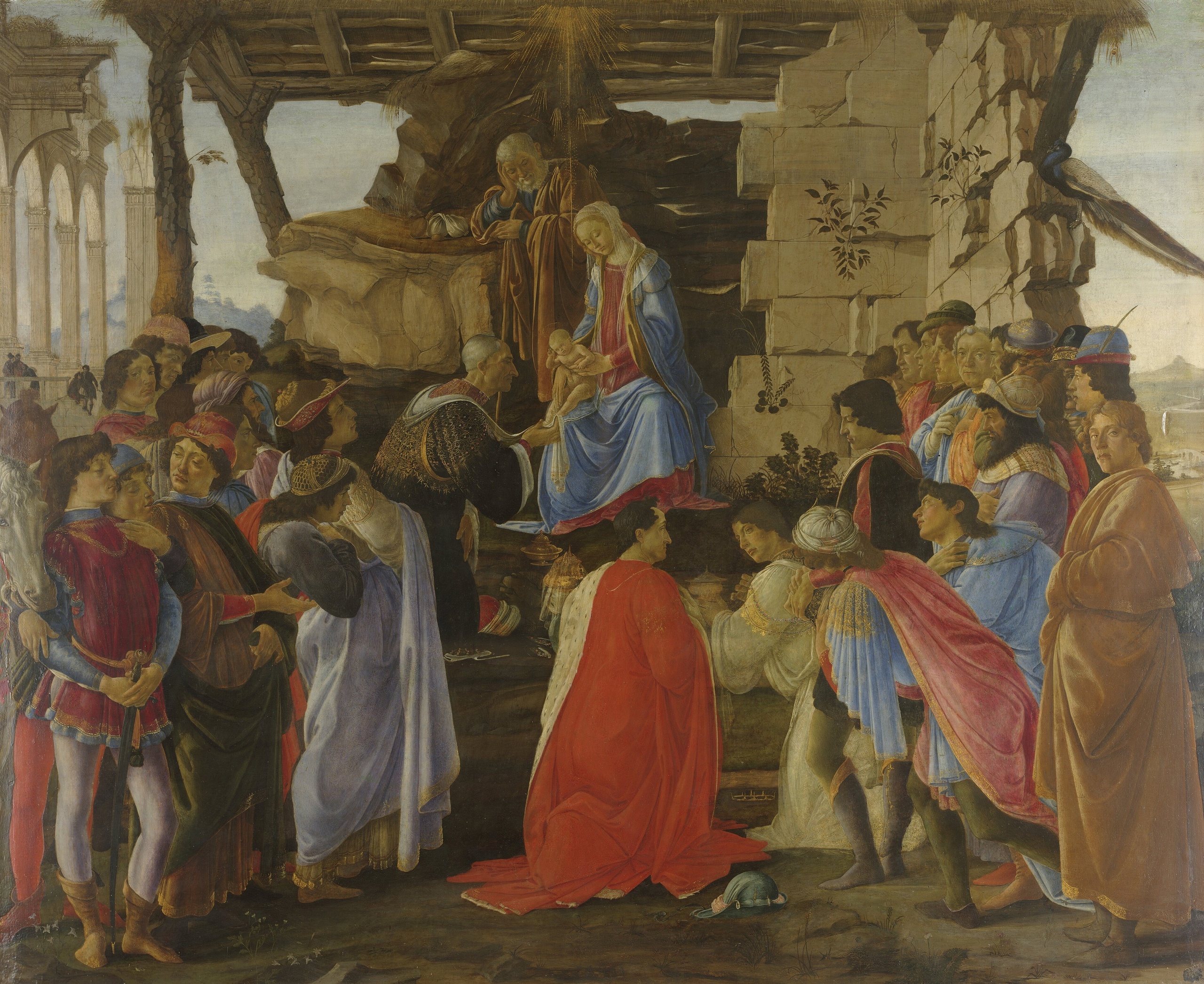
Adoration of the Magi is a painting by Sandro Botticelli from around 1475, made for an altar in Santa Maria Novella, Florence: Mary sits with the Christ Child and Joseph on a rocky ledge under a wooden shelter, the Magi kneel before them, and richly dressed men crowd around them, traditionally identified as members of the Medici family. The original, tempera on panel measuring 111 x 134 cm, hangs in the Uffizi Gallery in Florence. Our painter paints it for you by hand in oil on canvas, in 8 landscape sizes from 40 x 32 to 190 x 150 cm or made to measure. Before it leaves us, you receive a photograph of your finished painting.
| Title: | Adoration of the Magi |
| Other titles: | Adorazione dei Magi (Italian title) · Poklon treh kraljev (Slovene title) |
| Painter: | Sandro Botticelli (c. 1445–1510) |
| Year painted: | c. 1475 |
| Original size: | 111 cm x 134 cm (height x width) |
| Original technique: | Tempera on panel |
| Painting style: | Early Renaissance |
| Located at: | Uffizi Gallery, Florence, Italy, inv. 1890 no. 882 |
| Our reproduction: | Hand-painted in oil on canvas, 8 sizes or made to measure |
Adoration of the Magi – Sandro Botticelli
What does Adoration of the Magi show?
The scene is set among ancient ruins. At the top a wooden shelter with a thatched roof rests on two tree trunks, beside a cracked wall of large stone blocks where plants grow and a peacock perches; far off on the left stand the arches of a ruined arcade.
Mary, in blue over red, sits high on the rock with the naked Child on her lap. Behind her the grey-haired Joseph rests his head on his hand, and the golden rays of the star of Bethlehem fall from above.
The oldest king kneels in a gold-embroidered black robe, touching the Child’s foot with both hands. Lower down, his back to us, the second king kneels in a red cloak lined with ermine, beside the third in pale clothes with gold hems.
Some thirty men in red, blue, gold and black crowd both sides. Horses’ heads appear at the far left, a young man with a sword stands in front, and at the right edge a man in a yellow-brown cloak looks straight at us.
What story does the painting tell?
A star leads the wise men to the newborn Jesus, and they kneel to offer him gold, frankincense and myrrh. In theology the three kings were the first Gentiles to recognise Christ.
The subject may also have been personal: the patron, Gaspare del Lama, bore the Italian form of Caspar, the name of one of the kings, and his funerary chapel was dedicated on 6 January, the feast of the Epiphany.
The Holy Family sits on one of the classical ruins, which serves as a makeshift stable. Scholars think the gold-banded robes imitate costly Asian and Islamic textiles.
The saturated colours, the reds above all, had to stand out in a dim chapel, and by candlelight the reds probably glowed warmly.
Why is the painting so famous?
Among the kings and their followers, tradition recognises members of the Medici family. Giorgio Vasari wrote in 1550 that the oldest king, kneeling before the Child, is Cosimo de’ Medici the Elder, the middle one Giuliano de’ Medici and the third Cosimo’s son Giovanni.
Most scholars agree that the scene includes Cosimo and his sons Piero and Giovanni as posthumous portraits, and his grandsons Lorenzo and Giuliano, who were then alive. The Medici belonged to the Florentine confraternity of the Magi, and so were customarily shown as the kings.
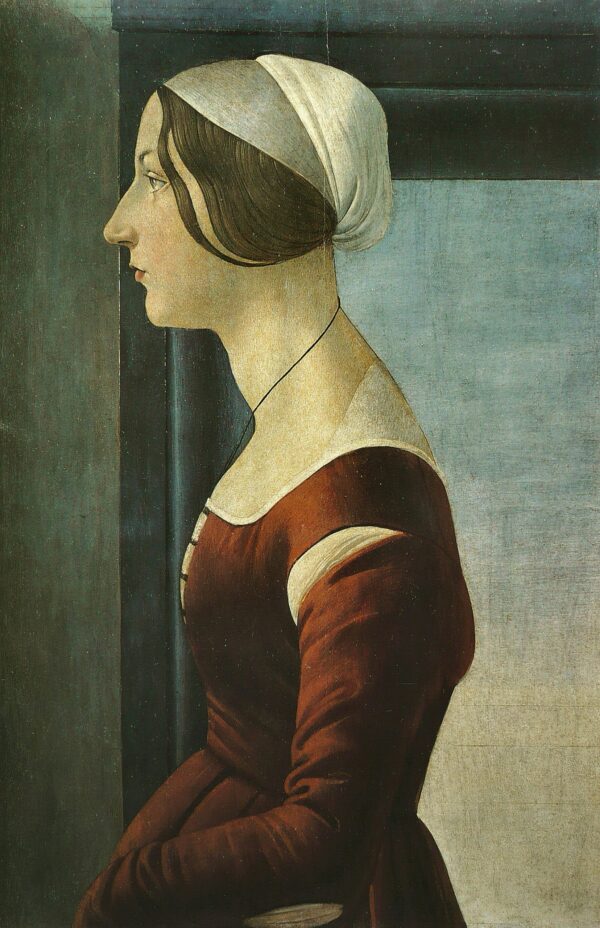
The patron is here too: Gaspare is the white-haired man in blue on the right who meets our eye. The man in the yellow cloak at the right edge is accepted by most scholars as Botticelli’s self-portrait. If you like his faces, you will find the same quiet focus in Portrait of a Young Woman, painted around the same year.
Vasari admired the variety of the heads, each with its own pose and expression. The Wikipedia article on the painting, in English, tells more about its portraits.
Where is the original today?
The original hangs in the Uffizi Gallery in Florence, inventory number 1890 no. 882; it arrived there in 1796.
For nearly a century it stayed on the altar with the patron’s descendants. Around 1570 the Marquess Fabio Arrazola de Mondragone took it to his palace; seized in 1575 when he betrayed Grand Duke Francesco I de’ Medici, it passed to the grand ducal collections, and in 1622 to the Villa del Poggio Imperiale.
Sandro Botticelli, born Alessandro Filipepi in Florence around 1445, was a tanner’s son. According to Vasari he trained first as a goldsmith and then under the painter Filippo Lippi, who also painted this subject. He died in 1510; the Pre-Raphaelites rediscovered him in the late 19th century.
Adoration of the Magi or another Botticelli?
Adoration of the Magi is a canvas painting for those who like a story told in many faces. It sits well in a dining room or above a sideboard.
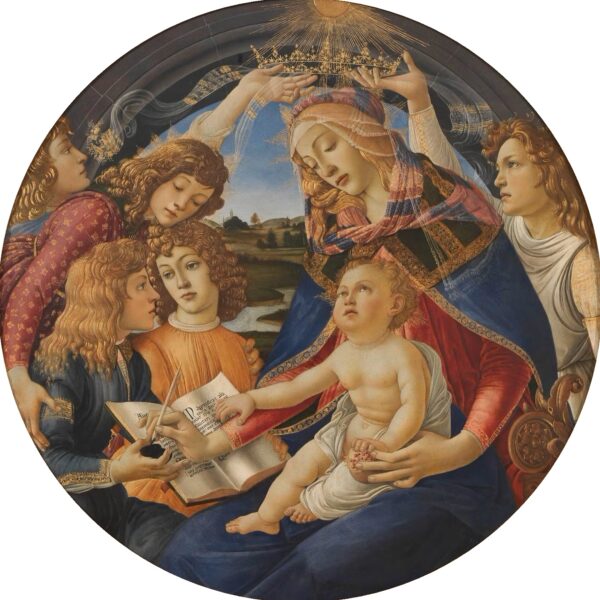
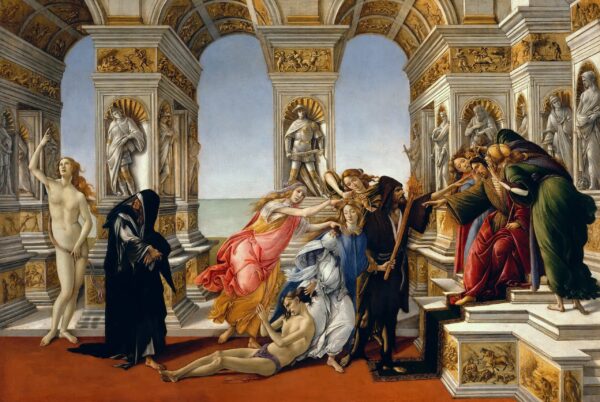
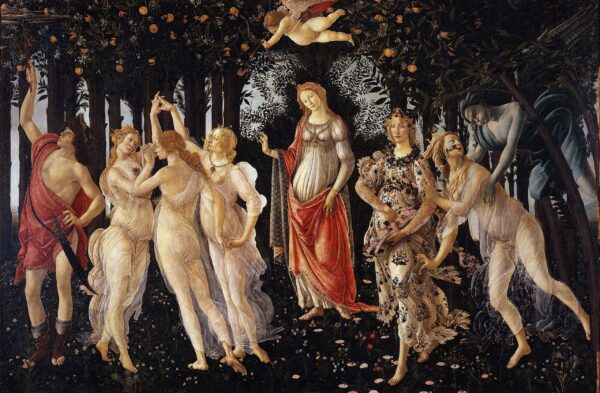
Botticelli was commissioned to paint this subject at least seven times. If his Madonnas appeal to you, see Madonna of the Magnificat, a round composition with Mary writing in a book. For mythology there is Primavera, with goddesses in a flowering grove, and for sharp allegory Calumny of Apelles, with its figures in a marble hall.
All our famous Botticelli paintings, each painted to order, are gathered on the Sandro Botticelli page.
How do we hand-paint Adoration of the Magi?
Botticelli’s original is not an oil painting: it is tempera on a wooden panel, 111 x 134 cm. Ours is a Sandro Botticelli reproduction painted by hand in oil on canvas, layer by layer, so it can travel rolled, stretched on a stretcher bar or framed.
The painter first draws the shelter, wall and arcade, places the groups and sets the Holy Family on the rock. Then come the sky, the stones and the broad colours of the robes: the red cloak, Mary’s blue, the violet and green mantles.
He paints the faces one by one. Last come the gold hems, the embroidery on the black robe, the gifts, the peacock’s feathers and the rays of the star falling on Mary.
Which size suits which wall?
In short: small sizes for a hallway, middle ones above a sideboard, the largest for a big living-room wall.
We paint Adoration of the Magi in 8 landscape sizes (width x height): 40 x 32, 50 x 42, 65 x 52, 74 x 59, 95 x 75, 120 x 95, 150 x 120 and 190 x 150 cm. The original measures 134 x 111 cm (width x height). Every size up to 120 x 95 cm is therefore smaller, 150 x 120 cm is a little larger and 190 x 150 cm well larger than the panel in Florence.
At 40 x 32 and 50 x 42 cm the scene feels intimate, right for a bedroom. From 65 x 52 to 95 x 75 cm it hangs well above a chest of drawers, a bed or in a dining room. As a painting for the living room it comes into its own from 120 x 95 cm upwards, where the faces read from the sofa.
Can I have another size, and which frame suits it?
Yes. For other proportions we keep every figure whole and adjust only the sky, ground or ruins at the edges, so it remains a complete oil painting reproduction of the scene. Send us the measurements you need and we will quote a price and a date.
We ship it rolled in a tube, stretched on a stretcher bar or framed; our workshop in Slovenia stretches and frames it and packs it safely. In our 3D app you choose the moulding only; seeing the painting on your own wall is a separate service. A gilded frame suits the gold and red tones.
When will your Adoration of the Magi arrive?
Your painting is ready for dispatch 15 to 45 working days after you confirm the order. We send you a photograph when it is finished and make any changes before packing.
Within the EU it travels without customs, and our returns policy covers every order.
A scene of kings bringing gifts makes a fine Christmas present. Not sure of their wall? A wall art voucher lets them choose the painting and the size themselves.
Frequently asked questions
Where can I see the original?
In the Uffizi Gallery in Florence, inventory number 1890 no. 882.
Who is the man in the yellow cloak at the right edge?
Most scholars see in him a self-portrait of Sandro Botticelli.
Is it a print?
No. It is a hand-painted copy: our painter brushes every face and every fold.
How large is the original?
111 x 134 cm (height x width); our 150 x 120 cm size is a little larger.
Can you paint the Adoration in a size that is not listed?
Yes. Tell us the width and height for a price and a date.
How long does the Adoration take, and how is it sent?
15 to 45 working days until dispatch, rolled, stretched or framed.
Will the Adoration suit a dining room or a living room?
Yes. Its warm red, blue and gold go well with wooden furniture.
Which Medici appear in the painting?
Tradition names Cosimo the Elder, his sons Piero and Giovanni and his grandsons Lorenzo and Giuliano.
- Subject: the Holy Family under a wooden shelter, three kneeling kings and some thirty richly dressed figures, among them the Medici and the painter himself.
- Original: tempera on panel, c. 1475, 111 x 134 cm, Uffizi Gallery, Florence.
- Ours: hand-painted in oil on canvas, 8 sizes from 40 x 32 to 190 x 150 cm, or made to measure.
- Worth knowing: it was made for an altar in Santa Maria Novella and stayed there for nearly a hundred years.