







































Description
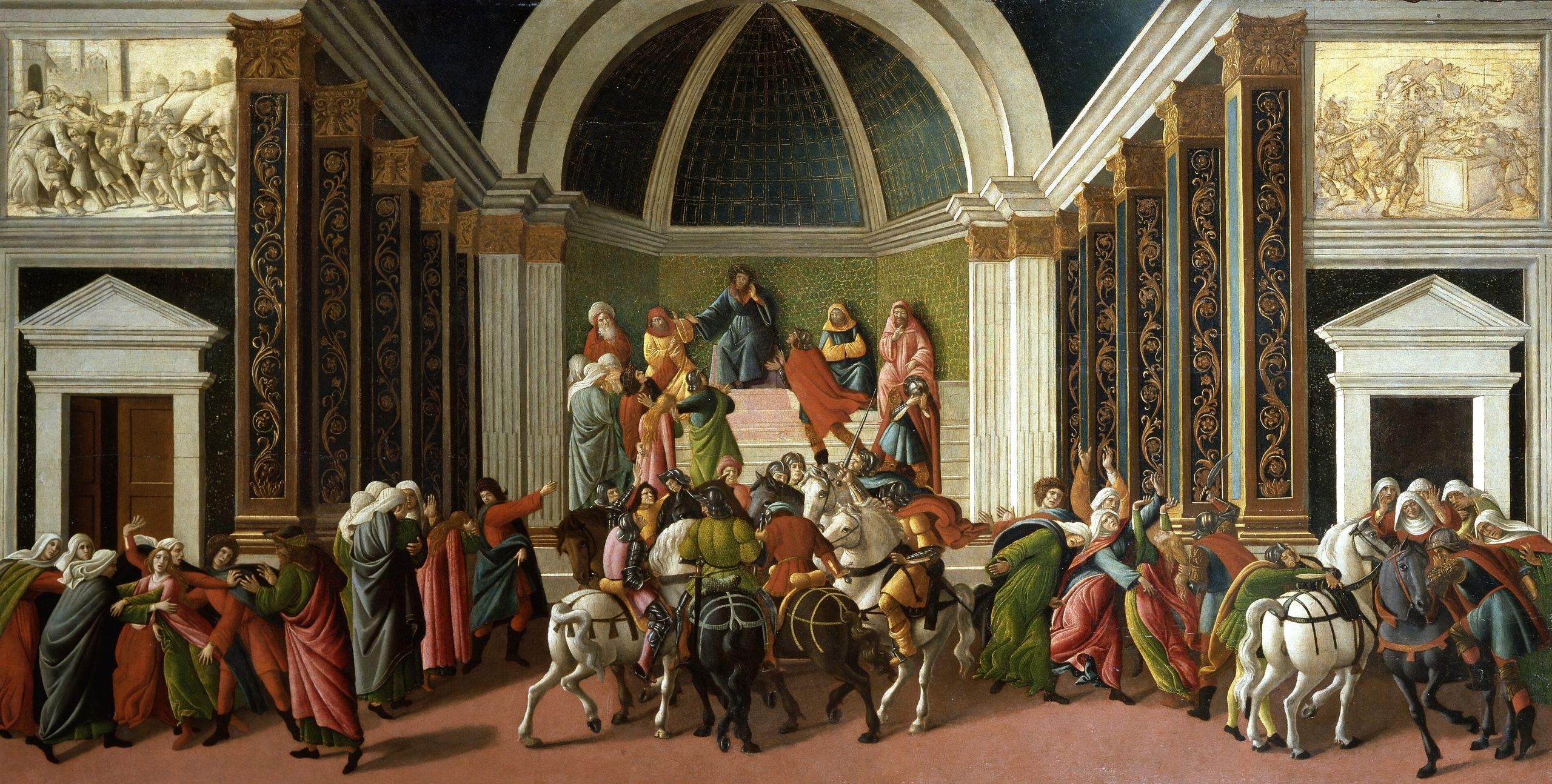
The Story of Virginia is a long panel that Sandro Botticelli painted around 1500: inside a grand hall with a domed apse, a Roman legend told by Livy unfolds in several scenes from left to right, from the moment the young Virginia is seized among her companions to the judgement of the magistrate Appius Claudius and her father’s flight on horseback. The original, tempera on panel measuring 86 x 165 cm, belongs to the Accademia Carrara in Bergamo. Our painter recreates it for you by hand in oil on canvas, in 4 landscape sizes from 100 x 51 to 200 x 97 cm or made to measure. You see a photograph of the finished painting before we send it.
| Title: | The Story of Virginia |
| Other titles: | Storie di Virginia (Italian title) · Zgodba o Virginiji (Slovene title) |
| Painter: | Sandro Botticelli (c. 1445–1510) |
| Year painted: | c. 1500 |
| Original size: | 86 cm x 165 cm (height x width) |
| Original technique: | Tempera on panel |
| Painting style: | Early Renaissance |
| Located at: | Accademia Carrara, Bergamo, Italy |
| Our reproduction: | Hand-painted in oil on canvas, 4 sizes or made to measure |
The Story of Virginia – Sandro Botticelli
What does The Story of Virginia show?
The whole panel is taken up by one monumental building. In the middle a wide arch opens onto a half-dome painted with a fine grid of gold lines on deep blue, and beneath it a green wall closes off a raised platform. To either side stand rows of dark pillars covered in climbing gold scrolls. In the two upper corners are pale reliefs of crowded battles, and at the far left and far right a small temple front frames a doorway.
On the left, by a half-open wooden door, women in white veils and long cloaks of green, grey and red surround a fair-haired girl in pink. A man in a red tunic has taken hold of her arm.
At the top of the pink steps in the centre, a judge in a blue cloak sits on a high throne, flanked by four men in red, yellow and orange robes. Before him the girl appears again, now led by an older man in green, while an armed man in a red cloak kneels on the steps.
Across the front a knot of riders in armour turns on white, black and brown horses, swords raised above their helmets. To the right, women with lifted arms and wind-blown mantles gather around a sinking figure, and at the very edge a rider on a white horse leaves the scene.
Which Roman legend does the painting tell?
The legend comes from the Roman historian Livy and is set around 449 BC, when Rome was governed by the decemvirs, ten magistrates given full powers to write down the laws. One of them, Appius Claudius, desired Virginia, the daughter of the centurion Lucius Virginius, who was away with the army.
Virginia was betrothed to Icilius and turned Appius away. He then had his client Marcus Claudius claim in the forum that the girl was born to a slave of his household and so belonged to him. The case came before a tribunal presided over by Appius himself, who declared her a slave.
Her father, called back from the camp, and her betrothed pleaded for mercy in vain. Seeing no other way to keep his daughter out of slavery and her honour intact, Virginius took her life and escaped on horseback. In Livy’s account the Romans then rose up, and the rule of the decemvirs came to an end.
Why is the painting so admired?
It is one of the last works in which Botticelli held up an example of virtue, as he did with the tale of Lucretia, and the two panels are often paired.
Its subject is often read as an allusion to the right to rise against tyranny, a burning question in Florence after the expulsion of Piero de’ Medici and the founding of the republic of Savonarola.
Art historians count it among the most complex narrative pictures of Botticelli’s late style, with some fifty small figures kept legible by bright robes and quick gestures. A short overview of the scenes is given in the English Wikipedia article, which is written in English.
Where is the original today?
The original hangs in the Accademia Carrara in Bergamo.
The panels with Virginia and Lucretia belonged to a set of painted spalliere recorded around 1500 in the Vespucci house in Florence, today Palazzo Incontri. In 1550 Giorgio Vasari described several very lively paintings by Botticelli set into such a spalliera in the house of Giovanni Vespucci.
Sandro Botticelli was born around 1445 in Florence, the son of a tanner, and trained under Filippo Lippi. He spent almost his whole life in the same Florentine neighbourhood; his longest time away was in Rome in 1481–82, when he painted the walls of the Sistine Chapel, among them the fresco The Punishment of the Rebels. He died in 1510.
The Story of Virginia or another Botticelli?
This canvas painting suits anyone who likes to read a work slowly, scene by scene. Its long, low format fits above a sofa, a sideboard or a bed, where a square painting would leave half the wall empty.
If you want the full pair, hang it beside The Story of Lucretia, the companion panel with the Roman heroine whose fate, according to Livy, came about fifty years earlier. The marble hall recalls the richly decorated architecture of Calumny of Apelles, another late work, and The Story of Nastagio degli Onesti, Part One also unfolds its tale along a long panel.
The famous Botticelli paintings we offer, all painted to order, are gathered on one page: Sandro Botticelli.
How do we hand-paint The Story of Virginia?
Botticelli’s original is tempera on a wooden panel of 86 x 165 cm. Our oil painting reproduction, by contrast, is hand-painted in oil on canvas, built up layer by layer, so it can travel rolled, stretched on a stretcher bar or framed.
The painter starts with the perspective. The arch, the gridded half-dome, the steps and the receding rows of pillars all lead the eye to the throne, so the lines must be right before the first figure appears.
Which size for which wall?
In short: the two smaller sizes for a hallway, a study corner or above a bed, the two larger ones for a long wall above a sofa or sideboard.
We paint The Story of Virginia in 4 landscape sizes (width x height): 100 x 51, 135 x 70, 160 x 77 and 200 x 97 cm. The panel in Bergamo measures 165 x 86 cm (width x height). Our 100 x 51 and 135 x 70 cm are smaller than it, 160 x 77 cm comes very close to its width, and 200 x 97 cm is larger.
As a painting for the living room it works best from 160 x 77 cm, when the faces on the steps and the gold ornament on the pillars can be read from the sofa.
Can I order another size, and which frame suits it?
Yes. If your wall needs a different ratio, we keep every scene whole and adjust the floor at the bottom or the dark band above the arch. Send us your custom size request and we reply with the price and the time needed.
The painting ships rolled in a tube, stretched on a stretcher bar or framed. Our workshop in Slovenia does the stretching and framing and packs this Sandro Botticelli reproduction with care. You look at and pick the moulding in our 3D app; seeing the painting on your own wall is a separate service.
When will your Story of Virginia arrive?
Your Virginia panel is ready to leave us 15 to 45 working days after you confirm the order. When it is finished we send you a photograph, and if you would like something changed, we do it before packing.
No customs duties apply within Slovenia or anywhere else in the EU, and our returns policy covers every order.
Not sure about the wall? Give a gift voucher and let them choose the painting and size themselves.
Frequently asked questions
Where can I see the original?
In the Accademia Carrara in Bergamo, Italy.
Who sits on the throne in the centre?
The decemvir Appius Claudius, who in the legend declares Virginia a slave.
Is this a print?
No. It is a hand-painted copy: our painter paints every horse, pillar and face with a brush.
How big is the original panel?
86 x 165 cm (height x width); our 160 x 77 cm comes close to its width, and 200 x 97 cm is larger.
Can you paint The Story of Virginia in a size not on your list?
Yes. Tell us the width and height you need, and we answer with the price and the time needed.
How long does The Story of Virginia take, and how does it travel?
Dispatch follows 15 to 45 working days after your order is confirmed; the long canvas then travels rolled, stretched or framed.
Is the subject suitable for a bedroom?
Such legends were usually painted for private rooms such as bedrooms; told calmly, the story suits a bedroom or a study.
Does the panel have a companion?
Yes, the tale of Lucretia, now in the Isabella Stewart Gardner Museum in Boston; the two are often shown together.
- Subject: the Roman legend of Virginia in several scenes inside a hall with a domed apse: her seizure, the tribunal of Appius Claudius, the uprising and her father’s flight.
- Original: tempera on panel, c. 1500, 86 x 165 cm, Accademia Carrara, Bergamo.
- Our painting: hand-painted in oil on canvas in 4 sizes from 100 x 51 to 200 x 97 cm or made to measure.
- Good to know: around 1500 it was recorded together with the Lucretia panel in the Vespucci house in Florence.