







































Description
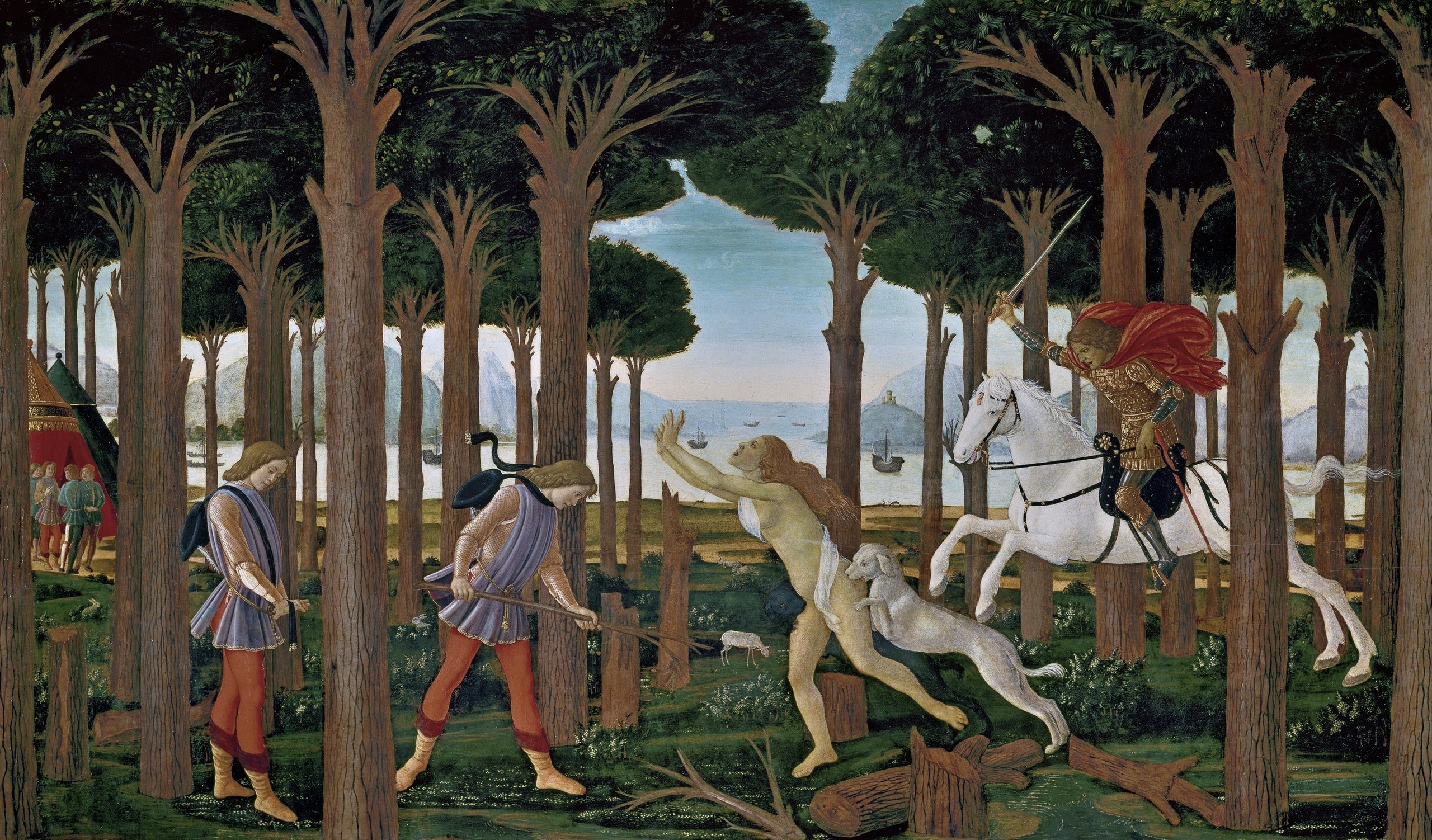
The Story of Nastagio degli Onesti, Part One is a painting by Sandro Botticelli from 1483, the first of four panels based on Boccaccio’s Decameron: in a pine forest by the sea, young Nastagio watches a knight on a white horse hunt a naked woman with his dogs and tries to fend them off with a branch. The original, tempera on panel measuring 83 x 138 cm, belongs to the Museo del Prado in Madrid. Our painter paints it for you by hand in oil on canvas, in 5 landscape sizes from 90 x 55 to 190 x 110 cm or made to measure. When it is finished, we send you a photograph before it leaves us.
| Title: | The Story of Nastagio degli Onesti, Part One |
| Other titles: | Nastagio degli Onesti, primo episodio (Italian title) · Zgodba o Nastagiu degli Onestiju, prvi del (Slovene title) |
| Painter: | Sandro Botticelli (c. 1445–1510) |
| Year painted: | 1483 |
| Original size: | 83 cm x 138 cm (height x width) |
| Original technique: | Tempera on panel |
| Painting style: | Early Renaissance |
| Located at: | Museo del Prado, Madrid, Spain, acc. no. P002838 |
| Our reproduction: | Hand-painted in oil on canvas, 5 sizes or made to measure |
The Story of Nastagio degli Onesti, Part One – Sandro Botticelli
What does the first Nastagio panel show?
The scene is set in a pine forest near the coast. Tall, straight trunks stand in close rows across the surface; between them the view opens onto calm water with ships, an island with a tower and bluish mountains.
At the far left, in front of a red and a green tent, friends advise Nastagio, in red hose, to leave the city for a while. Closer to us the same young man walks alone with his head bowed, lost in thought.
Beside him, a third time, he steps forward with a long branch to drive the dogs away. In the middle a naked woman with long golden-brown hair runs with her arms stretched out, a thin white veil at her hip, as a large white hound seizes her.
From the right a knight in golden armour and a streaming red cloak charges in on a rearing white horse, his sword raised high. Yet a white sheep grazes calmly in the clearing.
What is Boccaccio’s tale about?
The story of Nastagio degli Onesti is the eighth tale of the fifth day in Giovanni Boccaccio’s Decameron. Nastagio, a nobleman of Ravenna, falls in love with the daughter of Paolo Traversari, but she turns down his courtship.
Disappointed, he leaves the city and wanders sadly through the pine wood near Ravenna, where a knight with his dogs is chasing a woman. Nastagio tries to protect her, in vain: the woman and the knight are ghosts, and she is punished for having been ungrateful to the man who loved her.
Boccaccio gives the tale a happy ending. Seeing this punishment for the same sin of ingratitude, Traversari’s daughter changes her mind about Nastagio. This happy outcome made the subject fit for wedding panels. Botticelli tells it calmly, without harshness, somewhere between fairy tale and reality.
Why is this panel special?
On a single panel Botticelli shows several moments of the story one after another, which is why Nastagio appears three times. This way of telling a story was typical of the late Middle Ages, and the tale reads from left to right.
The upright tree trunks and the horizontal line of the sea behind them together form a kind of grid that gives the scene a remarkable depth.
The panel is the first of four that together tell the whole tale. Botticelli conceived all four, but he left part of the execution to assistants, above all Bartolomeo di Giovanni for the first three and Jacopo da Sellaio for the fourth.
More on the series is in the Wikipedia article, which is in English.
Where is the original today, and how did it get there?
The original is in the Museo del Prado in Madrid, inventory number P002838, with the second and third parts; the fourth panel is back in Florence, where it began.
All four panels were commissioned in 1483 for the wedding of Giannozzo Pucci and Lucrezia di Piero Bini, possibly by Lorenzo de’ Medici. Botticelli painted Lorenzo’s younger brother in Portrait of Giuliano de’ Medici. The panels stayed in the Palazzo Pucci in Florence until 1868, when they were sold.
Botticelli painted it in the 1480s, his most successful decade, soon after working in the Sistine Chapel in Rome in 1481 and 1482.
The Nastagio panel or another Botticelli?
The first part of the Nastagio story is a canvas painting for those who love a narrative and a woodland scene. Its long, low format suits the wall above a sofa or a sideboard.
Botticelli’s best-known works are mythological. The goddess on her shell drifts ashore in The Birth of Venus, and figures from myth gather in a flowering grove in Primavera; both hang in the Uffizi. If you like his storytelling in several scenes, see the fresco The Temptations of Christ in the Sistine Chapel.
The rest of the famous Botticelli paintings we paint to order are collected on our Sandro Botticelli page.
How do we hand-paint the Nastagio story?
Botticelli’s original is not an oil painting but tempera on a wooden panel, 83 x 138 cm. Our version is a Sandro Botticelli reproduction built up by hand in oil on canvas, one layer over the next, which means it can reach you rolled, on a stretcher bar or in a frame.
The painter first sets out the tree trunks, the grid that carries the composition, then the sky, the sea with its ships and the dark crowns of the pines.
Only then come the figures: Nastagio three times in red hose, the pale body of the fleeing woman, the white hound and the rearing horse. Last come the gold lights on the armour and the folds of the red cloak.
Which size fits which wall?
In short: small sizes for a narrow wall or a corner, middle ones above a chest of drawers or a bed, the largest above the sofa in a living room.
We paint the first Nastagio panel in 5 landscape sizes (width x height): 90 x 55, 104 x 60, 130 x 77, 145 x 90 and 190 x 110 cm. The original measures 138 x 83 cm (width x height), so all three sizes from 90 x 55 to 130 x 77 cm are smaller, 145 x 90 cm is a little larger and 190 x 110 cm much larger than the panel in the Prado.
90 x 55 cm suits a chest of drawers, a bed or a dining room. As a painting for the living room it comes into its own from 104 x 60 cm up.
Can I order another size, and which frame suits it?
Yes. If you need other proportions, we keep every figure whole and adjust only the sky, the forest floor or the trees at the edge, so it remains an oil painting reproduction of the complete story. Tell us the size you have in mind and we will come back with a price and a date for your Nastagio.
It leaves us rolled in a tube, stretched on a stretcher bar or framed, as you prefer. Our workshop in Slovenia does the stretching and framing and packs the painting carefully for the journey. You pick the moulding in our 3D app, which is for frame choice only; a view of the painting on your own wall is a separate service.
When will your Nastagio painting arrive?
Allow 15 to 45 working days from your order confirmation until the Nastagio panel is ready to ship. We send you a photograph of the finished painting first and make any change you ask for before packing.
Within Slovenia and to other EU countries it travels without customs, and every order is covered by our returns policy.
Since the series was made for a wedding, this scene makes a fine wedding or anniversary present. Not sure which wall is waiting for it? Give a wall art voucher and let them choose the painting and size themselves.
Frequently asked questions
Where is the original kept?
In the Museo del Prado in Madrid, inventory number P002838.
Who is the young man in red hose?
He is Nastagio degli Onesti, a nobleman of Ravenna; he appears three times in the panel.
Is it a print?
No. It is a hand-painted copy: our painter brushes in every trunk, every figure and every wave.
How large is the original?
83 x 138 cm (height x width); our 145 x 90 and 190 x 110 cm sizes are larger.
Is the Nastagio panel available in an unlisted size?
Yes, any width and height; write to us and we will quote a price.
How long will I wait, and how does it travel?
15 to 45 working days until dispatch; it arrives rolled, stretched or framed.
Is it suitable for a bedroom?
The scene is dramatic and shows a naked woman, so it suits an adult bedroom or a living room better than a child’s room.
What does the story mean?
A moral tale with a happy ending that warns against ingratitude in love.
- Subject: Nastagio three times in a seaside pine forest, a naked woman fleeing a white hound, and a knight with his sword raised.
- Original: tempera on panel, 1483, 83 x 138 cm, Museo del Prado, Madrid.
- Ours: hand-painted in oil on canvas, 5 sizes from 90 x 55 to 190 x 110 cm, or made to measure.
- Worth knowing: the first of four panels painted in 1483 for a Florentine wedding, after a tale from the Decameron.