Description
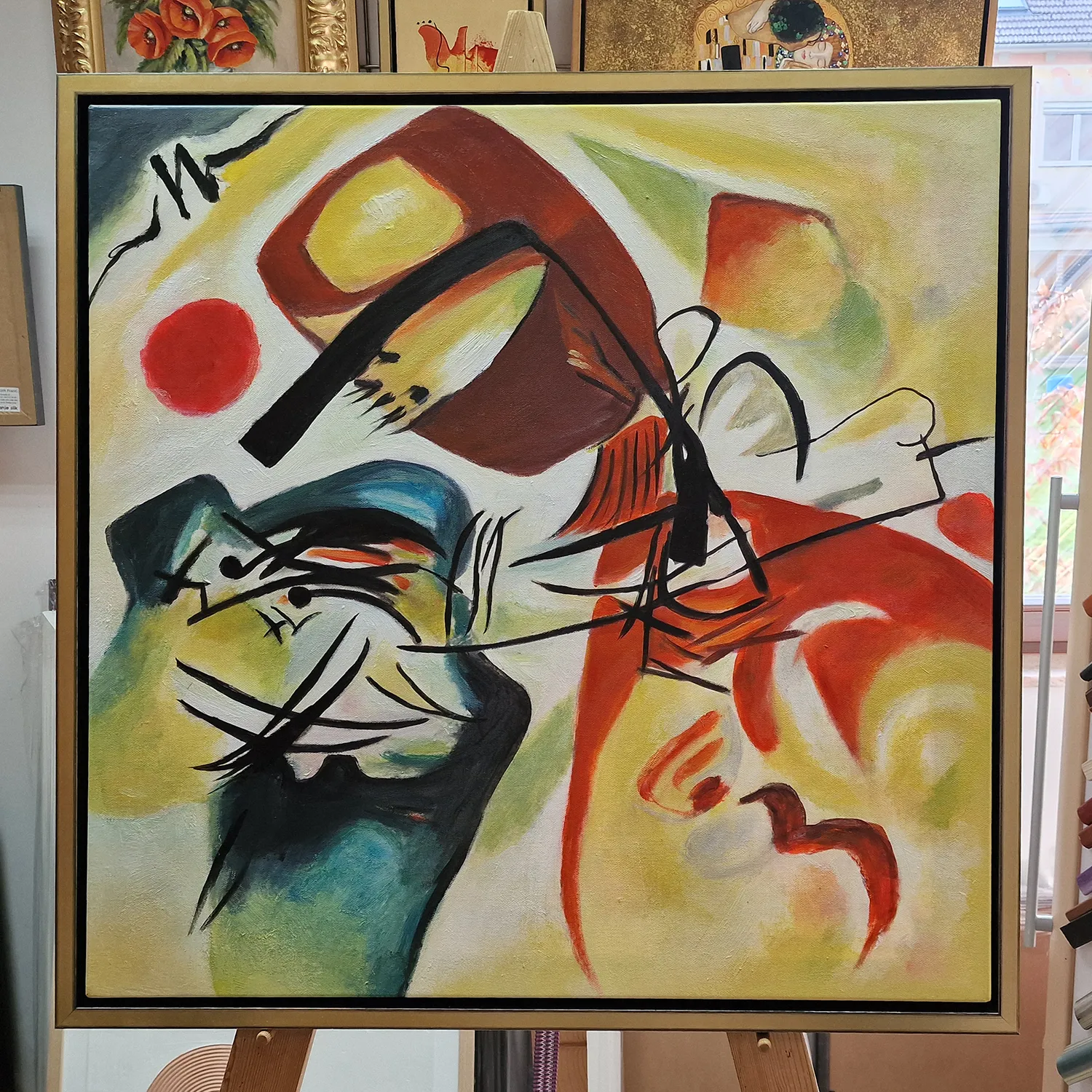
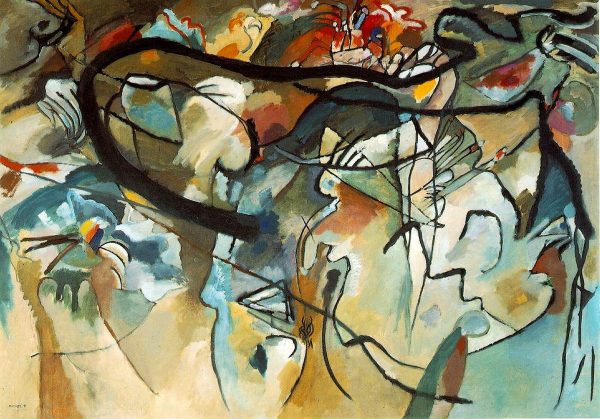
With the Black Arch is a work by Wassily Kandinsky from 1912: a nearly square canvas crossed by a broad black arch, around which three large masses of colour gather and almost touch. The original is at the Centre Pompidou in Paris. We make it as a hand-painted reproduction in oil on canvas, in eight sizes or to your measurements, with a photograph of the finished work sent for approval before dispatch.
| Title: | With the Black Arch |
| Other titles: | Mit dem schwarzen Bogen · Avec l’arc noir · Con l’arco nero · S črnim lokom |
| Painter: | Wassily Kandinsky (1866–1944) |
| Year: | 1912 |
| Original size: | 198 cm x 189 cm |
| Original technique: | Oil on canvas |
| Style: | Abstract art |
| Location: | Musée national d’art moderne, Centre Pompidou, Paris (inv. AM 1976-852) |
| Our reproduction: | hand-painted oil on canvas, 8 sizes from 60 x 60 cm to 196 x 188 cm, made to measure on request |
With the Black Arch – Wassily Kandinsky
What holds this painting together?
The black arch. The museum that holds the work describes it as a large black arc holding back three masses of colour that are ready to collide with one another – in its own text, three continents colliding. The arch neither separates them nor encloses them: it stands among them like a strut that keeps the distance open. That is why the composition does not fall apart although nothing in it can be recognised: the tension between the masses is held rather than resolved. This was exactly Kandinsky’s work in those years – how a whole can be assembled with no scene, no perspective and no story.
What is on the canvas?
The canvas is nearly square, only slightly wider than it is tall, and the ground is light, a yellowish cream, nowhere uniform. A broad black band arcs across the upper half: at the lower left it ends bluntly, as if cut off, and does not reach the edge of the canvas; it then rises across the wine-red mass, growing narrower, and to the right it drops as a thin line into a short, thick black bar. This is the arch the work is named for. Behind it lies a large dark wine-red mass, thick and rounded, with a pale yellow field inside it, so that the mass reads as a thick ring. Beside it to the right is a smaller orange-red area with soft edges. At the lower left stands a second mass, dark blue-green, crossed by thin black strokes that intersect as if drawn in a single movement. At the lower right a third mass spreads out, a strong red, with rounded edges and lighter places where the paint thins. At the left, on the empty ground, rests a round red disc. In the upper left corner stands a small black zigzag, and at the right a few thin black loops, drawn rather than painted. On the original, the signature and the date are at the lower left.
Where does the black arch come from?
From a horse harness. The museum explains that the arch was prompted by the douga, part of the traditional Russian harness for a team of three: a bent bow of elm wood, irregular in shape and tending towards a semicircle, fixed above the middle horse. Kandinsky grew up in Russia and the shape was as ordinary to him as a door handle is to us. On the canvas no team and no horses remain, only the shape, and it is not a regular arc because elm bends the way elm bends.
What happened in the autumn of 1912?
The work went to Berlin. It was painted in Munich in the autumn of 1912, and according to the museum’s record Kandinsky changed the plan for his first solo exhibition at the Der Sturm gallery just then. In a letter to Herwarth Walden of 20 September 1912 he wrote that he was sending this canvas in place of Improvisation 27, which had already been with Walden the previous winter, and proposed the left wall of the second room for it. The opening, planned for 1 October, was put back by one day. The work is therefore among the first the public saw as part of Kandinsky’s solo exhibition rather than as a contribution to a group show.
Why does this work matter?
Because music can be heard in it. The museum says so plainly: the lines dissociate from the colours, matches and mismatches arise, and this path is akin to the principle of dissonance of the composer Arnold Schoenberg – and it led Kandinsky to an abstract visual language as powerful as music. The museum’s commentary also points to a letter Kandinsky wrote to Schoenberg in August 1912, arguing that construction can be reached on the principle of dissonance as well, and not only through insistent geometry. As an abstract painting it is one of the works in which what had been a scene turns finally into a relation.
How is our hand-painted version made?
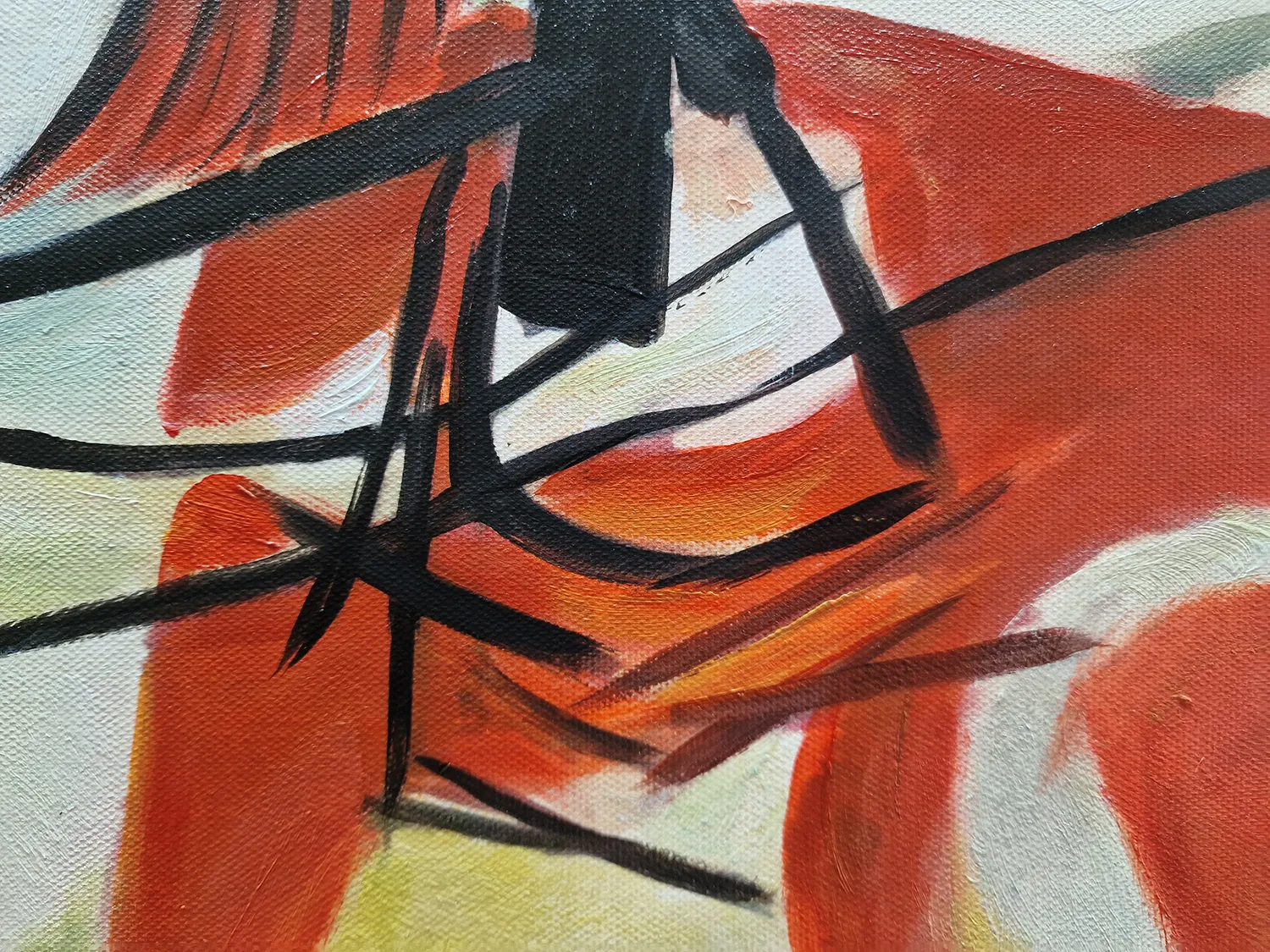
We paint it in oil on canvas, stroke by stroke, in our studio in Slovenia. The first photograph shows the finished work framed on the easel: the whole canvas edge to edge, with nothing cropped. The fourth photograph is taken close up and shows what a screen otherwise hides – the red mass crossed by black strokes, the weave of the canvas under the paint, and the slight ridges the brush leaves where the paint went on more thickly. Because every canvas is painted singly, no two match to the last detail; what matches is the subject, the proportions and the range of colour.
Which size for which wall?
Our scale ends at 196 x 188 cm, our closest size to the original. Above a sofa, 100 x 100 cm is enough for the work to start doing its job, and at 120 x 120 cm the black arch takes on its full weight. As a painting for the living room, this work is best on a quiet, unpatterned wall, because it is lively enough by itself. For a hallway or an office choose 80 x 80 cm; in a tall room with an empty wall, a square canvas carries the largest sizes better than a narrow landscape one does.
Made to measure, stretcher and frame
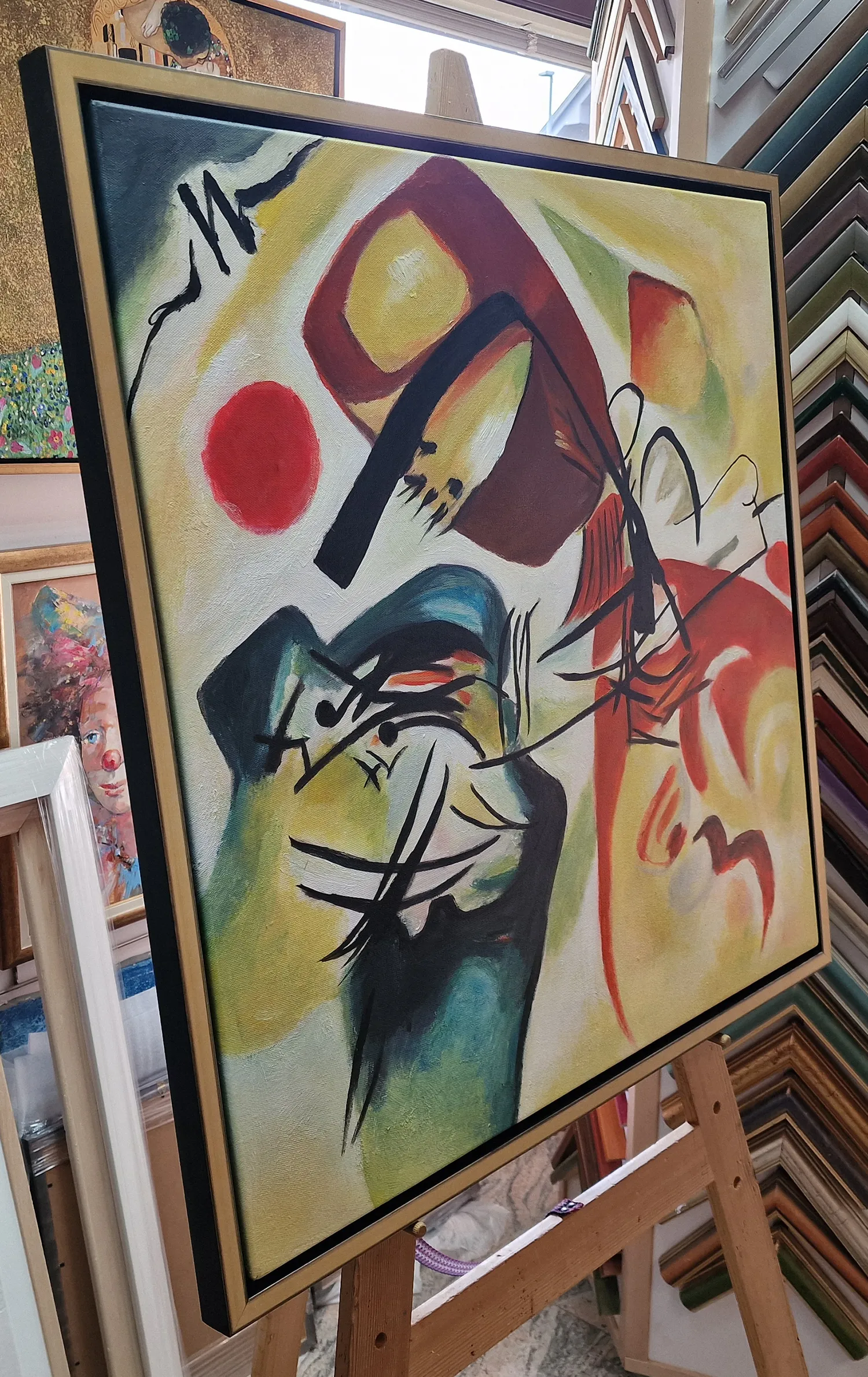
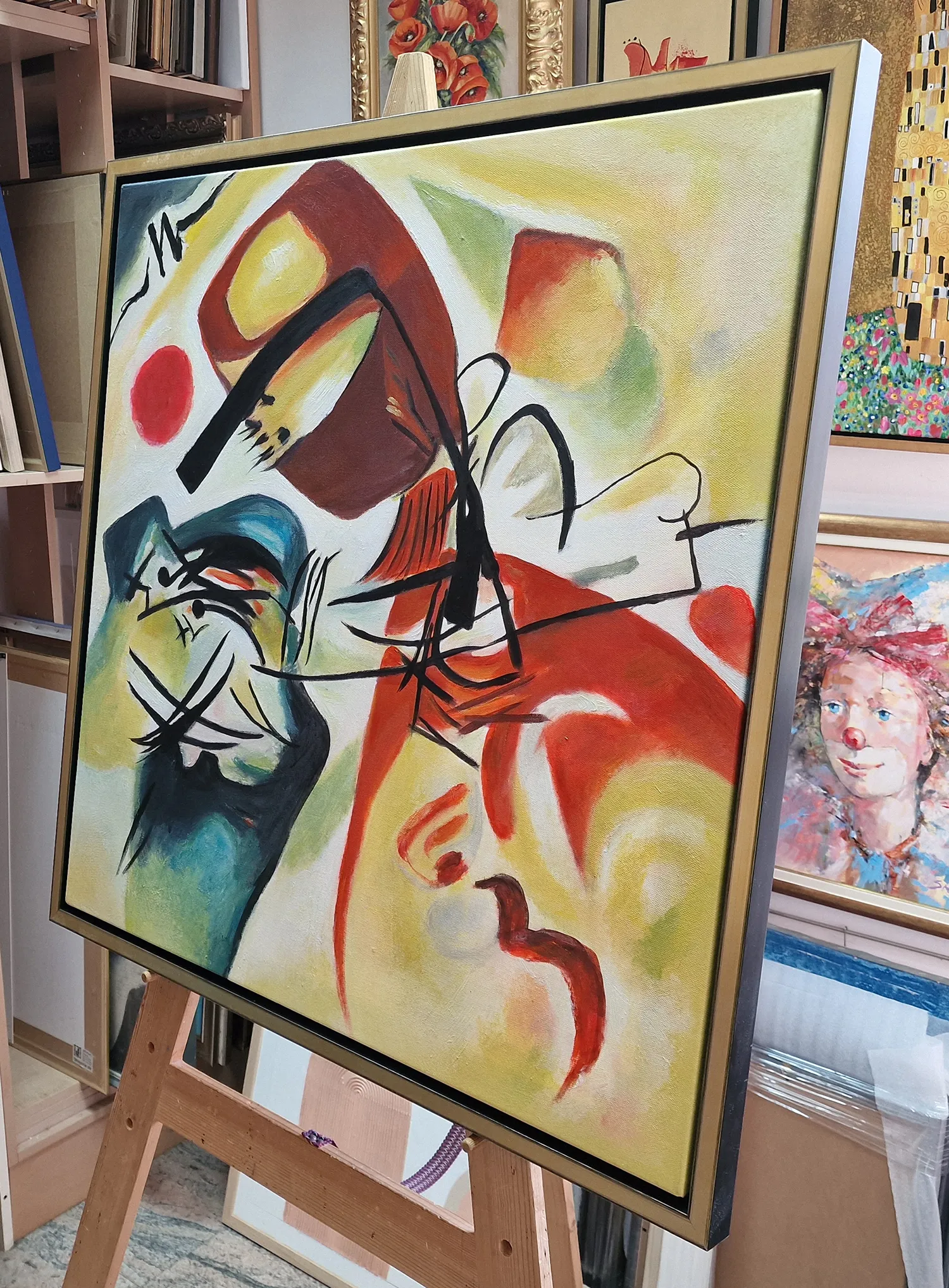
Every canvas is stretched on a wooden stretcher; when it travels stretched, it arrives ready to hang. The second photograph, taken from the side, shows the depth of the frame the work appears in: a black-and-gold floater frame that does not touch the canvas, so a thin shadow stays between edge and frame. The third photograph shows the same frame from the other side, with the studio and the easel. A frame is optional and not in the base price. When none of the eight sizes fits, we work to measure in the proportion your wall asks for.
Delivery and guarantee
The work travels rolled in a tube or stretched on its stretcher, insured and tracked. Because every canvas here is painted only after the order, delivery takes 15–45 days, as the size selector also shows. If something is wrong on arrival, write and we will put it right.
Frequently asked questions
Where is the original?
In Paris, in the collection of the Musée national d’art moderne at the Centre Pompidou, under inventory number AM 1976-852. Until 14 February 2027 it is on loan to the Kandinsky exhibition at Palazzo Bonaparte in Rome. It came to the museum in 1976 as a gift from the painter’s widow, Nina Kandinsky. The museum’s own record can be read on the Centre Pompidou page.
How large is the original?
It measures 198 x 189 cm. We give the width first; the museum gives the height first, as 189 x 198 cm. The canvas is therefore nearly square but just wider than it is tall, and that small difference is noticeable when you stand in front of it.
When was it painted?
In 1912. The museum adds that it was made in Munich in the autumn of that year; the signature and the date are at the lower left of the canvas.
What does it show?
Nothing that could be named. The museum’s description speaks of a black arc holding back three masses of colour ready to collide, and of the world of appearances turning here into a world of shapes, colours, nuances and movement.
Is this a print?
No. This is a canvas painting and not a print: it is painted by hand in oil, the brushstrokes are visible in raking light and can be felt, and in the fourth photograph they are shown close up.
Which size should I choose?
For a living room 100 x 100 or 120 x 120 cm, for a hallway or office 80 x 80 cm, for a large empty space 160 x 150 cm or more. Tape a sheet of paper of that size to the wall and leave it there for a day.
Can I have a size that is not on the list?
Yes. We paint sizes outside the scale, in the proportion your wall needs, and tell you where the subject crops and where it does not.
How is it delivered?
Insured and tracked, rolled in a tube or stretched on its stretcher. Before dispatch you approve a photograph of the finished Kandinsky reproduction.
What is it about, briefly?
Held tension. Three masses of colour approach a collision and a black arch, taken from a Russian horse harness, keeps them apart, with nothing recognisable anywhere in it.
Is the original for sale, and what is it worth?
It is not for sale. It belongs to a public museum collection and stays there; what we offer is a hand-painted copy, not the original, and we never confuse the two.
Does it work as a gift?
It does, if the person receiving it can take strong colour and a large canvas. If you are unsure about the subject or the size there is a gift voucher, and the choice stays with them.
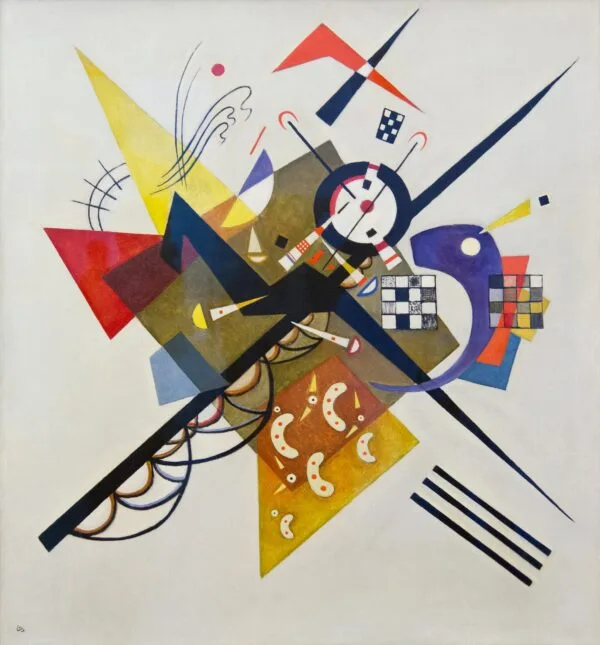
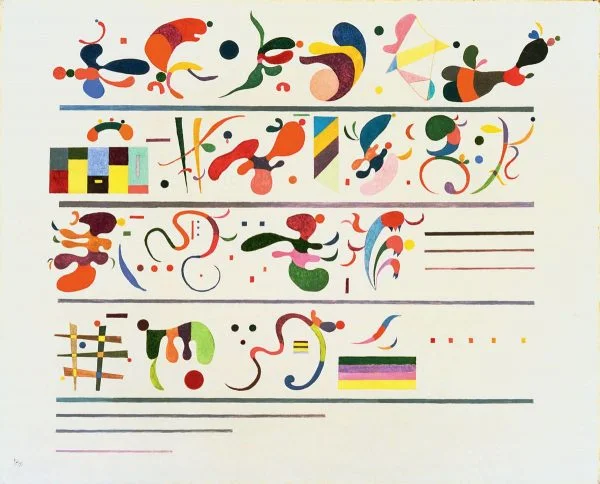
All of Kandinsky’s works here are gathered in our Wassily Kandinsky gallery: they include Composition VII, Several Circles, The Blue Mountain and Impression III (Concert). The painter is introduced in an article about Wassily Kandinsky. Among the works in the same Paris museum is Impression V (Parc), painted a year earlier. In changing daylight our oil painting reproduction keeps its strong colours.
- Subject: a broad black arch over a light ground, three masses of colour around it – wine-red, blue-green and red
- Original: Centre Pompidou, Paris, inv. AM 1976-852, 1912, 198 x 189 cm, gift of Nina Kandinsky 1976
- Our execution: hand-painted oil on canvas, eight sizes from 60 x 60 to 196 x 188 cm, stretched and framed on request
- Worth knowing: the black arch has the shape of the douga, the elm bow of the Russian three-horse harness