







































Description
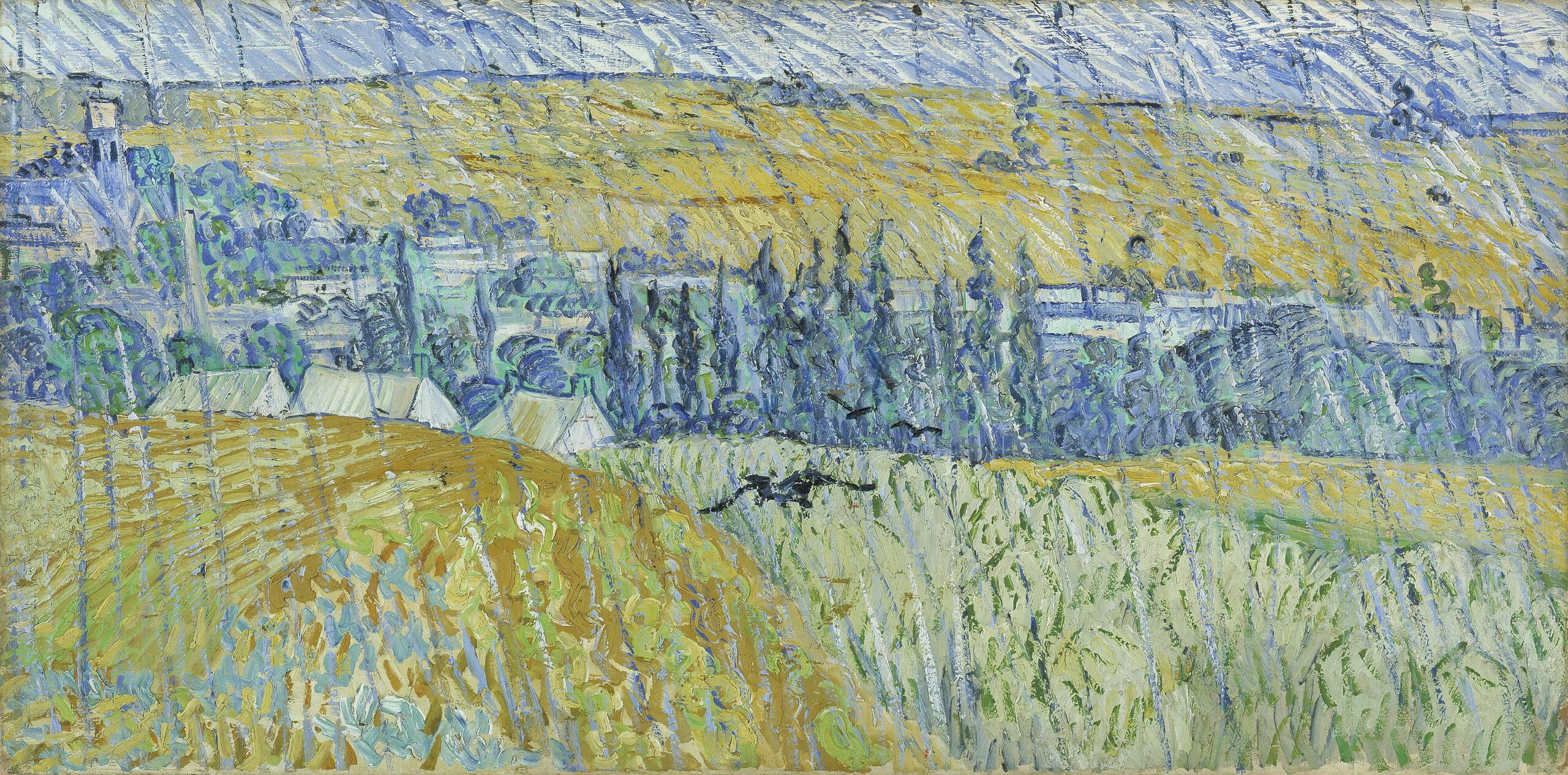
Landscape at Auvers in the Rain is Vincent van Gogh’s wide view of Auvers-sur-Oise and its fields in a downpour, painted in July 1890, in the last days of his life: yellow and green fields under a high horizon, the village among blue trees, a few crows, and thin strokes of rain across the whole canvas. The original measures 50.3 x 100.2 cm, twice as wide as it is high, and belongs to Amgueddfa Cymru – Museum Wales in Cardiff. We paint it by hand in oil on canvas, in 14 sizes from 60 x 30 to 180 x 90 cm or to your own measurement, and send you a photograph of the finished work for approval before dispatch.
| Title: | Landscape at Auvers in the Rain |
| Other titles: | Rain – Auvers · Rain, Auvers · Paysage d’Auvers sous la pluie |
| Painter: | Vincent van Gogh (1853–1890) |
| Year painted: | July 1890, Auvers-sur-Oise |
| Original size: | 50.3 cm x 100.2 cm |
| Original technique: | Oil on canvas |
| Painting style: | Post-Impressionism |
| Located at: | Amgueddfa Cymru – Museum Wales, Cardiff (inv. NMW A 2463) |
| Our reproduction: | Hand-painted oil on canvas, 14 sizes or made to measure |
Landscape at Auvers in the Rain – Vincent van Gogh
What does Landscape at Auvers in the Rain show?
The painting looks out over Auvers-sur-Oise, a village north-west of Paris, from a hillside. The canvas is twice as wide as it is high, and the horizon sits so high that only a narrow band of blue-grey sky shows along the top. Below it, fields in yellow, ochre and soft green run across the canvas in long horizontal strokes.
In the middle lies the village: white and blue walls and roofs among rounded trees in deep blue and blue-green, with tall, slender trees near the centre and a tower at the far left. Lower down, the pale roofs of a few low houses sink into the slope. The foreground is split in two: on the left a yellow-ochre field in long, curving strokes, on the right a light green field of short, upright dashes, with a few small black birds above it. There are no people. Over everything falls the rain, in thin dark blue lines that slant across the whole canvas.
Why is the rain painted as lines across the whole canvas?
The rain is not a grey veil but separate strokes drawn over the landscape. According to Amgueddfa Cymru – Museum Wales, this treatment of the rain as diagonal strokes derives from a woodcut of a bridge in the rain by the Japanese artist Hiroshige, which Van Gogh had copied in 1887. Wikipedia gives the woodcut its full title, Sudden Shower over Shin-Ōhashi Bridge and Atake.
Wikipedia also records where Van Gogh stood: the expert Wouter van der Veen found that he set up his easel on the hills of Méry-sur-Oise, south of Auvers, and painted the eastern part of the village, from the church to the hamlet of Cordeville.
What does the painting mean?
The museum connects its atmosphere with Longfellow’s poem The Rainy Day and quotes its lines: ‘Into each life some rain must fall, Some days must be dark and dreary.’ It also quotes his last letter: he was quite absorbed in the immense plain with wheat fields against the hills, boundless as a sea.
According to Wikipedia, the painting has been interpreted as symbolising the cycle of human suffering contrasted with a sense of hope. The writer Naomi Margolis Maurer, quoted there, saw the fields of grain as the vulnerable existence of mankind and the storm as passing catastrophes. These readings are gathered in the Wikipedia article on Landscape at Auvers in the Rain.
Where is the original today?
The original belongs to Amgueddfa Cymru – Museum Wales in Cardiff, which records it as Rain – Auvers, 1890, oil on canvas, 50.3 cm high and 100.2 cm wide, under the item number NMW A 2463. It is one of thirteen double-square canvases of the fields and gardens around Auvers that Van Gogh painted between 17 June and 27 July 1890. He died on 29 July 1890, shortly after painting it.
According to Wikipedia, Gwendoline Davies bought the painting in 1920 from the Bernheim-Jeune gallery in Paris for £2,020. She kept it in the music room of her home, Gregynog Hall, in Wales, and it came to the museum in 1952 with her bequest.
Landscape at Auvers in the Rain or another painting from Auvers – which to choose?
Van Gogh lived in Auvers-sur-Oise from May 1890 until his death. Wheat Field with Crows, also painted in Auvers in 1890, is a wide landscape of wheat under a dark sky, with a path running into the field. The Church at Auvers-sur-Oise, from June 1890, shows the village church in an upright format. Portrait of Dr. Gachet, also from 1890, shows the doctor who treated him in Auvers. Choose Landscape at Auvers in the Rain for a calm, wide panorama in yellow, green and blue on a long wall.
Bridge in the Rain is Van Gogh’s own copy, painted in 1887, of the Hiroshige woodcut that the museum names as the source of the rain strokes in this landscape. Side by side, the two show the same rain lines three years apart.
How is our hand-painted Landscape at Auvers in the Rain made?
The painter first sets out the horizon, the village and the edges of the fields. Then come the sky, the distant fields in long horizontal strokes, the houses and blue trees, the ochre field in curving strokes and the green field in short dashes, with the birds. The lines of rain go on last. Our oil painting reproduction is painted by hand in oil on canvas with real impasto: the paint goes on thickly, so the brushstrokes stand up from the canvas as they do in the original and catch the light.
On this painting the relief matters most in the dense strokes of the foreground fields and in the lines of rain that cross them. A print shows only a flat surface; on our painting every stroke is real paint.
Every painting is a hand-painted copy made for your order, so no two are quite the same.
Which size for which wall?
Short answer: 120 x 60 or 140 x 70 cm above a sofa, 100 x 50 or 110 x 55 cm above a sideboard, a desk or a bed, and 160 x 80 or 180 x 90 cm for a long wall. The wide format also suits a corridor or the wall above a headboard.
There are 14 sizes: 60 x 30, 70 x 35, 80 x 40, 90 x 45, 100 x 50, 101 x 50, 110 x 55, 120 x 60, 130 x 65, 140 x 70, 140 x 71, 150 x 75, 160 x 80 and 180 x 90 cm (width x height). The original is 100.2 cm wide and 50.3 cm high, so our 100 x 50 cm size is practically the size of the canvas in Cardiff. It sits well on a white, light grey or cream wall, and on a soft blue one that picks up the trees. The 60 x 30 cm size fits above a narrow shelf. A painting for the living room should take up about two thirds of the width of the furniture below it.
Hang it with the centre of the canvas about 150 cm above the floor, leaving 20 to 30 cm between the furniture and the bottom edge.
What if I need a custom size or a frame?
If none of the 14 sizes fits your wall, we paint it to measure. Keep the proportion of two to one, or the village and fields get squeezed. Send us the width and height you want and we will quote a price and a lead time. Every painting we make is stretched over a wooden stretcher and ready to hang.
For the moulding, use our 3D application: it shows each of our frame profiles on this subject, so you can compare gold, silver, black, white and natural wood – the application is for choosing the frame only. Seeing the painting on your own wall is our separate room placement service. A gold frame picks up the yellow and ochre of the fields, a black or dark wood frame deepens the blue.
How does delivery work, and what is the guarantee?
Every painting is made to order in our studio in Slovenia, so allow 15 to 45 days depending on the size you choose. We ship it stretched and protected, framed if you chose a frame, across the EU with no customs. Before dispatch you receive a photograph of the finished work to approve, and we correct anything that is not right. Our returns policy applies to every order.
You will find more famous Van Gogh paintings among all our Vincent van Gogh paintings, and there is more about the painter in our article on Vincent van Gogh. If you are giving it as a present and are not sure of the size, a wall art voucher lets the recipient choose.
Frequently asked questions
Where is the original of Landscape at Auvers in the Rain today?
In Cardiff, in the collection of Amgueddfa Cymru – Museum Wales, which records it as Rain – Auvers, 1890, oil on canvas, item number NMW A 2463. Gwendoline Davies bought it in Paris in 1920 and kept it at Gregynog Hall in Wales; it came to the museum with her bequest in 1952.
When did Van Gogh paint Landscape at Auvers in the Rain?
In July 1890, in Auvers-sur-Oise north-west of Paris, where he lived from May 1890. Wikipedia dates its completion to three days before his death on 29 July 1890. According to the museum, it belongs to a group of thirteen double-square canvases painted between 17 June and 27 July.
Was Landscape at Auvers in the Rain inspired by Japanese art?
Yes, in the way the rain is painted. Amgueddfa Cymru – Museum Wales writes that the diagonal strokes of rain derive from Hiroshige’s woodcut Bridge in the Rain, which Van Gogh had copied in 1887. Wikipedia adds that his brother Theo’s collection of Japanese art had a strong influence on Vincent.
What does Landscape at Auvers in the Rain mean?
There is no single answer. Wikipedia notes that it has been interpreted as symbolising the cycle of human suffering contrasted with a sense of hope. The museum links its mood to Longfellow’s poem The Rainy Day, with the line ‘Into each life some rain must fall’. In one of his last letters Van Gogh wrote of the immense plain of wheat fields, boundless as a sea.
Are there crows in Landscape at Auvers in the Rain?
Yes. A few small black birds fly over the light green field on the right of the canvas. Wikipedia calls them crows and links them with the crows of Wheat Field with Crows, another Auvers painting from 1890. A critic quoted there notes that they lift from the fields and are lost in the vegetation.
How big is the original of Landscape at Auvers in the Rain?
The original is 50.3 cm high and 100.2 cm wide, a double-square format twice as wide as it is high. Our 100 x 50 cm size is practically the same, and there are 14 sizes from 60 x 30 to 180 x 90 cm, or a custom size painted to measure.
Does your Landscape at Auvers in the Rain have the raised brushstrokes of the original?
Yes. We paint our copy in impasto: the paint goes on thickly, so the brushstrokes stand up from the canvas as on Van Gogh’s original. You see it best in the curving strokes of the ochre field, in the short dashes of the green wheat and in the thin lines of rain, where the relief catches the light as you walk past.
Is Landscape at Auvers in the Rain a good gift?
It suits someone who is drawn to Van Gogh’s last weeks in Auvers, to rainy country landscapes or to art shaped by Japan, and it fits a long wall above a sofa or a bed. As a canvas painting in soft yellow, green and blue, it brings calm colour into a room, and a voucher lets the recipient choose the size.
- Subject: Auvers-sur-Oise and its fields seen from a hill in the rain, in yellow, green and blue, with diagonal lines of rain and a few crows.
- Original: July 1890, Auvers-sur-Oise, 50.3 x 100.2 cm, Amgueddfa Cymru – Museum Wales, Cardiff.
- Ours: a Van Gogh reproduction painted by hand in oil on canvas, in 14 sizes from 60 x 30 to 180 x 90 cm or made to measure.
- Worth knowing: our 100 x 50 cm size is practically the size of the original in Cardiff.