







































Description
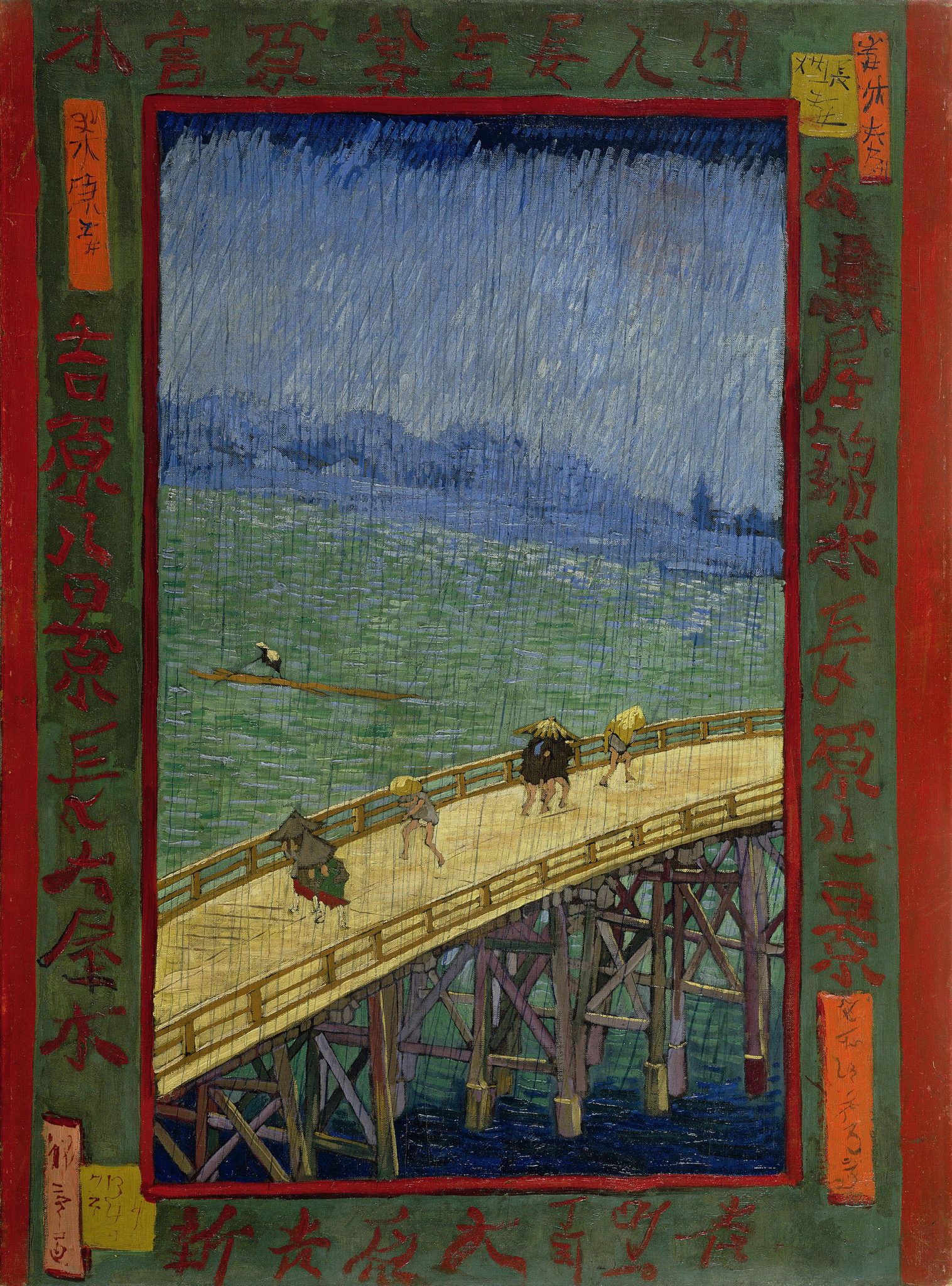
Bridge in the Rain (after Hiroshige) is the painting Vincent van Gogh made in Paris in October and November 1887 after a Japanese woodcut by Utagawa Hiroshige: a wooden bridge in a sudden downpour, small figures hurrying across under umbrellas, a raft on green water, all inside a painted border of red and green filled with Japanese characters. The original, oil on canvas, measures 73.3 x 53.8 cm and hangs in the Van Gogh Museum in Amsterdam. We paint it by hand in oil on canvas, in 16 sizes from 40 x 50 to 100 x 130 cm or to your own measurement, and send you a photograph of the finished work for approval before dispatch.
| Title: | Bridge in the Rain (after Hiroshige) |
| Other titles: | Brug in de regen (naar Hiroshige) · The Bridge in the Rain (after Hiroshige) |
| Painter: | Vincent van Gogh (1853–1890) |
| Year painted: | October–November 1887, Paris |
| Original size: | 73.3 cm x 53.8 cm |
| Original technique: | Oil on canvas |
| Painting style: | Post-Impressionism, Japonisme |
| Located at: | Van Gogh Museum, Amsterdam (inv. s0114V1962) |
| Our reproduction: | Hand-painted oil on canvas, 16 sizes or made to measure |
Bridge in the Rain (after Hiroshige) – Vincent van Gogh
What does Bridge in the Rain (after Hiroshige) show?
A wooden bridge on thin wooden piles crosses the painting on a slant, from the lower left to the right edge, where it runs out of the canvas. Small figures hurry over it, bent under umbrellas and wide hats. On the left a man poles a long raft across the green water, and the far bank is a grey-blue strip fading into the weather.
The sky is a heavy dark blue, and the rain falls through the whole scene in long, thin, dark lines. Around the river scene Van Gogh painted a narrow red frame and a wide green border filled with Japanese characters, with small orange and yellow panels. The Van Gogh Museum notes that he made the colours more intense than in Hiroshige’s print.
Why does the painting have a border with Japanese characters?
Because of the format. The Van Gogh Museum explains that he painted the work on a standard size canvas but wanted to keep the proportions of Hiroshige’s print. So he left a border around the scene and filled it with Japanese characters copied from other prints.
The characters are decoration rather than a message about the scene: as the English Wikipedia article on his Japonaiserie puts it, he added borders filled with calligraphic characters he borrowed from other prints. He did the same in his second copy after Hiroshige, Flowering Plum Tree, also of 1887.
What does Bridge in the Rain (after Hiroshige) mean?
It is Van Gogh learning from Japan. According to the Van Gogh Museum, he admired Japanese woodcuts for their bright colours and distinctive compositions. He and his brother Theo dealt in ukiyo-e prints and owned hundreds, now in the Van Gogh Museum, and in 1887 he organised an exhibition of Japanese prints in Paris.
You can see here what he took from those prints: the bridge cut off by the edge, the bold outlines, and river and sky laid down as flat bands of colour. He later wrote: “All my work is based to some extent on Japanese art.” His idea of the Japanese artist also led him south, to the Yellow House in Arles.
Where does the original hang?
The original hangs in the Van Gogh Museum in Amsterdam, which lists it as Bridge in the Rain (after Hiroshige), Paris, October–November 1887, oil on canvas, 73.3 x 53.8 cm, under the object number s0114V1962. The painting belongs to the Vincent van Gogh Foundation.
Van Gogh left it at Theo’s apartment in Paris in the autumn of 1887. After Theo’s death in January 1891 it passed to his widow, Jo van Gogh-Bonger, and their son, Vincent Willem, who transferred it to the Vincent van Gogh Foundation in 1962. It was on loan to the Stedelijk Museum until the Van Gogh Museum opened in 1973, and it has hung in the Van Gogh Museum ever since. In 1988 it was shown at the Musée d’Orsay in the exhibition Van Gogh à Paris.
Bridge in the Rain (after Hiroshige) or another Van Gogh – which should you choose?
This painting is a landscape in rain, with a strong diagonal and a painted frame. Its closest companion is Courtesan, painted in Paris in October and November 1887 as well, which also copies a Japanese print, this time a figure in a patterned kimono. From the Paris years also comes Self-Portrait as an Artist, in which he shows himself at the easel.
Almond Blossom sets flowering branches against a flat blue sky, and Irises gives every flower a firm outline. Choose the bridge for movement and weather on a narrow wall, the courtesan if you want a Japanese pair, Almond Blossom for a calm bedroom and Irises for colour above a sofa.
How is our hand-painted Bridge in the Rain (after Hiroshige) made?
The painter first draws the red frame, the border and the line of the bridge and checks the proportions against the original, so that the bridge crosses the canvas at Van Gogh’s angle. Then come the sky, the water and the far bank, after them the bridge, the figures and the raft, then the rain, stroke by stroke, and last the characters in the border. Our oil painting reproduction is painted by hand in oil on canvas with real impasto: the paint goes on thickly, so the brushstrokes stand up from the canvas as they do in the original and catch the light.
On this painting the relief shows most in the long strokes of rain, in the horizontal strokes of the water and along the planks of the bridge. A print shows only a flat surface; on our painting the strokes are real.
Every painting is a hand-painted copy made for your order, so no two are quite the same. Before dispatch we photograph it, sending you the photograph to approve.
Which size for which wall?
Short answer: 40 x 50 or 50 x 70 cm for a narrow wall in a hallway or beside a door, 60 x 80 or 70 x 90 cm above a chest of drawers or a bed, and 80 x 105 or 90 x 120 cm above a sofa. The largest size, 100 x 130 cm, suits a high wall in a stairwell. The portrait format fits between two windows or next to a wardrobe.
There are 16 sizes: 40 x 50, 50 x 66, 50 x 69, 50 x 70, 54 x 75, 59 x 75, 60 x 80, 64 x 81, 70 x 90, 74 x 94, 75 x 100, 80 x 100, 80 x 105, 84 x 105, 90 x 120 and 100 x 130 cm (width x height). The original is 53.8 cm wide and 73.3 cm high, so our 54 x 75 cm size is almost exactly the size of the painting in the museum. The dark sky and the green water are cool, so it looks best on a white or light grey wall and under warm light. A painting for the living room should cover about two thirds of the width of the furniture below it.
Hang it with the centre of the canvas about 150 cm above the floor. Above a sofa, a bed or a sideboard, leave 20 to 30 cm between the furniture and the bottom edge.
What if I need a custom size or a frame?
If none of the 16 sizes fits your wall, we paint it to measure. Our 54 x 75 cm size keeps the original proportions to within two centimetres; for a larger version in the same proportions, ask for a custom size such as 66 x 90 cm. Send us the width and height you want and we will quote a price and a lead time. Every painting we make is stretched over a wooden stretcher and ready to hang.
For the moulding, use our 3D application: it shows each of our frame profiles on this subject, so you can compare gold, silver, black, white and natural wood – the application is for choosing the frame only. Seeing the painting on your own wall is our separate room placement service. The painted border already works as a frame, so a narrow black or natural wood moulding suits it best.
How does delivery work, and what is the guarantee?
Every painting is made to order in our studio in Slovenia, so allow 15 to 45 days depending on the size you choose. We ship it stretched and protected, framed if you chose a frame, across the EU with no customs. Before dispatch you receive a photograph of the finished work to approve, and we correct anything that is not right. Our returns policy applies to every order.
More famous Van Gogh paintings are in the Vincent van Gogh gallery, and there is more about the painter in our article on Vincent van Gogh. If you are giving it as a present and are not sure of the size, a wall art voucher lets the recipient choose.
Frequently asked questions
Where is the original Bridge in the Rain (after Hiroshige) today?
In the Van Gogh Museum in Amsterdam. The museum lists it as oil on canvas, 73.3 x 53.8 cm, under the object number s0114V1962, in the collection of the Vincent van Gogh Foundation. Van Gogh left it with his brother Theo in Paris in 1887, and it stayed in the family until 1962.
When and where did Van Gogh paint Bridge in the Rain (after Hiroshige)?
In Paris, in October and November 1887, according to the Van Gogh Museum, which also records that he left the finished painting at his brother Theo’s apartment there. The museum dates his copy of a courtesan by Eisen to the same two months. In 1887 he also organised an exhibition of Japanese prints in Paris.
Which Hiroshige print is Bridge in the Rain (after Hiroshige) based on?
On Sudden Shower over Shin-Ōhashi Bridge and Atake, a colour woodcut of 1857 by Utagawa Hiroshige. Van Gogh owned twelve prints from Hiroshige’s series One Hundred Famous Views of Edo. In his copy he kept the composition, made the colours more intense, as the Van Gogh Museum notes, and added a border of his own.
What do the Japanese characters around Bridge in the Rain (after Hiroshige) say?
They are not a message about the scene. The Van Gogh Museum states that Van Gogh copied the characters from other prints and used them to fill the border he needed to keep the proportions of Hiroshige’s print on a standard canvas. The museum does not translate them; in the painting they work as decoration.
How is Bridge in the Rain (after Hiroshige) different from the Hiroshige original?
In three ways. Van Gogh made the colours more intense, according to the Van Gogh Museum, he painted the scene in oil with visible brushstrokes instead of flat printed colour, and he surrounded it with a red frame and a green border carrying Japanese characters taken from other prints. The bridge, the figures, the raft and the rain follow Hiroshige.
Why did Van Gogh copy a Japanese print for Bridge in the Rain (after Hiroshige)?
To learn from it. The Van Gogh Museum says he admired Japanese woodcuts for their bright colours and distinctive compositions. Copying one was a way to study its cropping, flat colour and bold outlines with his own brush. He did it three times in 1887, twice after Hiroshige and once after Eisen.
How big is the original Bridge in the Rain (after Hiroshige)?
The original is 73.3 cm high and 53.8 cm wide, a modest portrait format. Our 54 x 75 cm size is almost exactly the same, and there are smaller and larger sizes from 40 x 50 up to 100 x 130 cm, as well as custom sizes in any proportions you need.
Which size of Bridge in the Rain (after Hiroshige) suits a living room?
Above a sofa, choose 80 x 105 or 90 x 120 cm, so that the canvas painting covers about two thirds of the width of the sofa. For a living room with a high ceiling, 100 x 130 cm works as a single large piece. On a narrow wall beside the sofa or between two windows, 54 x 75 or 60 x 80 cm is enough.
Does your Bridge in the Rain (after Hiroshige) have the raised brushstrokes of the original?
Yes. We paint our bridge in impasto: the paint goes on thickly, so the brushstrokes stand up from the canvas as on Van Gogh’s original. You see it best in the long strokes of the rain, in the horizontal strokes of the green water and along the planks of the bridge, where the relief catches the light. A print cannot have this relief, because its surface is flat.
- Subject: a wooden bridge in a sudden downpour, figures under umbrellas, a raft on green water, inside a red and green border with Japanese characters.
- Original: October–November 1887, Paris, oil on canvas, 73.3 x 53.8 cm, Van Gogh Museum, Amsterdam.
- Ours: a Van Gogh reproduction painted by hand in oil on canvas, in 16 sizes from 40 x 50 to 100 x 130 cm or made to measure.
- Worth knowing: you receive a photograph of the finished work for approval before dispatch.