Description
Wheat Field with Crows is the painting Vincent van Gogh made in Auvers-sur-Oise in July 1890: a wide field of yellow-orange wheat under a stormy blue sky, with black crows flying over it and a red path that stops in the middle of the field. The original measures 50.5 x 103 cm, a long double-square format, and belongs to the Van Gogh Museum in Amsterdam. We paint it by hand in oil on canvas, in 15 sizes from 80 x 40 to 200 x 100 cm or to your own measurement, and send you a photograph of the finished work for approval before dispatch.
| Title: | Wheat Field with Crows |
| Other titles: | Wheatfield with Crows · Korenveld met kraaien · Champ de blé aux corbeaux |
| Painter: | Vincent van Gogh (1853–1890) |
| Year painted: | July 1890, Auvers-sur-Oise |
| Original size: | 50.5 cm x 103 cm |
| Original technique: | Oil on canvas |
| Painting style: | Post-Impressionism |
| Located at: | Van Gogh Museum, Amsterdam (inv. s0149V1962) |
| Our reproduction: | Hand-painted oil on canvas, 15 sizes or made to measure |
Wheat Field with Crows – Vincent van Gogh
What does Wheat Field with Crows show?
A wheat field stretches across almost the whole width of the canvas. The windswept wheat is yellow-orange and fills about two thirds of the painting; above it hangs a heavy, stormy blue sky, and a flock of black crows flies low over the field, without a clear direction. Three paths cut through the wheat: one at the bottom left, one at the bottom right, and a red one in the middle that runs into the field and simply stops.
Van Gogh built the painting on strong colour contrasts. The Van Gogh Museum points them out: the blue sky against the yellow-orange wheat, and the red of the path, made even stronger by the green bands of grass beside it.
Why is Wheat Field with Crows called his last painting?
It is often said that this was Van Gogh’s very last work, and that the menacing sky, the crows and the dead-end path point to the end of his life. The Van Gogh Museum calls this a persistent myth: he made several other works after this one. The idea spread above all through the 1956 film Lust for Life by Vincente Minnelli, which shows him painting it just before his death.
His letters suggest that the canvas was finished around 10 July 1890. Paintings such as Auvers Town Hall, dated 14 July, and Daubigny’s Garden came later, and the painting most likely to be his last is Tree Roots, from the end of July 1890.
What does Wheat Field with Crows mean?
Van Gogh explained it himself. Around 10 July 1890, after visiting his brother Theo and his wife Jo in Paris on 6 July, he wrote to them about three large canvases he had painted since: two immense stretches of wheat fields under troubled skies, and Daubigny’s Garden. In the wheat fields he wanted to express sadness and extreme loneliness, he wrote, but at the same time to show what he considered healthy and fortifying about the countryside.
So the painting holds both moods at once: the threat in the sky and the strength of the ripe wheat. Some writers read the crows as a symbol of death and rebirth; Walther and Metzger, authors of the catalogue Van Gogh: The Complete Paintings, point out that nothing in Van Gogh’s own words supports a simple reading of despair.
Where does the original hang?
The original belongs to the Van Gogh Museum in Amsterdam, under the object number s0149V1962, together with the Vincent van Gogh Foundation. After Vincent’s death the canvas stayed with Theo in Paris; when Theo died on 25 January 1891 it passed to his widow, Jo van Gogh-Bonger, and their son, Vincent Willem van Gogh. From 1931 it was on loan to the Stedelijk Museum in Amsterdam, in 1962 it was transferred to the foundation, and since the museum opened on 2 June 1973 it has been part of its collection.
When we checked in October 2026, the museum’s page said the painting is undergoing conservation treatment and is therefore not on display right now, so check before you plan a visit. In 1991 it was stolen from the museum together with nineteen other Van Gogh paintings, quickly recovered, and badly damaged during the theft. More is on Wikipedia.
Wheat Field with Crows or Tree Roots – which should you choose?
Both paintings were made in Auvers in July 1890 on the same long canvas, about twice as wide as it is high. Wheat Field with Crows opens out into a wide landscape with a deep sky and drama in the weather. Tree Roots comes very close instead: no sky, only blue trunks, roots and earth, almost like an abstract pattern.
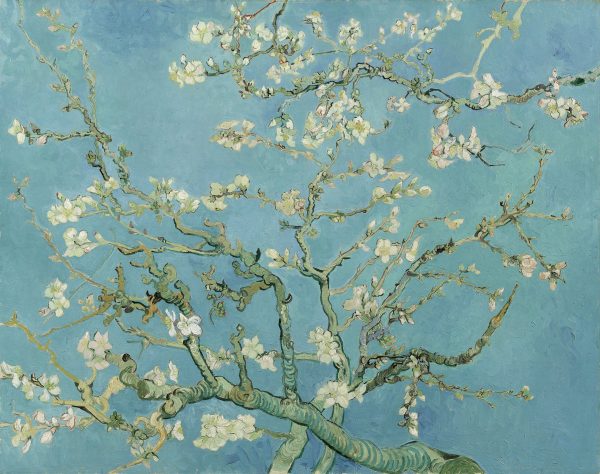
Choose Wheat Field with Crows if you want a landscape with depth and a strong mood; choose Tree Roots for a modern surface of colour. If you like the night sky as much as the field, there is The Starry Night from Saint-Rémy, 1889; for a lighter spring mood Almond Blossom from February 1890; and for another field painted under a huge sky, The Sower from Arles, 1888.
How is our hand-painted Wheat Field with Crows made?
The painter first draws the horizon and the three paths on the long canvas and checks them against the original, because the whole composition rests on where the paths meet and where the wheat ends. Then come the blue sky in short, crossing strokes, the yellow-orange wheat bending in the wind, the red path with its green bands of grass, and last the black crows. Our oil painting reproduction is painted by hand in oil on canvas with real impasto: the paint goes on thickly, so the brushstrokes stand up from the canvas as they do in the original and catch the light.
In this painting the movement is in the strokes. The painter follows their direction as Van Gogh laid them down, swirling in the sky and upright in the wheat. A print shows only a flat surface; on our painting the relief is real.
Every painting is a hand-painted copy made for your order, so no two are quite the same. Before dispatch we photograph it, sending you the photograph to approve.
Which size for which wall?
Short answer: 160 x 77 or 180 x 90 cm above a sofa, 120 x 60 or 130 x 65 cm above a sideboard or a chest of drawers, 140 x 68 or 150 x 70 cm above a double bed, and 90 x 45 or 103 x 50 cm for a long hallway or above a desk. For a large empty wall there is 200 x 100 cm.
There are 15 sizes: 80 x 40, 90 x 42, 90 x 45, 103 x 50, 110 x 55, 120 x 60, 130 x 61, 130 x 65, 140 x 68, 150 x 70, 160 x 77, 165 x 80, 170 x 85, 180 x 90 and 200 x 100 cm (width x height). The original is 103 cm wide and 50.5 cm high; our 103 x 50 cm size is the closest to it, so the painting on your wall is almost exactly as large as it is in the museum. The long format is made for long furniture and long walls: above a sofa, a sideboard, a bed headboard or along a corridor, where an upright painting would look lost. A painting for the living room should cover about two thirds of the width of the furniture below it.
Hang it with the centre of the canvas about 150 cm above the floor. Above a sofa or a headboard, leave 20 to 30 cm between the furniture and the bottom edge.
What if I need a custom size or a frame?
If none of the 15 sizes fits your wall, we paint it to measure. We recommend keeping the proportion close to two to one, as in the original, otherwise the field loses its width or the sky gets squeezed. Send us the width and height you want and we will quote a price and a lead time. Every painting we make is stretched over a wooden stretcher and ready to hang.
For the moulding, use our 3D application: it shows each of our frame profiles on this subject, so you can compare gold, silver, black, white and natural wood – the application is for choosing the frame only. Seeing the painting on your own wall is our separate room placement service. A plain dark frame calms the stormy sky, while a warm gold or natural wood profile picks up the yellow of the wheat.
How does delivery work, and what is the guarantee?
Every painting is made to order in our studio in Slovenia, so allow 15 to 45 days depending on the size you choose. We ship it stretched and protected, framed if you chose a frame, across the EU with no customs. Before dispatch you receive a photograph of the finished work to approve, and we correct anything that is not right. Our returns policy applies to every order.
More famous Van Gogh paintings are in the Vincent van Gogh gallery, and there is more about the painter in our article on Vincent van Gogh. As a gift, Wheat Field with Crows suits someone who loves landscapes, open fields or dramatic skies. If you are not sure of the size, a wall art voucher lets the recipient choose.
Frequently asked questions
Where is the original Wheat Field with Crows today?
In the Van Gogh Museum in Amsterdam, under the object number s0149V1962, together with the Vincent van Gogh Foundation. When we checked in October 2026, the museum’s page said the painting is undergoing conservation treatment and is not on display for now. It came to the museum through Van Gogh’s family and has been in the collection since 1973.
When and where did Van Gogh paint Wheat Field with Crows?
In July 1890 in Auvers-sur-Oise, a small town north of Paris where he spent the last months of his life. His letters suggest it was finished around 10 July 1890. He painted it on a double-square canvas, the long format he used only in June and July 1890, in the wheat fields around the town.
Is Wheat Field with Crows Van Gogh’s last painting?
No. It is often called his last painting, but the Van Gogh Museum calls this a persistent myth: he made several other works after it, including Auvers Town Hall and Daubigny’s Garden. The painting most likely to be his last is Tree Roots. The myth spread mainly through the 1956 film Lust for Life.
What did Van Gogh write about Wheat Field with Crows?
Around 10 July 1890 he wrote to his brother Theo and his wife Jo about two immense stretches of wheat fields under troubled skies. He wanted to express sadness and extreme loneliness, but also, in the same canvases, what he considered healthy and fortifying about the countryside. The painting is meant to hold both moods.
What do the crows and the path in Wheat Field with Crows stand for?
Van Gogh did not explain them, so every reading is an interpretation. The red path that stops in the middle of the field and the crows flying without a clear direction are often read as signs of the end of his life; the museum calls that reading a myth. Some writers see the crows as a symbol of death and rebirth.
Why are the colours in Wheat Field with Crows so strong?
Because Van Gogh set opposite colours side by side. The Van Gogh Museum points out how the blue sky contrasts with the yellow-orange wheat, and how the red of the path is made stronger by the green bands of grass. Opposite colours make each other look brighter, which is why the painting seems to glow even under a stormy sky.
How big is the original Wheat Field with Crows?
The original is 50.5 cm high and 103 cm wide, a double-square format about twice as wide as it is high. Our 103 x 50 cm size is the closest to it. Because the format is so long, this canvas painting also works very well larger, at 160 x 77 or 180 x 90 cm above a sofa, or at 200 x 100 cm on a big wall.
Was Wheat Field with Crows ever stolen?
Yes, once. In 1991 Wheat Field with Crows was stolen from the Van Gogh Museum in Amsterdam together with nineteen other Van Gogh paintings. It was recovered quickly, but it was badly damaged during the theft. Today it belongs to the museum again, which was carrying out conservation treatment on it when we checked in October 2026.
Does your Wheat Field with Crows have the raised brushstrokes of the original?
Yes. We paint our Wheat Field with Crows in impasto: the paint goes on thickly, so the brushstrokes stand up from the canvas as on Van Gogh’s original. You see it best in the swirling sky, the wheat bending in the wind and the black crows, where the relief catches the light. A print cannot have this relief, because its surface is flat.
- Subject: a yellow-orange wheat field under a stormy blue sky, with black crows and a red path that stops in the middle of the field.
- Original: July 1890, Auvers-sur-Oise, 50.5 x 103 cm, Van Gogh Museum, Amsterdam.
- Ours: a Van Gogh reproduction painted by hand in oil on canvas, in 15 sizes from 80 x 40 to 200 x 100 cm or made to measure.
- Worth knowing: you receive a photograph of the finished work for approval before dispatch.