







































Description
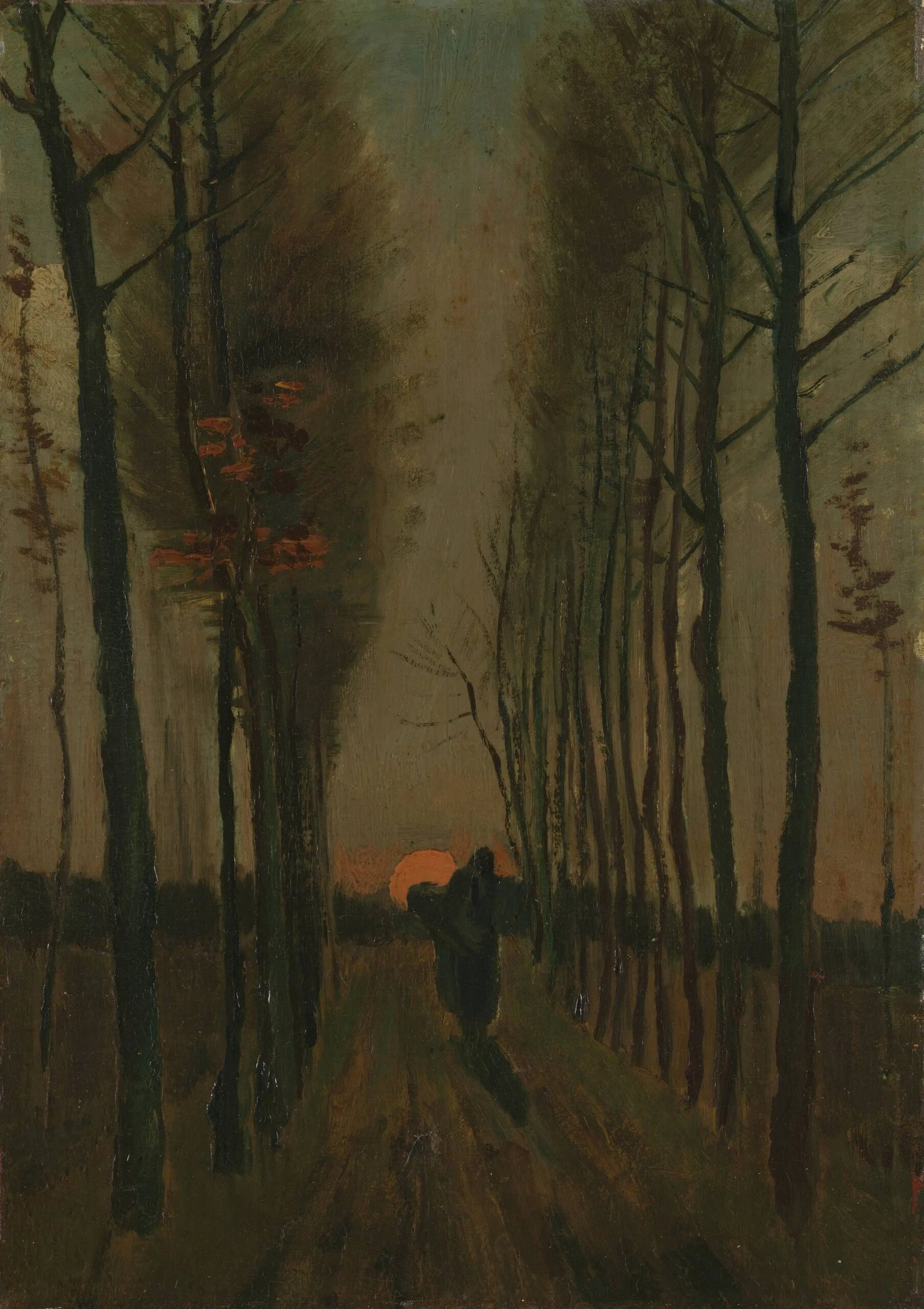
Lane of Poplars at Sunset is the painting Vincent van Gogh made in Nuenen, in the Netherlands, in the autumn of 1884: a straight road runs between two rows of tall, almost bare poplars towards an orange-red sun low on the horizon, and a dark figure walks along it. The original measures 45.8 x 32.2 cm and is in the Kröller-Müller Museum in Otterlo. We paint it by hand in oil on canvas, in 17 sizes from 32 x 46 to 120 x 170 cm or to your own measurements, and send you a photograph of the finished painting for approval before dispatch.
| Title: | Lane of Poplars at Sunset |
| Other titles: | Populierenlaan bij zonsondergang · Avenue of Poplars at Sunset |
| Painter: | Vincent van Gogh (1853–1890) |
| Year painted: | October 1884, Nuenen |
| Original size: | 45.8 cm x 32.2 cm |
| Original technique: | Oil on canvas |
| Painting style: | Realism, Dutch period |
| Located at: | Kröller-Müller Museum, Otterlo (accession no. KM 100.120) |
| Our reproduction: | Hand-painted oil on canvas, 17 sizes or made to measure |
Lane of Poplars at Sunset – Vincent van Gogh
What does Lane of Poplars at Sunset show?
The painting shows a straight country road between two rows of tall poplars, seen from the middle of the road. On the left the trunks are thick and dark, and their upper branches form a heavy, dark brown mass against the sky. On the right a longer row of thin trunks recedes into the distance, their bare twigs drawn in fine dark lines. Most of the leaves have fallen; only a few orange-red leaves still hang on the trees at the left and on a small tree at the right edge.
At the far end of the road an orange-red sun sits on the horizon, just left of the centre, above a low dark line of fields and trees. A dark figure walks on the road a little to the right, against the light, and the pale road in the foreground is streaked with brown and grey. The sky between the treetops is a muted grey-green, and the whole scene is held in dark olive, brown and rust tones.
Why does the sun sit exactly at the end of the lane?
Because the whole composition is built on it. According to the Kröller-Müller Museum, the painting is divided by central perspective, which the poplar-lined road strongly emphasises, and the vanishing point coincides with the setting sun.
The museum also points to the figure: it describes a female figure that stands out darkly against the light of the bright orange sun. According to Wikipedia, she is a woman in the distance, walking towards the sunset on a gravel road lined with poplars whose autumn leaves have been shed.
What does the painting mean?
The museum places it among Van Gogh’s thoughts on the seasons. He often wrote about how the moods of the changing seasons could be expressed in colour, and for him autumn was the contrast of the yellow leaves against violet tones. The museum writes that autumn was the season he preferred: he relished the leaves turning and falling, the stormy skies and the melancholy of the twilight. In his words: ‘How beautiful it is outside – I sometimes yearn for a country where it would always be autumn.’
In the museum’s reading, the dark silhouette against the setting sun signifies that one day the sun will set for good for everyone.
Where is the original today?
The original is in the Kröller-Müller Museum in Otterlo, in the Netherlands. The museum lists it as Populierenlaan bij zonsondergang, Lane of Poplars at Sunset, October 1884, oil on canvas, under the inventory number KM 100.120.
The Wikipedia article on the painting, which calls it Avenue of Poplars at Sunset, gives its size as 45.8 x 32.2 cm and its catalogue numbers as F123 and JH518. It dates the work more narrowly than the museum, to 13 or 14 November 1884, and places it in Nuenen, the village in the Netherlands where Van Gogh painted it.
Lane of Poplars at Sunset or another Nuenen painting – which to choose?
Four other paintings in our range come from the same village. The Potato Eaters was painted in Nuenen in 1885 and shows a peasant family at their evening meal indoors under a lamp. The Cottage is from May 1885: a thatched double cottage at dusk, with a woman at the door. Still Life with Bible, also from Nuenen in 1885, shows a large open Bible on a table beside a smaller yellow book.
Autumn Landscape with Four Trees was painted in Nuenen in November 1885 and is also in the Kröller-Müller Museum: three large trees in rust-orange leaves and a fourth, bare one. Choose Lane of Poplars at Sunset if you want an upright format and a deep view into the distance: a road, a sunset and a single walker rather than a room, a house or a broad landscape.
How is our hand-painted Lane of Poplars at Sunset made?
The painter first draws the two rows of trunks, the edges of the road and the horizon, so that every line meets at the sun. Then come the grey-green sky, the dark mass of branches at the left and the fine twigs at the right, and last the sun, the few orange-red leaves and the figure on the road. Our oil painting reproduction is painted entirely by hand on canvas with real impasto: the paint goes on thickly, so the brushstrokes stand up from the canvas as they do in the original and catch the light.
On this painting the relief matters most in the streaked surface of the road, in the dark branches and in the small, thick disc of the sun. A print is completely flat; on our painting every brushstroke stands out in real paint.
Every painting is a hand-painted copy made for your order, so no two are quite the same.
Which size for which wall?
Short answer: 50 x 70 or 60 x 90 cm above a chest of drawers or on a narrow wall, 70 x 100 or 80 x 120 cm beside a sofa or in a hallway, and 120 x 170 cm for a tall wall or a stairwell. The upright format suits narrow spaces: between two windows, beside a door or at the end of a corridor, where the road seems to lead on.
There are 17 sizes: 32 x 46, 40 x 60, 45 x 65, 50 x 69, 50 x 70, 54 x 75, 57 x 82, 60 x 90, 65 x 95, 70 x 100, 77 x 107, 80 x 120, 85 x 125, 89 x 130, 93 x 135, 100 x 140 and 120 x 170 cm (width x height). The original is 32.2 cm wide and 45.8 cm high, so our 32 x 46 cm size is almost exactly its size. With its dark olive and brown tones and the one orange-red sun, it sits well on a warm white, cream or light grey wall. A painting for the living room in this tall format looks best on its own wall section or paired with a second painting beside a doorway.
Hang it with the centre of the canvas about 150 cm above the floor, leaving 20 to 30 cm between the top of the furniture and the bottom of the canvas.
What if I need a custom size or a frame?
If none of the 17 sizes fits your wall, we paint it to measure. Keep the proportions close to the original, otherwise the poplars get squeezed or the road stretched. Send us the width and height you want and we will quote you a price and a delivery time. Every painting we make is mounted on a wooden stretcher, ready to hang.
Our 3D app shows each of our frame profiles on this painting, so you can compare gold, silver, black, white and natural wood. The app is for choosing the frame only. To see the painting on your own wall, use our separate room placement service. A gold frame picks up the orange-red sun, and a dark wood frame suits the browns of the trunks and the road.
How does delivery work, and what is the guarantee?
Every painting is made to order in our studio in Slovenia, so allow 15 to 45 days depending on the size you choose. We ship it on its stretcher, carefully packed (and framed, if you chose a frame), across the EU with no customs duty. Before dispatch we send you a photograph of the finished painting to approve, and we correct anything that is not right. Our returns policy applies to every order.
You will find more of Van Gogh’s famous works among all our Vincent van Gogh paintings, and there is more about the painter in our article on Vincent van Gogh. If you are giving it as a present and are not sure of the size, a wall art voucher lets the recipient choose.
Frequently asked questions
Where is the original of Lane of Poplars at Sunset today?
In the Kröller-Müller Museum in Otterlo, in the Netherlands. The museum lists it as Populierenlaan bij zonsondergang, October 1884, oil on canvas, under the inventory number KM 100.120. Wikipedia, which calls it Avenue of Poplars at Sunset, gives its size as 45.8 x 32.2 cm and its catalogue numbers as F123 and JH518.
When and where did Van Gogh paint Lane of Poplars at Sunset?
In Nuenen, in the Netherlands, in the autumn of 1884. The Kröller-Müller Museum dates it to October 1884, while Wikipedia gives a narrower date, 13 or 14 November 1884. Both agree on the season: the poplars have lost most of their leaves, and the sun is setting at the end of the road.
Who is the figure walking in Lane of Poplars at Sunset?
It is not known who she is. The Kröller-Müller Museum describes a female figure that stands out darkly against the light of the bright orange setting sun, and Wikipedia describes her as a woman in the distance walking towards the sunset. In the painting she is a small dark shape on the road, a little right of the sun.
What does the setting sun in Lane of Poplars at Sunset mean?
In the Kröller-Müller Museum’s reading, the dark silhouette against the setting sun signifies that one day the sun will set for good for everyone. The museum also notes that the vanishing point of the road coincides with the sun, so every line of the composition leads there. In the painting the sun is a small orange-red disc on the horizon, just left of the centre.
Why did Van Gogh paint the poplars in autumn?
Because, as the Kröller-Müller Museum explains, autumn was the season he preferred. He relished the leaves turning and falling, the stormy skies and the melancholy of the twilight, and for him autumn meant the contrast of yellow leaves against violet tones. He once wrote that he sometimes yearned for a country where it would always be autumn.
How big is the original of Lane of Poplars at Sunset?
According to Wikipedia, the original is 45.8 cm high and 32.2 cm wide, an upright format. Our 32 x 46 cm size is almost exactly its size, and there are larger sizes from 40 x 60 up to 120 x 170 cm, as well as custom sizes painted to measure. For a narrow wall, 50 x 70 or 60 x 90 cm is a good choice, and 80 x 120 cm suits a hallway.
Does your Lane of Poplars at Sunset have the raised brushstrokes of the original?
Yes. We paint it in impasto, building up each brushstroke in thick oil, so the surface is raised like Van Gogh’s original. You see this best in the streaked surface of the road, in the dark branches against the sky and in the small orange-red sun, where the relief catches the light and changes as you walk past the painting.
Is Lane of Poplars at Sunset a good gift?
It suits someone who is drawn to autumn, long walks and evening light, or to Van Gogh’s early Dutch years in Nuenen, and its upright format fits a hallway, a study or a narrow wall. As a canvas painting in dark olive and brown with one warm orange-red sun, it brings a quiet evening mood into a room, and a voucher lets the recipient choose the size.
- Subject: a straight road between two rows of tall, almost bare poplars, a dark walker on it and an orange-red sun setting at the end of the lane.
- Original: autumn 1884, Nuenen, 45.8 x 32.2 cm, Kröller-Müller Museum, Otterlo.
- Ours: a Van Gogh reproduction painted by hand in oil on canvas, in 17 sizes from 32 x 46 to 120 x 170 cm or made to measure.
- Worth knowing: our 32 x 46 cm size is almost exactly the size of the original in Otterlo.