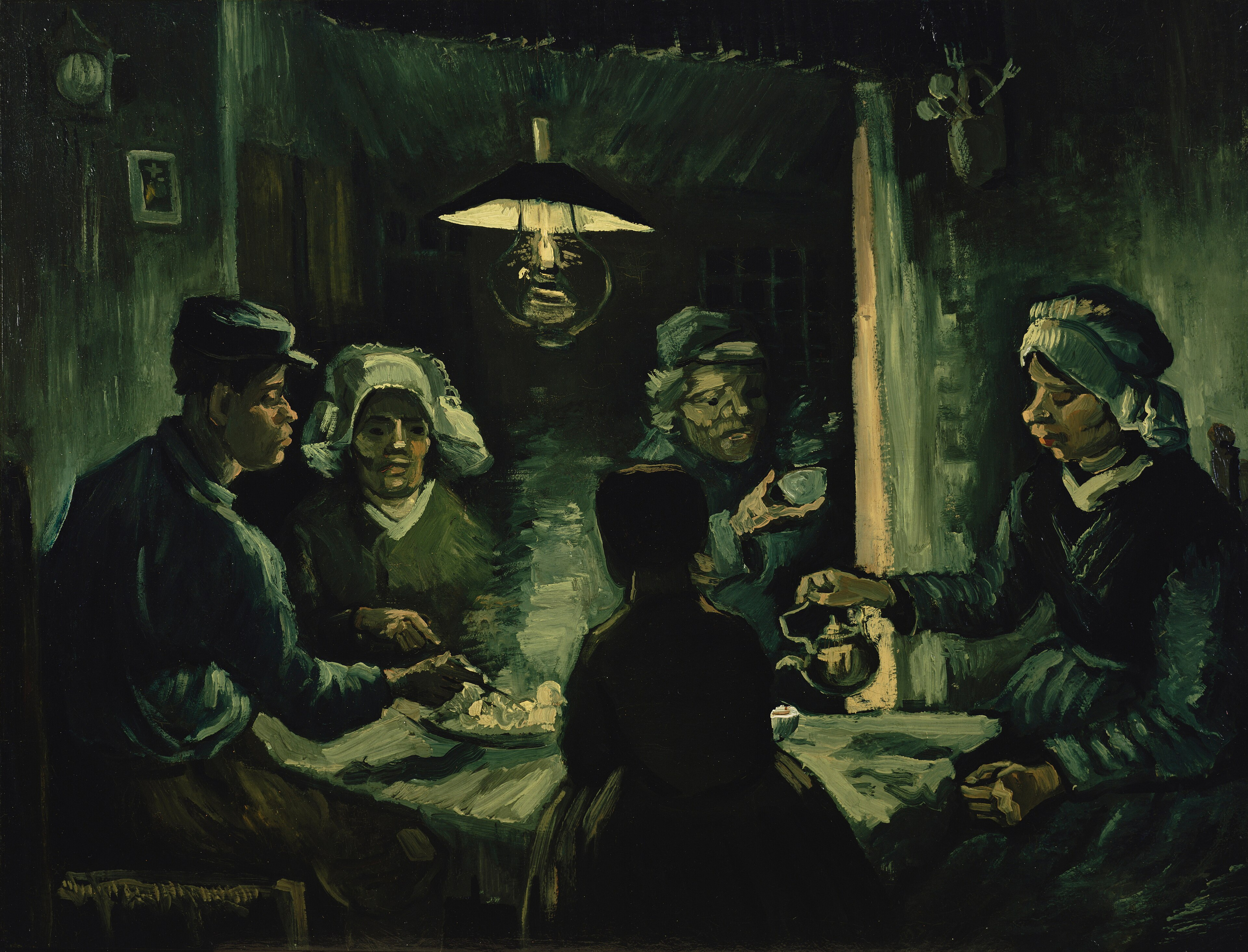








































Description
The Potato Eaters is the painting Vincent van Gogh made in Nuenen in April and May 1885: five peasants at their evening meal around a dish of potatoes, under the light of a single oil lamp in a dark cottage. He planned it as his first ambitious figure painting. The original, 82 x 114 cm, hangs in the Van Gogh Museum in Amsterdam. We paint it by hand in oil on canvas, in 15 sizes from 70 x 50 to 250 x 180 cm or to your own measurement, and send you a photograph of the finished work for approval before dispatch.
| Title: | The Potato Eaters |
| Other titles: | De Aardappeleters · Potato Eaters |
| Painter: | Vincent van Gogh (1853–1890) |
| Year painted: | April–May 1885, Nuenen |
| Original size: | 82 cm x 114 cm |
| Original technique: | Oil on canvas |
| Painting style: | Realism, Dutch period |
| Located at: | Van Gogh Museum, Amsterdam (inv. s0005V1962) |
| Our reproduction: | Hand-painted oil on canvas, 15 sizes or made to measure |
The Potato Eaters – Vincent van Gogh
What does The Potato Eaters show?
Five people sit around a small table in a cramped cottage in the evening. An oil lamp hangs from the beams above them and is the only light in the room. It falls on their faces, on their hands and on the steaming dish of potatoes in the middle of the table. On the left a young man reaches into the dish with his fork; on the right an older woman pours a hot drink from a kettle into cups. In the centre, with her back to us, a girl sits as a dark shape against the lamplight.
The faces are coarse and the hands are bony and knotted, the hands of people who work the land. Van Gogh painted the whole scene in earth colours, browns, dark greens and greys: the colour, as he put it, of a really dusty potato, unpeeled of course.
How did The Potato Eaters come about in Nuenen?
In 1885 Van Gogh was living with his parents in the village of Nuenen in North Brabant, among farmers, labourers and weavers whom he drew and painted again and again. He wanted to prove that he was becoming a good figure painter, so he chose a difficult subject on purpose: several figures, lit by one lamp, in a dark interior. He worked on the final canvas from about 13 April to early May 1885.
Before it he painted a smaller oil sketch of the scene and made a lithograph of the composition, drawn from memory in a single day. His brother Theo, who supported him, was not enthusiastic about the first sketches. Van Gogh carried on all the same, and at the beginning of May he sent the finished painting to Theo in Paris.
Why is The Potato Eaters so dark, and what did Van Gogh want to say?
The darkness is deliberate. Van Gogh wanted to show the harsh reality of country life, not the insipidly pretty peasants he disliked in the work of other painters. He wrote that these people had tilled the earth with the same hands they were putting into the dish, and so had honestly earned their food. A peasant painting, he added, could smell of bacon, smoke and potato steam, and that was fine.
His example was the Hague School, the Dutch painters of everyday rural life. Jozef Israëls’ A Peasant Family at the Table has a similar composition, with a figure in the centre seen from behind. For Van Gogh the message counted for more than correct anatomy, which is why some heads and limbs are out of proportion.
Where does the original hang, and what has happened to it?
The original hangs in the Van Gogh Museum in Amsterdam, on view in the permanent collection, and belongs to the Vincent van Gogh Foundation. After Theo it passed to his widow Jo van Gogh-Bonger and then to their son Vincent Willem, who transferred it to the foundation on 10 July 1962. It was on loan to the Stedelijk Museum until 1973, when the museum, then called the Rijksmuseum Vincent van Gogh, opened.
On 14 April 1991 thieves took it from the museum together with nineteen other paintings, but their getaway car had a flat tyre and the paintings were found about 35 minutes later.
The Potato Eaters or The Sower – which one suits you?
Both are peasant paintings, but they feel very different. The Potato Eaters is an interior: a family at the table at night, in dark earth colours and lamplight. The Sower takes the same theme of work on the land outdoors; Van Gogh borrowed it from Jean-François Millet, the painter of peasants he admired all his life, and painted it in the strong colour of his later years. Choose The Potato Eaters for a quiet, serious work in warm browns, and The Sower for movement and light.
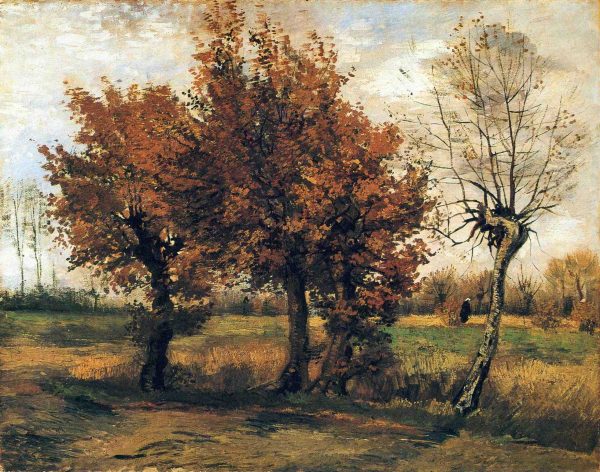
From the same Nuenen year, in the autumn of 1885, comes Autumn Landscape with Four Trees. To see how far his colour travelled after he left Holland, set it beside Bedroom in Arles of 1888 or The Starry Night of 1889.
How is our hand-painted Potato Eaters made?
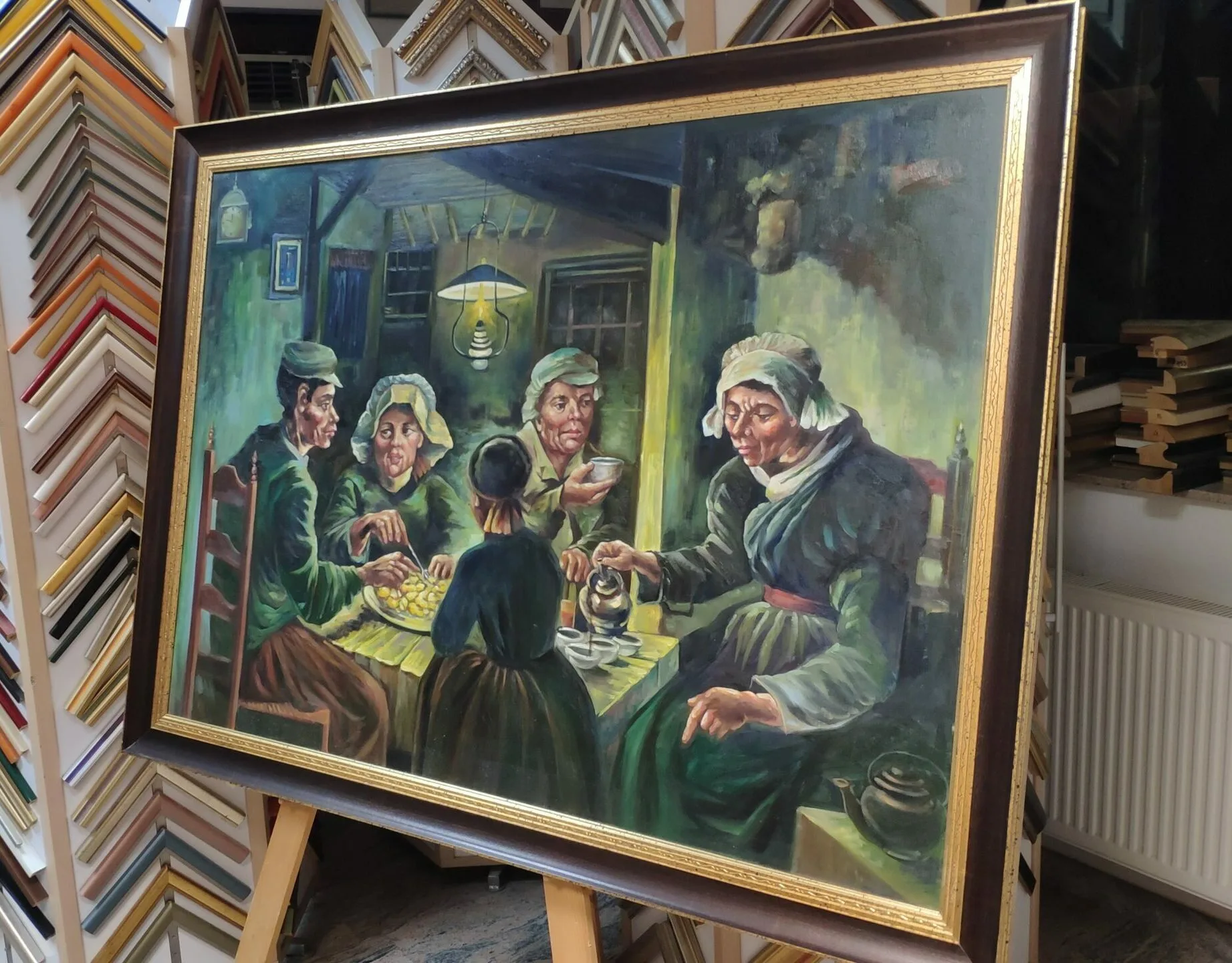
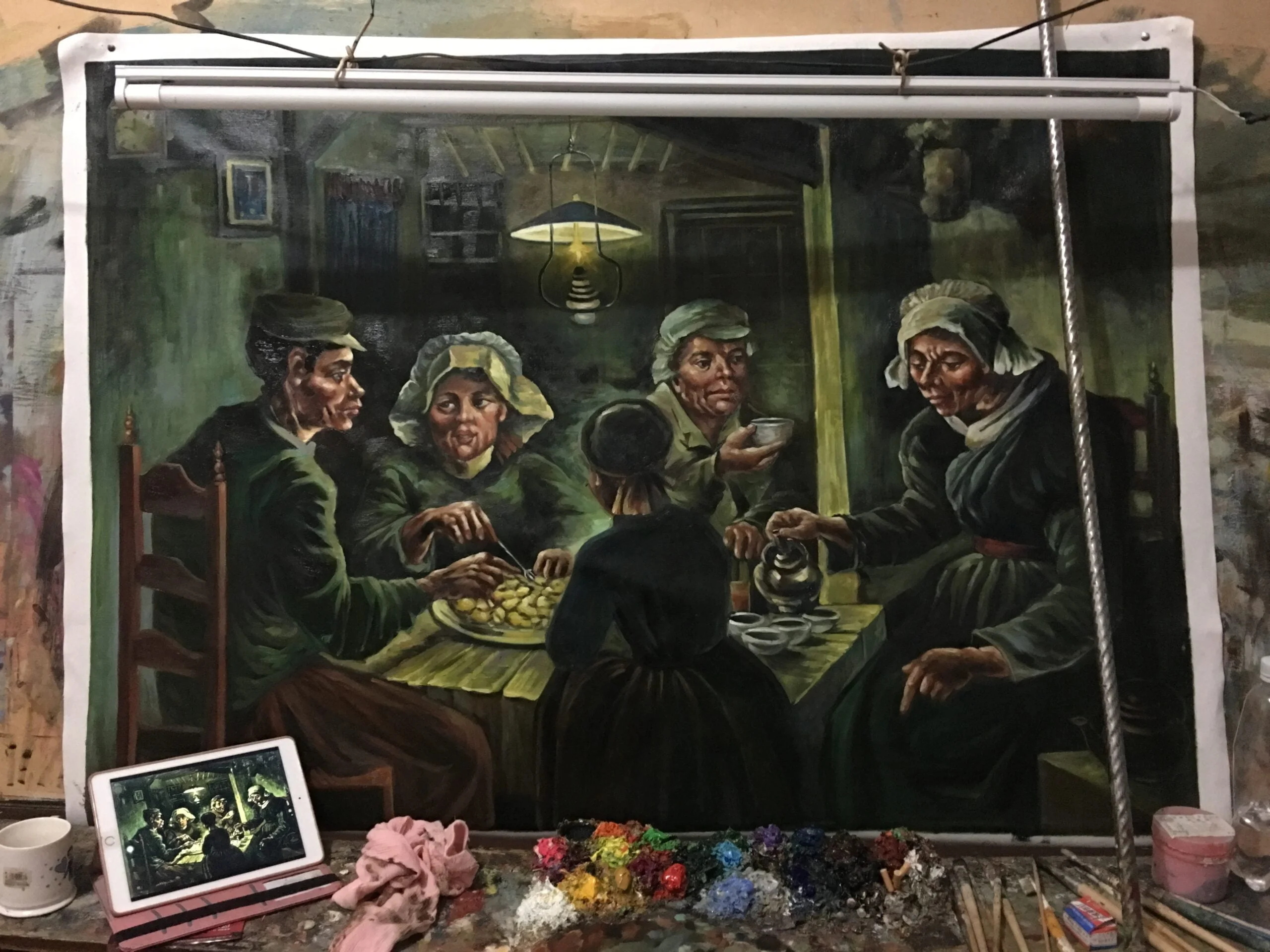
The painter first draws the table, the lamp and the five figures on the canvas, then builds up the dark room and the shadows, and only at the end the light of the lamp on the faces, the hands and the potatoes. Our oil painting reproduction is painted by hand in oil on canvas with real impasto: the paint goes on thickly, so the brushstrokes stand up from the canvas as they do in the original, and the browns and greens keep the depth of Van Gogh’s earth colours.
The first photograph shows a finished Potato Eaters in a dark frame with a gold inner lip, on an easel in our workshop, as you receive it. The second photograph shows a canvas in progress on the painter’s easel, with the reference on a tablet beside it and a palette of oil paints in front, so you can see how the work is built up layer by layer.
Every painting is a hand-painted copy made for your order, so no two are quite the same.
Which size of The Potato Eaters for which wall?
Short answer: 140 x 100 or 153 x 110 cm above a sofa or a sideboard, 90 x 65 or 101 x 74 cm above a chest of drawers or in a smaller room, and 200 x 150 or 250 x 180 cm for a large empty wall. It is a wide landscape format, so it suits long furniture, and as a meal scene it sits naturally in a dining room or a kitchen.
There are 15 sizes, from 70 x 50 to 250 x 180 cm. The original is 114 cm wide and 82 cm high, so our 114 x 82 cm size is practically the same as the painting in Amsterdam. A painting for the living room should cover about two thirds of the furniture below it: 140 x 100 cm above a sofa of about 210 cm. Because the scene is dark, give it a wall with good light, or a lamp aimed at it, so that the faces and the lamplight read from across the room.
Hang it with the centre of the canvas about 150 cm above the floor, and 20 to 30 cm above a sofa or a sideboard.
What if I need a custom size or a frame?
If none of the 15 sizes fits your wall, we paint it to measure. Keep the proportions close to the original, otherwise the five figures get squeezed or stretched. Send us the width and height you want and we will quote a price and a lead time. Every painting we make is stretched over a wooden stretcher and ready to hang.
For the moulding, use our 3D application: it shows each of our frame profiles on this subject – the application is for choosing the frame only. If you would like to see how the painting will look on your own wall, that is our separate room placement service. A dark frame with a gold inner lip suits the lamplit browns, as you see in the first photograph.
How does delivery work, and what is the guarantee?
Every painting is made to order in our studio in Slovenia, so allow 15 to 45 days depending on the size you choose. We ship it stretched and protected, framed if you chose a frame, across the EU with no customs. Before dispatch you receive a photograph of the finished work to approve; if anything is not right, we correct it while the canvas is still in our workshop. Our returns policy applies to every order.
More famous Van Gogh paintings are in the Vincent van Gogh gallery, and there is more about the painter in our article on Vincent van Gogh. For a gift, a wall art voucher lets the recipient choose size and subject.
Frequently asked questions
Where is The Potato Eaters by Vincent van Gogh today?
In the Van Gogh Museum in Amsterdam, where it is on view in the permanent collection. It belongs to the Vincent van Gogh Foundation and has been at the museum since it opened in 1973. A smaller oil sketch of the same scene is in the Kröller-Müller Museum in Otterlo, which you can visit on the same trip.
When and where did Van Gogh paint The Potato Eaters?
In the spring of 1885, from about 13 April to early May, in Nuenen, a village in the Dutch province of North Brabant where he was living with his parents. He painted the final canvas after an oil sketch and a lithograph of the same scene, and at the beginning of May he sent it to his brother Theo in Paris.
Who are the people in The Potato Eaters?
They are peasants of Nuenen, a family of five at their evening meal of potatoes. Van Gogh did not paint them to flatter anyone. He wanted to show that they had tilled the earth with the same hands they put into the dish, and so had honestly earned their food. That is why the hands are so large and bony.
Why is The Potato Eaters so dark?
Because Van Gogh wanted it that way. He chose earth colours, the colour of a dusty unpeeled potato as he wrote, to match the hard life of the people he painted, and he lit the scene with a single lamp. The dark tones drew criticism at the time; his palette only grew lighter after he moved to Paris in 1886.
Why is The Potato Eaters seen as his first masterpiece?
It was the first painting Van Gogh planned as a major work, a showpiece to prove that he could handle several figures in one composition. Two years later he still told his sister Willemina it was the best thing he had done. Today it is one of his most famous works and the best known painting of his Dutch years.
How many versions of The Potato Eaters are there?
Three main ones. The final painting is in the Van Gogh Museum in Amsterdam; a smaller, earlier oil sketch is in the Kröller-Müller Museum in Otterlo; and before the painting he made a lithograph, drawn from memory in one day, of which impressions survive, for example at MoMA in New York. There is more on its history on Wikipedia.
What did critics say about The Potato Eaters?
Not much that was kind. His friend, the painter Anthon van Rappard, criticised it sharply, and in July 1885 Van Gogh replied that he had no right to condemn his work. Others objected to the dark colours and the mistakes in the figures. Van Gogh stood by it, writing that he was always doing what he could not yet do, in order to learn how.
Was The Potato Eaters ever stolen?
Yes, briefly. On 14 April 1991 thieves took it from the Van Gogh Museum along with nineteen other paintings. Their getaway car had a flat tyre, and the paintings were found about 35 minutes later. The earlier oil sketch was stolen too, from the Kröller-Müller Museum in December 1988, and recovered in July 1989.
Is your version of The Potato Eaters a print?
No. Each one is painted by hand in oil on canvas, with the paint laid on thickly, as Van Gogh did. In the second photograph you can see a canvas still on the painter’s easel, with the palette of oil paints in front of it. So what you receive is a real canvas painting, which we photograph before dispatch, sending you the photograph to approve.
Does your version of The Potato Eaters have the raised brushstrokes of the original?
Yes. We paint it in impasto, so the brushstrokes stand up from the canvas as on Van Gogh’s original, and where the lamplight falls the thicker paint catches the light of your room. A print cannot have this relief: its surface is flat. You see the texture best when the painting is lit from the side, by a window or a wall lamp.
- Subject: five peasants at their evening meal of potatoes under a hanging oil lamp, in dark earth colours.
- Original: April–May 1885, Nuenen, 82 x 114 cm, Van Gogh Museum, Amsterdam.
- Ours: a Van Gogh reproduction painted by hand in oil on canvas, in 15 sizes from 70 x 50 to 250 x 180 cm or made to measure.
- Worth knowing: you receive a photograph of the finished work for approval before dispatch.