







































Description
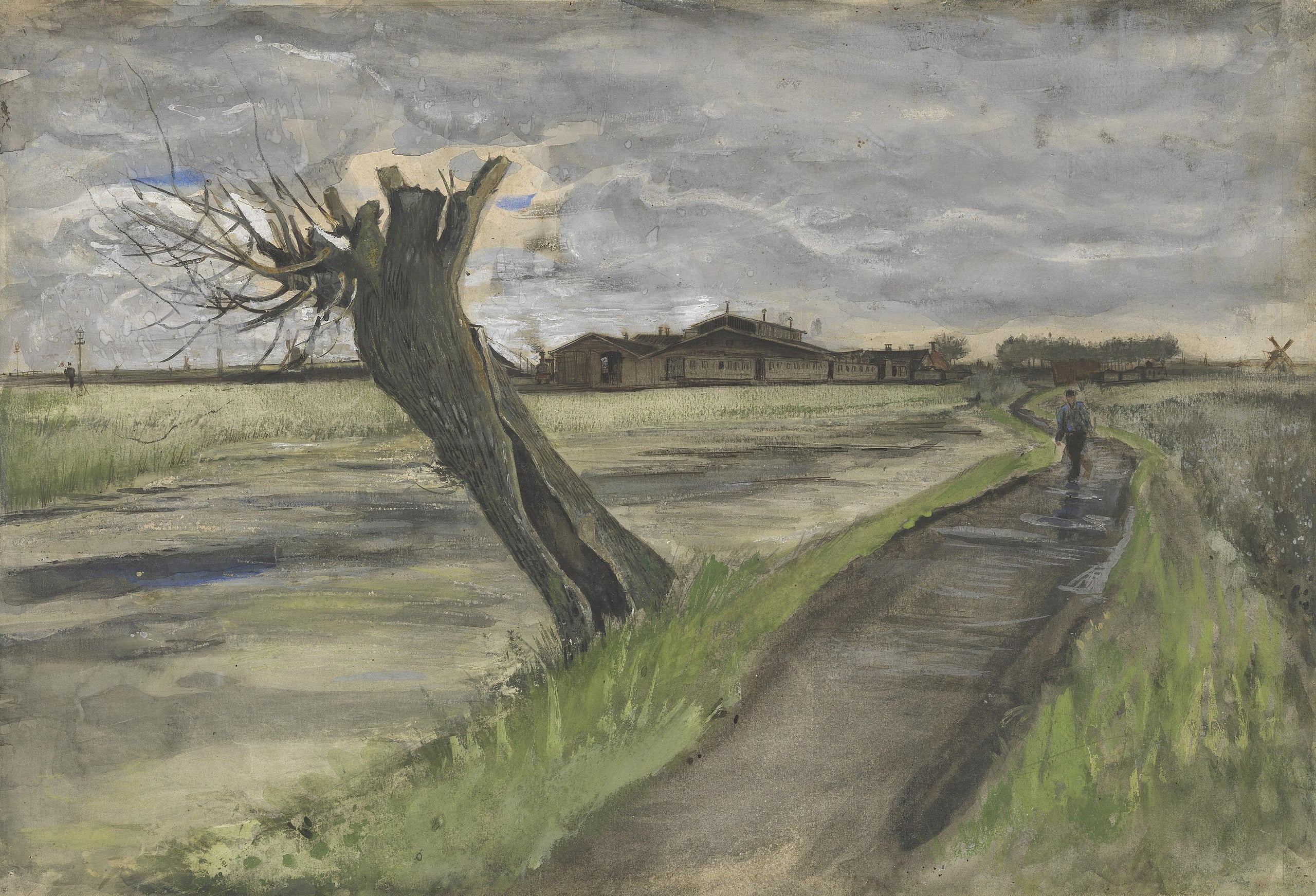
Pollard Willow is a watercolour Vincent van Gogh made in The Hague in July 1882: an old pollard willow with a thick, leaning trunk stands beside a stretch of still water, a wet path with a small walking figure runs off to the right, and low buildings and a windmill sit in the distance under a grey, cloudy sky. The original, in pencil, brown ink, watercolour and chalk on paper, measures 38 x 55.8 cm and is in the Van Gogh Museum in Amsterdam. We paint it by hand in oil on canvas after Van Gogh’s watercolour original, in 19 sizes from 45 x 25 to 157 x 90 cm or to your own measurement, and send you a photograph of the finished work for approval before dispatch.
| Title: | Pollard Willow |
| Other titles: | Knotwilg |
| Painter: | Vincent van Gogh (1853–1890) |
| Year painted: | July 1882, The Hague |
| Original size: | 38 cm x 55.8 cm |
| Original technique: | Pencil, brown ink, watercolour and chalk on paper |
| Painting style: | Realism, Dutch period (The Hague) |
| Located at: | Van Gogh Museum, Amsterdam (accession no. d1172S2012) |
| Our reproduction: | Hand-painted oil on canvas, 19 sizes or made to measure |
Pollard Willow – Vincent van Gogh
What does Pollard Willow show?
The watercolour shows a flat Dutch landscape on an overcast day. One old willow stands a little left of the centre, on a grassy bank: a thick, split trunk in dark brown and grey that leans to the left as it rises, cut off at the top into a stubby head. From that head a fan of thin, bare shoots spreads out to the left against the sky.
To the left of the trunk lies a wide sheet of still water, grey and brownish, reflecting the clouds. A wet path with shining puddles runs off to the right between two strips of bright green grass, and a small dark figure walks along it. In the middle distance stands a row of long, low buildings with dark roofs, a line of trees beside them and a small windmill on the horizon at the right. The grey sky fills almost half the sheet, with darker bands of cloud and a patch of pale yellow and blue behind the willow’s head.
What is behind the willow?
Van Gogh described the scene himself. In a letter to his brother Theo, written in The Hague on 31 July 1882, he characterised it as a dead tree beside a stagnant pond covered in duckweed, with a Rijnspoor depot in the distance, where railway lines cross, and smoke-blackened buildings.
He also listed green meadows, a cinder road, and a sky in which the clouds are racing, grey with an occasional gleaming white edge, and a depth of blue where the clouds tear apart for a moment. So the long buildings in the middle distance are, in his words, the depot, and the path in the foreground is his cinder road.
What does the watercolour mean?
Van Gogh wanted it to carry a mood. In letter 252 to Theo he called it a sombre landscape, and wrote that he wanted to make it the way he imagined the signalman with his smock and red flag must see and feel it when he thinks: ‘how gloomy it is today’. It is not known whether the figure on the path is meant to be that signalman.
He was pleased with the result. In the same letter he wrote that he thought it was the best of his watercolours. In a postscript, beside a sketch of the composition, he added that in the watercolour itself there is no black except in a mixed state, and that its strongest tones are dark green, brown and dark grey.
Where is the original today?
The original is in the Van Gogh Museum in Amsterdam. The museum lists it as Pollard Willow, The Hague, July 1882, pencil, brown ink, watercolour and chalk on paper, 38 x 55.8 cm, under the object number d1172S2012, with the catalogue numbers F947 and JH164.
It joined the museum’s collection only in 2012. According to the museum’s record, the sheet passed through dealers and collectors in Rotterdam, Amsterdam, New York and Japan, and was sold at Christie’s in New York in 2007 for 1,608,000 dollars. On 7 February 2012 the Van Gogh Museum bought it at Christie’s in London for 1,273,250 pounds, with the support of several funds and foundations.
Pollard Willow or a Nuenen painting – which to choose?
Pollard Willow is from The Hague in 1882; the other early Dutch works in our range were painted a few years later in Nuenen. Lane of Poplars at Sunset, from the autumn of 1884, shows a road between two rows of bare poplars, a single walker and an orange-red sun. The Potato Eaters, from 1885, shows a peasant family at their evening meal indoors under a lamp. The Cottage, from May 1885, shows a thatched double cottage at dusk with a woman at the door.
Autumn Landscape with Four Trees was painted in Nuenen in November 1885: three large trees in rust-orange leaves and a fourth, bare one. Choose Pollard Willow if you want a wide, open landscape in cool grey and green, with one strong tree, water and sky, rather than a sunset, a house or an interior.
How is our hand-painted Pollard Willow made?
We paint it in oil on canvas after Van Gogh’s watercolour original, keeping his palette of dark green, brown and grey and the light patch in the sky. The painter first draws the horizon, the bank, the path and the line of the trunk. Then come the sky and the water, the grass and the buildings, and last the bare shoots, the puddles and the figure.
Our oil painting reproduction is painted entirely by hand with real impasto: the paint goes on thickly, so the brushstrokes stand up from the canvas and catch the light. Van Gogh’s sheet is a watercolour, so the relief is our addition in oil; it matters most in the bark of the trunk, in the grass along the path and in the racing clouds. A print shows only a flat surface; on our painting the strokes are real.
Every painting is a hand-painted copy made for your order, so no two are quite the same.
Which size for which wall?
Short answer: 80 x 50 or 90 x 55 cm above a chest of drawers, a desk or a bed, 120 x 70 or 140 x 83 cm above a sofa, and 157 x 90 cm for a large wall. The wide landscape format suits a long wall above furniture, a dining room or a study.
There are 19 sizes: 45 x 25, 56 x 32, 60 x 35, 70 x 40, 80 x 50, 90 x 51, 90 x 55, 99 x 55, 100 x 60, 110 x 62, 110 x 65, 110 x 68, 116 x 68, 120 x 70, 130 x 75, 139 x 80, 140 x 83, 145 x 90 and 157 x 90 cm (width x height). The original is 55.8 cm wide and 38 cm high, so our 56 x 32 cm size is about as wide, but 6 cm shorter. With its grey sky, green verges and dark trunk, it sits well on a white, light grey or pale green wall. A painting for the living room in this format should take up about two thirds of the width of the furniture below it.
Hang it with the centre of the canvas about 150 cm above the floor, leaving 20 to 30 cm between the furniture and the bottom edge.
What if I need a custom size or a frame?
If none of the 19 sizes fits your wall, we paint it to measure. Keep the proportions close to the original, otherwise the landscape gets squeezed or the willow stretched. Send us the width and height you want and we will quote a price and a lead time. Every painting we make is stretched over a wooden stretcher and ready to hang.
For the moulding, use our 3D application: it shows each of our frame profiles on this subject, so you can compare gold, silver, black, white and natural wood – the application is for choosing the frame only. Seeing the painting on your own wall is our separate room placement service. A natural or dark wood frame suits the brown trunk and the earth, and a silver or white frame keeps the grey sky cool.
How does delivery work, and what is the guarantee?
Every painting is made to order in our studio in Slovenia, so allow 15 to 45 days depending on the size you choose. We ship it stretched and protected, framed if you chose a frame, across the EU with no customs. Before dispatch you receive a photograph of the finished work to approve, and we correct anything that is not right. Our returns policy applies to every order.
You will find more famous Van Gogh paintings among all our Vincent van Gogh paintings, and there is more about the painter in our article on Vincent van Gogh. If you are giving it as a present and are not sure of the size, a wall art voucher lets the recipient choose.
Frequently asked questions
Where is the original of Pollard Willow today?
In the Van Gogh Museum in Amsterdam. The museum lists it as Pollard Willow, The Hague, July 1882, pencil, brown ink, watercolour and chalk on paper, 38 x 55.8 cm, under the object number d1172S2012. It bought the sheet at Christie’s in London on 7 February 2012 for 1,273,250 pounds.
When and where did Van Gogh make Pollard Willow?
In The Hague, in July 1882. The Van Gogh Museum dates it to July 1882, and Van Gogh described the finished watercolour in a letter to his brother Theo written in The Hague on 31 July 1882. In that letter he wrote that he had attacked ‘that old giant of a pollard willow’, and placed a Rijnspoor depot in the distance.
Is Pollard Willow an oil painting or a watercolour?
It is a work on paper. The Van Gogh Museum gives the medium as pencil, brown ink, watercolour and chalk on paper, and Van Gogh himself called it one of his watercolours. Our version is different: we paint it by hand in oil on canvas after Van Gogh’s watercolour original, keeping the composition and the grey, green and brown palette.
What did Van Gogh write about his Pollard Willow?
He was proud of it. In his letter of 31 July 1882 he wrote to Theo that he thought it was the best of his watercolours. He called it a sombre landscape and said he wanted to show the scene as a signalman with his smock and red flag must see and feel it when he thinks: ‘how gloomy it is today’.
What are the buildings behind the willow in Pollard Willow?
According to Van Gogh’s own letter, they are the smoke-blackened buildings of a Rijnspoor depot in the distance, where railway lines cross. In the watercolour they appear as a row of long, low buildings with dark roofs in the middle distance, with a line of trees beside them and a small windmill on the horizon at the right.
How big is the original of Pollard Willow?
The Van Gogh Museum gives the size as 38 x 55.8 cm, so it is 55.8 cm wide and 38 cm high, a landscape format. Our 56 x 32 cm size is about as wide as the original, and there are 19 sizes from 45 x 25 to 157 x 90 cm, as well as custom sizes painted to measure. Above a sofa, 120 x 70 or 140 x 83 cm is a good choice.
Does your Pollard Willow have raised brushstrokes?
Yes. We paint our copy in oil with real impasto: the paint goes on thickly, so the brushstrokes stand up from the canvas. Van Gogh’s original is a watercolour on paper, so this relief belongs to our oil version. You see it best in the bark of the split trunk, in the grass along the path and in the clouds, where the strokes catch the light.
Is Pollard Willow a good gift?
It suits someone who is drawn to Dutch landscapes, wide skies and quiet, grey weather, or to Van Gogh’s early years in The Hague, and its wide format fits a living room or a study. As a canvas painting in grey, green and brown with one strong tree at its centre, it brings a calm, open view into a room, and a voucher lets the recipient choose the size.
- Subject: an old pollard willow beside still water, a wet path with a small figure, low railway buildings and a windmill in the distance under a grey sky.
- Original: July 1882, The Hague, watercolour with pencil, brown ink and chalk on paper, 38 x 55.8 cm, Van Gogh Museum, Amsterdam.
- Ours: a Van Gogh reproduction painted by hand in oil on canvas, in 19 sizes from 45 x 25 to 157 x 90 cm or made to measure.
- Worth knowing: with our 3D application you can try every frame profile on this painting before you order.