







































Description
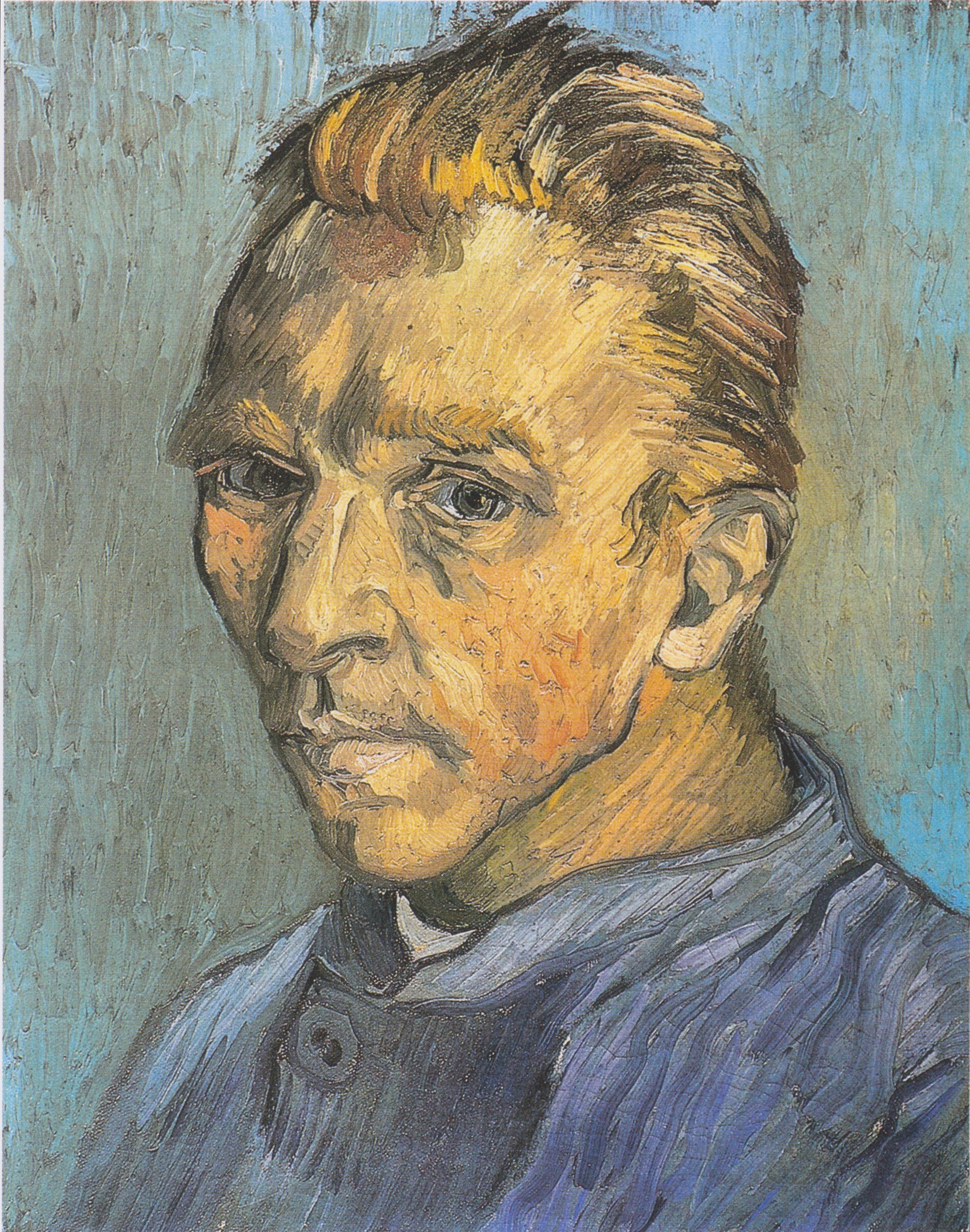
Self-Portrait without Beard is the small self-portrait Vincent van Gogh painted in Saint-Rémy in September 1889, clean-shaven: orange-red hair swept back, a face in ochre and green turned to our left, a blue jacket with a white collar, and a blue-green background of short upright strokes. The original, oil on canvas, measures 40 x 31 cm and is in a private collection. We paint it by hand in oil on canvas, in 16 sizes from 40 x 50 to 164 x 210 cm or to your own measurements, and send you a photograph of the finished painting for approval before dispatch.
| Title: | Self-Portrait without Beard |
| Other titles: | Self-portrait with clean-shaven face (F 525 / JH 1665) · Portrait de l’artiste sans barbe |
| Painter: | Vincent van Gogh (1853–1890) |
| Year painted: | end of September 1889, Saint-Rémy-de-Provence |
| Original size: | 40 cm x 31 cm |
| Original technique: | Oil on canvas |
| Painting style: | Post-Impressionism |
| Located at: | Private collection |
| Our reproduction: | Hand-painted oil on canvas, 16 sizes or made to measure |
Self-Portrait without Beard – Vincent van Gogh
What does Self-Portrait without Beard show?
Van Gogh shows himself from the chest up, close to the edge of the canvas, his head turned in three-quarter view towards our left while his eyes glance back at us. There is no beard and no moustache: the jaw, the chin and the upper lip are bare, and the hollow cheek is modelled in yellow ochre with green and blue shadows. His orange-red hair is swept back from a high forehead, a few strands standing up at the crown, and one ear shows on our right.
He wears a blue jacket buttoned high, with a dark round button at the front and a narrow strip of white shirt collar at the throat. Dark blue lines trace the outline of the shoulder, the ear and the nose. The background is a cool blue-green, laid on in short upright strokes that run side by side across the whole canvas, so the warm head stands out against a cool, gently moving ground.
Who was Self-Portrait without Beard painted for?
For his mother. On 28 September 1889 Van Gogh wrote to his brother Theo from Saint-Rémy that he would soon send some smaller canvases with the four or five studies he wanted to give to their mother and sister: reductions of the Wheatfield and cypresses, Olive trees, Reaper and Bedroom, “and a little portrait of me”. The notes to letter 806 in the Van Gogh Letters edition identify that little portrait as this canvas, catalogued as F 525 / JH 1665 and measuring 40 x 31 cm.
The same notes add a detail worth looking for: Van Gogh painted the portrait into The Bedroom (F 483), the smaller version of his bedroom that was also meant for his mother and his sister Willemien. Wikipedia’s list of his self-portraits calls the canvas a birthday gift to his mother.
What does Self-Portrait without Beard tell us about Van Gogh?
It shows him in Saint-Rémy in the autumn of 1889, still painting while he recovered. In the same letter of 28 September he tells Theo: “You’ll see that I’m gaining a little patience, and that persevering will be a result of my illness.” The face in the portrait is calm and attentive rather than dramatic, and the letter’s own words are the best guide to the mood in which it was painted.
The bare face is the feature that gives the portrait its name. The English Wikipedia article on the portraits of Vincent van Gogh says he painted it just after he had shaved himself, and records that Hulsker thought it was painted in Arles after his stay in hospital, when he had also been shaved. The same article names it, with the September 1889 self-portrait in the Musée d’Orsay, as a contender for being his last self-portrait; the question is not settled.
Where is the original today?
The original is in a private collection. Wikipedia’s list of his self-portraits gives it as end of September 1889, oil on canvas, 40 x 31 cm, private collection, catalogue number F 525, and the Van Gogh Letters edition gives the same number with the Hulsker number JH 1665.
The canvas changed hands in public once in recent history. According to the same Wikipedia list, it sold for $71.5 million in 1998 in New York, and at the time it was the third (or, adjusted for inflation, the fourth) most expensive painting ever sold. It is not known who owns it today.
Self-Portrait without Beard or Self-Portrait with Bandaged Ear – which should you choose?
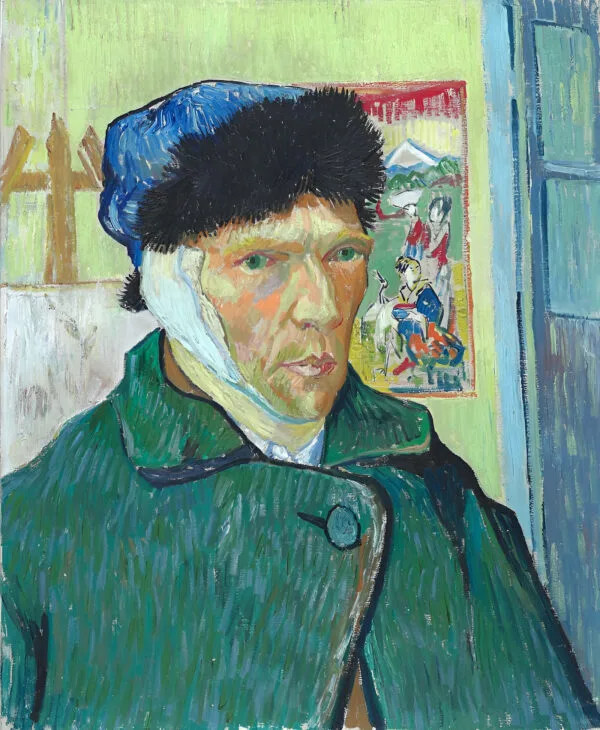
Choose this one for a quiet, clean-shaven face in blue and ochre against blue-green, or choose Self-Portrait with Bandaged Ear, painted in Arles in January 1889, for the earlier portrait with the fur cap and the bandage. Hulsker, who dated this portrait to Arles after the hospital stay, linked the bare face to January 1889, the time of the bandaged-ear portrait.
If you would like another face for company, our range has more. Self-Portrait as an Artist, painted in Paris, shows him at the easel with palette and brushes, and Self-Portrait with Grey Felt Hat is one he painted in Paris. For a landscape from the same place, The Starry Night was painted in Saint-Rémy in June 1889, three months before this portrait.
How is our hand-painted Self-Portrait without Beard made?
The painter first draws the head, the line of the hair, the ear and the shoulders, and checks the proportions against the original. Then comes the blue-green background in its short upright strokes, then the blue jacket and the collar, and last the face, the orange-red hair and the dark outlines. Our oil painting reproduction is painted by hand on canvas, with real impasto: the paint goes on thickly, so the brushstrokes stand up from the canvas as they do in the original and catch the light.
On this painting the relief shows most in the combed strokes of the hair, in the rows of short strokes behind the head and in the long, curving strokes of the jacket. A print is completely flat; on our painting every stroke is real.
Every painting is a hand-painted copy made for your order, so no two are quite the same.
Which size for which wall?
Short answer: 40 x 50 or 50 x 65 cm for a narrow wall in a hallway or a study, 60 x 80 or 70 x 90 cm above a chest of drawers or a desk, and 90 x 120 or 104 x 135 cm above a sofa or on a large wall.
There are 16 sizes: 40 x 50, 50 x 62, 50 x 65, 56 x 70, 60 x 80, 70 x 90, 80 x 100, 90 x 120, 97 x 127, 104 x 135, 111 x 145, 121 x 150, 130 x 162, 138 x 180, 150 x 195 and 164 x 210 cm (width x height). The original is only 31 cm wide and 40 cm high, so even our smallest size, 40 x 50 cm, is a little larger than Van Gogh painted it. The 60 x 80 cm size keeps his proportions almost exactly at about twice the size, and 90 x 120 cm at about three times. Because the canvas is upright and the head fills it, the portrait works well on a narrow wall, between two windows or beside a doorway. A painting for the living room should cover about two thirds of the width of the furniture below it.
Place the centre of the canvas about 150 cm above the floor, so the painter’s eyes are close to your own. Above a sofa, a bed or a sideboard, leave 20 to 30 cm between the top of the furniture and the bottom of the canvas.
What if I need a custom size or a frame?
If none of the 16 sizes fits your wall, we paint it to measure in any width and height you need. Send us the width and height you want and we will quote you a price and a delivery time. Every painting we make is mounted on a wooden stretcher, ready to hang.
Our 3D app shows each of our frame profiles on this painting, so you can compare gold, silver, black, white and natural wood. The app is for choosing the frame only. To see the painting on your own wall, use our separate room placement service. A gold frame picks up the orange-red hair and the ochre of the face, while a dark one repeats the blue of the jacket.
How does delivery work, and what is the guarantee?
Every painting is made to order in our studio in Slovenia, so allow 15 to 45 days depending on the size you choose. We ship it on its stretcher, carefully packed (and framed, if you chose a frame), across the EU with no customs duty. Before dispatch we send you a photograph of the finished painting to approve, and we correct anything that is not right. Our returns policy applies to every order.
You will find more of Van Gogh’s famous works among all our Vincent van Gogh paintings, and more about the painter in our article on Vincent van Gogh. If it is a present and you are not sure of the size, a wall art voucher lets the recipient choose.
Frequently asked questions
Where is the original Self-Portrait without Beard today?
In a private collection. Wikipedia’s list of Van Gogh’s self-portraits gives it as end of September 1889, oil on canvas, 40 x 31 cm, private collection, catalogue number F 525, and the Van Gogh Letters edition records the same canvas as F 525 / JH 1665. It is not known who owns it today; it was sold at auction in New York in 1998.
When and where did Van Gogh paint Self-Portrait without Beard?
In Saint-Rémy-de-Provence, in September 1889. Wikipedia’s list dates it to the end of that month, and on 28 September 1889 Van Gogh wrote to Theo that the studies meant for his mother and sister, among them a little portrait of himself, were drying. Hulsker, as Wikipedia records, thought it was painted earlier, in Arles.
Why does Van Gogh have no beard in Self-Portrait without Beard?
Because he had just shaved. Wikipedia says he painted the portrait just after he had shaved himself, which is why the jaw, the chin and the upper lip are bare here and the hollow of the cheek shows clearly. Hulsker linked the bare face to his stay in hospital in Arles, where he was also shaved, as in the bandaged-ear portraits.
Who did Van Gogh give Self-Portrait without Beard to?
To his mother. In his letter of 28 September 1889 he lists “a little portrait of me” among the studies he wanted to give to his mother and his sister, and the notes of the Van Gogh Letters edition identify it as this canvas. Wikipedia calls it a birthday gift to his mother. He also painted it into the smaller Bedroom meant for them.
Is Self-Portrait without Beard Van Gogh’s last self-portrait?
It may be, but the question is open. Wikipedia names it as one of two contenders: this canvas, from the end of September 1889, and the September 1889 self-portrait in the Musée d’Orsay in Paris, which he gave to his brother Theo. Art historians date the two differently, so neither can be called his last with certainty.
How much did Self-Portrait without Beard sell for?
$71.5 million, in 1998 in New York, according to Wikipedia’s list of Van Gogh’s self-portraits. At the time it was the third most expensive painting ever sold, or the fourth when the earlier prices are adjusted for inflation. It is not known who bought it, and the canvas is in a private collection.
How big is the original Self-Portrait without Beard?
40 cm high and 31 cm wide, according to the Van Gogh Letters edition and Wikipedia: a small canvas, which is why Van Gogh called it a little portrait. Even our smallest size, 40 x 50 cm, is a little larger than the original. If you want the face larger, there are 16 sizes up to 164 x 210 cm, and custom sizes in any proportions.
Which size of Self-Portrait without Beard suits a living room?
Above a sofa, choose 90 x 120 or 104 x 135 cm, so that the canvas painting holds its own on a large wall and the face reads clearly from across the room. On a narrower wall, beside a bookcase or above a sideboard, 60 x 80 or 70 x 90 cm works well. For a very large wall, choose our largest size, 164 x 210 cm.
Does your Self-Portrait without Beard have the raised brushstrokes of the original?
Yes. We paint it in impasto, building up each brushstroke in thick oil, so the surface is raised like Van Gogh’s original. You see this best in the combed strokes of the orange-red hair, in the short upright strokes of the blue-green background and in the curving strokes of the jacket, where the relief catches the light from the side.
- Subject: Van Gogh himself, clean-shaven, with orange-red hair swept back, in a blue jacket with a white collar, against a blue-green background of short strokes.
- Original: September 1889, Saint-Rémy, oil on canvas, 40 x 31 cm, private collection.
- Ours: a Van Gogh reproduction painted by hand in oil on canvas, in 16 sizes from 40 x 50 to 164 x 210 cm or made to measure.
- Worth knowing: our 3D app shows every frame profile on this self-portrait, so you can choose the frame before you order.