







































Description
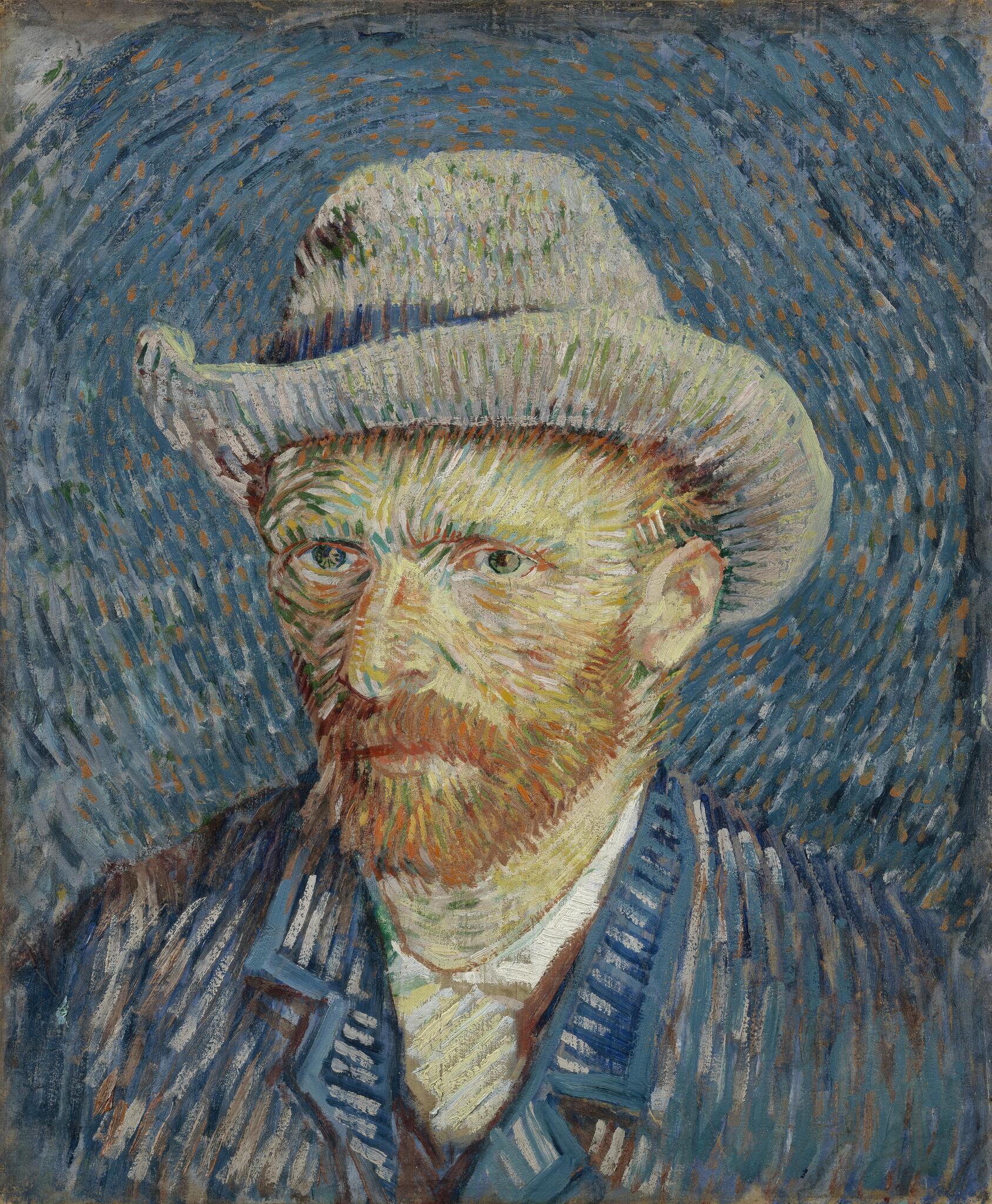
Self-Portrait with Grey Felt Hat is the head-and-shoulders self-portrait Vincent van Gogh painted in Paris in 1887: a face built from short strokes of yellow, green and orange, a red beard, a light grey felt hat and a dark blue jacket, set against a background of blue and orange dashes that circle his head. The original, oil on cotton, measures 44.5 x 37.2 cm and is in the Van Gogh Museum in Amsterdam. We paint it by hand in oil on canvas, in 16 sizes from 40 x 50 to 135 x 160 cm or to your own measurement, and send you a photograph of the finished work for approval before dispatch.
| Title: | Self-Portrait with Grey Felt Hat |
| Other titles: | Self-Portrait with a Grey Felt Hat · Zelfportret met grijze vilthoed |
| Painter: | Vincent van Gogh (1853–1890) |
| Year painted: | September–October 1887, Paris |
| Original size: | 44.5 cm x 37.2 cm |
| Original technique: | Oil on cotton |
| Painting style: | Post-Impressionism |
| Located at: | Van Gogh Museum, Amsterdam (acc. no. s0016V1962) |
| Our reproduction: | Hand-painted oil on canvas, 16 sizes or made to measure |
Self-Portrait with Grey Felt Hat – Vincent van Gogh
What does Self-Portrait with Grey Felt Hat show?
Van Gogh fills almost the whole painting with his own head and shoulders. He turns slightly to the left, but his blue-green eyes look straight out at you. The face is built from short, separate strokes of yellow, pink, green and orange, and the beard and moustache are red and orange with green strokes between them. On his head sits a light grey felt hat with a wide brim, painted in short touches of grey, white and blue.
He wears a dark blue jacket with lapels edged in lighter blue, over a white shirt. The background is a deep blue made of short dashes that run in different directions, mixed with small flecks of orange. Close to the head the dashes follow its outline, so the head seems to sit inside a ring of strokes.
How did Van Gogh paint the strokes in Self-Portrait with Grey Felt Hat?
With short stripes of colour, each one set down on its own. The Van Gogh Museum writes that the work makes clear he had studied the technique of the Pointillists, and that he applied it in his own, original way: he placed the short stripes of paint in different directions rather than in one even pattern.
The effect is easiest to see in the background. According to the museum, where the stripes follow the outline of his head they form a kind of halo. In the face and the hat the strokes are shorter; in the jacket they run downwards along the lapels.
What does Self-Portrait with Grey Felt Hat mean?
The museum calls it one of Van Gogh’s boldest colour experiments in Paris. He set complementary colours side by side: blue and orange in the background, red and green in the beard and the eyes. In the museum’s words, the colours intensify one another.
Time has changed that balance a little. The museum notes that the red pigment has faded, so strokes that were once purple now look blue, and the contrast with the yellow is less powerful than when he painted it. The work also belongs to a long series: the English Wikipedia article on the portraits of Vincent van Gogh calls his dozens of self-portraits an important part of his work, and notes that he most probably painted his face from a mirror, so his right side in the painting is in reality the left side of his face.
Where is the original today?
The original is in the Van Gogh Museum in Amsterdam, which lists it as Self-Portrait with Grey Felt Hat, Paris, September–October 1887, oil on cotton, 44.5 x 37.2 cm, under the object number s0016V1962. Its credit line reads Van Gogh Museum, Amsterdam (Vincent van Gogh Foundation). Its own description places the work in the winter of 1887–88.
The museum also records how it got there. Van Gogh left the painting at the apartment of his brother Theo in Paris in September–October 1887. After Theo’s death on 25 January 1891 it passed to his widow, Jo van Gogh-Bonger, and their son Vincent Willem van Gogh, who transferred it to the Vincent van Gogh Foundation on 10 July 1962. Since the museum opened in Amsterdam in 1973, the painting has been there.
Self-Portrait with Grey Felt Hat or another Van Gogh – which should you choose?
First, which felt hat this is. Wikipedia’s list includes two self-portraits with a dark felt hat from 1886, and a much smaller self-portrait with a grey felt hat, oil on pasteboard, 19 x 14 cm, dated March–April 1887; all three are in the Van Gogh Museum as well. Our painting is the larger one, object number s0016V1962, with the blue background of short dashes.
Among the other works in our range, Self-Portrait as an Artist is another self-portrait, and Self-Portrait with Bandaged Ear dates from January 1889, in Arles, according to Wikipedia. The Italian Woman and A Pair of Shoes are two more paintings from his Paris years. Choose the Grey Felt Hat for a direct face in blue and orange, or the shoes for a still life instead of a face.
How is our hand-painted Self-Portrait with Grey Felt Hat made?
The painter first draws the head, the hat, the shoulders and the lapels, and checks the proportions against the original. Then comes the blue background, laid in short dashes that follow the outline of the head, then the jacket and the face, and last the red beard, the eyes and the grey hat. Our oil painting reproduction is painted by hand in oil on canvas with real impasto: the paint goes on thickly, so the brushstrokes stand up from the canvas as they do in the original and catch the light.
On this painting the relief shows most in the short dashes of the background, in the separate strokes of the face and beard and in the light touches on the brim of the hat. A print shows only a flat surface; on our painting every stroke is real.
Every painting is a hand-painted copy made for your order, so no two are quite the same.
Which size for which wall?
Short answer: 40 x 50 or 55 x 66 cm for a narrow wall in a hallway or a study, 80 x 100 cm above a chest of drawers or a desk, and 100 x 120 or 110 x 130 cm above a sofa or on a large wall.
There are 16 sizes: 40 x 50, 55 x 66, 60 x 70, 64 x 80, 70 x 85, 75 x 90, 80 x 100, 85 x 105, 90 x 110, 93 x 115, 100 x 120, 105 x 125, 110 x 130, 120 x 140, 127 x 150 and 135 x 160 cm (width x height). The original is 37.2 cm wide and 44.5 cm high, smaller than our smallest size, so even at 40 x 50 cm the face is a little larger than Van Gogh painted it. The 55 x 66 cm size keeps its proportions almost exactly at about one and a half times the size, and 110 x 130 cm at about three times. A painting for the living room should cover about two thirds of the width of the furniture below it.
Hang it with the centre of the canvas about 150 cm above the floor, so the painter’s eyes are close to your own. Above a sofa, a bed or a sideboard, leave 20 to 30 cm between the furniture and the bottom edge.
What if I need a custom size or a frame?
If none of the 16 sizes fits your wall, we paint it to measure in any width and height you need. Send us the width and height you want and we will quote a price and a lead time. Every painting we make is stretched over a wooden stretcher and ready to hang.
For the moulding, use our 3D application: it shows each of our frame profiles on this subject, so you can compare gold, silver, black, white and natural wood – the application is for choosing the frame only. Seeing the painting on your own wall is our separate room placement service. A black moulding repeats the jacket and the background, while a gold one picks up the orange flecks and the red of the beard.
How does delivery work, and what is the guarantee?
Every painting is made to order in our studio in Slovenia, so allow 15 to 45 days depending on the size you choose. We ship it stretched and protected, framed if you chose a frame, across the EU with no customs. Before dispatch you receive a photograph of the finished work to approve, and we correct anything that is not right. Our returns policy applies to every order.
You will find more famous Van Gogh paintings among all our Vincent van Gogh paintings, and more about the painter in our article on Vincent van Gogh. If it is a present and you are not sure of the size, a wall art voucher lets the recipient choose.
Frequently asked questions
Where is the original Self-Portrait with Grey Felt Hat today?
In the Van Gogh Museum in Amsterdam. The museum lists it under the object number s0016V1962 as a work painted in Paris in September–October 1887, oil on cotton, 44.5 x 37.2 cm, with the credit line Vincent van Gogh Foundation. Van Gogh left it at his brother Theo’s apartment in Paris, and it stayed with the family until it went to the foundation in 1962.
When did Van Gogh paint Self-Portrait with Grey Felt Hat?
In Paris, in 1887. The museum’s object data give September–October 1887, while its description and Wikipedia’s list of his self-portraits place it in the winter of 1887–88, when he had been living in Paris for almost two years. Either way, it comes from the end of his Paris years, before the self-portraits he painted in Arles.
Is Self-Portrait with Grey Felt Hat a pointillist painting?
Partly. The Van Gogh Museum writes that the work shows he had studied the technique of the Pointillists, but that he applied it in his own, original way: he placed short stripes of paint in different directions. Around the head these stripes follow its outline and, in the museum’s words, form a kind of halo against the blue background.
Why do the colours of Self-Portrait with Grey Felt Hat look different today?
Because one pigment has faded. According to the Van Gogh Museum, the red pigment has faded, so strokes that were once purple now look blue, and the contrast with the yellow is less powerful than when Van Gogh painted it. The pairs of opposite colours he set side by side, blue with orange and red with green, are still clearly visible.
How many self-portraits with a felt hat did Van Gogh paint?
Several. Wikipedia’s list of his self-portraits includes two with a dark felt hat from 1886, a small self-portrait with a grey felt hat on pasteboard from March–April 1887, and this larger one with the blue background. All four are in the Van Gogh Museum in Amsterdam. Altogether, Wikipedia speaks of dozens of self-portraits by Van Gogh.
What is Self-Portrait with Grey Felt Hat painted on?
On cotton. The Van Gogh Museum gives the technique as oil on cotton, not oil on canvas as some lists have it, and the size as 44.5 x 37.2 cm. Wikipedia’s list shows that in Paris he also painted self-portraits on pasteboard, so the support varied from work to work. Our version is painted in oil on a stretched canvas.
Which size of Self-Portrait with Grey Felt Hat suits a living room?
Above a sofa, choose 100 x 120 or 110 x 130 cm, so that the canvas painting holds its own on a large wall and the face reads clearly from across the room. On a narrower wall, beside a bookcase or above a sideboard, 64 x 80 or 80 x 100 cm is enough. For a very high wall, 135 x 160 cm is the largest size.
Does your Self-Portrait with Grey Felt Hat have the raised brushstrokes of the original?
Yes. We paint our Grey Felt Hat in impasto: the paint goes on thickly, so the brushstrokes stand up from the canvas as on Van Gogh’s original. You see it best in the short dashes of the blue background, in the separate strokes of the face and the red beard and in the light touches on the brim of the hat, where the relief catches the light from the side.
- Subject: Van Gogh himself in a light grey felt hat and a dark blue jacket, his face and red beard built from short strokes, against a blue background of circling dashes.
- Original: September–October 1887, Paris, oil on cotton, 44.5 x 37.2 cm, Van Gogh Museum, Amsterdam.
- Ours: a Van Gogh reproduction painted by hand in oil on canvas, in 16 sizes from 40 x 50 to 135 x 160 cm or made to measure.
- Worth knowing: our 3D application shows every frame profile on this self-portrait, so you can choose the frame before you order.