







































Description
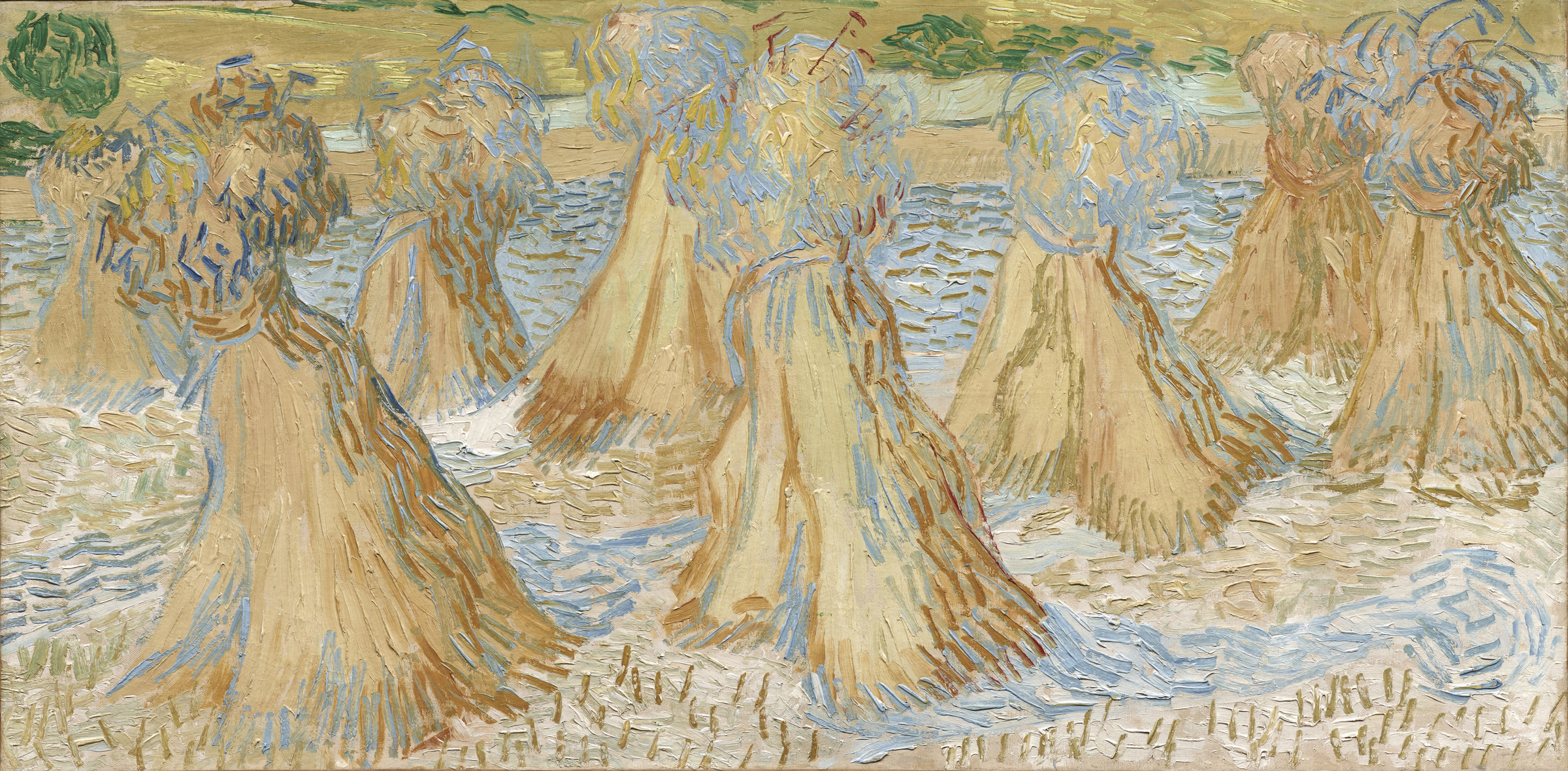
Sheaves of Wheat is one of the last paintings Vincent van Gogh made: eight tall sheaves of recently cut wheat standing close together in a stubble field at Auvers-sur-Oise in July 1890, painted in pale yellow and ochre with strokes of white, blue and lilac between them and a strip of green along the top. The original measures 50.5 x 101 cm and belongs to the Dallas Museum of Art. We paint it by hand in oil on canvas, in 10 sizes from 60 x 30 to 180 x 90 cm or to your own measurement, and send you a photograph of the finished work for approval before dispatch.
| Title: | Sheaves of Wheat |
| Other titles: | Wheat Sheaves · Feld mit Korngarben |
| Painter: | Vincent van Gogh (1853–1890) |
| Year painted: | July 1890, Auvers-sur-Oise |
| Original size: | 50.5 cm x 101 cm |
| Original technique: | Oil on canvas |
| Painting style: | Post-Impressionism |
| Located at: | Dallas Museum of Art, Dallas (inv. 1985.R.80) |
| Our reproduction: | Hand-painted oil on canvas, 10 sizes or made to measure |
Sheaves of Wheat – Vincent van Gogh
What does Sheaves of Wheat show?
The painting shows a field just after the harvest, seen from very close. Eight sheaves of wheat stand side by side across the canvas, so near that their tops almost reach the upper edge. Each is a tall bundle of straw gathered in at the middle, and no two lean the same way: some stand upright, others tilt or twist.
The sheaves are painted in pale yellow, ochre and light gold, in long strokes that follow the straw. Between them the stubble ground is laid on in short strokes of white, light blue and lilac, and the same blue and violet run through the shadows of the bundles. A narrow strip of green runs along the top edge. Wikipedia describes them as bathed in yellow light and notes that Van Gogh used a vivid lavender, the complementary colour of yellow, for the shadows and the earth.
Why is Sheaves of Wheat twice as wide as it is high?
Because it belongs to a group of wide canvases Van Gogh painted in his last weeks at Auvers-sur-Oise. The Dallas Museum of Art describes Sheaves of Wheat as part of a larger series of 13 canvases with an elongated rectangular format. At 101 by 50.5 cm, it is exactly twice as wide as high.
Wikipedia follows the same thirteen canvases through the wheat harvest around Auvers in the second half of July: the series began with Wheat Field under Cloudy Sky, went on to the wheat field with crows when the crop was about to be cut, came to Sheaves of Wheat after the harvest and ended with Field with Haystacks, now in a private collection.
What do the sheaves mean?
Van Gogh came to Auvers-sur-Oise from Saint-Rémy-de-Provence, by way of Paris, in May 1890. The Dallas Museum of Art says he moved to the village to continue treatment for his mental health, and that Sheaves of Wheat is among his very last works, painted during the final month of his life. In a letter to Theo that July he wrote that he was completely absorbed in the immense plain covered with fields of wheat against the hills, boundless as the sea.
In the museum’s reading, he spent his career trying to express the comforting feeling of eternity he found in the countryside, watching nature’s endless cycles such as the growing and harvesting of wheat. Wikipedia sums up his symbols: the sower and the wheat sheaf stood for eternity, the reaper and his scythe for death. In a letter to his sister in 1889 he asked whether we, who live on bread, are not to a considerable extent like wheat ourselves. The wider story of these fields is told in the Wikipedia article on Van Gogh’s wheat field paintings.
Where is the original today?
The original belongs to the Dallas Museum of Art in Texas. The museum lists it as Sheaves of Wheat, July 1890, oil on canvas, under the accession number 1985.R.80. In the catalogue of Van Gogh’s work it is F771.
It came to the museum as part of The Wendy and Emery Reves Collection.
Sheaves of Wheat or another wheat painting – which to choose?
Of the wheat paintings in our range, this is the closest and the calmest: no figures, just the sheaves in pale yellow light. Wheat Field with Crows belongs, in Wikipedia’s account, to the same group of wide canvases from July 1890 at Auvers, but there the wheat is still standing under a dark sky with black birds. The Harvest is earlier, painted at Arles in 1888, and Landscape with Wheat Sheaves and Rising Moon comes from Saint-Rémy in 1889.
For another field with bundles of cut wheat, see Wheat Field with Sheaves. Choose this painting for light colours and a long, quiet format.
How is our hand-painted Sheaves of Wheat made?
The painter first sets out the long canvas and the eight sheaves, their tilt and the gaps between them. Then come the stubble ground in short white, blue and lilac strokes, the strip of green at the top, and last the sheaves themselves, built up stroke by stroke in yellow and ochre. Our oil painting reproduction is painted by hand in oil on canvas with real impasto: the paint goes on thickly, so the brushstrokes stand up from the canvas as they do in the original and catch the light.
On this painting the relief matters most in the long strokes of the straw and in the dense, short strokes of the ground. A print shows only a flat surface; on our painting the strokes are real.
Every painting is a hand-painted copy made for your order, so no two are quite the same. Before dispatch we photograph it, sending you the photograph to approve.
Which size for which wall?
Short answer: 100 x 50 or 101 x 50 cm above a sideboard, a desk or a bed, 120 x 60 or 150 x 75 cm above a sofa, and 180 x 90 cm for a long empty wall. Twice as wide as it is high, it suits long, narrow spaces: a bed headboard, a corridor, a kitchen bench or a low bookcase.
There are 10 sizes: 60 x 30, 70 x 35, 80 x 40, 90 x 45, 100 x 50, 101 x 50, 110 x 55, 120 x 60, 150 x 75 and 180 x 90 cm (width x height). The original is 101 cm wide and 50.5 cm high; our 101 x 50 cm size is practically the size of the canvas in Dallas. The small 60 x 30 or 70 x 35 cm sizes fit above a narrow console. Its pale yellow and lilac sit well on a white, cream, warm grey or soft lavender wall. A painting for the living room should take up about two thirds of the width of the furniture below it.
Hang it with the centre of the canvas about 150 cm above the floor, leaving 20 to 30 cm between the furniture and the bottom edge.
What if I need a custom size or a frame?
If none of the 10 sizes fits your wall, we paint it to measure. Keep the proportions close to the original, two to one, otherwise the sheaves get squeezed or stretched. Send us the width and height you want and we will quote a price and a lead time. Every painting we make is stretched over a wooden stretcher and ready to hang.
For the moulding, use our 3D application: it shows each of our frame profiles on this subject, so you can compare gold, silver, black, white and natural wood – the application is for choosing the frame only. Seeing the painting on your own wall is our separate room placement service. A natural wood or gold frame suits the yellow of the straw, and a white or light frame keeps the whole painting bright.
How does delivery work, and what is the guarantee?
Every painting is made to order in our studio in Slovenia, so allow 15 to 45 days depending on the size you choose. We ship it stretched and protected, framed if you chose a frame, across the EU with no customs. Before dispatch you receive a photograph of the finished work to approve, and we correct anything that is not right. Our returns policy applies to every order.
You will find more famous Van Gogh paintings among all our Vincent van Gogh paintings, and there is more about the painter in our article on Vincent van Gogh. If you are giving it as a present and are not sure of the size, a wall art voucher lets the recipient choose.
Frequently asked questions
Where is the original Sheaves of Wheat by Van Gogh today?
In the Dallas Museum of Art in Texas. The museum lists it as Sheaves of Wheat, July 1890, oil on canvas, accession number 1985.R.80, part of The Wendy and Emery Reves Collection.
When did Van Gogh paint Sheaves of Wheat in 1890?
In July 1890, at Auvers-sur-Oise near Paris. The Dallas Museum of Art counts it among his very last works, painted in the final month of his life. Wikipedia places it after the harvest, in a series that followed the wheat around Auvers in late July. He died there on 29 July 1890.
How many sheaves are there in Sheaves of Wheat?
Eight. Wikipedia describes Van Gogh filling the whole surface with eight sheaves of wheat, as if seen from a worker’s point of view, bathed in yellow light and apparently just cut. They stand side by side across the wide canvas, each leaning its own way, with lavender shadows between them.
What do wheat sheaves mean in Van Gogh’s Sheaves of Wheat?
They stand for the cycle of nature and for eternity. The Dallas Museum of Art writes that Van Gogh tried to express the comforting feeling of eternity he found in nature’s endless cycles, like growing and harvesting wheat. Wikipedia sums up his symbols: the sower and the wheat sheaf for eternity, the reaper for death.
Is Sheaves of Wheat part of a series?
Yes. The Dallas Museum of Art places it in a larger series of 13 canvases with an elongated rectangular format, painted at Auvers-sur-Oise. Wikipedia describes the same thirteen as large horizontal views of the wheat harvest around the village, from Wheat Field under Cloudy Sky to Field with Haystacks, with Sheaves of Wheat painted after the crop was cut.
How much is Van Gogh’s Sheaves of Wheat worth?
It has no price, because the original belongs to a museum, the Dallas Museum of Art, and is not for sale. What you can own is a copy painted by hand in oil on canvas in our studio, in 10 sizes from 60 x 30 to 180 x 90 cm or made to measure.
Is Sheaves of Wheat one of Van Gogh’s last paintings?
Yes. The Dallas Museum of Art counts Sheaves of Wheat among Van Gogh’s very last works, painted during the final month of his life at Auvers-sur-Oise. He had settled in the village in May 1890, and Wikipedia counts about 70 paintings from then until his death on 29 July 1890.
Which size of Sheaves of Wheat suits a long wall?
For a long wall, 150 x 75 or 180 x 90 cm; above a sofa, 120 x 60 cm; above a sideboard or a bed, 100 x 50 or 101 x 50 cm. Being twice as wide as high, it also fits a corridor or a bed headboard. Our 101 x 50 cm size is practically the size of the original.
Does your Sheaves of Wheat have the raised brushstrokes of the original?
Yes. We paint our copy in impasto: the paint goes on thickly, so the brushstrokes stand up from the canvas as on Van Gogh’s original. You see it best in the long strokes of the straw and in the short strokes of the stubble ground, where the relief catches the light. A print cannot have this relief, because its surface is flat.
Is Sheaves of Wheat a good gift?
It is a calm, light gift for many homes: a living room or kitchen in warm tones, a long hallway, a country house, or someone who works with bread, grain or the land. As a canvas painting with a quiet subject, it also works for a new home, and a voucher lets the recipient choose the size.
- Subject: eight sheaves of cut wheat in a stubble field at Auvers, pale yellow with lilac shadows.
- Original: July 1890, Auvers-sur-Oise, 50.5 x 101 cm, Dallas Museum of Art.
- Ours: a Van Gogh reproduction painted by hand in oil on canvas, in 10 sizes from 60 x 30 to 180 x 90 cm or made to measure.
- Worth knowing: you receive a photograph of the finished work for approval before dispatch.