







































Description
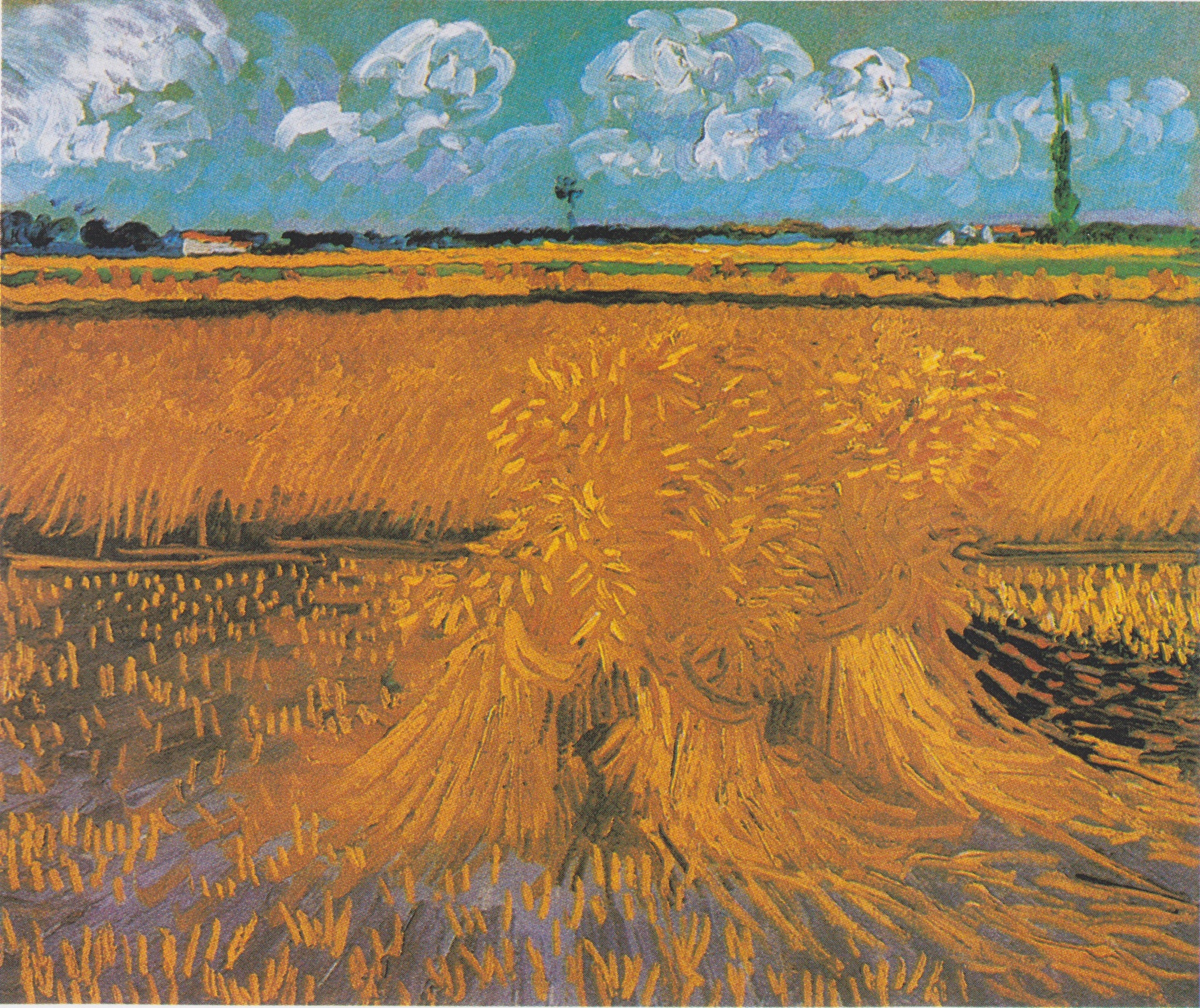
Wheat Field with Sheaves is the harvest landscape Vincent van Gogh painted near Arles in June 1888: a golden field of cut wheat with a large group of sheaves standing in the middle, bands of fields running back to a low horizon with farmhouses and trees, and a bright blue sky full of white clouds. The original measures about 55 x 67 cm and belongs to the Honolulu Museum of Art in Hawaii. We paint it by hand in oil on canvas, in 17 sizes from 50 x 40 to 150 x 120 cm or to your own measurement, and send you a photograph of the finished work for approval before dispatch.
| Title: | Wheat Field with Sheaves |
| Other titles: | Wheat Field · Wheat Fields |
| Painter: | Vincent van Gogh (1853–1890) |
| Year painted: | June 1888, Arles |
| Original size: | 55.2 cm x 66.6 cm |
| Original technique: | Oil on canvas |
| Painting style: | Post-Impressionism |
| Located at: | Honolulu Museum of Art, Honolulu (inv. 377.1) |
| Our reproduction: | Hand-painted oil on canvas, 17 sizes or made to measure |
Wheat Field with Sheaves – Vincent van Gogh
What does Wheat Field with Sheaves show?
The painting shows a wheat field in Provence just after the reaping. In the middle of the foreground stands a large group of sheaves, bundles of cut wheat set upright and leaning against each other so that they dry in the sun. They are painted in thick yellow, orange and ochre strokes that run in every direction, with dark lines between the stalks. Around them lies the stubble of the cut field, and on the right a dark, furrowed strip of ground crosses the canvas.
Behind the sheaves a broad band of golden wheat stretches from edge to edge, painted in long horizontal strokes. Further back come thinner bands of yellow and green fields, and on the low horizon stand small farmhouses with red roofs, dark trees and one tall, thin tree on the right. Above them the sky takes up about a quarter of the canvas: a clear blue with rounded white clouds outlined in blue.
Why did Van Gogh paint the wheat harvest in June 1888?
In February 1888 Van Gogh travelled from Paris to Arles in the south of France, where he painted the railway, the orchards, the canals and the wheat fields. When the harvest began in June, he went out into the fields every day. The Honolulu Museum of Art writes that this painting is one of ten paintings and five drawings showing different phases of the harvest, and that he completed the series in just over a week. He worked outdoors, in the same heat as the field workers he admired.
On 21 June 1888 he wrote to his brother Theo that he had spent a week working hard in the wheat fields under the blazing sun. He described the results as landscapes in yellow and old gold, done quickly, quickly, quickly, like the harvester who works in silence under the sun, intent only on the reaping.
What does the painting mean?
Wheat meant more to Van Gogh than a farm crop. Wikipedia explains that he saw ploughing, sowing and harvesting as part of the cycle of nature, and quotes the idea that the sower and the wheat sheaf stood for eternity, and the reaper and his scythe for death. The sheaves in this field are the end of one cycle and the promise of bread, the seed of the next.
In the museum’s reading, the brushstrokes going in many directions and the warm colour draw the eye to the harvested sheaves, the yellow-orange is set against the blue of the sky, and the restless foreground contrasts with the calm, horizontal bands of fields behind. In a letter of July 1888 Van Gogh wrote that some landscapes done more quickly than ever were among the best things he did, the harvest and the wheat stacks too. The whole series is described in the Wikipedia article on Van Gogh’s wheat field paintings.
Where does the original hang?
The original belongs to the Honolulu Museum of Art in Honolulu, Hawaii. The museum lists it simply as Wheat Field, 1888, oil on canvas, under the number 377.1, a gift of Mrs. Richard A. Cooke and Family in memory of Richard A. Cooke in 1946. Wikipedia lists it as Wheat Fields or Wheat Fields with Sheaves, June 1888, catalogue number F561.
The museum was known as the Honolulu Academy of Arts before it took its present name, so older books list the painting as in the Honolulu Academy of Arts.
Wheat Field with Sheaves or Sheaves of Wheat – which to choose?
The two titles are close, but they are different paintings. Wheat Field with Sheaves is the Arles canvas from June 1888, a deep view across the harvest with sky and horizon. Sheaves of Wheat was painted in Auvers-sur-Oise in 1890, a wide canvas that, as Wikipedia describes it, is filled with eight sheaves seen from close by. Choose this one if you want the open landscape and the blue sky, the 1890 painting if you want the sheaves alone.
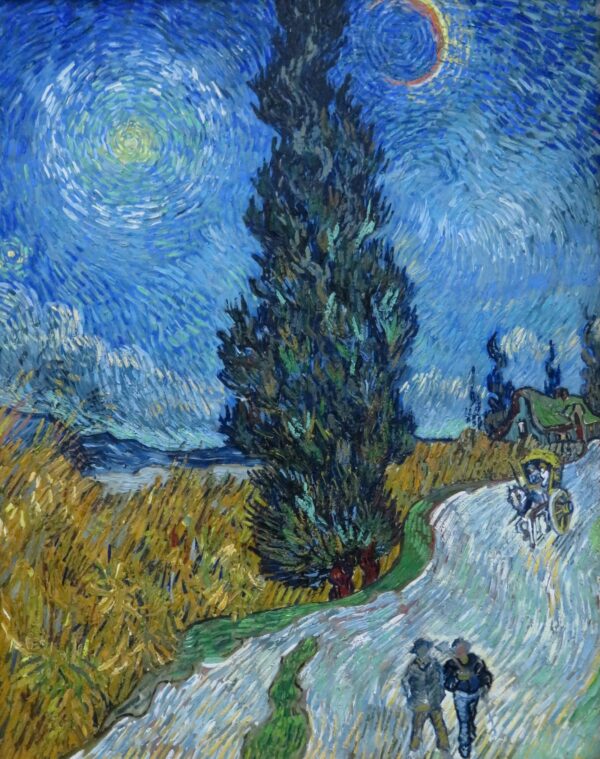
From the same June 1888 harvest at Arles comes The Harvest, a wide view over the plain with a haystack and a blue cart. The Sower, also painted in Arles in 1888, shows the other end of the farming year. A Wheat Field with Cypresses, painted at Saint-Rémy in 1889, puts dark cypresses beside the gold of the wheat.
How is our hand-painted Wheat Field with Sheaves made?
The painter first sets out the low horizon, the bands of the fields and the outline of the sheaves. Then come the blue sky and the white clouds, the distant fields and farmhouses, the broad band of standing wheat and last the sheaves and the stubble in short, crossing strokes. Our oil painting reproduction is painted by hand in oil on canvas with real impasto: the paint goes on thickly, so the brushstrokes stand up from the canvas as they do in the original and catch the light.
On this painting the relief matters most in the sheaves, in the stubble of the foreground and in the white clouds. A print shows only a flat surface; on our painting the strokes are real.
Every painting is a hand-painted copy made for your order, so no two are quite the same. Before dispatch we photograph it, sending you the photograph to approve.
Which size for which wall?
Short answer: 80 x 66 or 90 x 75 cm above a sideboard, a desk or a bed, 110 x 90 or 120 x 100 cm above a sofa, and 150 x 120 cm for a large empty wall. The landscape format suits a living room, a dining room, a kitchen or a hallway.
There are 17 sizes: 50 x 40, 60 x 50, 67 x 55, 70 x 56, 70 x 59, 74 x 61, 75 x 65, 80 x 66, 80 x 70, 85 x 72, 90 x 75, 100 x 80, 105 x 85, 110 x 90, 115 x 93, 120 x 100 and 150 x 120 cm (width x height). The original is 66.6 cm wide and 55.2 cm high; our 67 x 55 cm size is the closest to it, so the painting on your wall is almost exactly as large as the one in Honolulu. With so much yellow and gold, it sits well on a white, cream or light grey wall, and on a soft blue one that picks up the sky. A smaller size, 50 x 40 or 60 x 50 cm, fits above a bedside table or in a study. A painting for the living room should take up about two thirds of the width of the furniture below it.
Hang it with the centre of the canvas about 150 cm above the floor, leaving 20 to 30 cm between the furniture and the bottom edge.
What if I need a custom size or a frame?
If none of the 17 sizes fits your wall, we paint it to measure. Keep the proportions close to the original, otherwise the sheaves and the bands of the fields get squeezed or stretched. Send us the width and height you want and we will quote a price and a lead time. Every painting we make is stretched over a wooden stretcher and ready to hang.
For the moulding, use our 3D application: it shows each of our frame profiles on this subject, so you can compare gold, silver, black, white and natural wood – the application is for choosing the frame only. Seeing the painting on your own wall is our separate room placement service. A gold or natural wood frame picks up the warm colours of the wheat, and a white frame keeps the painting light and fresh.
How does delivery work, and what is the guarantee?
Every painting is made to order in our studio in Slovenia, so allow 15 to 45 days depending on the size you choose. We ship it stretched and protected, framed if you chose a frame, across the EU with no customs. Before dispatch you receive a photograph of the finished work to approve, and we correct anything that is not right. Our returns policy applies to every order.
You will find more famous Van Gogh paintings among all our Vincent van Gogh paintings, and there is more about the painter in our article on Vincent van Gogh. If you are giving it as a present and are not sure of the size, a wall art voucher lets the recipient choose.
Frequently asked questions
Where is the original Wheat Field with Sheaves today?
In the Honolulu Museum of Art in Honolulu, Hawaii. The museum lists it as Wheat Field, 1888, oil on canvas, number 377.1, and it came to the collection in 1946 as a gift of Mrs. Richard A. Cooke and Family in memory of Richard A. Cooke. The museum was formerly called the Honolulu Academy of Arts, which is why older sources give that name.
When and where did Van Gogh paint Wheat Field with Sheaves?
In June 1888, in the wheat fields around Arles in the south of France. Van Gogh had moved there from Paris in February of that year. He painted it outdoors during the harvest, as one of a group of ten paintings and five drawings of the harvest that, according to the Honolulu Museum of Art, he completed in just over a week.
What do the sheaves mean in Wheat Field with Sheaves?
For Van Gogh the farming year mirrored life itself. Wikipedia quotes the idea that the sower and the wheat sheaf stood for eternity, and the reaper with his scythe for death. The sheaves standing in the cut field close one cycle of growth and hold the grain for the next, which gives this sunny harvest scene its quiet weight.
Is Wheat Field with Sheaves part of a series?
Yes. It belongs to the harvest paintings Van Gogh made around Arles in the second half of June 1888. The Honolulu Museum of Art counts ten paintings and five drawings showing different phases of the harvest, finished in just over a week. The Harvest, a wide view over the plain, was also painted near Arles in June 1888.
Is Wheat Field with Sheaves the same painting as the one in the Musée Rodin?
No. The Musée Rodin in Paris holds another June 1888 harvest scene, Arles: View from the Wheat Fields, which is sometimes called Wheat Field with Sheaves and Arles in the Background and shows the town behind the field. Ours is the painting in the Honolulu Museum of Art, with sheaves in the centre and farmhouses, not a town, on the horizon.
How big is the original Wheat Field with Sheaves?
The original is about 55 cm high and 67 cm wide, a modest landscape format. Our 67 x 55 cm size is almost exactly the same, and there are smaller and larger sizes from 50 x 40 up to 150 x 120 cm, as well as custom sizes painted to measure. For a sofa wall, 110 x 90 or 120 x 100 cm is a good choice.
Does your Wheat Field with Sheaves have the raised brushstrokes of the original?
Yes. We paint our copy in impasto: the paint goes on thickly, so the brushstrokes stand up from the canvas as on Van Gogh’s original. You see it best in the sheaves, in the short crossing strokes of the stubble and in the white clouds, where the relief catches the light. A print cannot have this relief, because its surface is flat.
Is Wheat Field with Sheaves a good gift?
It is a warm, bright gift that suits many homes: a kitchen or dining room, a house in the country, or someone who grew up among fields or loves the summer light of Provence. As a canvas painting about harvest and plenty, it also works as a present for a new home, and a voucher lets the recipient choose the size.
- Subject: a large group of wheat sheaves in a cut field near Arles, with bands of fields, farmhouses and a blue sky with white clouds.
- Original: June 1888, Arles, 55.2 x 66.6 cm, Honolulu Museum of Art.
- Ours: a Van Gogh reproduction painted by hand in oil on canvas, in 17 sizes from 50 x 40 to 150 x 120 cm or made to measure.
- Worth knowing: you receive a photograph of the finished work for approval before dispatch.