







































Description
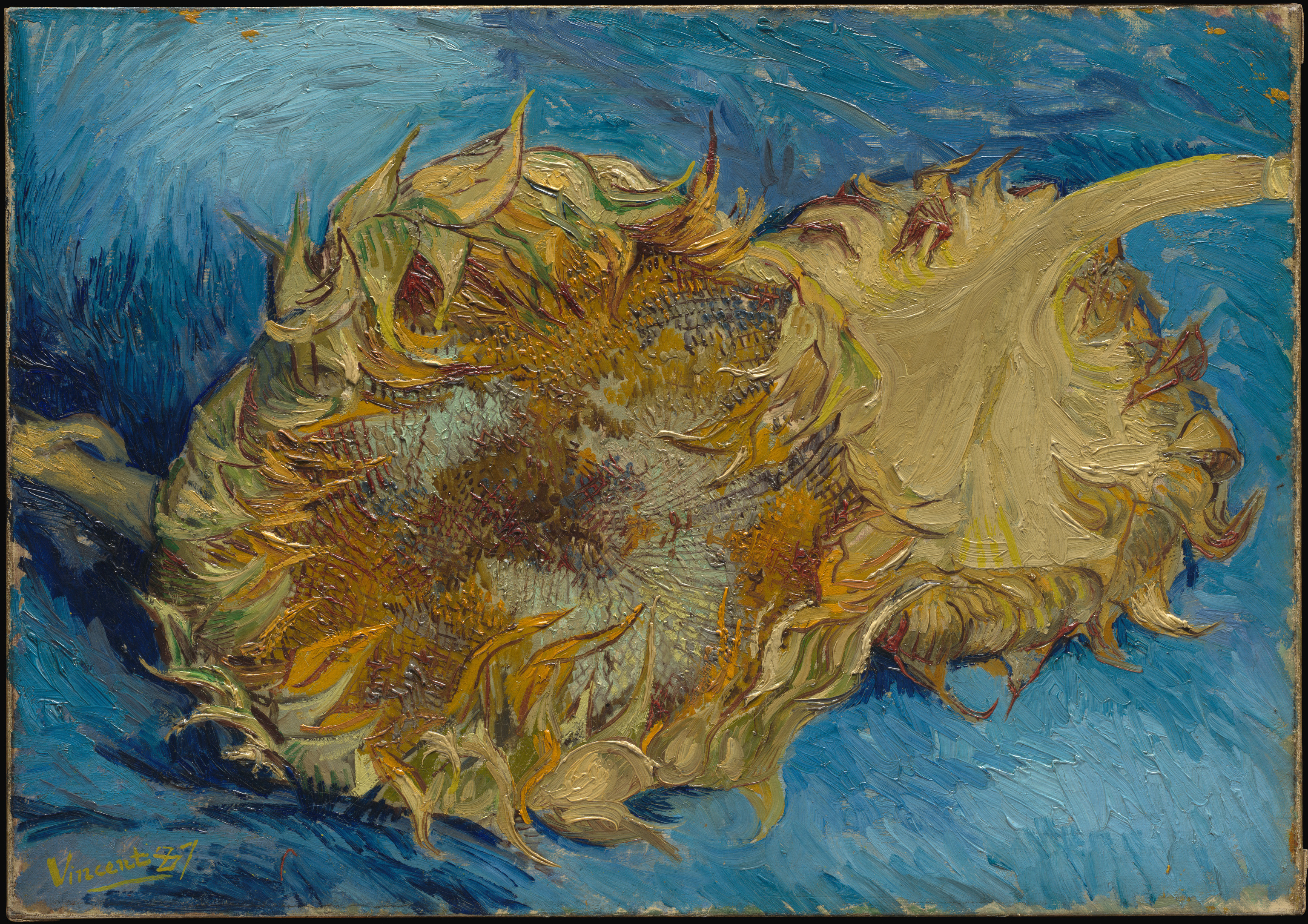
Two Cut Sunflowers is the still life Vincent van Gogh painted in Paris in 1887: two large sunflower heads lying side by side on a blue ground, the left one turned up to show its brown seed disc ringed with curled yellow petals, the right one turned over to show its pale green back and a short piece of stem. The original, oil on canvas, measures 43.2 x 61 cm and belongs to The Metropolitan Museum of Art in New York, which titles it simply Sunflowers. We paint it by hand in oil on canvas, in 15 sizes from 70 x 50 to 250 x 180 cm or to your own measurement, and send you a photograph of the finished work for approval before dispatch.
| Title: | Two Cut Sunflowers |
| Other titles: | Sunflowers · F375 |
| Painter: | Vincent van Gogh (1853–1890) |
| Year painted: | 1887, Paris |
| Original size: | 43.2 cm x 61 cm |
| Original technique: | Oil on canvas |
| Painting style: | Post-Impressionism |
| Located at: | The Metropolitan Museum of Art, New York (inv. 49.41) |
| Our reproduction: | Hand-painted oil on canvas, 15 sizes or made to measure |
Two Cut Sunflowers – Vincent van Gogh
What does Two Cut Sunflowers show?
Two sunflower heads, cut from their plants, fill almost the whole canvas. There is no vase, no table and no horizon: the flowers lie on a blue ground that runs from deep blue at the top to lighter turquoise strokes around the heads, and you look down at them from close by.
The head on the left is the larger. It faces up and a little towards you, so you see its round seed disc, a mass of brown, grey and dull green dabs, surrounded by a ring of yellow and ochre petals that curl, twist and droop in every direction. The head on the right lies the other way round. You see its back: a pale yellow-green cushion with green pointed leaves radiating from it, a few yellow petal tips showing at its edge, and a thick stem that rises towards the upper right corner, cut off short.
At the left edge a small yellow-green leaf reaches into the scene, and in the lower left corner, in the blue, is Van Gogh’s signature.
How did Van Gogh paint the two sunflower heads?
Each part of the canvas has its own kind of stroke. The blue ground is laid down in long, sweeping strokes that run mostly from left to right and curve around the flowers, so the background itself seems to move. The petals are painted in short, thick, curved strokes of yellow, ochre and green, one stroke for each petal.
The seed disc of the left head is built from small dabs set close together, in brown, grey and a little blue. The back of the right head is smoother, in long strokes of pale yellow and green that follow its shape towards the stem. The colour scheme is simple: blue against yellow, with brown and green between them.
Where does Two Cut Sunflowers belong among Van Gogh’s sunflowers?
Van Gogh’s sunflowers are two series of still lifes. According to the Wikipedia article on Van Gogh’s sunflower series, the first series, painted in Paris in 1887, shows the flowers lying on the ground, and the second, made a year later in Arles, shows a bouquet of sunflowers in a vase. This canvas belongs to the first, Paris series.
The same article lists the Paris works by their catalogue numbers: this painting as Two Cut Sunflowers, F375, oil on canvas, 43.2 x 61 cm, in The Metropolitan Museum of Art; a second Two Cut Sunflowers, F376, in Kunstmuseum Bern; a small study of two cut sunflowers, F377, at the Van Gogh Museum in Amsterdam; and Four Cut Sunflowers, F452, in the Kröller-Müller Museum in Otterlo.
The article also links both series to Paul Gauguin. He acquired two of the Paris versions, which Van Gogh exchanged with him in December 1887 or January 1888, and he later claimed one of the Arles versions in exchange for studies he had left behind in Arles.
Where is the original today and how did it get there?
The original belongs to The Metropolitan Museum of Art in New York, in its European Paintings department. The museum’s record gives the title Sunflowers, the date 1887, the medium oil on canvas and the size 17 x 24 inches, or 43.2 x 61 cm, under the accession number 49.41.
Its credit line reads Rogers Fund, 1949, so the canvas entered the museum’s collection in 1949, through the Rogers Fund. The longer title we use, Two Cut Sunflowers, is the one in the Wikipedia article on the series.
Two Cut Sunflowers or another Van Gogh flower painting – which should you choose?
Its closest companions in our range are Van Gogh’s other flower still lifes. Sunflowers I and Sunflowers II come from the second series, painted in Arles, with the sunflowers arranged as a bouquet in a vase. Vase with Irises Against a Yellow Background sets irises in a vase against yellow, and Vase with Red Poppies brings red into the set.
Choose Two Cut Sunflowers for a wide, landscape format and a close view of two single flower heads on blue; Sunflowers I or Sunflowers II for a full bouquet; the irises for blue-violet flowers on yellow; and the poppies if you want red to lead.
How is our hand-painted Two Cut Sunflowers made?
The painter first sketches the outline of the two heads, the stem and the small leaf, and checks the proportions against the original. Then comes the blue ground in long strokes around the shapes, after it the back of the right head and its stem, then the ring of curled petals on the left head, and last the seed disc in small dabs and the signature in the corner. Our oil painting reproduction is painted by hand in oil on canvas with real impasto: the paint goes on thickly, so the brushstrokes stand up from the canvas as they do in the original and catch the light.
On our version the relief shows most in the curled petals, in the dabbed seed disc and in the sweeping strokes of the blue ground. A print shows only a flat surface; on our painting the strokes are real.
Every painting is a hand-painted copy made for your order, so no two are quite the same.
Which size for which wall?
Short answer: 70 x 50 or 80 x 59 cm for a narrow wall in a hallway or beside a door, 101 x 74 or 120 x 90 cm above a chest of drawers or a bed, and 170 x 120 or 200 x 150 cm above a sofa or on a large wall.
There are 15 sizes: 70 x 50, 80 x 59, 90 x 65, 101 x 74, 114 x 82, 120 x 90, 130 x 94, 140 x 100, 153 x 110, 160 x 115, 170 x 120, 180 x 135, 195 x 140, 200 x 150 and 250 x 180 cm (width x height). The original is 61 cm wide and 43.2 cm high, so even our smallest size, 70 x 50 cm, is a little larger than Van Gogh’s canvas, and 70 x 50, 140 x 100 and 170 x 120 cm keep its proportions almost exactly. The blue and the yellow look best on a white, cream or light grey wall and sit well with natural wood. A painting for the living room should cover about two thirds of the width of the furniture below it.
Hang it with the centre of the canvas about 150 cm above the floor. Above a sofa, a bed or a sideboard, leave 20 to 30 cm between the furniture and the bottom edge.
What if I need a custom size or a frame?
If none of the 15 sizes fits your wall, we paint it to measure in any width and height you need. Send us the width and height you want and we will quote a price and a lead time. Every painting we make is stretched over a wooden stretcher and ready to hang.
For the moulding, use our 3D application: it shows each of our frame profiles on this subject, so you can compare gold, silver, black, white and natural wood – the application is for choosing the frame only. Seeing the painting on your own wall is our separate room placement service. A gold moulding picks up the yellow petals, while a white or natural wood one keeps the blue ground light and fresh.
How does delivery work, and what is the guarantee?
Every painting is made to order in our studio in Slovenia, so allow 15 to 45 days depending on the size you choose. We ship it stretched and protected, framed if you chose a frame, across the EU with no customs. Before dispatch you receive a photograph of the finished work to approve. Our returns policy applies to every order.
You will find more famous Van Gogh paintings among all our Vincent van Gogh paintings, and more about the painter in our article on Vincent van Gogh. If it is a present and you are not sure of the size, a wall art voucher lets the recipient choose.
Frequently asked questions
Where is the original Two Cut Sunflowers today?
In The Metropolitan Museum of Art in New York. The museum titles it Sunflowers and lists it as oil on canvas, painted in 1887, 43.2 x 61 cm, under the accession number 49.41. Its credit line, Rogers Fund, 1949, shows that it entered the collection in 1949.
When and where did Van Gogh paint Two Cut Sunflowers?
In Paris, in 1887. The Metropolitan Museum of Art dates the canvas to 1887, and the Wikipedia article on Van Gogh’s sunflowers places it in the first of his two sunflower series, the one he painted in Paris that year, in which the flowers lie on the ground rather than standing in a vase.
Why do the two heads in Two Cut Sunflowers look so different?
Because they lie in opposite directions. The left head faces up, so you see its brown seed disc and its ring of curled yellow petals. The right head lies on its face, so you see its pale green back, the pointed green leaves around it and a short, cut stem rising towards the upper right corner of the canvas.
Is Two Cut Sunflowers the same painting as the Met’s Sunflowers?
Yes. The Metropolitan Museum of Art titles the canvas simply Sunflowers, while the Wikipedia article on the series lists the same work, F375, 43.2 x 61 cm, as Two Cut Sunflowers. We use that longer title because it tells the Paris canvas apart from the sunflowers in a vase that Van Gogh painted in Arles.
How many paintings of cut sunflowers did Van Gogh make in Paris?
The Wikipedia article on the series lists four: this Two Cut Sunflowers in New York, a second Two Cut Sunflowers in Kunstmuseum Bern, a small study of two cut sunflowers at the Van Gogh Museum in Amsterdam, and Four Cut Sunflowers in the Kröller-Müller Museum in Otterlo. All are dated 1887 and show the flowers lying down.
Did Paul Gauguin own Van Gogh’s cut sunflowers?
Two of them, according to the Wikipedia article on the series: Gauguin acquired two of the Paris versions, which Van Gogh exchanged with him in December 1887 or January 1888. The article does not say which two canvases these were, so we do not claim that the painting in New York was one of them.
How big is the original Two Cut Sunflowers?
43.2 cm high and 61 cm wide, or 17 x 24 inches, according to The Metropolitan Museum of Art, a small landscape format. Our smallest size, 70 x 50 cm, is already a little larger than the original and keeps its proportions. There are 15 sizes up to 250 x 180 cm, and we also paint it to measure in any proportions.
Which size of Two Cut Sunflowers suits a living room?
Above a sofa, choose 170 x 120 or 200 x 150 cm, so that the canvas painting covers a good part of the width of the sofa and the two heads read clearly from across the room. On a narrower wall or above a sideboard, 101 x 74 or 120 x 90 cm is enough. For a very large wall, 250 x 180 cm is the largest size.
Does your Two Cut Sunflowers have the raised brushstrokes of the original?
Yes. We paint our sunflowers in impasto: the paint goes on thickly, so the brushstrokes stand up from the canvas as on Van Gogh’s original. You see it best in the curled petals and in the small dabs of the seed disc, where the relief catches the light, and in the long strokes of the blue ground around the flowers.
- Subject: two cut sunflower heads on a blue ground, one showing its seed disc and curled yellow petals, the other its pale green back and stem.
- Original: 1887, Paris, oil on canvas, 43.2 x 61 cm, The Metropolitan Museum of Art, New York.
- Ours: a Van Gogh reproduction painted by hand in oil on canvas, in 15 sizes from 70 x 50 to 250 x 180 cm or made to measure.
- Worth knowing: each painting is made to order, so allow 15 to 45 days, and our 3D application lets you try every frame on this subject first.