Description
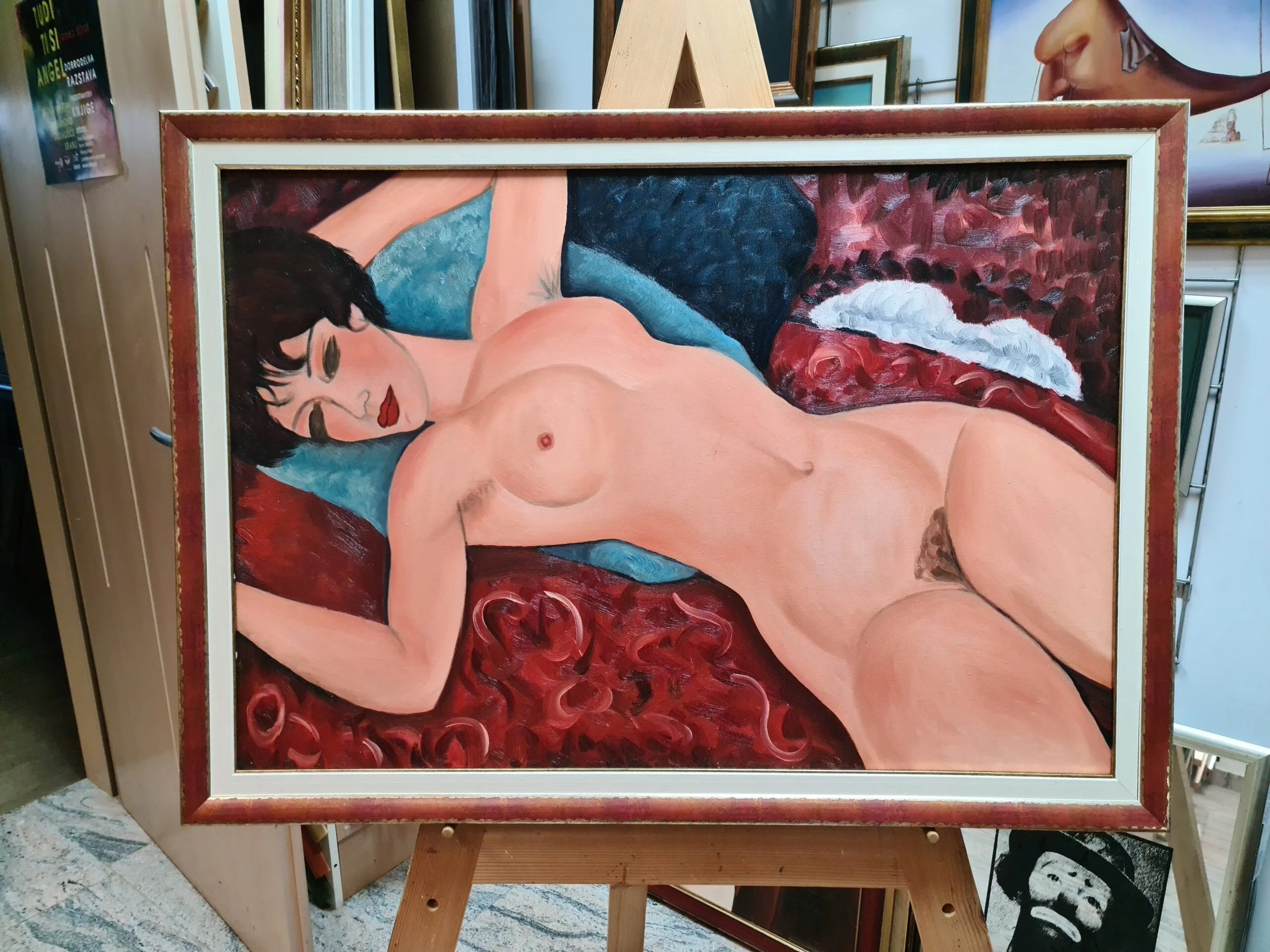
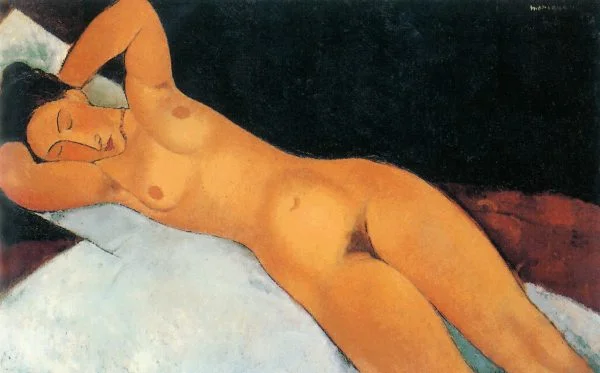
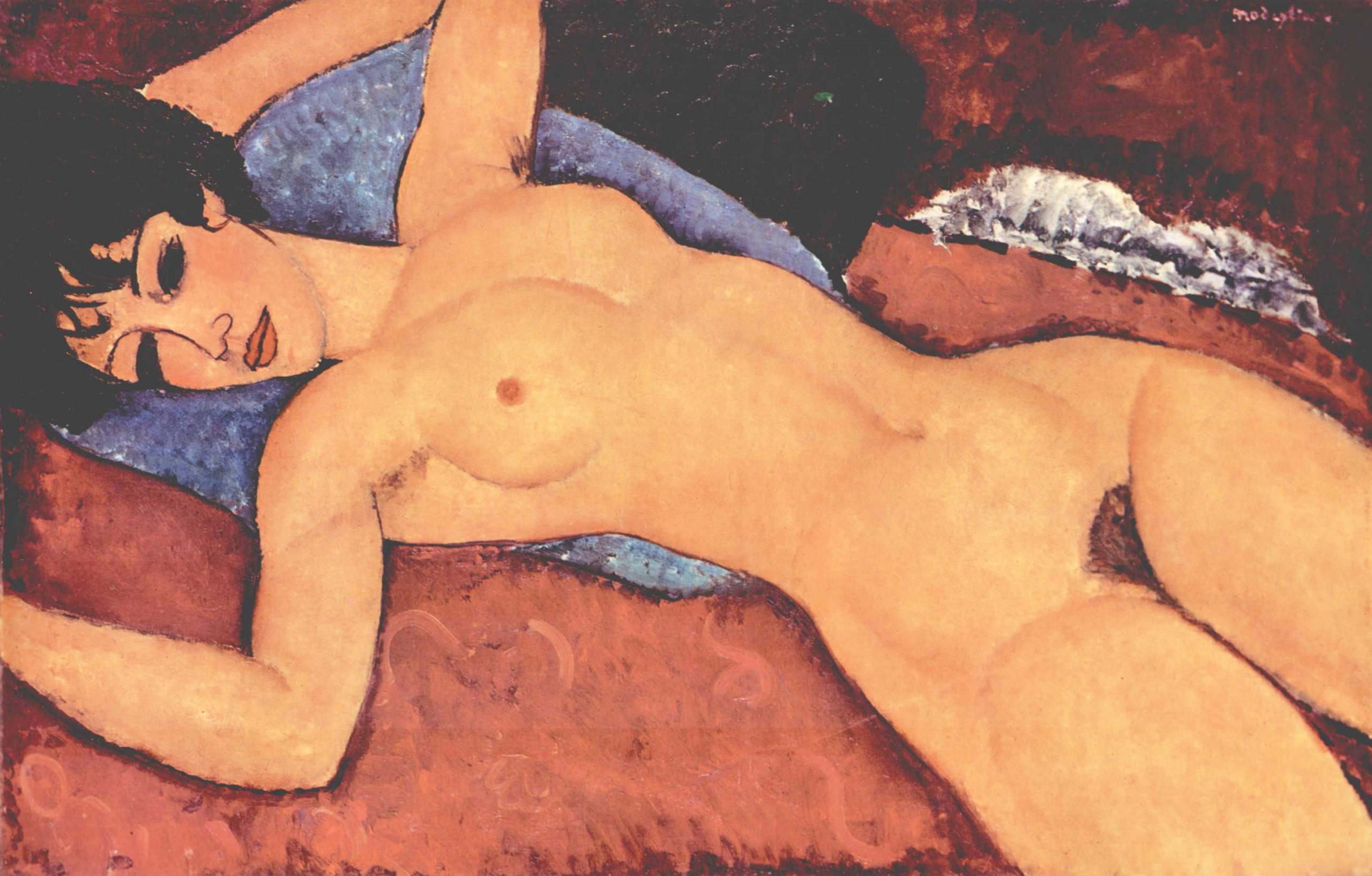
Red Nude, known in the specialist literature as Nu couché, is an oil on canvas painted by Amedeo Modigliani in 1917; the original measures 60 × 92 cm and is today in the collection of Liu Yiqian, shown at the Long Museum in Shanghai. The model lies on her back, both arms behind her head, looking straight out at the viewer; the warm red cloth beneath her gave the work the name it is known by. Our canvas painting is a hand-painted copy of that work: an academy-trained painter makes it in oils on cotton canvas, in eight landscape sizes from 60 x 40 cm to 180 x 130 cm or in a measurement you give us, and before dispatch we photograph it and send you the photograph for approval.
| Title: | Red Nude |
| Other titles: | Nu couché · Reclining Nude · Nudo sdraiato |
| Painter: | Amedeo Modigliani (1884–1920) |
| Year: | 1917 |
| Original size (height × width): | 60 × 92 cm (more precisely 59.9 × 92 cm) |
| Original technique: | Oil on canvas |
| Style: | Modern art, École de Paris |
| Location: | Long Museum, Shanghai, collection of Liu Yiqian – record of the work (private collection, no accession number) |
| Our reproduction: | hand-painted oil on canvas, eight sizes from 60 x 40 cm to 180 x 130 cm, made to measure on request |
Red Nude – Amedeo Modigliani
Who is the model?
The sources do not name her. For the reclining nudes Modigliani hired professional models and young women from the neighbourhood and did not record their names: the titles of these works describe a pose and a colour rather than a person. Of the woman on this canvas we do not know who she was or how long she sat. Where there is no source we invent no name. This is not a hole in the story but a trait of the series: the absence of a name is what separates these nudes from the portraits of the same months, which almost all carry the name of a client or a friend.
What is on the canvas?
The canvas is landscape, and the body runs across its whole width. The woman lies on her back, head to the left, both arms raised and bent behind it, so the figure opens and conceals nothing. Beneath her is a cool bluish cushion — the only cool area in the work; everything else is warm, from the ochre and pink of the skin to the deep red cloth and brownish ground. The eyes are half closed, the face calm, carrying no expression that would explain or apologise. Hands and feet are cut by the edge, which pushes the figure close and removes any distance. The contour is a single long, unhurried line; there is little shading, and the colour is laid in broad, smooth areas.
Why does this work matter?
Because it does without a pretext. In European painting the nude needed a mythological excuse for centuries — a goddess, a nymph, a scene from history — and here there is none. What remains is a body, colour, and a returned look. Behind it stands Cézanne, for whom the body was already a structure of planes and colour rather than a narrative; a post-impressionist painting of that kind is what Modigliani carried through to the end. In Paris he belonged to the circle of immigrant painters we now call the École de Paris, and there the nude was a working assignment, not a scandal. The scandal came from outside: when the dealer Berthe Weill put these nudes in her window, the police closed the exhibition the same day. A century later this very canvas became one of the most expensive ever sold: on 9 November 2015 Christie’s in New York took 170.405 million dollars for it; it was sold by Laura Mattioli Rossi, heir to the Gianni Mattioli collection, and bought by Liu Yiqian. There is a full account of the painter’s life away from our pages.
What does the work mean?
It means that a woman is painted as someone who knows she is being looked at and does not withdraw. The look is neither seductive nor shy; it is calm. That calm unsettled the audience of the day more than the nakedness itself, and it is why the work reads as surprisingly present. Modigliani neither flatters the body nor displays it: the long, slow contour binds it into a whole closer to a sculpture than a scene. If you want one thought to take away: the looking here goes both ways, and the work knows it.
Is this the same work as Reclining Nude?
No, and the difference is exactly the measurement. This canvas is 60 × 92 cm, and it is the one that reached 170.4 million dollars in 2015. Reclining Nude in our catalogue is the larger work, 89 × 146 cm, known in the literature as Nu couché (sur le côté gauche); it too has an auction history, but its own and a later one — 2018, at Sotheby’s. Two different canvases, two different sales. Related but separate are Nude with Loose Hair and Reclining Nude III; differently composed are Nude on a Blue Cushion and Nude Sitting on a Divan. The work is also recorded in the catalogue of his works. The full selection is in the Amedeo Modigliani gallery, and about the painter we have written a longer article.
How is our hand-painted version made?
The work is made by an academy-trained painter in oils on cotton canvas, stretched over a wooden frame. It is not a print and not a machine reproduction: every stroke is laid on by hand, so your canvas always differs a little from our reference in the thickness of the paint and in the shades. The first photograph on this page shows exactly such a hand-painted canvas of ours, photographed in the studio — it is not a picture of the original but the article you receive. The painter begins with the large red area, which decides how warm the skin will look, and only then draws the contour. Once dry, we photograph the work and send it for approval; only when you say it is right does it go further.
Which size for which wall?
For most homes 100 x 70 cm is the right choice. The landscape format sits best above a horizontal piece of furniture — a bed, a sofa or a sideboard — whose line it repeats. The small sizes, 60 x 40 and 70 x 50 cm, belong in a smaller bedroom or on a narrow wall. The middle sizes, 80 x 55 and 90 x 62 cm, suit the space above a narrower bed or a desk. The large ones, 120 x 80, 150 x 100 and 180 x 130 cm, ask for an empty wall and three metres of distance; there the figure reaches life size and takes over the room, which with this subject is deliberate. Being landscape, it will not carry a narrow, tall wall.
Custom size, stretcher bar and frame
If your wall calls for a measurement not on the list, we will make it. Give us height and width in centimetres; we check whether the ratio carries the crop and tell you what changes at the edges — on a reclining nude that shows first at the hands and feet. You can also choose whether we send it stretched and ready to hang, or rolled in a tube, which ships cheaper if your own framer will stretch it. This work is offered without a frame, so you choose it yourself. For placement we set the work into a photograph of your wall before you buy. For a work we do not carry, see paintings made by order.
Delivery and guarantee
We deliver across Europe to your address, the canvas held away from the outer wall of the packaging. Making time depends on the size and on the studio’s workload; we give an estimate when you order and tell you if it changes. We stand behind workmanship and material: if the work arrives damaged or does not match the photograph you approved, we put it right or repaint it at our cost. Because you see it photographed before dispatch, most questions are settled before the parcel leaves.
Frequently asked questions
Where is the original?
At the Long Museum in Shanghai, in the private collection of Liu Yiqian. As it is not in a public museum it has no accession number.
Whom did Modigliani paint here?
The model is not named: the titles describe a pose and a colour, not a person.
Is Nu couché the same work?
Yes. Nu couché is the specialist title of this very canvas. The larger work in our catalogue, which we call Reclining Nude, is a different canvas of 89 × 146 cm.
Which size should I choose?
If you cannot decide, 100 x 70 cm. Above a bed, 120 x 80 cm; in a smaller room, 70 x 50 cm.
How is it delivered?
Stretched and ready to hang, or rolled in a tube. Both travel in protective packaging.
What is it about, in one sentence?
That a body needs no excuse to deserve a whole canvas.
Is the original for sale and what is it worth?
We neither sell nor value the original. The last known sale was in 2015 at Christie’s, for 170.4 million dollars.
How high should I hang it?
The centre about 145 cm above the floor; above a bed or sofa, at least 25 cm between the back and the lower edge.
Is it suitable as a gift?
It is, but the subject is candid, so it helps to know where it will hang. In a bedroom it reads as natural; in a living room it is a choice.
How closely does it follow the original’s proportions?
The original measures 92 × 60 cm. The closest of our sizes is 120 x 80 cm, which departs from the original’s proportions by 2.17%.
- Subject: a reclining female nude, arms behind the head, blue cushion and deep red cloth, the face calm and turned to the viewer
- Original: 60 × 92 cm, oil on canvas, 1917, Long Museum Shanghai, collection of Liu Yiqian
- Ours: hand-painted oil on canvas, eight landscape sizes from 60 x 40 to 180 x 130 cm, made to measure on request, with a photograph for approval before dispatch
- Worth knowing: the cool blue cushion is the only cool area in the work — cover it and the whole canvas tips into a single warm tone
The eyes on this canvas are painted without pupils. We counted all 76 Modigliani works on this shelf: 53 are like that, 17 are not – work by work.