




Description
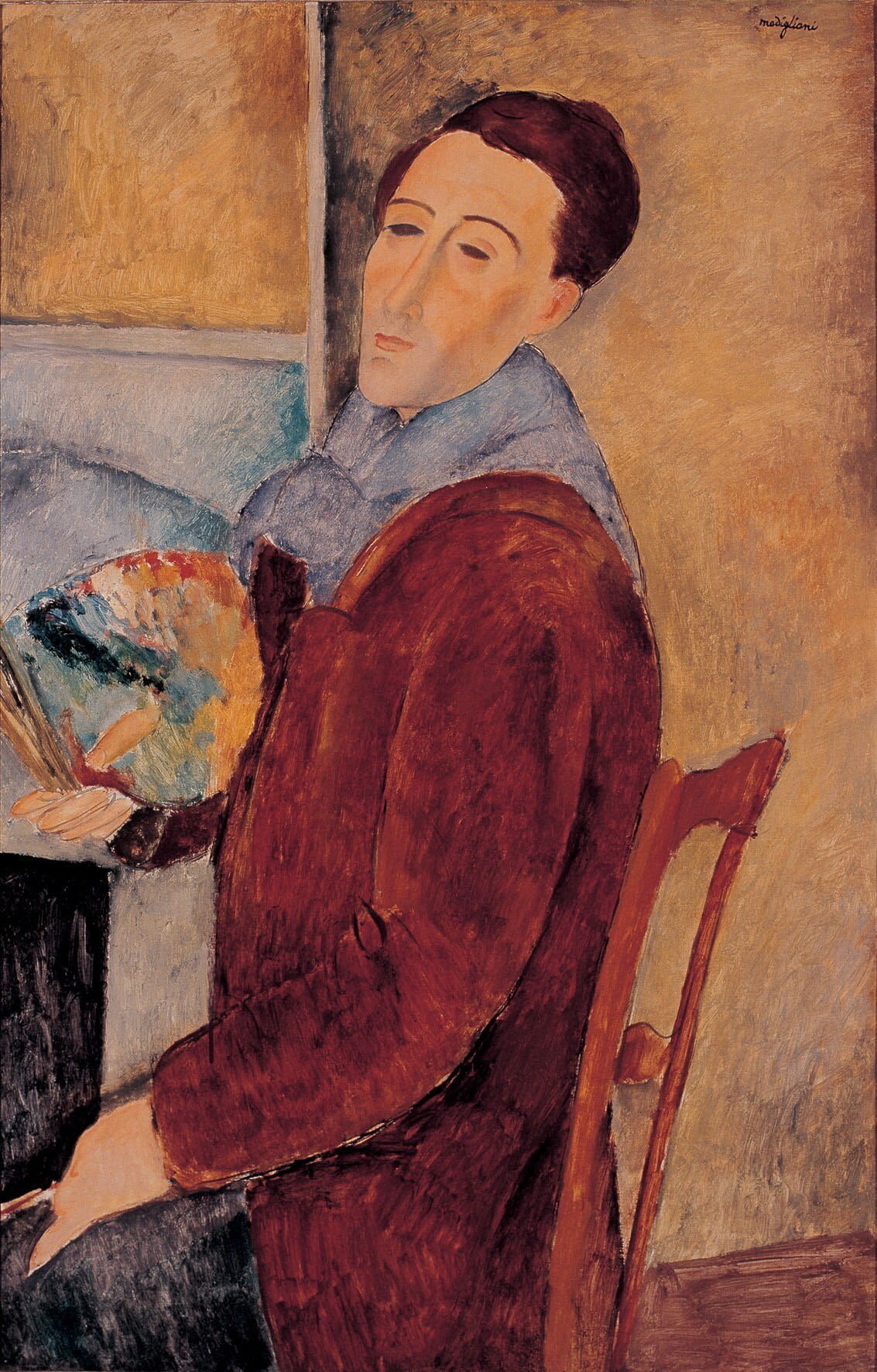
Self-Portrait is an oil on canvas painted by Amedeo Modigliani in 1919; the original measures 100 × 65 cm, is signed upper right and hangs in the Museu de Arte Contemporânea of the University of São Paulo in Brazil. It is the only painted self-portrait he is known to have made. Our canvas painting is a hand-painted copy of that work: an academy-trained painter makes it in oil on cotton canvas, in eight sizes from 40 × 60 cm to 120 × 180 cm or in the size you specify, and before dispatch we photograph it and send you the photograph for approval.
| Title: | Self-Portrait |
| Other titles: | Autoritratto · Autorretrato · Autoportrait |
| Painter: | Amedeo Modigliani (1884–1920) |
| Year: | 1919 |
| Original size (height × width): | 100 × 65 cm, portrait format |
| Original technique: | Oil on canvas, signed upper right |
| Painting style: | Modern art, École de Paris |
| Where it is: | Museu de Arte Contemporânea da Universidade de São Paulo (MAC USP), Brazil – published study of the canvas |
| Our reproduction: | hand-painted oil on canvas, eight sizes from 40 × 60 cm to 120 × 180 cm; one of them, 65 × 100 cm, is the measurement of the original |
Self-Portrait – Amedeo Modigliani
What is on the canvas?
The canvas stands upright. The painter sits on a wooden chair turned to his own right, its warm red-brown back with a shaped splat rising behind his shoulder at the right edge. He wears a deep wine-red jacket; a pale blue-grey scarf lies as a wide collar over the shoulders, knotted at the throat. The hair is dark auburn, swept back from a high forehead. The face and nose are long, the mouth small and closed, and the eyes are flat dark almonds with no pupil drawn in them — lowered, turned aside, not meeting you. Low at the left he holds a fan-shaped palette carrying patches of blue-green, orange, white and dark paint; the other hand rests pale against the blue-black of his knee at the bottom edge. Behind him the wall is ochre, broken at the upper left by a paler rectangle and at the left by a grey-blue plane, with a dark vertical edge running down behind his head. The signature sits in the top right corner. It is a post-impressionist painting in the sense in which post-impressionism meant building a head out of planes and contours rather than describing light. In Paris Modigliani belonged to the circle of immigrant painters we now call the École de Paris.
Where is the original today?
In the Museu de Arte Contemporânea of the University of São Paulo, in Brazil. The museum’s researchers published a material history of this one painting in 2019, in the journal of the Museu Paulista: 1919, oil on canvas, 100 × 65 cm, on a standard French canvas of the size the trade called a marine 40, used upright rather than in the landscape way that format implies. A summary record is held in the university repository. We print no accession number: none appeared in the sources we checked, and we will not invent one.
Why is there only one?
Modigliani painted several hundred portraits of other people and, so far as anyone has established, one of himself. He did not work from photographs; he painted whoever sat in front of him, usually a friend, a dealer or a model, and quickly. Turning that method on himself meant a mirror, and a mirror is the one sitter who cannot be asked to come back tomorrow. So this canvas is the only place in his whole output where the eye that looks and the face that is looked at belong to the same man. It is also striking for what it refuses: no studio, no easel, no gesture, no drama. The palette is the one object that says what he does for a living, and without it this would be one more sitter in a red jacket. He painted it in 1919; he died in Paris in January 1920, at thirty-five, of tubercular meningitis. Readers sometimes want a farewell in it. What is there is a working painter with a palette, sitting for himself the way he sat for everyone else.
The journey to Brazil in 1947
The canvas left Europe in 1947. The collector Francisco Matarazzo Sobrinho bought it in Milan that June, during a Modigliani exhibition, and it travelled to Brazil as a birthday present for Yolanda Penteado. It was shown in São Paulo in November 1949 in A nova pintura francesa e seus mestres, and in 1951 both at the first Bienal de São Paulo and, that spring in New York, in the Museum of Modern Art’s Modigliani exhibition; it was in Paris at the Galerie Charpentier in 1958. In 1973 it passed from Penteado’s collection into the university museum, where it has stayed.
Under the paint
In 2017 and early 2018 the museum examined the canvas within an international study of Modigliani’s materials. Under the paint there is a graphite drawing: the contour of head and shoulders was set down in pencil first, then followed. The colours are few — lead white, iron oxide earths, a mercury vermilion, Prussian blue and chrome yellows — laid on in thin translucent layers rather than built up thickly, which is why the weave of the cloth stays legible through the ochre wall. Worth knowing before you order: a copyist who paints this in heavy impasto gets the colours right and the surface wrong.
How is our hand-painted version made?
The work is made by an academy-trained painter in oil on cotton canvas over a wooden frame. It is not a print: every stroke is laid by hand, and your canvas always differs a little from any other. With this subject the difficulty is the face. The contour is a single continuous line, and it cannot be corrected afterwards without the correction showing, so the painter draws before painting, exactly as the original was drawn. The second difficulty is the red of the jacket: it has to stay warm and dark at once, and must not turn orange as it dries. When the paint is dry we photograph the work and send the photograph for approval.
Which size for which wall?
This is one of the rare cases where we can offer the original’s measurement exactly: 65 × 100 cm is 100 cm high and 65 cm wide, which is the canvas in São Paulo. If you want it at the size Modigliani painted it, that is the one. The smaller sizes, 40 × 60 and 50 × 80 cm, suit a hall or a narrow strip of wall. Above a sideboard or desk, 70 × 110 or 80 × 120 cm reads well. The large ones, 90 × 140, 100 × 150 and 120 × 180 cm, want a free wall and three metres of distance; at that scale the head is larger than life. The colouring is warm and closed, so it sits well on a white, cream or grey wall and needs nothing beside it.
Custom size, stretcher and frame
If your wall asks for a size that is not listed, we will make it. Give us the width and height in centimetres; we check whether the proportion carries the composition and tell you what changes at the edges. Here it shows first at the right, where the chair back stands, and at the bottom, where the knee is cut; a squarer format pushes the figure to the middle and loses the crop. It arrives either stretched on a wooden frame, ready to hang, or rolled in a tube, which is cheaper to ship. You pick the frame in our 3D application, which shows it realistically on the work, and on request we set it into a photograph of your wall. If you are looking for a work we do not carry, see our made-to-order paintings.
Delivery and guarantee
We deliver to your address, the canvas clear of the outer wall of the packaging. Lead time depends on size and the workshop load: we estimate it when you order and tell you if it changes. We guarantee workmanship and materials: if the work arrives damaged or does not match the photograph you approved, we repaint it at our cost. Because you see it photographed before it ships, most questions are settled before it leaves.
Frequently asked questions
Where is the original?
In the Museu de Arte Contemporânea of the University of São Paulo, Brazil.
What is its accession number?
We do not state one. No number appeared in the sources we checked, and we would rather leave it empty than print a figure we cannot support.
Is this really his only self-portrait?
It is the only painted one known. Drawings exist, but no second canvas has been established.
Do you have the original’s size?
Yes. 65 × 100 cm is exactly the measurement of the canvas in São Paulo, 100 cm high by 65 cm wide.
Which size should I choose?
For a living room wall, 80 × 120 cm. For a hall or a narrow wall, 50 × 80 cm.
How high should it hang?
With its centre about 145 cm above the floor. A tall format wants a little more wall above than below.
What is he holding?
A palette. It is the only object identifying him as a painter, and the reason we read the work as a self-portrait at all.
Which other Modigliani portraits of artists do you have?
See Portrait of Chaïm Soutine, Jacques and Berthe Lipchitz, Portrait of Juan Gris, Portrait of Max Jacob and Portrait of Moïse Kisling. The full choice is in the Amedeo Modigliani gallery, and we have written a longer article about the painter.
How closely does it follow the original’s proportions?
The original measures 65 × 100 cm, and that is exactly the size we list: 65 x 100 cm. The proportions are the original’s, with no deviation.
- Subject: the painter seated in a wine-red jacket and a blue-grey scarf, a palette held low at the left, an ochre wall behind
- Original: 100 × 65 cm, oil on canvas, 1919, Museu de Arte Contemporânea da Universidade de São Paulo
- Our version: hand-painted oil on canvas, eight sizes from 40 × 60 to 120 × 180 cm, one of which is the original’s own measurement
- Worth knowing: it is the only painted self-portrait Modigliani is known to have made, and it dates from the last year of his life
The eyes on this canvas are painted without pupils. We counted all 76 Modigliani works on this shelf: 53 are like that, 17 are not – work by work.