



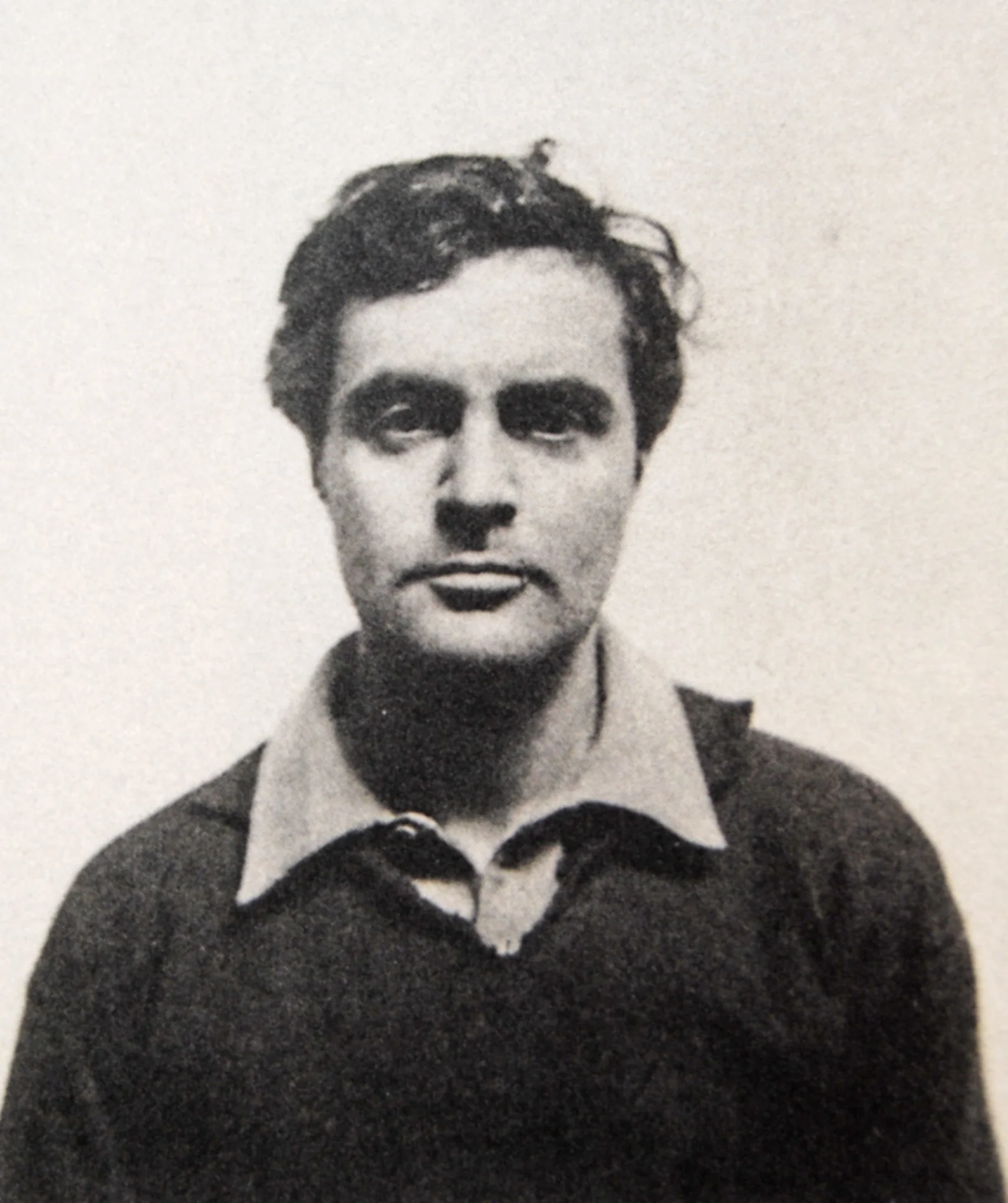
Amedeo Modigliani was an Italian painter and sculptor. He was born in Livorno on 12 July 1884 and died in Paris on 24 January 1920, at the age of thirty-five. He worked for barely fifteen years, almost all of them in France, and left a body of portraits and nudes that is recognised at a glance: the long neck, the oval face, the narrow almond eye.
His life and his work
Livorno, and the years before Paris
He grew up in an educated Jewish family in the port city of Livorno; Tate, in its own account of the painter, notes that the family encouraged his ambition and opened languages and literature to him. He learned to paint under Guglielmo Micheli, enrolled at the Scuola Libera di Nudo in Florence in 1902 and studied in Venice the following year. He reached Paris in 1906, at twenty-one, and stayed there for the rest of his life.
Paris, and the circle he painted
He lived first in Montmartre and then in Montparnasse. The Nasjonalmuseet in Oslo describes how he earned a living as a café artist: drawing quick portraits of café customers in the hope of a commission in oil. His circle included Constantin Brâncuși, Chaïm Soutine, Moïse Kisling, the sculptor Jacques Lipchitz, Max Jacob, Jean Cocteau, Juan Gris and the dealer Léopold Zborowski, who looked after him from 1916. He painted most of them, which is why with Modigliani we so often know exactly who is in the painting; the portraits of that circle are on our page of Modigliani paintings.
The sculptor who went back to painting
Between 1909 and 1913 he thought of himself chiefly as a sculptor. The Nasjonalmuseet records that he was Brâncuși’s assistant for about a year; he carved directly into stone, with no clay model. Tate writes that seven of those sculptures were shown at the Salon d’Automne in October and November 1912 – the only significant display of his sculpture in his lifetime – and that they were placed in a room of cubist paintings, which Modigliani may have anticipated when he called them a “decorative ensemble”.
He gave up carving soon afterwards. The Musée de Grenoble gives the reason as fragile health and material difficulties, which returned him to painting and to the commissioned portrait; the stone dust was intolerable to lungs already damaged by tuberculosis. He came back with a sculptor’s eyes.
Where those faces come from
The faces are mask-like, symmetrical, reduced to a few planes, and the eyes are often almond-shaped and left without pupils. The Musée de Grenoble names among his sources African art and archaic Greek, Etruscan and Egyptian statuary; the Nasjonalmuseet writes of African sculpture, whose linear, elongated style gave his figures an air of sophisticated modernity, and adds that in colour he preferred the restrained, anti-naturalistic palette of Cubism. The Dallas Museum of Art says beside its own work that he admired African masks together with Matisse, Picasso, Braque and Derain.
Likeness was not the object. The Nasjonalmuseet says of one of its own works that individualising features were not the painter’s manner and that the sitter is probably unknown – so the museum withdraws, in its own text, the name its own catalogue field carries.
A single exhibition
He had one solo exhibition in his lifetime, at Berthe Weill’s gallery in Paris in December 1917. She hung a nude in the window; the police ordered the works taken down the same day and the show closed almost immediately.
Jeanne Hébuterne and the last years
In the summer of 1917 he met Jeanne Hébuterne, herself an art student – so the curator of the Yale University Art Gallery describes her. The Norton Simon Museum records in its own entry that their daughter was born in November of the following year. He died on 24 January 1920 of tubercular meningitis. Jeanne Hébuterne, pregnant with their second child, died two days after him.
After his death
Recognition came afterwards. The Nasjonalmuseet writes that his fame was all the greater after his death and that during the 1920s his tragic life and singular pictorial expression became established as part of the story of European modernism. The Musée de Grenoble supplies the year in which that path became official: in 1923 it bought Woman with a White Collar – by its own record the first painting by Modigliani ever acquired by a museum, three years after the painter died.
His works are held today by, among others, the Metropolitan Museum of Art and the Solomon R. Guggenheim Museum in New York, the National Gallery of Art in Washington, the São Paulo Museum of Art, the Musée national d’art moderne – Centre Pompidou and the Musée de l’Orangerie in Paris, Tate in London, the Nasjonalmuseet in Oslo, the Yale University Art Gallery, the Musée de Grenoble and the Detroit Institute of Arts. Those elongated portraits remain among the most sought-after subjects for hand-painted reproductions of Modigliani paintings.
Ten things worth knowing
- He was born in Livorno on 12 July 1884 and lived and worked in France from 1906 onwards.
- He arrived in Paris at twenty-one and stayed until his death.
- He first earned a living drawing café customers, in the hope of a commission in oil.
- Between 1909 and 1913 he thought of himself chiefly as a sculptor, not a painter.
- Brâncuși taught him to carve directly into stone; he was his assistant for about a year.
- Seven of his sculptures were shown at the Salon d’Automne in 1912 – the only significant display of his sculpture in his lifetime.
- The faces were shaped by African art and by archaic Greek, Etruscan and Egyptian statuary.
- He often left the eyes without pupils – almond-shaped fields of colour that look past the viewer.
- He had a single solo exhibition, at Berthe Weill’s gallery in December 1917; the police had it taken down the same day over a nude in the window.
- The first of his paintings to be bought by a museum was bought in 1923, by the Musée de Grenoble, three years after his death.