


Description
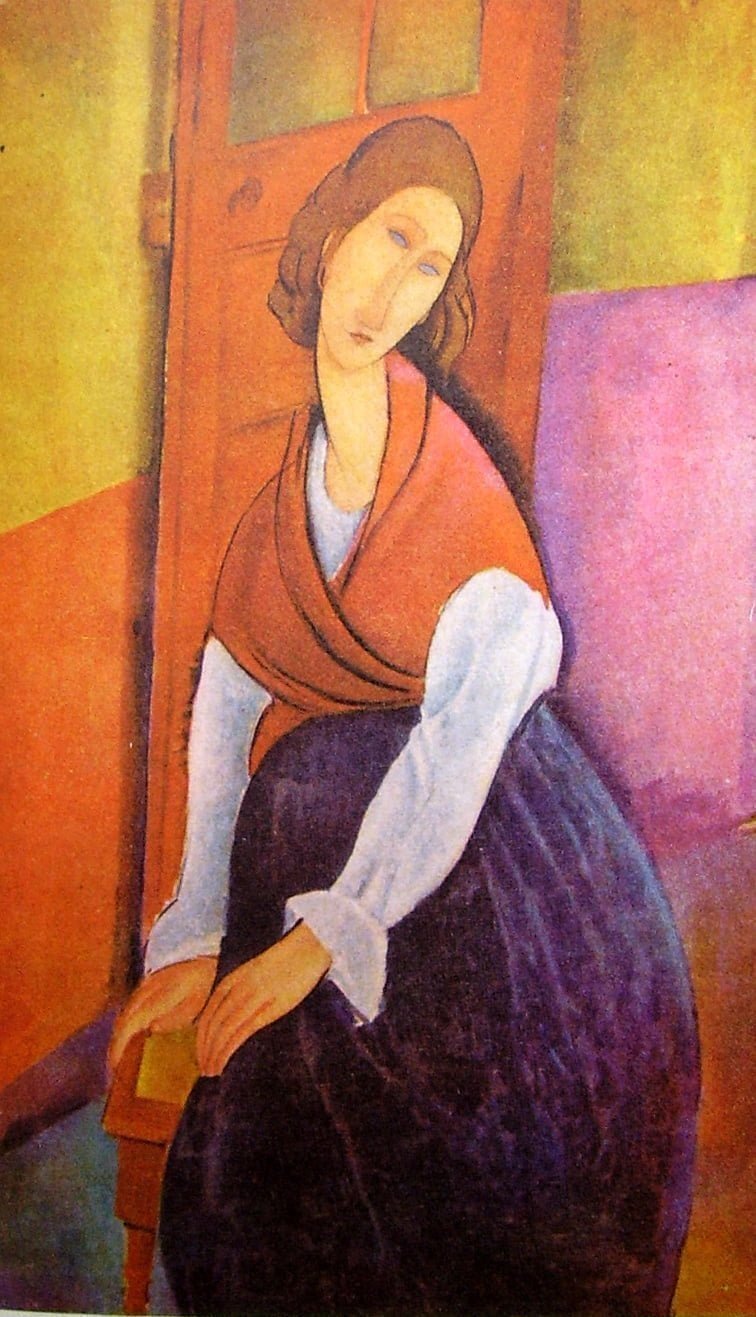
Portrait of Jeanne Hébuterne VI is an oil on canvas painted by Amedeo Modigliani in 1919; the original measures 129.5 × 81.5 cm, while the catalogues raisonnés of Parisot and Patani record it as 130 × 81 cm. The canvas is in private hands and was last sold in 2004 at Sotheby’s in New York. Our canvas painting is a hand-painted copy of that work: an academy-trained painter makes it in oil on cotton canvas, in eight sizes from 40 × 60 cm to 120 × 190 cm or in the size you specify, and before dispatch we photograph it and send you the photograph for approval.
| Title: | Portrait of Jeanne Hébuterne VI |
| Other titles: | Jeanne Hébuterne (devant une porte) · Jeanne Hebuterne in Red Shawl · Portrait of Mrs. Hebuterne |
| Painter: | Amedeo Modigliani (1884–1920) |
| Year: | 1919 |
| Original size (height × width): | 129.5 × 81.5 cm (Parisot and Patani: 130 × 81 cm) |
| Original technique: | Oil on canvas, signed upper right |
| Painting style: | Modern art, École de Paris |
| Where it is: | Private collection – catalogue entry; last at Sotheby’s New York, 2004 |
| Our reproduction: | hand-painted oil on canvas, eight sizes from 40 × 60 cm to 120 × 190 cm, custom size on request |
Portrait of Jeanne Hébuterne VI – Amedeo Modigliani
Who is the woman on the canvas?
Jeanne Hébuterne, the painter’s partner and mother of his daughter. Born in 1898, she was nineteen when she met Modigliani in the summer of 1917, studying at the Académie Colarossi. For the next three years she was his constant companion and his most frequent subject. This canvas is the last depiction of Jeanne he painted: it was made shortly before the deaths of both of them, two days apart, early in 1920. The work is not simply one of his portraits but the end of a series.
What is on the canvas?
A woman sits on a chair, turned slightly right, hands folded in her lap and head tilted to one side. A rust-red shawl lies over her shoulders, under it a white blouse with wide sleeves, and below a dark blue-violet skirt that spreads across the whole lower third of the canvas. Behind her stands an orange door with a glazed upper panel, to the right a pink plane, to the left and above a yellow-green wall. The face is pale and elongated, the eyes blue almond shapes without pupils. Those eyes keep the viewer from ever making contact with the sitter: they look, but do not answer. Since the canvas is nearly a metre thirty tall, the figure is close to life-size and meets us at eye level.
Why does this portrait matter?
Because it is the largest format Modigliani gave to Jeanne, and also the last. The auction record counts it among his most monumental portraits: almost all his portraits are about half a metre tall, this one three times that. Everything he developed after 1916 gathers in it — the geometric simplification of the body, the S-curve, the elongated neck, the tilted head, the stylised nose and the small, pursed mouth. It is a post-impressionist painting in the sense in which post-impressionism meant building the body out of planes rather than describing light. In Paris Modigliani belonged to that circle of immigrant painters we now call the École de Paris.
A room made of colour planes
Modigliani almost never painted interiors: in the great majority of his portraits there is only an indefinite ground behind the figure, telling us nothing about where we are. Here is the exception — behind the woman stand a real door, a real wall and a real corner of a room, and the French title of the work is Jeanne Hébuterne devant une porte, in front of a door. Yet even this is not perspectival space but a few large planes of pure colour meeting without shadow. The room is made of colour, not depth, and that is why the figure stays flat and calm despite the format. Anyone reproducing this work must grasp first that those planes rank equal with the face and are not scenery behind it. The door can be read as an exit, but in Modigliani such a reading is almost always too large: it is there because the room was like that. What remains is that this was the last time, and the big format is not showing off but the only way a figure this quiet holds so much space.
Where is the original today?
In a private collection, so there is no accession number. Its first owner was Leopold Zborowski, Modigliani’s dealer, who housed the painter in his own apartment and supplied him with models and materials; after him it belonged to the Baixeras family in Paris, to Mr and Mrs Brillouin in Paris and New York, and to Mr and Mrs Brody in Los Angeles. It was exhibited in 1951 at the Cleveland Museum of Art and the Museum of Modern Art, New York. In 2004 it was sold at Sotheby’s in New York; the catalogue names the Safra collection in London as a later owner. The photograph that circulates online is cropped for this work and therefore more elongated than the original: the measurements in the table are right, the photograph is not.
How is our hand-painted version made?
The work is made by an academy-trained painter in oil on cotton canvas, stretched over a wooden frame. It is not a print: every stroke is laid by hand, and your canvas always differs a little from our reference in brushwork and in the thickness of the paint. The painter begins with the ground — the orange door and the yellow-green wall — because those planes decide how light the face and blouse will look; only then comes the figure. Here the order matters more than usual, because pale skin next to a strong orange turns grey quickly if the ground is toned badly. When the paint is dry we photograph the work and send the photograph for approval.
Which size for which wall?
For most homes the right choice is 81 × 130 cm — that size follows the catalogue measurement one to one, so you receive the original proportions. The small ones, 40 × 60 and 50 × 80 cm, belong in a hallway or a narrow wall. The medium ones, 60 × 100 and 70 × 110 cm, work above a sideboard or sofa. The large ones, 90 × 140, 100 × 160 and 120 × 190 cm, want a free wall and three metres of distance; there the figure is larger than life and takes over the room. The format is upright and markedly tall, so it works where the wall is taller than wide — along a staircase or between two windows. The colours are strong and warm, so it carries a coloured wall too, but is at its best on a light one.
Custom size, stretcher and frame
If your wall asks for a size that is not on the list, we will make it. Give us the height and width in centimetres; we check whether the proportion carries the original’s crop and tell you what changes at the edges — here it shows first at the bottom, where the skirt spreads across the full width and cannot be cut without taking the figure’s base with it. You also choose whether it arrives stretched on a wooden frame, ready to hang, or rolled in a tube, which is cheaper to ship. You pick the frame in our 3D application, which shows it on the work, and on request we set it into a photograph of your wall. If you are looking for a work we do not carry, see our made-to-order paintings.
Delivery and guarantee
We deliver to your address, and the work travels protected, the canvas held clear of the outer wall of the packaging. Lead time depends on the size and the workshop’s load: we estimate it when you order and tell you if it changes. We guarantee workmanship and materials: if the work arrives damaged or does not match the photograph you approved, we repaint it at our own cost. Because you see it in a photograph before it ships, most questions are settled before the parcel leaves.
Frequently asked questions
Where is the original kept?
In a private collection. As it is privately owned, there is no accession number.
Is this really the last portrait of Jeanne Hébuterne?
According to the 2004 auction record, yes: the last depiction of Jeanne he painted.
Why are there two measurements in the table?
Because the sources differ: the auction record gives 129.5 × 81.5 cm, Parisot and Patani 130 × 81 cm. The difference is half a centimetre and both describe the same canvas.
Is this a print?
No. Every canvas is painted by hand by a painter, in oil. We print nothing.
Which size should I choose?
If you cannot decide, take 81 × 130 cm, the size of the original. For a narrow hallway wall 40 × 60 cm, for a large wall 120 × 190 cm.
Can I have a size that is not on the list?
Yes. Give us the height and the width in centimetres; we explain first how the size affects the crop.
How does it arrive?
Stretched on a wooden frame and ready to hang, or rolled in a tube. Both travel in protective packaging.
What is it about, in one sentence?
That the painter gave his partner, for the last time, the largest canvas he ever took for her.
Is the original for sale, and what is it worth?
It is not for sale. It is in private hands and we put no value on it; we say only that it was auctioned in 2004.
How high should it hang?
With its centre about 145 cm above the floor. With a tall format it pays to hang it a little lower than instinct suggests, or the head ends up above comfortable eye level.
Which other portraits of Jeanne do you have?
See Portrait of Jeanne Hébuterne I, Portrait of Jeanne Hébuterne V, Portrait of Jeanne Hébuterne in Black and Red Dress, Jeanne Hébuterne in a Yellow Sweater and Jeanne Hébuterne in a White Chemise. The full choice is in the Amedeo Modigliani gallery, and we have written a longer article about the painter.
How closely does it follow the original’s proportions?
The original measures 81.5 × 129.5 cm, and that is exactly the size we list: 81 x 130 cm. The proportions are the original’s, with no deviation. The catalogues do not agree on the size and give 81.5 × 129.5 cm; 81 × 130 cm; the comparison above starts from the first of them.
- Subject: Jeanne Hébuterne seated in front of an orange door, a rust-red shawl over her shoulders and a dark skirt across the full width of the canvas
- Original: 129.5 × 81.5 cm (Parisot and Patani 130 × 81 cm), oil on canvas, 1919, private collection
- Our version: hand-painted oil on canvas, eight sizes from 40 × 60 to 120 × 190 cm; the 81 × 130 cm size follows the catalogue measurement one to one
- Worth knowing: the last portrait Modigliani painted of Jeanne, and the largest format he gave her
The eyes on this canvas are painted without pupils. We counted all 76 Modigliani works on this shelf: 53 are like that, 17 are not – work by work.