


Description
Nude on a Blue Cushion is an oil on linen painted by Amedeo Modigliani in 1917; the original measures 65.4 × 100.9 cm, is signed upper right and hangs in the National Gallery of Art in Washington under accession number 1963.10.46. Our canvas painting is a hand-painted copy of that work: an academy-trained painter makes it in oil on cotton canvas, in eight sizes from 70 × 45 cm to 180 × 120 cm or in the size you specify, and before dispatch we photograph it and send you the photograph for approval.
| Title: | Nude on a Blue Cushion |
| Other titles: | Nu au coussin bleu · Nude on a Blue Cushion (1917) |
| Painter: | Amedeo Modigliani (1884–1920) |
| Year: | 1917 |
| Original size (height × width): | 65.4 × 100.9 cm, landscape format |
| Original technique: | Oil on linen, signed upper right |
| Painting style: | Modern art, École de Paris |
| Where it is: | National Gallery of Art, Washington, acc. 1963.10.46, Chester Dale Collection – museum record |
| Our reproduction: | hand-painted oil on canvas, eight sizes from 70 × 45 cm to 180 × 120 cm; one of them, 101 × 65 cm, is the original’s measurement to within four millimetres |
Nude on a Blue Cushion – Amedeo Modigliani
What is on the canvas?
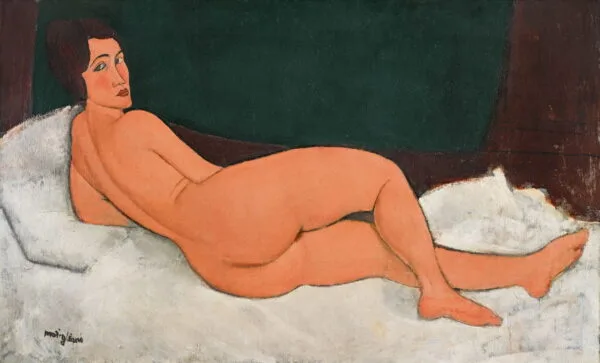
The canvas is landscape and the body fills it from edge to edge. A woman reclines on her side, propped on one elbow, the back of her other hand raised to her cheek with the fingers loosely curled. Her hair is dark, almost black, thick and swept back off the forehead. The face is turned to us: the nose is short and slightly upturned, the mouth small and coral red, the cheeks warm, and the eyes are open, blue-grey, with the pupils clearly drawn. Under her shoulder and hip is the blue cushion the title names, brushed in visible strokes, and along its lower edge runs a line of dark upholstery studs, so what she is lying on is a piece of furniture rather than a drape. Two pale patches show at the left edge and below her hip. The ground behind is a deep rust red-brown, worked with open brushstrokes and darker in the upper middle. The legs are cut by the right edge. The signature sits in the top right corner. It is a post-impressionist painting in the sense in which post-impressionism meant building a body out of contour and colour rather than out of the light in a room. In Paris Modigliani belonged to that circle of immigrant painters we now call the École de Paris.
Where is the original today?
In the National Gallery of Art in Washington, accession number 1963.10.46, in the Chester Dale Collection, and normally on view. The museum records the support more precisely than most listings do: oil on linen rather than simply canvas, which is the same material under a narrower name. The measurement is 65.4 by 100.9 centimetres. The recorded chain of owners begins with the dealer Paul Guillaume in Paris and ends with the American collector Chester Dale, whose collection came to the Gallery in 1963 — for a Modigliani that is unusually complete.
She is looking at you, and she is smiling
The reclining nudes are often described as remote, and many of them are: the eyes are blank almonds, the face is a mask, and the figure gives nothing back. This one does the opposite. Her eyes are painted with pupils and she meets the viewer directly, her mouth is turned up at one corner, and the raised hand at the cheek is a gesture of ease rather than defence. The museum’s own description calls the lips smiling. It matters for a copy: paint the eyes blank and the smile flat and you have a different picture, and a colder one than Modigliani made.
The nudes Zborowski paid for
This canvas belongs to the series of nudes Modigliani painted between 1916 and 1919 while the dealer Léopold Zborowski was supporting him, paying the rent and buying the materials and the models’ time. In December 1917 the gallerist Berthe Weill opened the only solo exhibition of his lifetime; the police closed it on its opening day because the nudes were visible from the street. He died in January 1920, aged thirty-five. The series runs to about two dozen canvases and it is the part of his work that hangs in the largest number of public collections today.
Two Modiglianis, one bequest
The National Gallery holds this painting and one other Modigliani that we also carry, the Portrait of Chaïm Soutine, and they arrived together. Both came with the Chester Dale collection in 1963, and their accession numbers are consecutive: 1963.10.46 for the nude, 1963.10.47 for the portrait. If you are hanging the two side by side that is not an invention of ours — it is how the museum received them.
How is our hand-painted version made?
The work is made by an academy-trained painter in oil on cotton canvas over a wooden frame. It is not a print: every stroke is laid by hand, and your canvas always differs a little from any other. The whole picture turns on one relation: the blue of the cushion is the only cool colour on the canvas, and it is what holds the warm body away from the warm ground. Make the blue too grey and the body sinks into the red; make it too bright and it becomes the subject. The painter therefore lays the ground and the cushion first and matches the flesh to both. The second difficulty is the face, which is small, close to the edge, and carries the entire expression in a mouth about a centimetre wide.
Which size for which wall?
The original is 100.9 cm wide and 65.4 cm high, and our 101 × 65 cm is that canvas to within four millimetres, so if you want it at the size Modigliani painted it, that is the rung. The smaller sizes, 70 × 45, 80 × 50 and 90 × 60 cm, suit a narrow wall or the space above a low sideboard. Above a bed or a sofa — the natural place for a landscape format — 110 × 70 and 120 × 80 cm read best. The large sizes, 150 × 100 and 180 × 120 cm, want a free wall and about three metres of distance. Hang it with the centre around 145 cm above the floor, and a little lower above a bed. The picture is warm throughout with one blue note, so it carries a white, cream or pale grey wall and competes with a red one.
Custom size, stretcher and frame
If your wall asks for a size that is not listed, we will make it. Give us the width and height in centimetres; we check whether the proportion carries the composition and tell you what changes at the edges. Here it shows first at the right, where the legs are already cut in the original, and at the left, where the cushion and the studded edge sit; narrowing there takes away the only cool colour and the only clue that she is on furniture. It arrives either stretched on a wooden frame, ready to hang, or rolled in a tube, which is cheaper to ship. You pick the frame in our 3D application, which shows it realistically on the work, and on request we set it into a photograph of your wall. If you are looking for a work we do not carry, see our made-to-order paintings.
Delivery and guarantee
We deliver to your address, the canvas clear of the outer wall of the packaging. Lead time depends on size and the workshop load: we estimate it when you order and tell you if it changes. We guarantee workmanship and materials: if the work arrives damaged or does not match the photograph you approved, we repaint it at our cost. Because you see it photographed before it ships, most questions are settled before it leaves.
Frequently asked questions
Where is the original?
In the National Gallery of Art in Washington.
What is the accession number?
1963.10.46, in the Chester Dale Collection.
Is it oil on canvas or on linen?
Both descriptions are of the same thing. The museum says linen, which is the specific fibre; canvas is the general word.
Is the painting signed?
Yes, in the top right corner.
Do you have the original’s size?
Effectively yes. The original is 100.9 × 65.4 cm and our 101 × 65 cm rung differs by one and four millimetres.
Which size should I choose?
Above a bed or sofa, 120 × 80 cm. For a narrower wall, 90 × 60 cm.
How high should it hang?
With its centre about 145 cm above the floor, a little lower above a bed, so a hand’s width is left between the headboard and the lower edge.
Which other Modigliani nudes do you have?
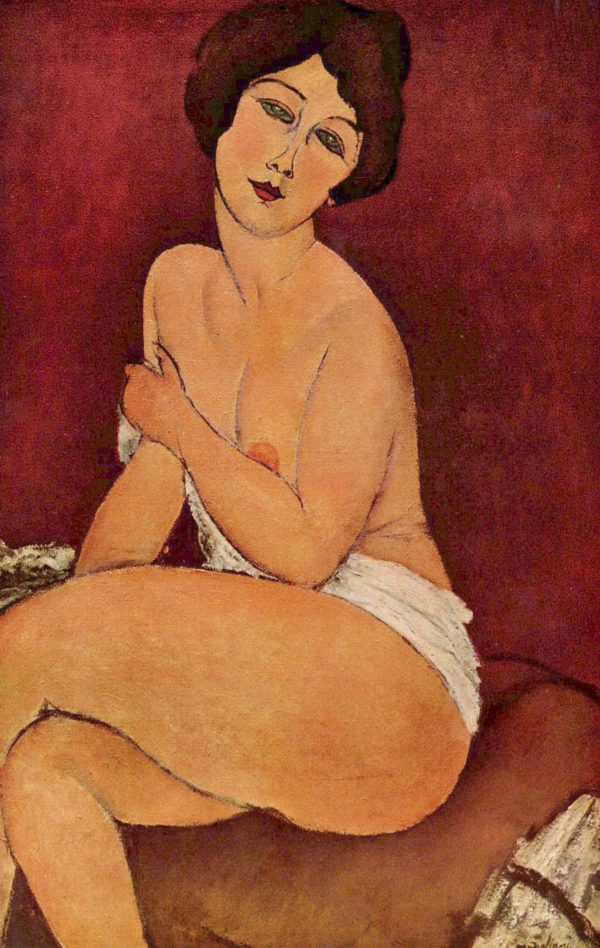
See Reclining Nude II, Red Nude and Seated Nude. The full choice is in the Amedeo Modigliani gallery, and we have written a longer article about the painter.
How closely does it follow the original’s proportions?
The original measures 100.9 × 65.4 cm, and that is exactly the size we list: 101 x 65 cm. The proportions are the original’s, with no deviation.
- Subject: a reclining female figure propped on one elbow, the back of the other hand at her cheek, a studded blue cushion beneath her and a rust-red ground behind
- Original: 65.4 × 100.9 cm, oil on linen, 1917, National Gallery of Art, Washington (acc. 1963.10.46)
- Our version: hand-painted oil on canvas, eight sizes from 70 × 45 to 180 × 120 cm, one of them the original’s measurement to within four millimetres
- Worth knowing: unlike most of the nudes, this one looks straight at the viewer and the mouth is smiling; the blue cushion is the only cool colour on the canvas
The eyes on this canvas are painted without pupils. We counted all 76 Modigliani works on this shelf: 53 are like that, 17 are not – work by work.