







































Description
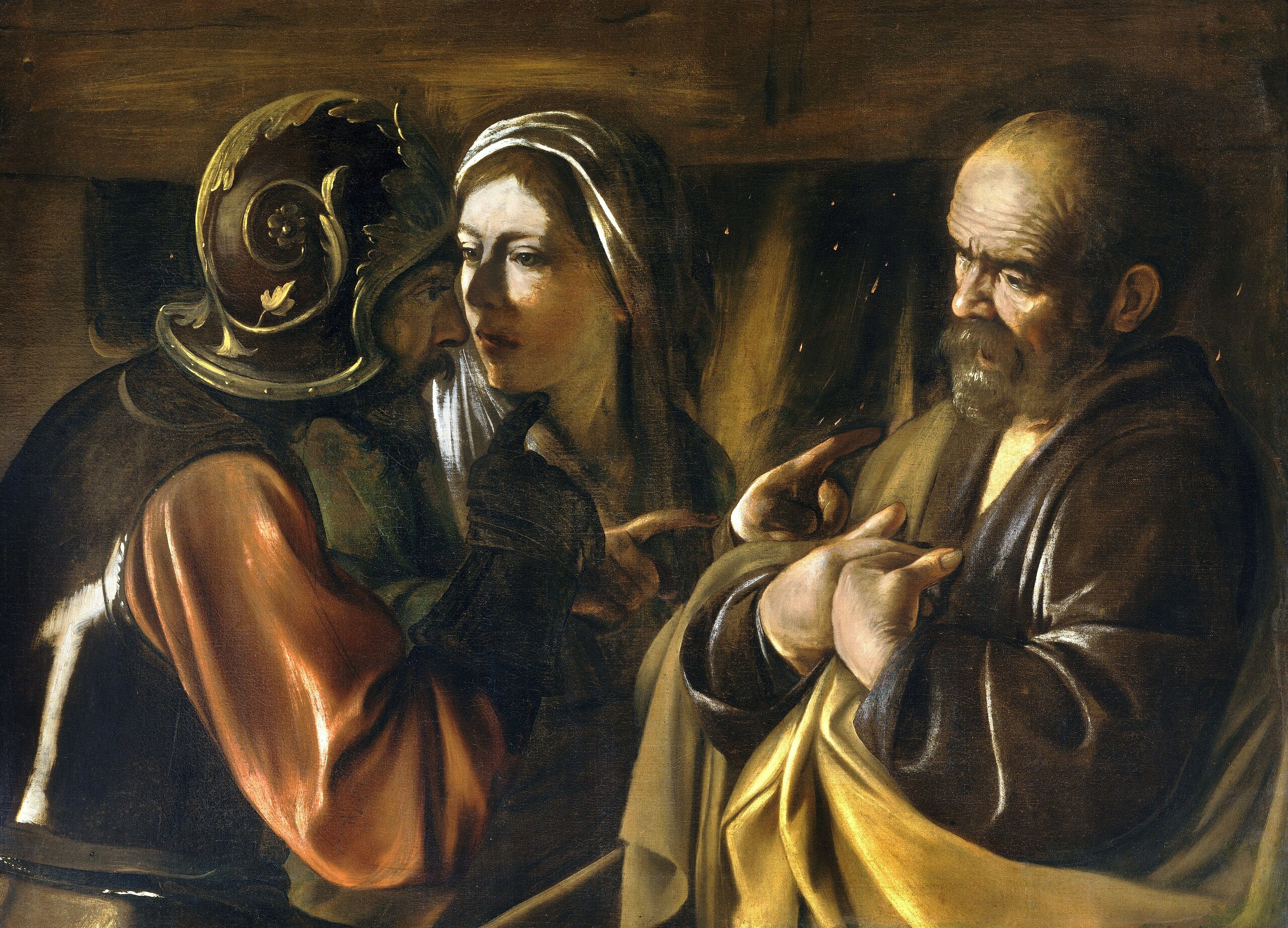
The Denial of Saint Peter is one of Caravaggio’s last works, painted around 1610: three half-length figures meet in the dark, a helmeted soldier and a maidservant point at the old Peter, and he raises his hands to his chest and denies that he knows Jesus. The original, oil on canvas, is 94 cm high and 125.4 cm wide and belongs to The Metropolitan Museum of Art in New York. Our painter paints it for you by hand in oil on canvas in 8 landscape sizes, from 56 x 40 to 180 x 140 cm, or to a size you choose; before it leaves us, we show you the finished painting in a photograph.
| Title: | The Denial of Saint Peter |
| Other titles: | Rinnegamento di san Pietro · Die Verleugnung Petri |
| Painter: | Michelangelo Merisi da Caravaggio (1571–1610) |
| Year painted: | c. 1610 |
| Original size: | 94 cm x 125.4 cm (height x width) |
| Original technique: | Oil on canvas |
| Painting style: | Baroque, tenebrism |
| Located at: | The Metropolitan Museum of Art, New York, USA |
| Our reproduction: | Hand-painted oil on canvas, 8 sizes or made to measure |
The Denial of Saint Peter – Caravaggio
What does The Denial of Saint Peter show?
The scene is horizontal and tightly cropped. The three figures are seen only to the waist, pressed close together, and around them there is nothing but darkness.
On the left stands a soldier in a helmet, turned away from us, so that we see mostly his back and shoulder. With his hand he points at Peter. In the middle a maidservant leans towards the apostle and aims two outstretched fingers at him.
On the right is the old Peter, wrapped in a yellow-brown cloak. He lifts both hands to his chest, and with that gesture he pushes the accusation away.
What is the story behind the scene?
All four Gospels tell how Peter, after the arrest of Jesus, followed him into the courtyard of the high priest. There he was accused three times of being one of his disciples, and three times he denied it. So Jesus’s prophecy came true, that Peter would deny him three times before the cock crowed.
Caravaggio does not paint the three accusations but a single instant, the one in which the fingers turn on Peter. The maid’s gesture is the charge, the soldier’s hand backs it up, and Peter’s hands on his chest are the reply.
Caravaggio painted the same apostle at an earlier moment too, when Jesus calls the fishermen brothers Simon Peter and Andrew. That is The Calling of Saints Peter and Andrew, where the older Peter in a brown cloak looks at Christ while Andrew holds a fish.
Why is this work so highly regarded?
Because it is generally thought to be one of Caravaggio’s last two paintings; the other is The Martyrdom of Saint Ursula. According to Wikipedia, The Denial of Saint Peter was probably finished in Naples in the summer of 1610, the year the painter died.
In October 1609 Caravaggio was attacked at the Osteria del Cerriglio, a tavern in Naples. Wikipedia suggests that he may never have fully recovered, and sees in this the reason for the broad brushwork and the slightly unfocused quality of the work.
That compression gives the painting the psychological intensity of his late work. For more on its history and style, see the English Wikipedia article.
Where is the original, and how did it get there?
The original has belonged to The Metropolitan Museum of Art in New York since 1997, under accession number 1997.167.
The road to New York was a long one. In 1613 the engraver Luca Ciamberlano handed it over to settle a debt owed to the painter Guido Reni, and by 1624 it appears in the inventory of Cardinal Paolo Savelli at his palace in Ariccia. It stayed with the Savelli family until about 1650, when the collection was offered for sale.
After the Second World War Vincenzo Imparato Caracciolo bought it from an antiques dealer in Naples as the work of an unknown hand. Following its restoration in 1959–1964, the art historian Roberto Longhi attributed it to Caravaggio on the basis of style.
The Denial of Saint Peter or another Caravaggio?
The Denial of Saint Peter is a canvas painting for anyone drawn to the late, dark Caravaggio: few figures, deep shadow and a question left open. It is at home in a study, a library or on a quiet dining-room wall.
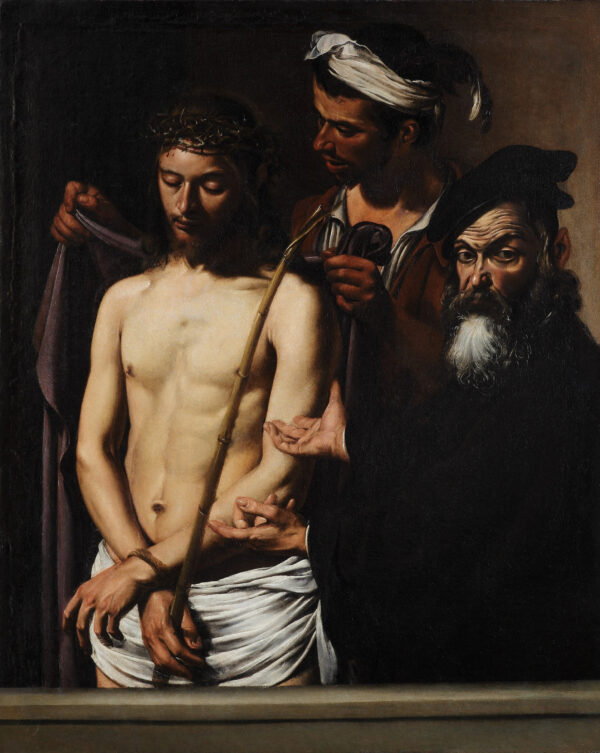
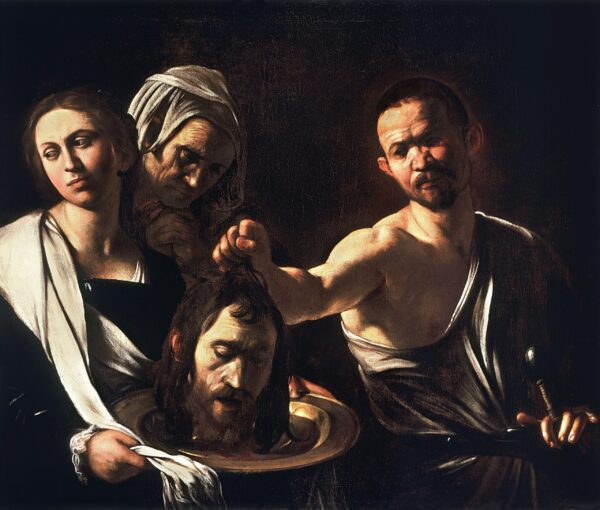
If you want another late and very dark scene beside it, look at Salome with the Head of John the Baptist from the National Gallery in London, in which Salome turns her face away from the platter. Just as restrained is Christ at the Column, where Christ stands at the column without resisting while his tormentors bind him.
For a contrast with the earlier, brighter Caravaggio there is The Calling of Saint Matthew, in which Christ raises his hand to summon Matthew from his table. The Caravaggio page gathers all the famous Caravaggio paintings we offer.
How does our painter paint The Denial of Saint Peter?
Every Denial of Saint Peter we make is painted to order, in oil on canvas and in several layers. The painter starts with a dark ground over the whole canvas, then sets down the three heads and the hands in thin strokes.
Next he builds the light, working from the darkest passages towards the brightest. Peter’s cloak takes on a warm yellow-brown, the helmet a metallic gleam, the faces soft transitions from light into shadow.
This Caravaggio reproduction carries brushmarks you can feel on the canvas and, in the shadows, a depth that print cannot reach. An oil painting reproduction of this kind looks calm in daylight, while in the evening, under a lamp, the faces of the maid and the apostle stand out from the dark even more.
Which size should you choose for your wall?
In short: 56 x 40 or 60 x 47 cm for a narrow wall or above a shelf, 80 x 59 or 90 x 66 cm for a hallway or study, 114 x 82 or 125 x 97 cm above a sofa or sideboard, and 160 x 123 or 180 x 140 cm for a large open wall.
We paint The Denial of Saint Peter in 8 landscape sizes (width x height): 56 x 40, 60 x 47, 80 x 59, 90 x 66, 114 x 82, 125 x 97, 160 x 123 and 180 x 140 cm. The closest to the original is 125 x 97 cm, which is 0.4 cm narrower and 3 cm taller.
As a painting for the living room it works well above a sofa at 114 x 82 cm, where you catch the gestures of the hands from the doorway.
Can I order another size or a frame?
Yes. The soldier stands at the left edge and Peter at the right, so we adapt the composition to a different ratio in a way that lets no hand slip past the edge. Send us the width and height you have in mind, and we will come back to you with a price and the time it will take.
We ship the painting rolled, stretched on a stretcher bar or already framed. Stretching and framing are done by our workshop in Slovenia, which readies every painting in our range for the journey. You pick the frame in our 3D app, which is for choosing a frame and nothing more; seeing the painting on your own wall is a separate service.
When and how does the painting arrive?
We begin painting your Denial of Saint Peter once you confirm the order, and it ships within 15 to 45 working days. Before that you receive a photograph of the completed painting; if you would like anything touched up, we do it before dispatch. Deliveries within Slovenia and the rest of the EU travel without customs, and our returns policy applies to every order.
It is a thoughtful gift for someone interested in Christian art or in Caravaggio’s late style. If the recipient should choose the size, give them a wall art voucher instead.
Frequently asked questions
Where can I see the original?
At The Metropolitan Museum of Art in New York, which has owned it since 1997.
Whom do the maid and the soldier accuse?
The apostle Peter, whom they recognise as a disciple of Jesus; he denies it.
Will I receive a print?
No. Each of our paintings is a hand-painted copy, made with a brush and oil paints on canvas.
How large is the original?
It is 94 cm high and 125.4 cm wide; our closest size is 125 x 97 cm.
When did Caravaggio paint this work?
Around 1610, most probably in Naples; it is counted among his last two paintings.
Is it better for a bedroom or a living room?
Better for a living room, a study or a hallway than a bedroom, as it is a serious and dark scene.
Will you paint it in a size that is not on the list?
Yes. Give us the width and height and we will send you a price and a date.
How long does it take to make?
15 to 45 working days, and you see a photograph of the finished painting before it ships.
- Subject: a maidservant and a helmeted soldier point at the old Peter, who, hands on his chest, denies knowing Jesus.
- Original: c. 1610, oil on canvas, 94 x 125.4 cm, The Metropolitan Museum of Art, New York.
- Ours: painted by hand with oil paints on canvas, in 8 landscape sizes from 56 x 40 to 180 x 140 cm or made to measure.
- Worth knowing: the painting long passed as the work of an unknown artist; it was given to Caravaggio after its 1959–1964 restoration.