







































Description
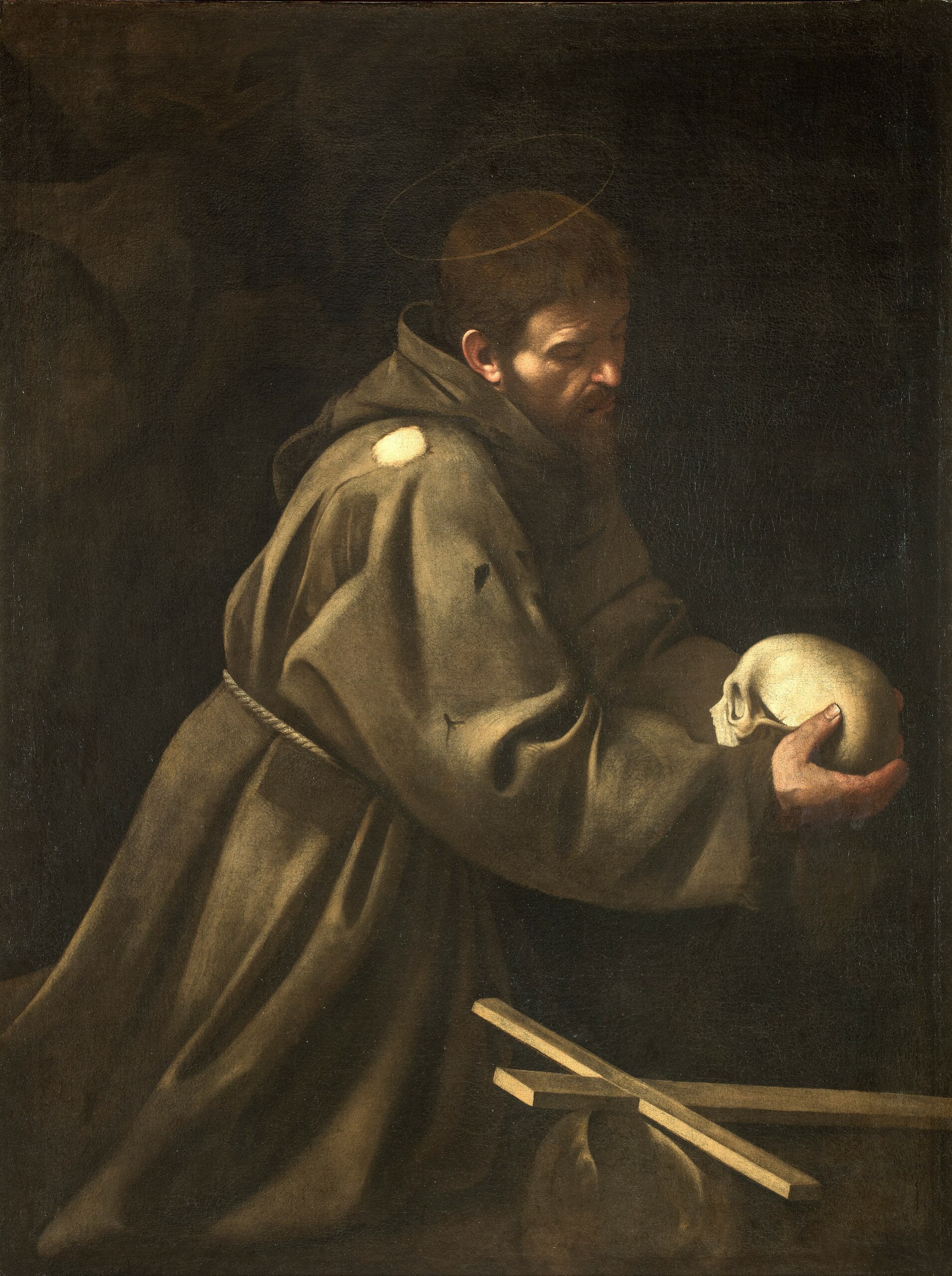
Saint Francis in Meditation is a painting by Caravaggio from around 1602–1604, though its date is uncertain: the saint kneels in the dark in his brown habit, holding a skull and gazing at it, a wooden cross lies at his feet, and a strong light falls on his face and hands. The original, oil on canvas, is 123 cm high and 92.5 cm wide and hangs in the Galleria Nazionale d’Arte Antica in the Palazzo Barberini, Rome. Our painter makes it to order by hand in oil on canvas, in 8 portrait sizes from 40 x 51 to 156 x 200 cm or to your own measurements, and shows you the finished work in a photograph before it is sent.
| Title: | Saint Francis in Meditation |
| Other titles: | San Francesco in meditazione · Saint Francis in Prayer |
| Painter: | Michelangelo Merisi da Caravaggio (1571–1610) |
| Year painted: | c. 1602–1604 |
| Original size: | 123 cm x 92.5 cm (height x width) |
| Original technique: | Oil on canvas |
| Painting style: | Baroque, tenebrism |
| Located at: | Galleria Nazionale d’Arte Antica, Palazzo Barberini, Rome, Italy |
| Our reproduction: | Hand-painted oil on canvas, 8 sizes or made to measure |
Saint Francis in Meditation – Caravaggio
What does Saint Francis in Meditation show?
The canvas is upright and almost entirely given over to darkness. Out of it comes a single figure: Saint Francis of Assisi, kneeling in a brown habit, with nothing recognisable around him.
He holds a skull in his hands and looks at it with full attention. Beside his feet lies a plain wooden cross without any ornament.
The light comes from one side and falls mainly on the face and the hands. The folds of the habit sink into shadow, so the viewer’s eye settles in three places: the face, the hands and the skull.
What does the scene mean?
Francis of Assisi chose a life of poverty and humility, and it was this side of his story that made him a popular subject for painters in Caravaggio’s day. Here we do not see him preaching or among people, but alone and absorbed in prayer.
The skull and the cross are what he is meditating on. The skull is a reminder of mortality, the cross of the suffering of Christ, and the saint does not hold them out to us; he contemplates them himself. On English Wikipedia the work is listed as Saint Francis in Prayer.
The writer Peter Robb places Francis beside John the Baptist and Saint Jerome: in his view they are three solitary men, young, mature and old, brooding and cut off from society, whom Caravaggio painted again and again. The oldest of the three appears in Saint Jerome Writing (Valletta), where a skull also lies on the table before the bald saint.
Why is this painting so admired?
Caravaggio reduces a well-loved subject to its essentials: one man, a skull, a cross and light. No angels, no miracles, no landscape, so whatever the scene has to say is said by the face of a man lost in thought.
A canvas painting like this needs no explanation to work: it is calm, serious and very direct. If you want to know more about its dating and the different versions, the English Wikipedia article has the details, in English.
Where is the original?
The painting is kept by the Galleria Nazionale d’Arte Antica in Rome, housed in the Palazzo Barberini.
It is not recorded in early documents, which makes it hard to date and even hard to tell the original apart from later copies. John Gash regards a version in the Chiesa dei Cappuccini as a good copy of a lost original, which some scholars identify with a painting from the Church of San Pietro in Carpineto Romano, now in the Museo di Palazzo Venezia. Helen Langdon, in her biography of Caravaggio, discusses the version in the Palazzo Barberini, which is the one we paint from.
The year is not settled either. At a libel trial in 1603 the painter Orazio Gentileschi, a friend of Caravaggio’s, said he had lent the artist a monk’s robe several months earlier, and the painting may be connected with it. That testimony is the main basis for a date of 1602–1604; Robb, however, points to the austere approach and less painterly technique and thinks it may date from 1606, when Caravaggio fled Rome as an outlaw after a death in a street brawl.
Saint Francis in Meditation or another Caravaggio?
This is a painting for anyone who wants quiet: one figure, few colours and a great deal of shadow. It suits a study, a reading corner or a hallway.
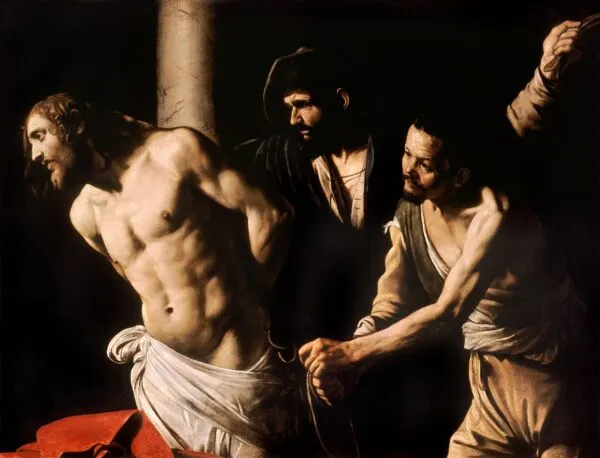
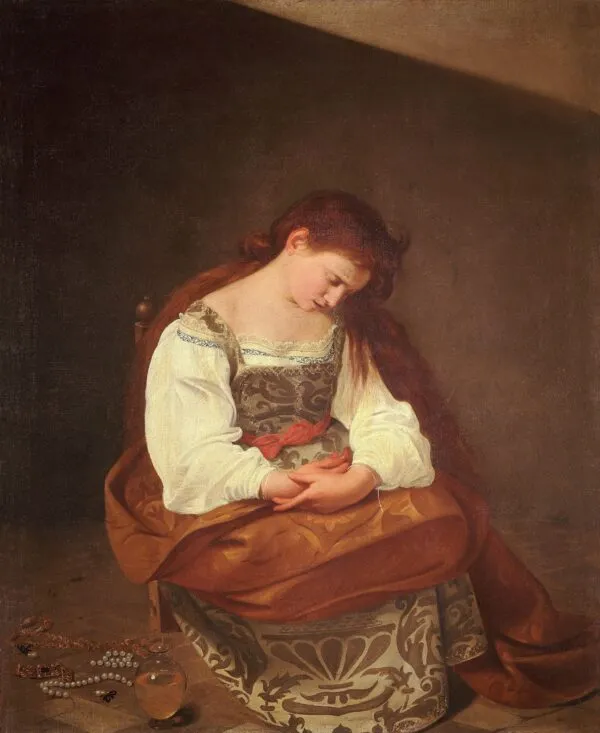
A similarly inward mood fills Penitent Magdalene in the Galleria Doria Pamphilj in Rome, in which a young woman sits with bowed head in an empty room, her pearls cast aside beside her. Probably from roughly the same years as our Francis comes The Crowning with Thorns, a busier scene with several figures, now in the Kunsthistorisches Museum in Vienna.
If you would rather have a painting without people, look at Still Life with Fruit on a Stone Ledge, which is attributed to Caravaggio. Our Caravaggio page brings together all the famous Caravaggio paintings we offer.
How does our painter paint this work?
Every Saint Francis we make is painted to order, in oil on canvas, layer upon layer. First a dark ground covers the canvas, then the painter places the kneeling figure, the skull and the cross with a few strokes.
Then comes the light. The face and hands receive warm tones that grow lighter by degrees, the brown habit deep folds that lose themselves in the dark towards the edge.
A hand-painted Caravaggio reproduction like this has brushmarks you can feel on the surface and a depth in the shadows that print does not give back. The result is an oil painting reproduction that is calm by day, while at night under a lamp the saint’s face stands further out of the dark.
Which size suits your wall?
In short: 40 x 51 or 45 x 60 cm above a bedside table, in a niche or on a narrow wall, 58 x 75 or 73 x 100 cm for a hallway or study, 84 x 110 or 105 x 145 cm above a chest of drawers or a sofa, and 120 x 160 or 156 x 200 cm for a tall wall or a stairwell.
We paint Saint Francis in 8 portrait sizes (width x height): 40 x 51, 45 x 60, 58 x 75, 73 x 100, 84 x 110, 105 x 145, 120 x 160 and 156 x 200 cm. The closest to the original is 84 x 110 cm, which is 8.5 cm narrower and 13 cm shorter.
As a painting for the living room it wants a quiet wall, for example at 73 x 100 cm above a reading chair.
Can I order another size or a frame?
Of course. The kneeling figure and the cross at his feet need room along the bottom, so with a different ratio we make sure the cross is not cut off and that enough darkness remains above the head. Tell us the width and height you would like, and we will reply with a price and a delivery time.
It can travel rolled, stretched on a stretcher bar or already framed, as you prefer. Our workshop in Slovenia does the stretching and framing and prepares every painting we sell for the journey. You choose the frame in our 3D app, which is only for picking a frame; showing the painting on your own wall is a separate service.
When will the painting arrive?
We start once you confirm the order and dispatch the painting within 15 to 45 working days. Before it leaves, we send you a photograph of the finished work, and if you would like a change, we make it. Shipments within Slovenia and to the rest of the EU travel free of customs, and our returns policy covers every order.
Saint Francis in Meditation makes a fine gift for someone close to Franciscan spirituality or fond of Assisi, or for someone called Francis. If you are unsure which size would suit them best, give a wall art voucher and let them choose.
Frequently asked questions
Where does the original hang?
In the Galleria Nazionale d’Arte Antica in the Palazzo Barberini, Rome.
What is the saint holding?
A skull, which he contemplates intently; a wooden cross lies at his feet.
Is this a printed reproduction?
No, it is a hand-painted copy that our painter makes with a brush and oil paints.
How large is the original?
It is 123 cm high and 92.5 cm wide; our nearest size is 84 x 110 cm.
When was it painted?
It is usually dated to around 1602–1604, though Peter Robb thinks it may be from 1606.
Does it suit a bedroom?
A study or living room is better; a skull on a dark ground is not to everyone’s taste in a bedroom.
Could you paint it in a size you do not list?
Yes, we paint it in the width and height you decide on.
How long will I wait for it?
It ships within 15 to 45 working days, and you see a photograph of it first.
- Subject: Saint Francis kneels in the dark in a brown habit, holding a skull and gazing at it, with a wooden cross at his feet.
- Original: c. 1602–1604, oil on canvas, 123 x 92.5 cm, Galleria Nazionale d’Arte Antica (Palazzo Barberini), Rome.
- Ours: painted by hand in oils on canvas, in 8 portrait sizes from 40 x 51 to 156 x 200 cm or made to measure.
- Worth knowing: the work is undocumented, so opinions differ on its date and on which version is the original.