







































Description
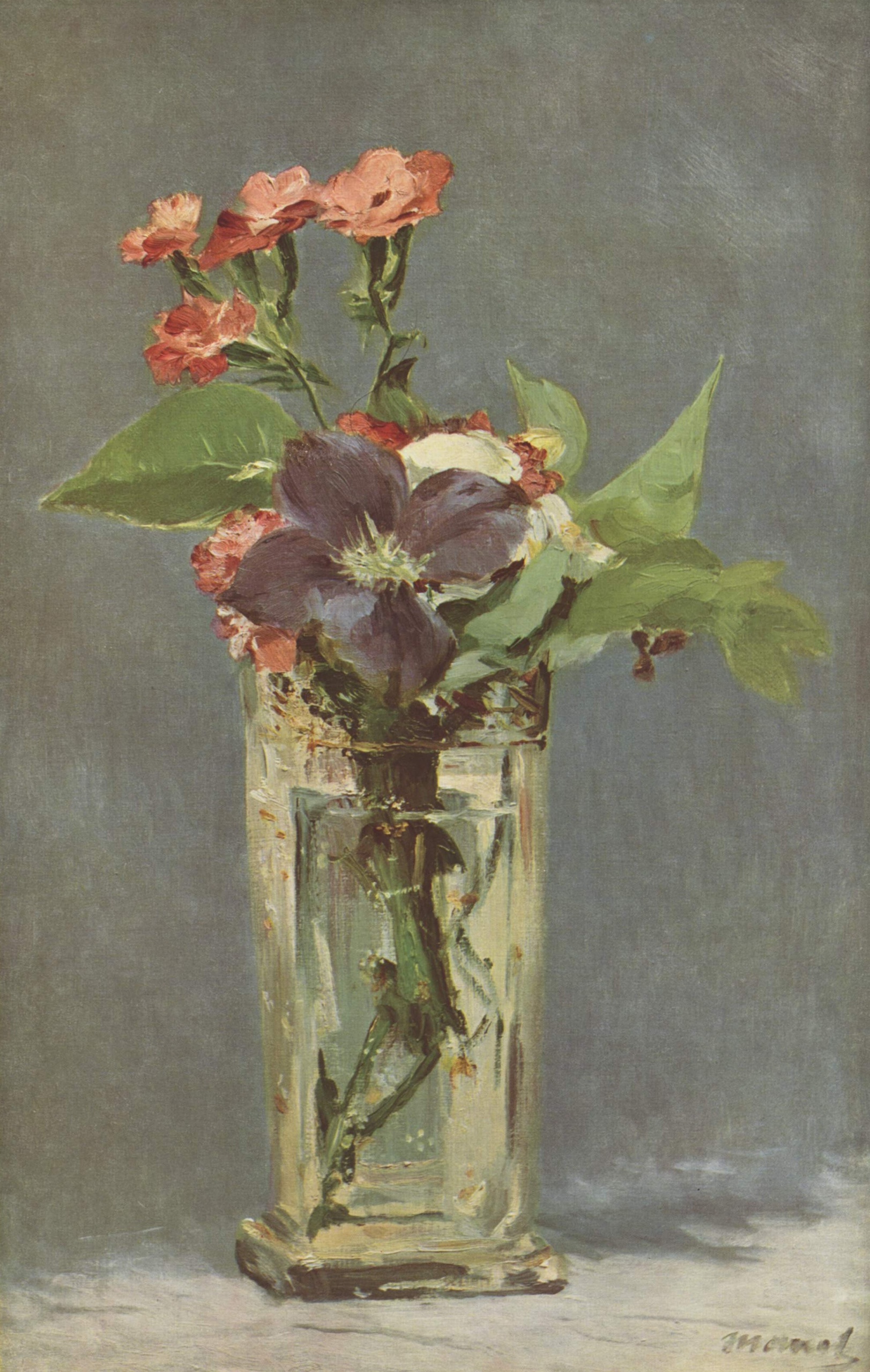
Flowers in a Crystal Vase is a still life Édouard Manet painted in 1882: a few pink and red carnations and a large violet clematis flower with green leaves stand in a tall, cut-crystal vase of clear water, the stems showing through the glass. The original, oil on canvas, is only 55 cm high and 34 cm wide and has been on deposit at the Musée Fabre in Montpellier since 2023. Our painter paints it for you by hand in oil on canvas, in 8 portrait sizes from 29 x 46 to 130 x 200 cm, or made to measure. Before the flowers leave us, you receive a photograph of the finished painting.
| Title: | Flowers in a Crystal Vase |
| Other titles: | Œillets et clématites dans un vase de cristal (French title) |
| Painter: | Édouard Manet (1832–1883) |
| Year painted: | 1882 |
| Original size: | 55 cm x 34 cm (height x width) |
| Original technique: | Oil on canvas |
| Painting style: | Realism and Impressionism |
| Located at: | Musée Fabre, Montpellier (on deposit, MNR 631) |
| Our reproduction: | Hand-painted in oil on canvas, 8 sizes or made to measure |
Flowers in a Crystal Vase – Édouard Manet
What does Flowers in a Crystal Vase show?
At the centre of the canvas stands a tall crystal vase with faceted sides, filled with clear water. Through the glass you see the green stems bend in the water and cross beneath the surface. The vase rests on a pale, almost white table against a soft grey background with no detail at all, so the eye stays on the flowers.
From the neck of the vase rise a few long-stemmed carnations, ranging from salmon pink to brick red, their petals jagged and slightly ragged. In front opens a large violet clematis with a pale, feathery centre, a white bloom sits behind it, and broad light-green leaves reach well beyond the rim.
The glass is made of a few white and golden strokes that catch the light along its edges. Manet’s signature sits at the lower right, on the pale table.
Which flowers did Manet put in the vase?
The French title names carnations and clematis (œillets et clématites). In French, œillets covers several kinds of cut flowers, many of them from the genus Dianthus, so they need not be garden carnations in today’s sense.
The painting was probably made in July 1882 at Rueil and belongs to a group of still lifes, mostly of flowers, that Manet painted at the end of his life.
The sources read no hidden symbolism into these blooms. What you see is a simple bunch in water, looked at closely, and that is where its charm lies.
Why is this still life so admired?
Among the first nineteenth-century artists to paint modern life, Édouard Manet (1832–1883) is a pivotal figure in the move from Realism to Impressionism. Two large canvases he showed in Paris in 1863 and 1865 caused great scandals and are now seen as the start of modern art.
This bunch shows a quieter side of the same painter. A year earlier he had received the Légion d’honneur; the next spring he died after a long illness, which places these small flower pieces in his final period.
A short description, the French title and the dating are given in the Wikipedia article on the painting, which is in English.
Where is the original, and how did it get there?
The original measures 55 x 34 cm (height x width). It belongs to the French national museums under inventory number MNR 631.
The letters MNR tell its story: the painting is among the works recovered after the Second World War, and in 1951 it was entrusted to the care of the French national museums.
It was kept first at the Louvre and then at the Musée d’Orsay in Paris, and in 2023 it was placed on deposit at the Musée Fabre in Montpellier, where it is today.
Flowers in a Crystal Vase or another Manet?
This canvas painting suits anyone who loves calm rooms and soft colour: pink, violet and grey, which sit happily with almost any furniture.
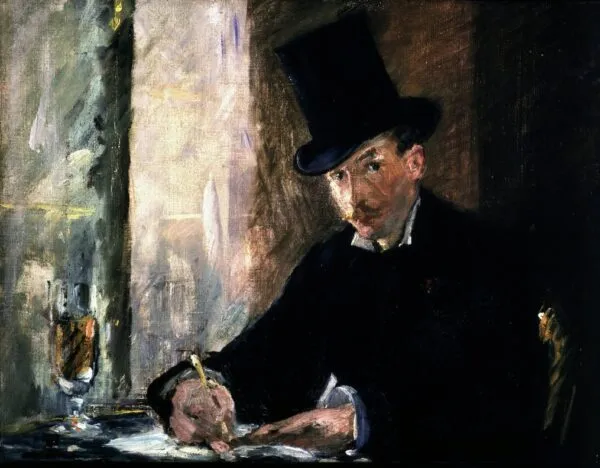
If Manet’s Paris draws you, look at The Café-Concert, where a grey-bearded gentleman in a top hat and a young woman sit at a marble table while a waitress behind them drinks beer, or at Corner of a Café-Concert, with a waitress carrying two glasses of beer. More personal is the Portrait of Stéphane Mallarmé, the poet leaning back on a sofa with a cigar, and the sea arrives with The Kearsarge at Boulogne, a warship at anchor beyond the waves.
Beside this bouquet, the Édouard Manet page lists the other famous Manet paintings we hand-paint to order.
How do we hand-paint Flowers in a Crystal Vase?
Manet’s original is a small oil on canvas of only 55 x 34 cm. Ours is an oil painting reproduction on new canvas: the painter works it in oil on canvas, in the size you choose, layer upon layer.
He first lays in the grey ground and the outline of the vase, then the stems in the water and the light breaking on the cut facets. Only then come the flowers: the clematis in dense violet strokes, the carnations in warm pinks and reds, the leaves in a few broad sweeps of green.
At the larger sizes Manet’s quick brushwork reads from across the room, so the painter leaves it loose rather than smoothing it into a photographic finish.
Which size suits which wall?
In short: 29 x 46 or 40 x 62 cm for a narrow wall or above a bedside table, 48 x 75 and 55 x 85 cm above a chest of drawers or in a dining room, 70 x 110 and 77 x 129 cm in a living room, and 100 x 159 or 130 x 200 cm for a tall wall or a stairwell.
The bouquet comes in 8 portrait sizes (width x height): 29 x 46, 40 x 62, 48 x 75, 55 x 85, 70 x 110, 77 x 129, 100 x 159 and 130 x 200 cm. The original measures 34 x 55 cm (width x height), so only 29 x 46 cm is smaller, 40 x 62 cm already slightly exceeds it, and every larger size enlarges it, the biggest to more than three times its height.
As a painting for the living room it works best at 70 x 110 or 77 x 129 cm, beside the sofa or between two windows, where the tall format fills the space well.
Can I have another size or a frame?
Yes. The tall, narrow proportion matters here, because the vase must keep its slender shape. If you need other proportions, we add or remove a little grey ground around the bunch, and the vase and flowers stay whole. Send us the size you need and we will quote a price and a date for your bouquet.
The painting travels rolled, stretched on a stretcher bar or framed, and our workshop in Slovenia does the stretching and framing. The moulding for your vase is chosen in our 3D app, which exists only for picking a frame; a view of the painting on your own wall is a separate service.
A slim pale moulding gives the grey room to breathe, while darker wood brings out the violet clematis.
How and when does the painting arrive?
Work on your carnations starts as soon as you confirm the order, and the painting is ready to ship within 15 to 45 working days. Before packing we send you a photograph of the finished work, and if you would like anything changed, we make the corrections.
There are no customs duties within Slovenia and the rest of the EU, and our returns policy applies to every order.
Flowers in a crystal vase make a fine gift for a birthday, Mother’s Day or a new home. If you are unsure of the size, give a wall art voucher and let the recipient pick the painting and the size.
Frequently asked questions
Where can I see the original?
Since 2023 it has been on deposit at the Musée Fabre in Montpellier, inventory number MNR 631.
Which flowers are in the painting?
Carnations in pinks and reds and a large violet clematis with green leaves.
Is this a print?
No. Each one is a hand-painted copy, worked by our painter with a brush in oil on canvas.
How big is the original?
It measures 55 x 34 cm (height x width); even our 40 x 62 cm size is a little larger.
Can I order a size that is not listed?
Gladly. Write to us with the width and height for your wall, and the offer comes back with a price and a delivery time.
How long does it take to make?
Between 15 and 45 working days, and we send you a photograph before it ships.
Is it right for a bedroom or as a gift?
Yes. The calm colours and the delicate bunch suit a bedroom, and as a present it pleases anyone who loves flowers.
When did Manet paint these flowers?
Most likely in July 1882 at Rueil, less than a year before his death.
- Subject: carnations and a violet clematis in a tall faceted crystal vase against a grey ground.
- Original: oil on canvas, 1882, 55 x 34 cm, Musée Fabre, Montpellier.
- Ours: hand-painted in oil on canvas as an Édouard Manet reproduction, in 8 sizes from 29 x 46 to 130 x 200 cm or made to measure.
- Worth knowing: one of the flower still lifes from Manet’s last years.