







































Description
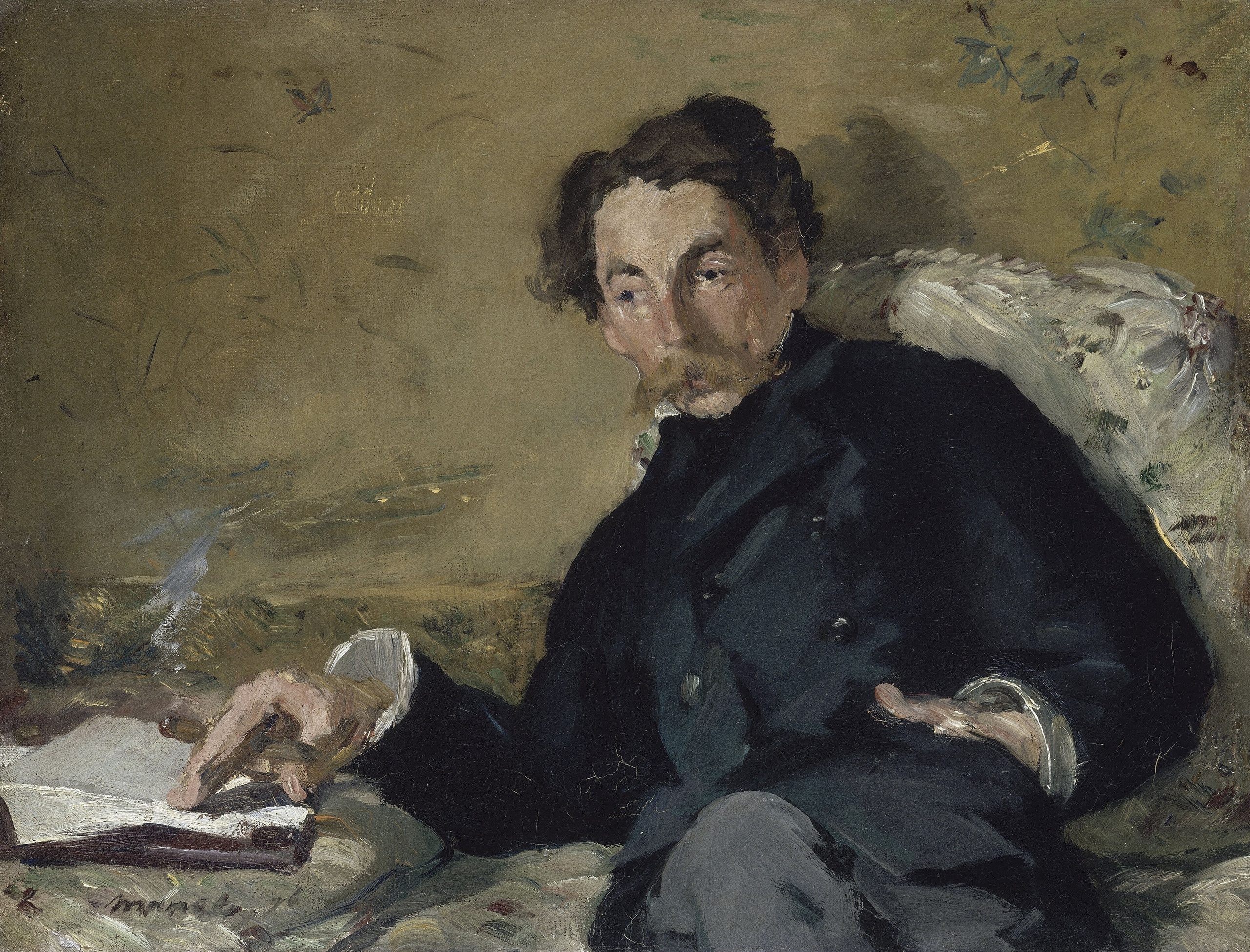
Portrait of Stéphane Mallarmé is the canvas Édouard Manet painted in 1876 of his friend the poet Stéphane Mallarmé, who leans back against the cushions of a sofa, a cigar in his right hand. The original is a small oil on canvas, just 27 x 36 cm, in the Musée d’Orsay in Paris. Our painter paints it for you by hand in oil on canvas, in 8 landscape sizes from 40 x 30 to 200 x 148 cm or made to measure, every one of them larger than the original. Before the poet and his cigar are packed, you get a photograph of the finished painting.
| Title: | Portrait of Stéphane Mallarmé |
| Other titles: | Portrait de Stéphane Mallarmé (French title) |
| Painter: | Édouard Manet (1832–1883) |
| Year painted: | 1876 |
| Original size: | 27 cm x 36 cm (height x width) |
| Original technique: | Oil on canvas |
| Painting style: | Realism and Impressionism |
| Located at: | Musée d’Orsay, Paris, France |
| Our reproduction: | Hand-painted in oil on canvas, 8 sizes or made to measure |
Portrait of Stéphane Mallarmé – Édouard Manet
What does Portrait of Stéphane Mallarmé show?
The poet sits back against pale cushions in a small floral fabric. His dark hair is tousled, he has a thick moustache, and white shirt cuffs show beneath his blue-black coat. Head slightly bowed, he looks down past us, lost in thought.
His right hand, holding a lit cigar, rests on an open book or a low stack of papers at the left edge, and the smoke rises in a thin grey trail. His left hand sits at his hip, by the pocket of his coat.
Behind him is a warm brown-olive wall with light strokes that suggest leaves and blades of grass; look closely at the top left and you find a tiny bird. Some critics see butterflies and flowers in the decoration, others Japanese motifs. Manet signed at the lower left and added the year 76.
What bound the poet and the painter together?
Mallarmé met Manet in 1873, when he arrived in Paris. He taught English at a lycée and almost every day, walking home in the late afternoon, dropped in on the painter for a talk, until Manet’s death in 1883. Afterwards he wrote to Paul Verlaine that he had seen his dear Manet every day for ten years and found his absence unbelievable.
When the Paris Salon jury turned down several of Manet’s works in 1874, Mallarmé defended him in an article, and in 1876 he wrote an essay on the Impressionists and Manet for a London magazine. The art historian Hajo Düchting reads the portrait partly as a thank-you for that support.
For Mallarmé’s translation of Poe’s The Raven, Manet made four lithographs, and for The Afternoon of a Faun wood engravings.
Why is this portrait so admired?
His contemporaries thought it the best likeness of Mallarmé among the many paintings and engravings of him. Verlaine reproduced it in 1886 in his book Les Poètes maudits, in the chapter on Mallarmé. The French writer Georges Bataille wrote that it radiates the friendship of two great minds.
The art historian Anne Coffin Hanson contrasts the cigar smoke with the delicate Japanese patterns on the wall, a pairing at once sensual and reflective. In her view, set against the stiff stance of Manet’s Duret, Mallarmé’s loose pose makes the picture feel spontaneous, informal and pointedly modern.
Édouard Manet (1832–1883) was among the first painters of the nineteenth century to take modern life as his subject, at the turn from Realism to Impressionism. The Wikipedia article on the portrait, in English, tells more about the two men.
Where is the original today?
The original, oil on canvas measuring 27 x 36 cm (height x width), belongs to the Musée d’Orsay in Paris, accession number RF 2661. According to Adolphe Tabarant the canvas was at first only 34 cm wide, and Manet sewed a two-centimetre strip onto its right side while he worked.
The public first saw the portrait in 1884, after the painter’s death. In 1928 the Louvre bought it from Mallarmé’s family with help from the Société des Amis du Louvre and D. David Weill. From 1947 it hung in the Jeu de Paume, and in 1986 it moved to the Musée d’Orsay. It has since been lent to shows in Spain, Russia, Japan and the United States.
Portrait of Stéphane Mallarmé or another Manet?
This small, quiet portrait is a canvas painting for lovers of books and poetry, at home in a study or a reading corner.
For Manet’s sea, see The Kearsarge at Boulogne, a dark steamship at anchor and a fishing boat under a brown sail, or Rochefort’s Escape, a small rowing boat on deep blue water. Everyday Paris returns in Corner of a Café-Concert, a waitress holding two glasses of beer, and in The Rue Mosnier with Flags, a sunny street hung with French flags.
Our Édouard Manet shelf gathers the other famous Manet paintings we paint to order.
How do we hand-paint Portrait of Stéphane Mallarmé?
Manet’s original is a small oil on canvas, barely 36 cm wide. Ours is an oil painting reproduction made on new canvas: the painter lays down the oil colours layer by layer, in the size you have chosen.
He first blocks in the diagonal of the body, rising from the book on the left to the cushions on the right, then the head and hands. Next come the blue-black coat, the pale cushion and the olive wall; last, the smoke, the white cuffs, the bird, the leaves and the signature.
Manet put the paint on lightly here, in loose, visible strokes, and our painter widens them with the size instead of smoothing the face, so the sketch-like freshness survives.
Which size suits which wall?
In short: 40 x 30 or 53 x 38 cm for a shelf, a desk or a narrow wall, 65 x 50 and 87 x 62 cm above a chest of drawers or in a study, 98 x 70 and 125 x 90 cm above a sofa, and 160 x 115 or 200 x 148 cm for a large empty wall.
We paint the portrait in 8 landscape sizes (width x height): 40 x 30, 53 x 38, 65 x 50, 87 x 62, 98 x 70, 125 x 90, 160 x 115 and 200 x 148 cm. The original is only 36 x 27 cm (width x height), so even our smallest size, 40 x 30 cm, is a little larger, every other size enlarges it, and at 200 x 148 cm the canvas is more than five times as wide as Manet’s.
As a painting for the living room it works best at 98 x 70 or 125 x 90 cm above the sofa, where the face and the hand with the cigar read clearly from the doorway.
Can I have another size or a frame?
Yes. For other proportions we keep the poet, the book and the cushion whole and adjust only the edge of the wallpaper. Send us the size you need, and you will hear the price and the date for your Mallarmé.
The portrait travels rolled, stretched on a stretcher bar or framed by our workshop in Slovenia. The moulding is picked in our 3D app, which exists only for frame choice; a view of the portrait on your own wall is a separate service. Dark wood echoes the coat, thin gold the warm wall.
When will my painting arrive?
Our painter picks up the brush once you confirm, and the portrait is ready to ship within 15 to 45 working days. Before packing you receive a photograph of it, and we make any changes you ask for.
There are no customs duties within Slovenia or anywhere else in the EU, and our returns policy covers every order.
The poet with his cigar makes a fine gift for a reader, a writer or a lover of French poetry. Unsure which wall will take him? With a wall art voucher, the reader you are spoiling picks the size.
Frequently asked questions
Where can I see the original?
At the Musée d’Orsay in Paris, under accession number RF 2661.
Who is the man in the painting?
The French poet Stéphane Mallarmé, who met Manet in 1873 and from then on visited him almost daily.
Is this a print?
No. Each portrait is a hand-painted copy, laid on the canvas by our painter with brushes and oil colours.
How big is the original?
Only 27 x 36 cm (height x width), so every size we paint is larger.
Can I order the portrait in a size that is not listed?
Yes. Give us the width and height, and we will quote a price and a time for the poet in that size.
How long does it take to make?
Between 15 and 45 working days, and before it ships we send you a photograph of the painting.
Is the poet with his cigar right for a study, or as a gift?
Yes. The calm portrait suits a study or a library and pleases anyone who loves to read.
What do the papers under the poet’s hand mean?
Art historians suggest they may allude to Mallarmé’s article defending Manet or to the translation of The Raven.
- Subject: the poet Stéphane Mallarmé with a cigar, leaning back on the pale cushions of a sofa before an olive wall with Japanese-style motifs.
- Original: oil on canvas, 1876, 27 x 36 cm, Musée d’Orsay, Paris.
- Ours: an Édouard Manet reproduction in oil on canvas, painted by hand in 8 sizes between 40 x 30 and 200 x 148 cm, or made to measure.
- Worth knowing: contemporaries thought it the truest likeness of the poet.