







































Description
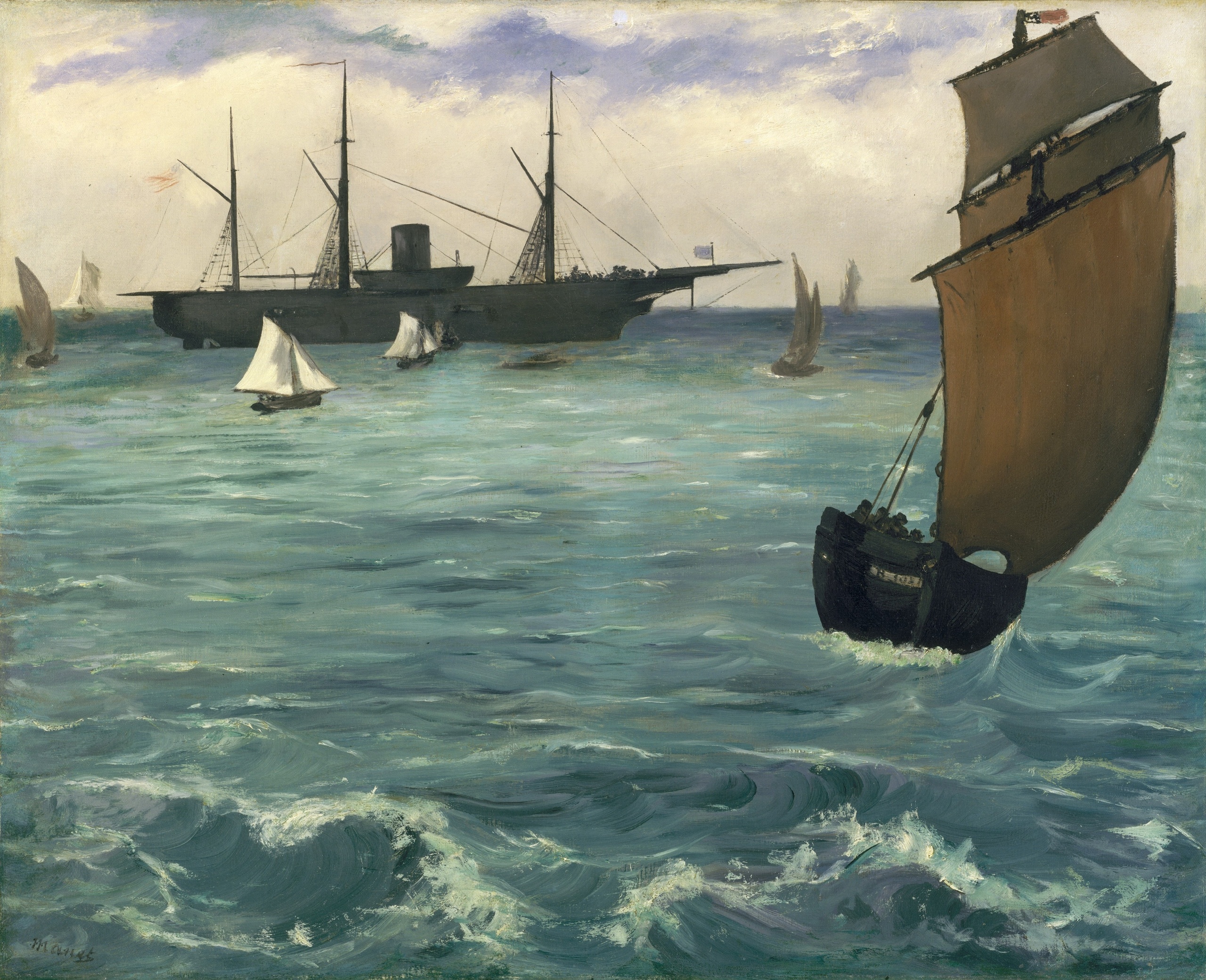
The Kearsarge at Boulogne is a seascape Édouard Manet painted in 1864: the American warship Kearsarge rides at anchor high on the horizon, while in front a fishing boat with a big brown sail cuts through a green sea flecked with foam. The original is oil on canvas, 81.6 x 100 cm, and belongs to the Metropolitan Museum of Art in New York. We hand-paint it for you in oil on canvas, in 8 landscape sizes from 40 x 32 to 200 x 159 cm, or made to measure. Before ship and boat set sail for your home, you receive a photograph of the finished painting.
| Title: | The Kearsarge at Boulogne |
| Other titles: | Le «Kearsarge» à Boulogne (French title) · The Steamboat |
| Painter: | Édouard Manet (1832–1883) |
| Year painted: | 1864 |
| Original size: | 81.6 cm x 100 cm (height x width) |
| Original technique: | Oil on canvas |
| Painting style: | Realism and Impressionism |
| Located at: | The Metropolitan Museum of Art, New York, United States |
| Our reproduction: | Hand-painted in oil on canvas, 8 sizes or made to measure |
The Kearsarge at Boulogne – Édouard Manet
What does The Kearsarge at Boulogne show?
The sea fills most of the canvas: dark green and choppy at the bottom, with white crests, lightening into turquoise and blue towards the horizon. Manet laid the water in with broad, energetic strokes of blue and grey over deep green, and two arcs of white foam in the lowest band mark currents pulling opposite ways.
In the right foreground the wind drives a dark-hulled fishing boat with a large brown sail diagonally towards the viewer. A flag flies at its masthead, and tiny dark figures sit on board. The brown sail is a warm counterweight to the turquoise water and balances the dark mass of the warship on the left.
The Kearsarge sits just below the horizon, in profile, as the ship portraits of the day required: a black hull, a funnel between the masts, rigging and thin pennants. Smaller boats with white and grey sails give depth and scale. The sky is pale, with white clouds that grey towards the horizon, and Manet signed his name at the lower left.
What happened off Boulogne in the summer of 1864?
In June 1864 the Kearsarge sank the Confederate raider CSS Alabama off Cherbourg, in one of the most celebrated naval actions of the American Civil War. Manet did not see the battle; he painted it as an imagined scene, perhaps from press reports, and the result is The Battle of the Kearsarge and the Alabama, now in Philadelphia.
In July 1864 the Kearsarge called at Boulogne-sur-Mer several times, the first American warship to do so, and drew crowds of onlookers. Manet visited the ship and may even have gone aboard around the tenth of July to study her profile among the other craft.
He also made a watercolour of her, though it is uncertain whether it was done from life. In a letter Manet said he had painted the ship the way it looks at sea, which some scholars read as a sign that this time he worked from observation.
Why is this seascape so admired?
Édouard Manet (1832–1883), a key figure between Realism and Impressionism, was among the first painters of the nineteenth century to paint modern life.
Scholars call the painting typical of Manet: sharp contrasts of light and shade, and rich, unmuted colours laid in broad swaths instead of half-tones.
Although the Kearsarge is the subject, Manet pushes her up into a higher band and gives the foreground to the fishing boat, so attention moves from the recent victory to everyday life in the port. The simplified, silhouetted rigging has been compared with Japanese prints, which interested Manet. A fuller account, in English, is the Wikipedia article on the painting.
Where is the original, and where has it been?
The original, oil on canvas, 81.6 x 100 cm (height x width), belongs to the Metropolitan Museum of Art in New York, accession number 1999.442.
It was also known as The Steamboat and as Fishing Boat Coming in Before the Wind. Manet showed it at Martinet’s in Paris in 1865 and two years later at a Manet exhibition on the Avenue de l’Alma.
Its early owners were the Paris firm Boussod and Valadon and the collector Goupy, who had it in 1890; it was sold at the Drouot auction house in 1898. Later owners were the dealer Durand-Ruel, Mrs. H. O. Havemeyer of New York, Adaline Havemeyer Frelinghuysen and Peter H. B. Frelinghuysen.
The Kearsarge at Boulogne or another Manet?
This is a canvas painting for lovers of the sea, wind in the sails and a story hidden behind an ordinary-looking day in port.
A deep-blue night sea with a small boat of oarsmen fills Rochefort’s Escape, the journalist’s flight from New Caledonia in 1874. A city celebration appears in The Rue Mosnier with Flags, a Paris street hung with tricolours for the peace festival of 1878.
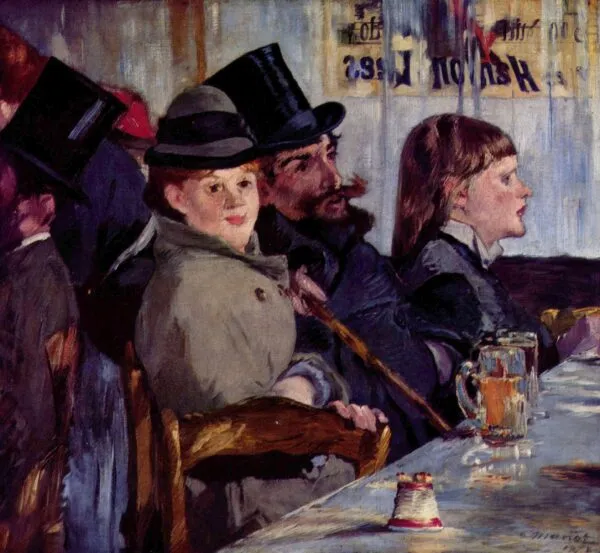
If you prefer interiors, see Corner of a Café-Concert, with a waitress holding two glasses of beer, or Flowers in a Crystal Vase, carnations and clematis from Manet’s last years. Other famous Manet paintings, from the sea to Paris streets, are on our Édouard Manet page.
How do we hand-paint The Kearsarge at Boulogne?
The original is an oil on canvas 100 cm wide, with dense, visible brushwork. Yours is an oil painting reproduction in oil on canvas, in the size you choose, built up in layers.
He first fixes the high horizon and the outline of the warship, then the slanting fishing boat, because these two masses hold the scene in balance. Next come the bands of sea, from deep green to blue near the horizon, the brown sail and the sky; last, with a fine brush, the rigging and the white foam. The broad strokes in the water stay visible, as Manet left them, so the sea still moves on your wall.
Which size suits your wall?
In short: up to 66 x 55 cm for a small wall or a shelf, 80 x 63 and 100 x 79 cm above a chest of drawers or a desk, and from 125 x 99 cm upwards above a sofa or on a large empty wall.
We paint it in 8 landscape sizes (width x height): 40 x 32, 50 x 42, 66 x 55, 80 x 63, 100 x 79, 125 x 99, 160 x 125 and 200 x 159 cm. The original measures 100 x 81.6 cm (width x height), so the sizes up to 80 x 63 cm are smaller, 100 x 79 cm is just as wide and only slightly lower, and 125 x 99, 160 x 125 and 200 x 159 cm are larger than the original.
As a painting for the living room it works best at 125 x 99 or 160 x 125 cm, where the waves and the brown sail read best.
Can I order another size or a frame?
Yes. If your wall needs other proportions, we keep the warship and the fishing boat whole and adjust the band of sea or sky. Send us the size you need for a price and a delivery time.
The seascape travels rolled, stretched on a stretcher bar or already framed. Our workshop in Slovenia stretches and frames it and packs it with care. You choose the moulding for the seascape in our 3D app, which is only for picking the frame; seeing the painting on your own wall is a separate service.
When will your painting arrive?
The painter starts on the sea and sails as soon as you confirm the order, and the painting is ready to leave within 15 to 45 working days. Before packing, we photograph the finished seascape for you and adjust anything you ask.
The seascape reaches Slovenia and every other EU country without customs duties, and our returns policy covers each order.
This sea scene makes a fine gift for a sailor or a home on the coast; if you are unsure of the size, a wall art voucher leaves the choice to the recipient.
Frequently asked questions
Where can I see the original?
At the Metropolitan Museum of Art in New York, accession number 1999.442.
Which ship is shown?
The American warship USS Kearsarge, anchored off Boulogne-sur-Mer a few weeks after her victory over the CSS Alabama.
Is this a print?
No. It is a hand-painted copy: every stroke is laid by our painter with a brush, in oil on canvas.
How big is Manet’s canvas?
It measures 81.6 x 100 cm (height x width); our 125 x 99, 160 x 125 and 200 x 159 cm sizes are larger.
Can I order a size that is not listed?
Yes. Send us the width and height, and we will quote a price and a delivery date.
How long does it take to make?
Between 15 and 45 working days, and before dispatch you see the finished seascape in a photograph.
Does it suit a bedroom or an office?
Yes. The calm green sea and pale sky quieten a bedroom; in an office the sails bring a fresh feel.
What does the fishing boat in front mean?
Scholars see it as shifting attention from the warship’s recent victory to the everyday life of the port.
- Subject: the American warship Kearsarge at anchor on the horizon, with a brown-sailed fishing boat on a choppy green sea in front.
- Original: oil on canvas, 1864, 81.6 x 100 cm, Metropolitan Museum of Art, New York.
- Ours: an Édouard Manet reproduction hand-painted in oil on canvas, in 8 sizes from 40 x 32 to 200 x 159 cm or made to measure.
- Worth knowing: Manet visited the ship in July 1864, when she was the first American warship to call at Boulogne-sur-Mer.